The recent Amazon layoffs - 30,000 corporate and tech jobs cut between October 2025 and January 2026 - highlight a critical shift in hiring priorities. Simply having a big-name employer like Amazon on a resume no longer guarantees that a candidate is prepared for the fast-changing demands of today’s workforce. Here’s what you need to know:
- Why It Happened: Amazon reduced roles tied to bureaucracy and outdated processes, focusing instead on AI investments ($125 billion in 2026 alone). Engineers who relied on legacy systems or internal tools were most affected.
- What This Means: Modern hiring should focus less on brand names and more on current skills, measurable results, and AI tool proficiency.
- Key Insights: Developers who thrive today are those with recent project ownership, active engagement with AI-driven workflows, and proof of results like cost reductions or efficiency improvements.
Takeaway: Hiring based on resumes and big-brand affiliations is outdated. Using a structured developer hiring checklist can help shift focus toward objective performance metrics. Instead, prioritize candidates who showcase recent, impactful contributions and the ability to work with modern tools like AI assistants.
What the Layoffs Expose About Hiring Practices
Amazon's recent restructuring highlights a glaring issue with traditional hiring methods. Systems like ATS keyword matching, resume pattern recognition, and brand-name bias tend to prioritize familiarity over actual ability. While this worked in more stable times, it’s becoming outdated as AI reshapes what it means to perform effectively.
The decision to cut 30,000 jobs wasn’t arbitrary. Amazon specifically targeted bureaucratic roles while continuing to hire in areas deemed critical for its future. This shows that not every engineer at Amazon was driving progress. Some adapted and evolved with their roles, while others became stagnant. This shift in how performance is evaluated offers insight into why some engineers thrived while others didn’t.
Two Types of Engineers: Active vs. Coasting
The layoffs revealed a clear divide among Amazon's engineers. Mid-level software development engineers (SDE II) were hit the hardest, making up nearly 40% of the engineering roles eliminated in key hubs like Washington, New York, New Jersey, and California. These roles often included experienced developers who had grown comfortable rather than continuing to push for growth.
On the other hand, engineers who took ownership of projects and expanded their skill sets were more likely to stay. Those who operated as small cogs in large, multi-layered teams - where internal processes took precedence over delivering tangible results - were more vulnerable. As Amazon CEO Andy Jassy explained, the layoffs weren’t just about cutting costs; they aimed to reduce layers of bureaucracy that diluted accountability: "Layers can weaken the ownership of the people".
How AI Changed What Skills Matter
Amazon’s embrace of AI has completely redefined the skills that matter most. Tools like Kiro, Cursor, and OpenAI’s solutions are now handling tasks that once required entire teams. Engineers who integrated AI-driven workflows and techniques like "vibe coding" - using AI to quickly prototype and iterate - achieved productivity boosts of 10–15%. Meanwhile, those who stuck to manual coding methods struggled to keep up with the pace of automation.
This shift underscores a simple truth: staying relevant in tech now depends more on mastering AI tools than on previous affiliations or credentials. Beth Galetti, Amazon’s Senior VP of People Experience and Technology, made it clear:
As we roll out more Generative AI and agents, it should change the way our work is done. We will need fewer people doing some of the jobs that are being done today.
Amazon’s strategy isn’t just about cutting costs; it’s about reallocating resources. The company is moving away from human-heavy bureaucracy to invest in AI infrastructure. Engineers who failed to adapt to AI-enabled workflows became part of the "jobs that are being done today" instead of contributing to the next wave of innovation.
Why Resume Credentials Don't Tell the Full Story
Having names like Amazon, Google, or Meta on a resume might seem impressive, but it's often misleading. Research from interviewing.io shows that hiring teams only guess a candidate's actual abilities correctly 53% of the time when relying on resumes - essentially the same odds as flipping a coin. When multiple reviewers assess the same resumes, their opinions rarely align. The inter-rater agreement is just 0.13 on the Fleiss' kappa scale, underscoring how subjective and unclear this process can be.
The presence of Big Tech logos on resumes can also obscure a candidate's true contributions. Many engineers in these companies spend years working on narrowly focused tasks within complex, layered systems. Aline Lerner, CEO of interviewing.io, sums it up bluntly:
Resumes might actually suck... the resume is a low-signal document.
This issue grew during the pandemic, as tech giants nearly doubled their headcounts between 2020 and 2022. With larger teams, individual contributions often became harder to identify. Meanwhile, recruiters, who spend an average of just six seconds scanning resumes, tend to focus on familiar company names rather than concrete evidence of skills. Lindsay Mustain, a former Amazon recruiter, cautions:
If you're marketing a skillset that's becoming antiquated, that's a problem; you're not competing in the current labor market.
What to Look for Instead
Today's engineering leaders place far more emphasis on side projects (38%) and public repositories (34%) than on school prestige (17%) or credentialing programs (4%). It's not about dismissing experience but about prioritizing evidence that someone is actively growing and contributing.
Look for developers who can back up their work with measurable results. For instance, they might highlight achievements like reducing cloud costs by a specific percentage, improving deployment frequency from weekly to daily, or halving incident response times. Mustain suggests using the "seven-figure signature" test: candidates should demonstrate $1M in measurable impact per $100K salary through revenue growth, risk reduction, or profit improvement. Strong candidates don't just list responsibilities - they showcase outcomes.
Recent activity is also a key indicator. Candidates who have contributed to open-source projects or updated personal repositories within the last three to six months stand out. Developers leveraging AI tools like Cursor or OpenAI assistants are earning an additional $18,000 annually, on average. Their ability to adapt quickly to new technologies and produce production-ready code is now more valuable than years spent maintaining outdated systems.
These criteria help identify developers who go beyond credentials and demonstrate real, ongoing impact.
Warning Signs to Avoid
Be cautious of resumes that list vague responsibilities without measurable achievements. Gabrielle Davis, a career expert at Indeed, identifies patterns like:
consistent underperformance and missed KPIs, a lack of effort or engagement, resistance to change or inadaptability, or poor collaboration
as red flags that often signal trouble during hiring. Developers who have spent extended periods on narrowly defined tasks within highly structured teams may struggle when required to work independently. Beth Galetti, Amazon's Senior VP of People Experience and Technology, explained their layoffs by stating:
This is a continuation of the work we've been doing... to strengthen the company by reducing layers, increasing ownership, and removing bureaucracy.
Another warning sign is a lack of recent, self-initiated learning. Developers who haven't built anything independently, engaged with technical communities, or adapted to new tools may be falling behind. 51% of jobs requiring AI skills are now in non-tech industries, up from 44% in 2022. Staying stagnant in this fast-moving field can make it difficult to remain competitive.
How to Identify the Right Candidates
::: @figure 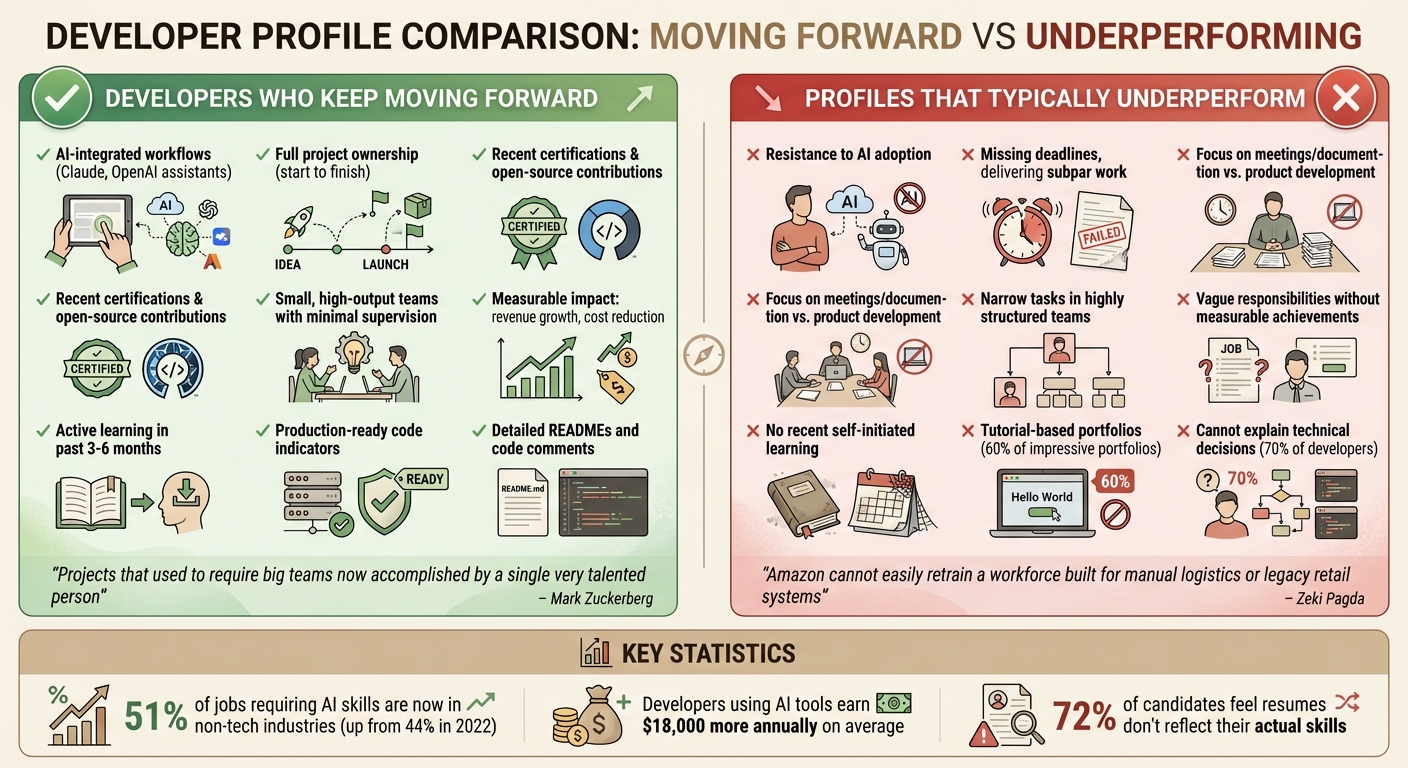 {Active vs. Coasting Engineers: Key Hiring Indicators}
The key to distinguishing a developer who excels from one who struggles often lies in their ability to adapt and maintain momentum. Amazon's experience offers a telling example: during their 2026 workforce reductions, the gap between thriving and stagnant engineers became clear. Some embraced AI-driven workflows and took ownership of projects, while others clung to outdated methods and rigid management structures. This highlights the importance of hiring candidates who demonstrate active engagement and measurable results over static credentials.
Profiles That Typically Underperform
Candidates entrenched in outdated workflows, particularly those resistant to AI adoption, are more likely to falter. Amazon's cuts showed that employees slow to embrace AI tools were often left behind. Career expert Keith Spencer pinpoints several red flags:
Common pitfalls to avoid include missing deadlines, delivering subpar work, resisting change, being openly critical of others, refusing to adopt new tools or processes, ignoring feedback, and being unclear, unresponsive, or inconsistent in your communication.
Candidates whose recent roles focus more on facilitating meetings or producing internal documentation - rather than hands-on product development - may struggle in modern, flatter organizational setups. As Zeki Pagda, Assistant Professor at Rutgers Business School, noted:
Amazon cannot easily retrain a workforce built for manual logistics or legacy retail systems into one that builds generative AI agents.
By identifying these warning signs, recruiters can better align their hiring strategies with the demands of today’s fast-evolving tech environment.
Developers Who Keep Moving Forward
On the flip side, forward-thinking developers stand out through their proficiency in AI-enhanced problem-solving and their ability to go beyond routine tasks. Meta CEO Mark Zuckerberg highlighted this shift:
We're starting to see projects that used to require big teams now be accomplished by a single very talented person.
The strongest candidates embrace AI-integrated workflows, showcasing their skills through recent certifications, open-source contributions, and demonstrable impact. In interviews, ask candidates to discuss specific challenges they’ve solved using tools like Claude or OpenAI assistants. This approach quickly reveals whether they use AI to boost efficiency or remain stuck in repetitive roles.
Amazon CEO Andy Jassy captured this mindset perfectly:
Be curious about AI, educate yourself, attend workshops and take trainings, use and experiment with AI whenever you can.
Developers who thrive in today’s landscape exhibit full project ownership. They’ve worked in small, high-output teams with minimal supervision, proving their adaptability and readiness for the rapidly changing tech world.
Hiring engineers?
Connect with developers where they actually hang out. No cold outreach, just real conversations.
How to Improve Your Hiring Process
Traditional resumes often fail to reveal a candidate's true technical skills. In fact, the shift from resume-focused hiring to activity-based evaluations highlights a measurable improvement in identifying talent. Studies show that recruiters often disagree when assessing the same resumes, and the recent Amazon layoffs illustrate how brand names and job titles don't guarantee future success. These inefficiencies point to a need for better methods, such as evaluating real-time developer engagement.
How to Assess Current Developer Activity
Focus on what developers are actively creating right now instead of relying on outdated projects. Simply counting repositories on platforms like GitHub isn't enough. Instead, look for meaningful, consistent contributions and production-ready indicators, such as error handling, input validation, and deployment configurations. These elements demonstrate a commitment to continuous growth and skill refinement.
Here’s an important insight: 60% of impressive-looking portfolios are filled with tutorial-based projects. Repositories named "react-tutorial" or "bootcamp-project", along with sparse commit histories, are warning signs. Even more telling, 70% of developers struggle to explain the technical decisions behind their work. On the other hand, portfolios with detailed READMEs and thorough code comments provide valuable insights into a developer's thought process and expertise.
This approach lays the foundation for using tools that spotlight active talent.
Using daily.dev Recruiter to Find Active Developers
Platforms like daily.dev Recruiter help you connect with developers who are actively honing their skills. Instead of relying on outdated profiles, this tool focuses on candidates with ongoing contributions and learning activities. You can customize your criteria to filter for the most suitable talent, saving time and targeting high-quality matches.
Resume-Based vs. Activity-Based Hiring
The difference between these two approaches is striking. Resume-based hiring often rewards self-promotion and prestigious affiliations over actual technical ability. In fact, 72% of candidates feel their resumes don’t accurately reflect their skills.
Activity-based hiring shifts the focus to real-world capabilities. Methods like job simulations, portfolio reviews, and analyzing current engagement allow candidates to demonstrate their skills directly. For example, replace traditional coding challenges with short tasks (30–60 minutes) that mimic real work, such as debugging code, implementing a small feature, or reviewing a pull request.
Additionally, define roles using 5–7 measurable skills - like "can deploy containerized apps" - instead of vague requirements like "knows AWS." This strategy not only reduces bias but also improves accuracy in predicting a candidate's success while giving them the opportunity to showcase their genuine abilities.
Conclusion
The 2026 Amazon layoffs highlight a critical reality: a prestigious resume no longer guarantees performance. Take the case of N. Lee Plumb, Amazon's head of "AI enablement." Despite eight years at the company and ranking among the top five users of Amazon's internal AI coding tool, he was laid off in January 2026. His situation - along with the 16,000 other roles eliminated - makes one thing clear: what truly matters is measurable, current impact, not past affiliations .
This shift has redefined what companies look for in developers. Speed, ownership, and mastery of AI-driven workflows are now the gold standard. As Mark Zuckerberg put it:
We're starting to see projects that used to require big teams now be accomplished by a single very talented person .
The focus has moved to hiring individuals who can deliver results from start to finish, rather than those who simply know their way around large systems.
It's all about what you're doing now. Employers are scrutinizing how developers have grown over the past 6–12 months, how they leverage AI tools to boost productivity, and whether they can show tangible outcomes - like driving revenue or cutting costs. The market no longer rewards prestige; it demands proof.
FAQs
What’s the best way to evaluate a candidate’s AI skills during hiring?
To assess a candidate's AI skills effectively, look beyond standard coding tests. Focus on their practical problem-solving skills and hands-on experience with AI tools. The ability to design and fine-tune AI systems while staying aligned with the latest technologies is far more telling.
Use tools or assessments that evaluate real-world scenarios. For example, analyzing work samples or assigning interactive tasks that mirror actual challenges can provide deeper insights. These methods highlight what candidates are currently learning, creating, and prioritizing. This way, you can identify individuals who bring up-to-date expertise and forward momentum to your team, ensuring you're hiring for today’s needs rather than relying on past achievements or big-name affiliations.
What skills should hiring managers focus on instead of brand-name experience?
Hiring managers should focus on flexibility, continuous growth, and problem-solving skills rather than being swayed by big-name companies on a résumé. In today’s fast-evolving tech world, qualities like human-AI collaboration - the skill to work seamlessly with artificial intelligence - and keeping pace with new tools and technologies carry more weight than a prestigious employer listed on paper.
The recent Amazon layoffs serve as a reminder that internal performance and staying relevant are far more important than a candidate’s past affiliations. Seek out individuals who show a commitment to learning, take initiative to expand their skills, and can adapt to fast-changing environments. These traits are far stronger predictors of future success than the reputation of a previous employer.
Why are activity-based evaluations better than relying on resumes?
Activity-based evaluations shift the focus to what candidates are currently doing - what they’re learning, building, and contributing - rather than relying solely on their past roles or credentials. This method takes a closer look at their present skills and efforts, offering a clearer picture of their readiness.
Take the 2026 Amazon layoffs as an example. They revealed that brand-name experience doesn’t always guarantee a candidate’s ability to grow or adapt. Some professionals may have stayed stagnant in their roles, lacking the continuous development needed to meet evolving demands.
By prioritizing recent actions and skills, hiring teams can spot candidates who are proactive and aligned with what organizations need today. This approach reduces the risk of favoring familiarity over relevance, helping you find talent ready to succeed in a fast-changing job market.
.png)