AI is transforming recruitment, but not all tools deliver on their promises. Some streamline hiring by automating repetitive tasks, improving candidate matching, and fostering trust. Others complicate workflows, amplify biases, and overwhelm recruiters with irrelevant profiles.
Key Insights:
- Effective tools focus on double opt-in connections, real-time behavior insights, and ATS integration vs. manual processes (e.g., daily.dev Recruiter). They save time and improve hiring outcomes.
- Ineffective tools rely on cold emails vs. warm intros, rigid keyword matching, and opaque algorithms, leading to wasted time, reduced trust, and biased decisions.
- Key stats: 72% of HR leaders use AI in hiring (2025), but 39% of job seekers blame AI for eroding trust.
To choose the right tool, prioritize those that simplify tasks, respect candidates, and integrate seamlessly into your workflow. Avoid tools that add noise or fail to address real hiring challenges.
AI Recruiting Tools That Help Developer Hiring
The right AI tools don't just automate processes - they help create meaningful connections with developers. Instead of relying on outdated methods like resume keyword searches or cold outreach, these tools focus on understanding intent, context, and building trust.
daily.dev Recruiter: Building Trust Through Double Opt-In Connections
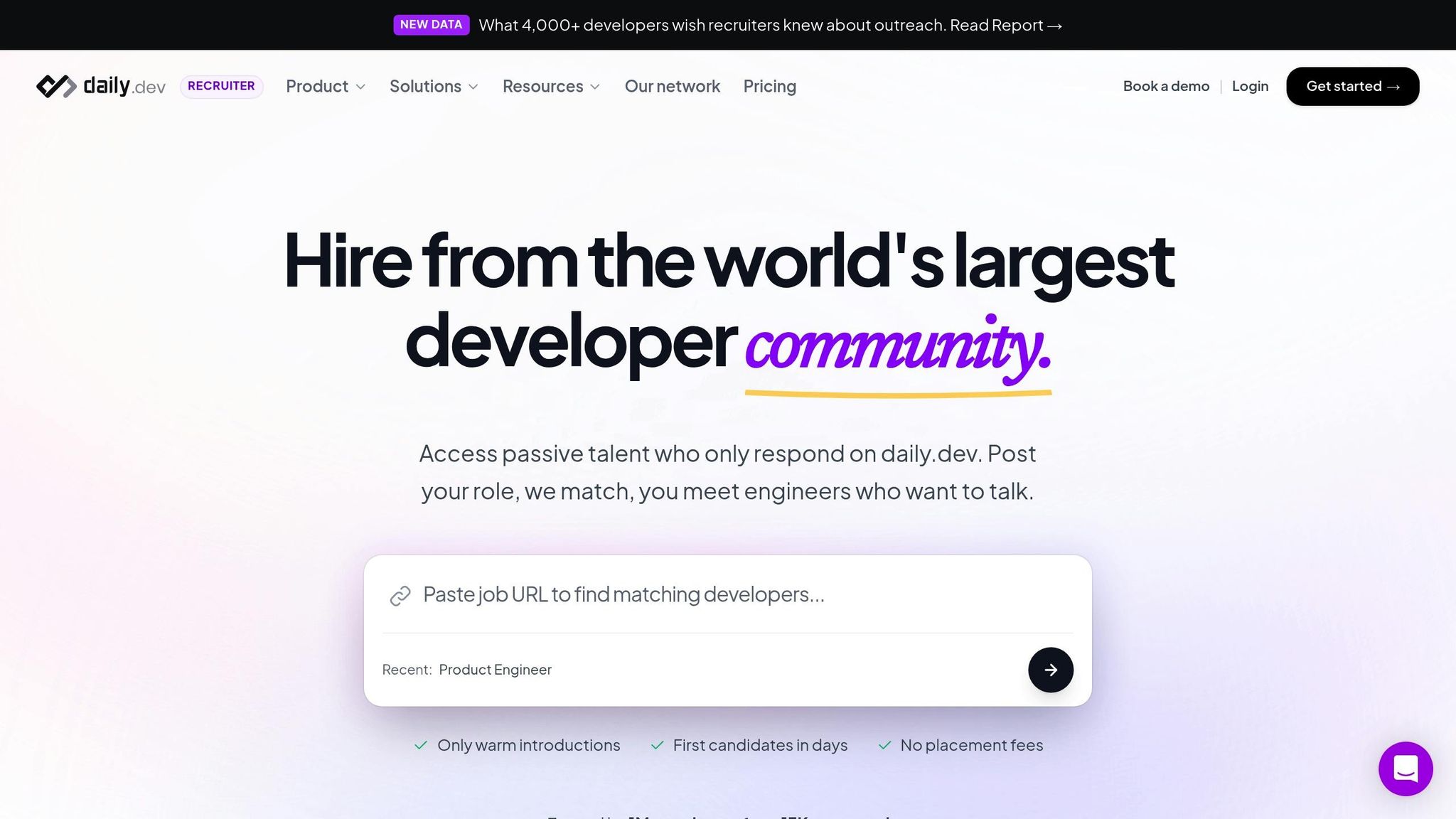
Unlike platforms that bombard developers with cold pitches, daily.dev Recruiter takes a more thoughtful approach. It connects you with developers who have already reviewed your job details - like the tech stack, salary, and team structure - and expressed genuine interest. This double opt-in process requires both parties to agree before starting a conversation, significantly reducing the chances of being ghosted.
What makes daily.dev stand out is its focus on real-time behavior. Instead of outdated resumes, it analyzes what developers are actively reading, building, and engaging with. Once a developer opts in, their profile is automatically synced with your ATS (like Greenhouse, Lever, or Ashby), instantly integrating them into your hiring pipeline. By providing transparent job details upfront, such as salary ranges and team size, it eliminates the need for generic job descriptions and allows developers to assess the role's fit right away.
daily.dev boasts a 100% trust score for its outreach, compared to less than 1% for cold emails and 5% for LinkedIn InMail, and achieves reply rates three times higher than traditional cold outreach .
"Developers ignore cold outreach. They trust their community. daily.dev is the only channel where you start with trust." – daily.dev
But connecting with candidates is just the first step. AI can also refine how you evaluate them.
AI-Powered Screening and Insights
Effective screening tools go beyond filtering resumes - they help identify candidates with the potential to excel. Using Natural Language Processing (NLP), semantic matching understands context. For example, a candidate with experience in "React.js" and "Node.js" could qualify for a full-stack role, even if they describe their skills differently. Automated code review tools further streamline evaluation by scoring submissions against expert benchmarks, assessing both the quality of the code and the reasoning behind it.
Take HackerRank's AI-enabled integrity features as an example. In July 2024, Atlassian's campus recruiting team reduced plagiarism flags from 10% to 4% across 35,000 applicants, saving significant manual review time. With 76% of developers now using tools like ChatGPT for work, monitoring for integrity has become more crucial than ever .
The best screening tools also anonymize resumes by hiding names, photos, and graduation years to ensure evaluations focus solely on technical skills. By combining this with GitHub analysis - where repository metadata is used to assign "Coder Scores" based on contribution impact and recency - you can evaluate candidates based on their actual work rather than just their claims.
Beyond screening, AI-driven tools are also transforming how candidates are matched to roles.
Data-Driven Talent Matching
Modern AI tools do more than match keywords - they understand relationships between skills and predict candidate success. For instance, semantic analysis recognizes that a "UI engineer" might have similar qualifications to a "frontend developer." These tools also evaluate the recency of skills, distinguishing between someone who last used a technology years ago and someone actively using it today.
Predictive analytics take this further. IBM’s predictive AI models, for instance, achieved 95% accuracy in identifying employees at risk of leaving . This same data-driven approach can forecast a candidate’s potential fit and future performance.
An example of this in action: In July 2024, Cogent Biosciences overhauled their recruitment process using Lever ATS and "Visual Insights" analytics. By analyzing full-cycle recruiting data, they were able to meet hiring goals more efficiently.
Takeaway: Sync your ATS with tools like daily.dev Recruiter to engage interested developers right away. Use behavioral data to tailor outreach based on what candidates are actively working on, rather than relying on outdated resumes. This approach ensures your conversations are relevant and aligned with their current technical interests.
Hiring engineers?
Connect with developers where they actually hang out. No cold outreach, just real conversations.
AI Recruiting Tools That Add Noise
Not every AI recruiting tool lives up to its hype. While some genuinely streamline hiring, others create more chaos than clarity. The wrong tools can flood your pipeline with irrelevant candidates, harm your reputation with developers, and waste time instead of saving it. One of the biggest culprits? Mass outreach practices that amplify the noise.
Over-Reliance on Mass Outreach
When AI tools prioritize quantity over quality, they often create more problems than they solve. Automated, high-volume outreach has led to a vicious cycle: candidates use AI to mass-apply, and recruiters are left managing triple the number of applications per role compared to 2021 . This approach erodes trust on both sides of the hiring process.
The impact is clear: 39% of job seekers blame AI for diminishing trust in hiring . Automation has pressured candidates to inflate their resumes, which only worsens the problem. 80% of tech professionals admit to exaggerating their qualifications to pass algorithmic filters .
"AI has enabled the mass production of artificially polished candidates who merely look great. Employers know this, and as a result increasingly distrust the very signals they collect." – Tomas Chamorro-Premuzic, Professor and Author, Harvard Business Review
This trend has real consequences. 30% of tech professionals are considering leaving the industry altogether, citing dehumanizing AI-driven hiring processes as a major factor . When outreach feels impersonal and robotic, it doesn’t just push candidates away - it also damages your employer brand.
Irrelevant or Overwhelming Candidate Suggestions
Some AI tools rely too heavily on rigid keyword matching, which often results in a flood of irrelevant candidate profiles. These systems tend to prioritize job titles over actual skills, leaving recruiters to manually sift through hundreds of mismatched applications.
Here’s a shocking example: A fast-growing AI startup discovered that its own recruitment tool rejected applications from the very data scientists and engineers who had built the company. The tool, designed to filter profiles in under 12 seconds, failed to recognize non-linear but valuable career paths .
This rigidity doesn’t just waste time - it actively harms diversity and fairness. For instance, an IBM AI system initially scored women 12% lower for tech roles due to biased training data . These tools don’t just create noise; they amplify systemic bias in technical hiring, undermining the very efficiencies AI is supposed to deliver.
"One biased human hiring manager can harm a lot of people in a year... But an algorithm that is maybe used in all incoming applications at a large company… that could harm hundreds of thousands of applicants." – Hilke Schellmann, Assistant Professor, NYU
Fragmented Workflows and Lack of Developer Focus
Instead of simplifying workflows, many AI tools end up complicating them. Recruiters often find themselves re-checking AI-generated scores, handling exceptions, and managing edge cases that the system can’t process. The promised time savings? They often disappear.
"Instead of reducing workload, many AI recruitment tools introduce new layers of review, configuration, and exception handling... The promised time savings quietly evaporate." – HireForge
Some platforms marketed as "AI-powered" are even less advanced than they claim. Investigations have revealed tools that rely on offshore human teams to manually filter results, all while branding themselves as autonomous AI systems . Essentially, companies pay for automation but receive little more than outsourced human labor wrapped in a tech label.
For developer hiring, generic AI tools often fall short. They lack the technical context to differentiate between candidates with similar resumes but vastly different skill sets. For example, they might treat someone who hasn’t used Python in five years the same as someone actively contributing to open-source Python projects. They also fail to recognize that a "UI engineer" and a "frontend developer" could be the same role, depending on terminology. This lack of nuance leads to either an overwhelming number of false positives or missed opportunities to connect with top talent. Ultimately, these inefficiencies undermine AI’s potential to transform developer recruitment.
Comparison Table: Helpful vs. Noisy AI Recruiting Tools
::: @figure 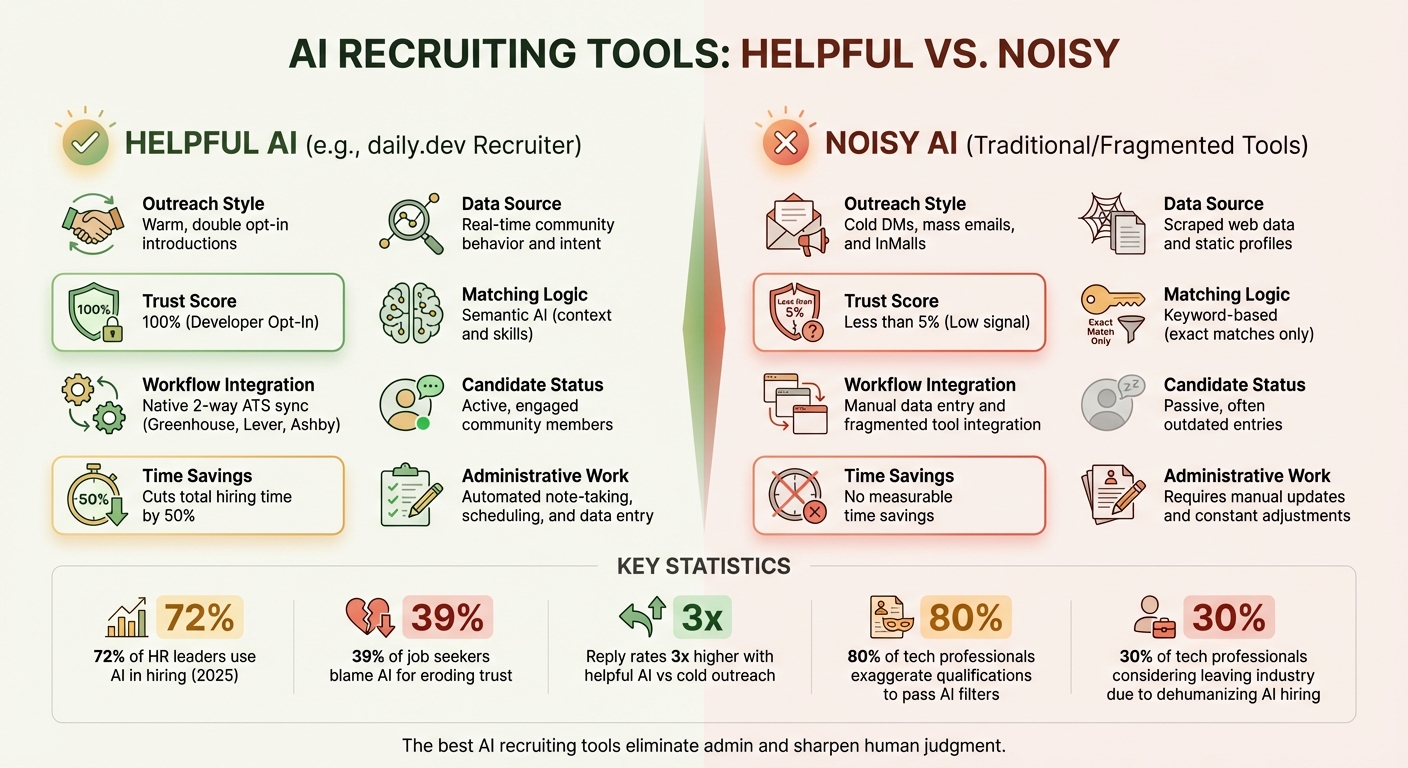 {Helpful vs Noisy AI Recruiting Tools Comparison}
The right AI tools simplify your hiring process, respect candidates' time, and integrate smoothly with your existing systems. On the other hand, inefficient tools can create unnecessary work, flood your pipeline with irrelevant candidates, and even harm your reputation. Here's a quick breakdown of how these tools stack up:
| Feature | Helpful AI (e.g., daily.dev Recruiter) | Noisy AI (Traditional/Fragmented Tools) |
|---|---|---|
| Outreach Style | Warm, double opt-in introductions | Cold DMs, mass emails, and InMails |
| Data Source | Real-time community behavior and intent | Scraped web data and static profiles |
| Trust Score | 100% (Developer Opt-In) | Less than 5% (Low signal) |
| Matching Logic | Semantic AI (context and skills) | Keyword-based (exact matches only) |
| Workflow Integration | Native 2-way ATS sync (e.g., Greenhouse, Lever, Ashby) | Manual data entry and fragmented tool integration |
| Candidate Status | Active, engaged community members | Passive, often outdated entries |
| Time Savings | Cuts total hiring time by 50% | No measurable time savings |
| Administrative Work | Automated note-taking, scheduling, and data entry | Requires manual updates and constant adjustments |
The takeaway? The best hiring tools for technical roles don’t just save time - they eliminate tedious administrative tasks while keeping human judgment at the forefront . They work with your existing workflows rather than forcing you to manage yet another standalone platform. This is why it is essential to audit your tech hiring stack to ensure every tool adds value. If a tool demands hours of setup just to produce a shortlist, it’s probably creating more noise than value .
How to Select Effective AI Recruiting Tools
Before diving into new AI tools, take a close look at your current tech stack. Evaluate your Applicant Tracking System (ATS), Human Capital Management (HCM) platform, and CRM to pinpoint areas where automation could genuinely fill gaps instead of creating new problems . For instance, if your ATS already excels at tracking candidates, there's no need to add another tool that duplicates this function. Instead, focus on tools that address unmet needs, like sourcing passive candidates or automating repetitive tasks like note-taking. One key consideration is how the tool handles filtering versus ranking candidates.
Focus on filtering, not ranking. Tools that rank candidates using opaque scoring systems can be hard to trust and even harder to explain to hiring managers. Instead, choose tools that filter out unqualified candidates, saving you time and effort . As Metaview aptly states:
"AI works best when it's embedded in workflows. Standalone 'AI features' rarely stick" .
To ensure the tool is a good fit, start with a pilot program. Test it on one high-priority role before rolling it out company-wide . During the pilot, compare the AI-generated shortlist with what you'd create manually. Measure key metrics like time-to-hire, quality-of-hire, and candidate satisfaction scores before and after implementation. This data will help justify the investment and show whether the tool is genuinely saving time or just shifting work around . For example, companies using AI for screening often report saving up to 60% of time on administrative tasks - but only if the tool integrates smoothly into their existing workflows . Once the tool proves its value, shift your focus to security and compliance.
Ensure security and compliance standards are met. Ask vendors for documentation on GDPR, SOC 2 Type II, and CCPA compliance to confirm they can handle sensitive candidate data responsibly . Transparency is equally important - request reports that explain how the AI makes decisions and what measures are in place to prevent algorithmic bias .
Look for human-in-the-loop designs. The best AI recruiting tools allow you to review decisions at critical points, such as the first set of auto-rejections, giving you the opportunity to make adjustments and refine the model over time . With AI adoption in recruiting doubling from 26% to 53% in just one year , recruiters are moving away from administrative work and focusing more on strategic oversight. This shift involves fine-tuning AI processes and enhancing candidate interactions . The goal is for the tool to complement your expertise, not replace it, by strengthening decision-making and maintaining control over the hiring process.
Conclusion
In the fast-changing world of tech recruitment, the gap between useful AI tools and distracting ones comes down to purpose and thoughtful design. The best tools, like daily.dev Recruiter, focus on meaningful, double opt-in connections with developers who are already engaged. Instead of flooding you with irrelevant profiles, they help you identify qualified technical candidates. Plus, they work with your current processes, not against them, by avoiding unnecessary administrative headaches.
"The best AI recruiting tools don't replace recruiters. They eliminate admin and sharpen human judgment" .
These qualities highlight what really matters when evaluating AI tools. Look for solutions that simplify repetitive tasks, enhance decision-making, and respect the candidate experience - especially for developers who are often put off by spammy or low-effort outreach.
Prioritize platforms that improve the hiring process by boosting interview quality and providing automated, data-driven insights . Steer clear of tools that focus on increasing candidate volume without improving quality or rely on opaque ranking systems that leave hiring managers guessing.
Although AI is becoming more common in recruitment, its popularity alone isn't enough reason to jump in. Start with a trial program, track measurable outcomes like time-to-hire and candidate satisfaction, and confirm the tool meets essential security and compliance standards, such as GDPR and SOC 2 Type II.
FAQs
How can I tell if an AI recruiting tool is adding noise?
AI recruiting tools can sometimes create more problems than they solve. For instance, they might overwhelm your hiring pipeline with duplicates, fake profiles, or irrelevant candidates. This clutter makes it tougher to spot the truly qualified applicants. On top of that, if the tool delivers inconsistent results or pulls in candidates that don’t match your hiring goals, it can lead to inefficiencies and slow down decision-making.
What does “double opt-in” outreach mean for developer hiring?
In developer hiring, “double opt-in” outreach means that both the recruiter and the candidate consent to connect before any follow-up communication happens. This approach makes sure the developer is actually interested, which helps build trust and cuts down on unnecessary or unwelcome interactions. It’s particularly effective for reaching passive candidates, as it respects their preferences for clear and courteous recruitment. The result? Better response rates and more meaningful connections.
How do I pilot an AI tool without risking bias or trust?
To test an AI recruiting tool without jeopardizing fairness or trust, start by outlining specific tasks for the AI, such as sourcing candidates or screening resumes. These tasks should aim to ease manual workload while maintaining a fair process. It's crucial to routinely review the tool's outputs to spot any biases, especially if the AI was trained on imperfect or skewed data.
Be open with candidates about how AI is being used in the hiring process. Transparency helps build trust. Additionally, always include human oversight in the final decision-making stages. This approach ensures accountability and fairness throughout the recruitment process.
.png)