AI tools often fail to match skilled DevOps engineers with job opportunities. Here's why:
- Keyword Issues: AI systems rely on keyword matching rather than understanding deeper expertise. This leads to irrelevant results and overlooks qualified candidates.
- Data Gaps: Only 8–10% of engineers have public GitHub profiles, and less than 1% provide enough data for meaningful evaluation. Most work is hidden behind corporate firewalls.
- Skill Complexity: DevOps roles require a broad mix of technical skills, from cloud platforms to CI/CD pipelines, which AI struggles to evaluate accurately.
- Soft Skills: Communication and teamwork are critical in DevOps, but AI can't measure these traits or predict team fit.
- Passive Candidates: Many top engineers aren't actively job hunting, and AI tools often miss these candidates due to limited online activity.
The solution? Combine AI's efficiency with human judgment. Learn how to hire in developer communities, use specialized platforms, and invest in internal training programs to build a stronger talent pipeline.
::: @figure 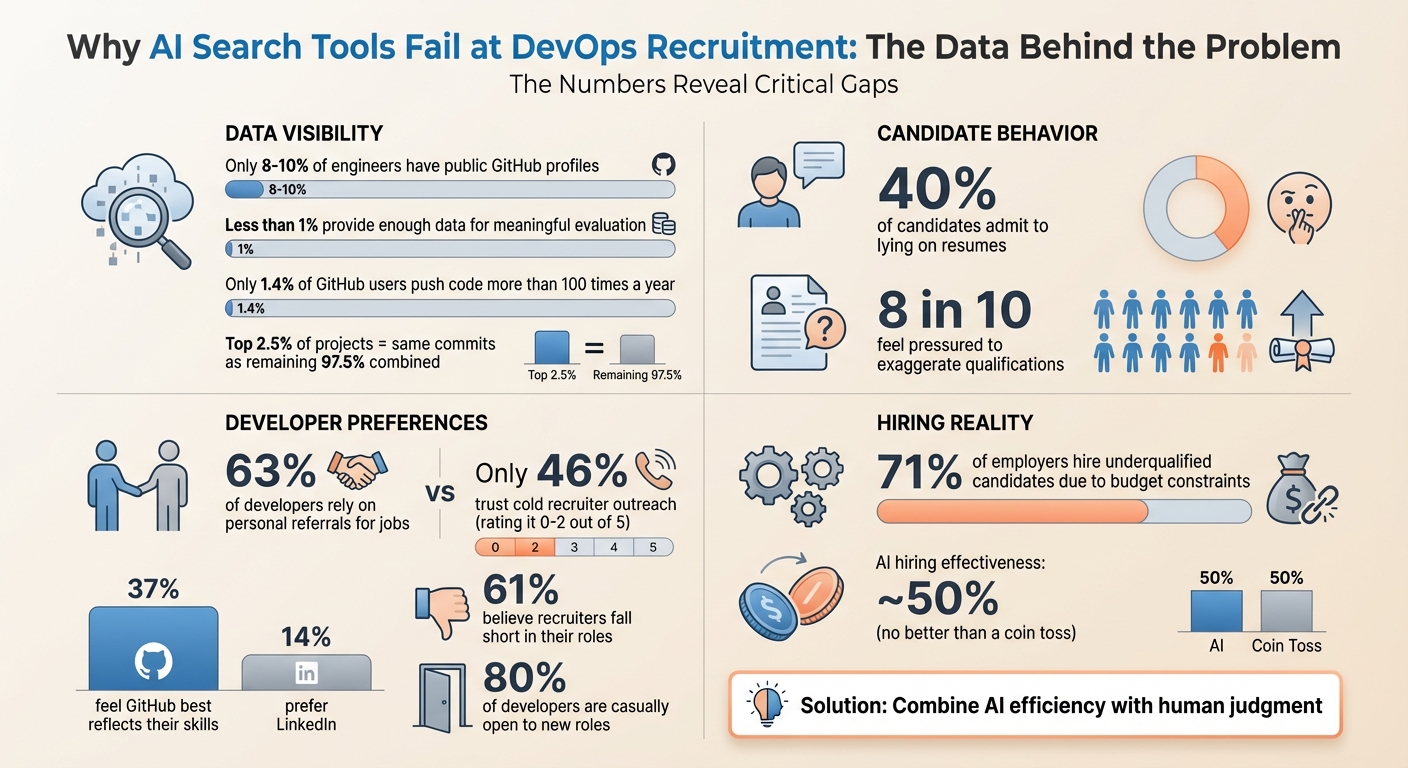 {Why AI Fails at DevOps Recruiting: Key Statistics and Challenges}
The Complexity of the DevOps Skillset
The Wide Range of Technical Skills Required
DevOps engineers are expected to master a variety of technical domains. From managing cloud platforms like AWS, Azure, or Google Cloud to working with containerization tools like Kubernetes and Docker, the list of skills is extensive. On top of that, they need to create CI/CD pipelines using tools such as Jenkins or GitHub Actions, implement observability with solutions like Grafana and OpenTelemetry, design scalable microservices architectures, and write code in languages like Python, Go, or JavaScript.
The challenge lies in distinguishing true expertise from surface-level knowledge. For instance, someone who has merely glanced at an AWS dashboard might appear similar to a candidate who has built an entire cloud infrastructure from scratch. This difficulty stems from the very nature of DevOps, which merges two traditionally separate disciplines - Development and Operations. As Software Engineer Matt Lievertz explains:
DevOps is a portmanteau of development and operations, which are historically distinct careers... seeking out DevOps engineers is a bad way to find engineers to do DevOps .
AI tools often fail to grasp this nuance, struggling to determine whether a role requires an Operations expert focused on automation or a Developer skilled in writing infrastructure code. The sheer breadth of technical expertise required makes it difficult for keyword-based AI systems to accurately assess a candidate's qualifications.
How AI Misinterprets Technical Keywords
AI recruitment tools often reduce the evaluation process to counting keywords, which leads to oversimplification. For example, a candidate who mentions "Java" multiple times in their resume might rank higher than someone who has built complex distributed systems but only references the language once . This approach overlooks the depth and context of a candidate's experience.
The problem worsens when candidates manipulate the system. Buzzwords like "Kubernetes" and "Docker" are often overused in resumes to pass AI filters, even if the candidate's actual experience is limited. Artur Haponik, CEO of Addepto, highlights the core issue:
When context gets stripped away, you end up making the same mistakes, only faster .
AI struggles to differentiate between someone who has designed and implemented a CI/CD pipeline and someone who has merely used a pre-existing one. This inability to assess the depth of expertise underscores the limitations of relying on keyword-driven AI tools for evaluating DevOps talent.
Soft Skills and Collaboration Challenges in DevOps Hiring
The Role of Communication and Teamwork in DevOps
DevOps isn't just about technical know-how; it's also about excelling in communication and teamwork. Imagine engineers drafting crystal-clear design documents, analysts presenting trade-offs effectively, or security leads calming the waters during a crisis. These skills don’t just streamline workflows - they save time, protect revenue, and let everyone sleep a little better at night .
Teams thrive when individuals naturally break down silos. Often, these are "polymaths" or folks with diverse, non-linear career paths . They bring a mindset of collaboration that no certification can teach. And while AI tools might spot the word "collaboration" on a resume, they can’t tell if someone genuinely embodies it.
Aline Lerner, Founder of interviewing.io, cuts to the heart of it:
Chemistry is king. Get the right two people to have the right conversation, and everything else goes out the window.
This "chemistry" can outweigh factors like salary or specific technical skills. Yet, AI tools struggle to measure it. They lack the context of past team dynamics, making it nearly impossible to predict how well someone will gel with a team . Recognizing this human element remains a significant hurdle for AI in hiring.
AI's Inability to Assess Cultural Fit
Soft skills are the glue of collaboration, but AI tools fall short in evaluating these traits. They can’t measure qualities like adaptability, empathy, or a knack for bridging gaps between teams . Sure, AI can confirm technical credentials - like a Kubernetes certification - but it can’t assess how someone will handle a high-pressure outage or navigate creative problem-solving .
Even worse, algorithms can misread behaviors. A nervous candidate in a video interview might be flagged as lacking confidence. Or, cultural differences in communication styles could go unnoticed or misinterpreted . Unlike human recruiters, AI can’t pick up on body language, tone, or subtle cues that reveal whether someone will thrive in a team setting .
Another challenge is the mismatch between how traditional recruiting works and how AI operates. Recruiters look for specific, nuanced qualities, while AI relies on statistical probabilities. This often leads to pattern-matching that misses the mark . The opaque nature of AI decisions - often no better than a coin toss (with around 50% effectiveness) - further highlights its limitations. Without the ability to blend technical expertise with interpersonal insights, AI tools fall short of fully addressing the hiring needs for DevOps roles.
Market Challenges and Data Limitations in AI Recruitment
AI recruitment tools face more than just technical hurdles; market dynamics and the quality of available data also play a major role in limiting their effectiveness in DevOps hiring.
Problems with Incomplete or Outdated Candidate Data
One of the biggest challenges is the reliance on incomplete or outdated candidate information. AI tools often pull data from platforms like LinkedIn and GitHub, but these sources rarely provide a full picture - especially for senior DevOps engineers. For example, only about 8–10% of GitHub users have public code commits, and less than 1% of accounts offer enough meaningful data for hiring purposes . Many seasoned engineers do their most impactful work behind corporate firewalls, which means their contributions aren’t visible in open-source repositories.
Adding to this, candidate profiles can be misleading. A staggering 40% of candidates admit to lying on their resumes, and 8 in 10 feel pressured to exaggerate their qualifications to pass AI-driven filters . Some even use tactics like inserting hidden keywords into their resumes to trick AI systems . This creates a situation where candidates may look highly qualified on paper but lack the practical skills needed for the role.
Another issue is the fast-paced evolution of DevOps technologies. Unlike traditional degrees, which have a relatively long shelf life, the relevance of specific tools and frameworks can fade quickly. This makes credential-based filtering less reliable, as a tool or skill listed on a resume might already be outdated . AI systems that rely on rigid checklists often fail to identify candidates with transferable skills or experience in related technologies, further narrowing the talent pool .
These data challenges make it even harder to identify passive candidates - those who aren’t actively seeking new opportunities but often represent the best talent.
The Difficulty of Finding Passive Candidates
Passive candidates are highly sought after in DevOps hiring, but they’re notoriously hard to find. AI tools depend heavily on publicly available data, which means they often overlook individuals with minimal online activity. This problem, sometimes called the "Boolean Clash", can lead to irrelevant search results, like suggesting candidates from entirely different geographic regions .
The scarcity of meaningful data only makes things worse. For instance, just 1.4% of GitHub users push code more than 100 times a year . Additionally, the most active 2.5% of projects account for as many commits as the remaining 97.5% combined. This means AI models trained on public repositories may miss the majority of professional work happening behind the scenes . Without public portfolios or active profiles, passive candidates essentially become invisible to these systems.
One way to address this is by combining AI with human expertise. For example, AI can reduce a large candidate pool to a manageable size, and then human recruiters can review the top 5% of auto-rejections. This approach helps catch qualified candidates who might have been overlooked due to unconventional resume formats or incomplete profiles . By blending machine efficiency with human judgment, companies can mitigate the blind spots of AI-driven hiring processes.
How to Recruit DevOps Engineers Beyond AI Tools
Given the limitations of AI in recruitment, it's crucial to shift toward strategies that prioritize human connection, community involvement, and internal growth. These approaches help build trust, tap into hidden talent pools, and develop skilled professionals from within.
Engaging with DevOps Communities
The top DevOps engineers aren't spending their time browsing job boards. Instead, they're active in technical communities, contributing to open-source projects, and sharing expertise with their peers. In fact, 63% of developers rely on personal referrals from friends and colleagues for job opportunities, while only 46% trust cold outreach from recruiters, rating it a mere 0-2 out of 5 . This stark contrast highlights why traditional recruiting tactics often fall flat with senior technical talent.
Mass messaging on LinkedIn? Skip it. Instead, consider the trade-offs between social media and cold emails and focus on being present where developers spend their time - at meetups, conferences, and technical forums. Sponsoring events, contributing to open-source projects, or publishing insightful technical blogs can show your company’s genuine commitment to the developer community. Actions like these build trust and credibility, making developers more likely to consider your company when opportunities arise.
Also, keep in mind that 37% of developers feel GitHub best reflects their skills, compared to only 14% who prefer LinkedIn . This means paying attention to their technical contributions on platforms like GitHub can offer better insights into their expertise than polished resumes or profiles.
Using Developer-Centric Platforms
Beyond community involvement, it's important to connect with developers where they already spend their time. While traditional job boards and LinkedIn cater to active job seekers, 80% of developers are at least casually open to new roles, even if they aren’t actively looking . This presents a huge opportunity to reach passive candidates who often represent the most skilled talent.
Platforms like daily.dev Recruiter are designed for this purpose. They connect employers with developers who are already engaging with technical content, learning new skills, and staying informed on industry trends. These platforms go beyond outdated methods like resume screening by using real-time behavioral data to match candidates with roles that align with their interests and expertise.
What sets these platforms apart is their double opt-in model, which ensures that both the employer and candidate express mutual interest before initiating a conversation. This eliminates the spammy experience of traditional recruiting and significantly boosts response rates. Plus, tools like these integrate seamlessly with Applicant Tracking Systems (ATS) such as Greenhouse, Lever, and Ashby, streamlining the hiring process without the need for tedious manual data entry.
Building Internal Talent Development Programs
Sometimes, the best DevOps candidates are already part of your team. With 71% of employers hiring underqualified candidates due to budget constraints, developing internal talent is not just a smart move - it’s a necessity .
Start by identifying team members - such as developers or IT staff - who have strong foundational skills in areas like system design, API development, or infrastructure management. Then, invest in their growth through structured training programs to help them transition into DevOps roles.
Support this development by offering clear certification paths. Certifications like AWS Certified DevOps Engineer or Certified Kubernetes Administrator can provide the technical grounding they need. But don’t stop there. Dedicate both time and budget to learning - don’t expect employees to squeeze training into leftover hours. Internal hackathons can also be a great way to encourage collaboration across teams while practicing DevOps principles in a low-pressure environment.
Track their progress with practical assessments that mimic real-world challenges, and measure success by how quickly they make meaningful contributions to the team. This approach not only builds loyalty but also ensures your DevOps talent pipeline is filled with individuals who understand your organization’s unique systems and challenges.
Conclusion
Key Takeaways
AI search tools face significant challenges in DevOps recruitment because they fail to grasp the complex mix of skills required. The issue goes beyond technical expertise - it's rooted in structural limitations. AI depends heavily on keyword matching, often missing the deeper expertise that DevOps engineers bring to the table. With 61% of developers already believing recruiters fall short in their roles , adding AI's shortcomings only widens the trust gap.
The main problem? AI cannot evaluate essential soft skills like communication and teamwork - abilities critical for DevOps engineers, who must bridge gaps across development, operations, and security teams. It also struggles to assess whether a candidate fits within a team's dynamics or culture, factors that frequently determine long-term success. Moreover, AI operates with incomplete data, as many engineers' most impactful work remains locked behind corporate firewalls, out of AI's reach. This lack of visibility highlights a fundamental contradiction in relying on AI for hiring decisions.
So, what's the alternative? A human-centered, community-driven approach that fosters trust and genuine engagement. This means connecting with developers where they already spend their time - on technical forums, contributing to open-source projects, and engaging with platforms that support their growth. It also involves replacing impersonal LinkedIn messages with personalized introductions through double opt-in platforms. Finally, investing in internal talent development can help cultivate DevOps expertise within your existing team.
These challenges underscore the need for a recruitment strategy that blends AI's efficiency with human insight.
The Future of DevOps Recruitment
The path forward lies in combining AI's strengths with the irreplaceable judgment of human recruiters. AI can take on administrative tasks like scheduling interviews or identifying potential skill overlaps. However, evaluating technical expertise, gauging collaboration skills, and building trust must remain human-led efforts.
The next phase of recruitment will integrate technology with personal expertise. Think of AI as a support tool - great for identifying patterns or automating repetitive processes, but not a substitute for human evaluation. As Nimrod Kramer, CEO of daily.dev, aptly puts it:
AI can clear grunt work; it cannot fix a trust problem .
The companies that excel in hiring top DevOps talent will be those that balance automation with authentic human connection. Meeting developers in their spaces, respecting their time, and building relationships that go beyond surface-level qualifications will be key to long-term success.
FAQs
How can I verify real DevOps skills without GitHub data?
To assess DevOps skills without relying on GitHub data, you can use practical evaluations that focus on real-world tasks. These include coding tests, work samples, live problem-solving sessions, and task simulations. Key areas to evaluate should include automation, CI/CD pipelines, and infrastructure management. These approaches provide a clear view of both technical abilities and hands-on experience.
What signals show depth beyond keywords like Kubernetes?
Depth beyond keywords like Kubernetes can be measured by looking at behavioral indicators. These include things like recent updates to a profile, active contributions on GitHub, and holding relevant certifications. Together, these signals demonstrate genuine interest, ongoing engagement, and a dedication to staying current in the field.
How do I reach passive DevOps candidates effectively?
To connect with passive DevOps candidates, you need a thoughtful and tailored approach that prioritizes trust and relevance. Start by leveraging data-driven tools to analyze behavioral patterns and activity on platforms like GitHub. These insights can help you understand their interests and engagement levels.
When reaching out, make it personal. Include specific technical details, potential salary ranges, and clear growth opportunities that align with their skills and aspirations. Building developer personas can guide you in crafting messages that resonate.
Finally, focus on engaging through trusted communities like GitHub or Stack Overflow, where developers already feel at home. By combining data insights, personalized communication, and community interaction, you’ll have a better chance of sparking their interest.
.png)