AI is transforming technical recruiting in 2026, making processes faster and smarter but requiring careful balance with human oversight. Here’s what you need to know:
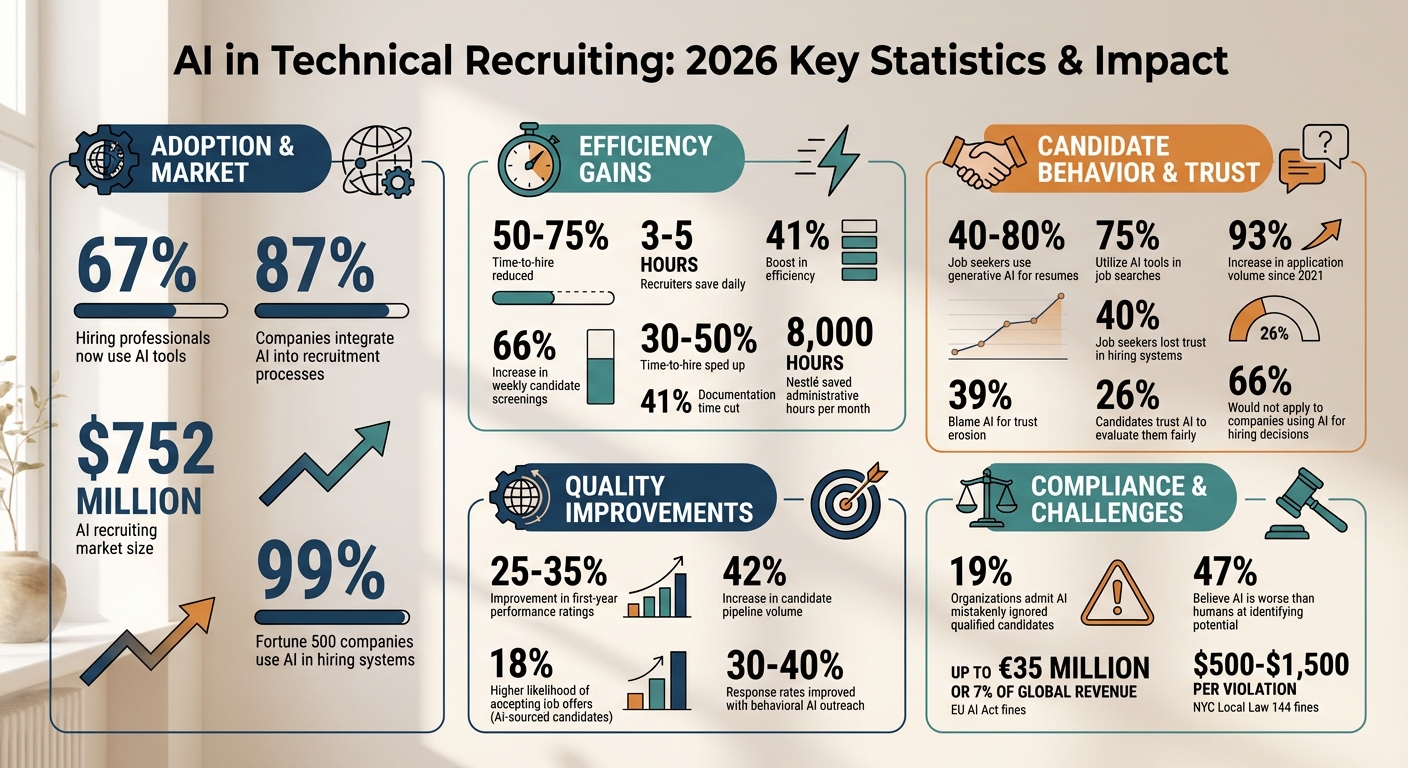
- 67% of hiring professionals now use AI tools, cutting time-to-hire by 50%–75%.
- AI excels at automating tasks like sourcing, screening with resume parsing, and scheduling, saving recruiters hours.
- Challenges include AI-generated resumes, bias risks, and maintaining trust in automated systems.
- Legal compliance is critical, with regulations like NYC Local Law 144 and the EU AI Act enforcing transparency and fairness.
- Human recruiters remain essential for evaluating candidates’ potential, motivations, and building genuine relationships.
The key takeaway? AI handles repetitive tasks, but human judgment drives better hiring decisions. Use AI to enhance efficiency, but keep people at the center of the process.
AI in Recruiting: What's Real and What's Hype in 2026
The AI recruiting market has grown to about $752 million, with 87% of companies now integrating some form of AI into their recruitment processes . To make the most of these tools, it's crucial to separate what AI can genuinely deliver from areas where it still falls short.
One major change in 2026 is how AI handles search and filtering. Recruiters now rely on natural language descriptions like "senior backend engineer with distributed systems experience" instead of complex Boolean strings to sift through massive databases containing over 750 million profiles . Modern AI not only understands specific job titles but also identifies similar roles, such as equating "staff software developer" with "senior backend engineer." This ability to recognize patterns and context saves recruiters 3 to 5 hours daily, boosting efficiency by 41% . However, this progress also highlights the limitations of AI in recruiting.
For instance, AI doesn't uncover "hidden" talent that others can't find. Most AI tools comb through the same public databases, meaning the "hidden" candidates are often those who are simply unresponsive to outreach. Fully autonomous AI recruiting also remains out of reach. Even though 99% of Fortune 500 companies use AI in their hiring systems, human judgment is still indispensable for critical decisions .
Another challenge is the rise of the "AI-on-AI" problem. Between 40% and 80% of job seekers now use generative AI to craft resumes and cover letters, and 75% utilize AI tools in their job searches . This has caused a 93% increase in application volume since 2021 , creating a flood of bot-generated content that recruiters must sift through. Nearly half of job seekers apply to more positions in an attempt to bypass automated filters, further complicating the process . As a result, 40% of job seekers report losing trust in hiring systems, with 39% directly blaming AI for this erosion . These issues highlight the importance of balancing AI's capabilities with human oversight.
What AI Actually Does Well in Recruiting
AI's strengths become evident when looking at its practical applications. For example, it excels at handling repetitive administrative tasks. Automated interview scheduling can reduce the time-to-fill for entry-level positions by as much as 90%, saving companies thousands of hours each month. Nestlé, for instance, reported saving 8,000 administrative hours per month using such tools in early 2026 .
Screening is another area where AI shines. It quickly narrows down large applicant pools to a manageable number by focusing on relevance, rather than attempting to assign arbitrary "quality" scores. This approach has led to a 66% increase in weekly candidate screenings and sped up time-to-hire by 30% to 50% . AI tools that record and summarize interviews also help recruiters focus on candidates instead of note-taking, cutting documentation time by 41% .
AI has also advanced in skills-based screening. Instead of relying on basic keyword matching, modern tools assess actual abilities, enabling recruiters to identify transferable skills that might not align perfectly with job titles .
| AI Capability | Reality (What it does well) | Hype (What it struggles with) |
|---|---|---|
| Sourcing | Quickly scans massive databases | Doesn't find "hidden" talent |
| Screening | Filters out unqualified candidates | Can't predict long-term performance or "culture fit" |
| Scheduling | Automates coordination across time zones | Struggles with nuanced candidate questions |
| Interviews | Summarizes and transcribes conversations | Lacks human empathy and relationship-building skills |
Common Myths About AI Recruiting
Myth #1: AI will replace recruiters entirely.
This hasn't happened, and it likely won't. Only 26% of candidates trust AI to evaluate them fairly, and many find AI-driven interviews and personality scoring impersonal . Moreover, 84% of companies haven’t restructured roles to rely solely on AI .
"The best results come from AI handling repetitive tasks while humans make the judgment calls" .
Myth #2: AI can rank candidates from best to worst.
AI's ranking systems often give a false sense of precision, favoring polished resumes over actual skills . Many technical roles are loosely defined or constantly evolving, requiring human insight to interpret unconventional backgrounds and exceptions.
"Hiring by algorithm is just outsourcing accountability. Automated rankings don’t find talent - they find people who know how to prompt the machine" .
Myth #3: AI eliminates bias in hiring.
AI can actually amplify biases if trained on flawed historical data. For example, Amazon abandoned an internal AI tool in 2018 after discovering it penalized resumes with the word "women's" due to past male-dominated hiring patterns . Similarly, the EEOC settled a $365,000 case against iTutorGroup in 2023 after their algorithm automatically rejected older applicants .
Myth #4: More AI features mean better results.
AI works best when targeted at specific bottlenecks rather than applied as a catch-all solution . For example, Unilever reduced time-to-fill for entry-level roles by 90% and cut recruiter review time by 75% using AI-driven automation and video interviews, while still relying on human oversight for final decisions . The real value of AI lies in reducing noise - filtering out unqualified candidates - rather than selecting the perfect hire .
Ultimately, AI is most effective as a tool to support human decision-making, not as a replacement for it. Tools that allow for human intervention and align with recruiter workflows tend to succeed, while opaque systems that can't be easily explained or challenged often fail .
AI-Powered Sourcing: How Behavioral Data Finds Better Candidates
AI is reshaping sourcing just as it has transformed screening, with behavioral data now playing a key role in finding talent that might otherwise go unnoticed. Traditional sourcing methods rely on static profiles and keyword searches, which often lead to recruiters competing for the same pool of visible candidates. Behavioral sourcing flips this model by tracking real-time activities - like what developers are reading, learning, or engaging with - to identify skilled passive candidates before they even update their resumes.
This approach is gaining traction because traditional cold outreach is becoming less effective. Developers now receive 10–15 messages weekly on older platforms, causing response rates to dip below 10% . However, when outreach is based on a developer’s current learning habits rather than outdated job titles, it feels more relevant and less intrusive. AI-driven outreach, personalized through behavioral signals, has shown to improve response rates by 30–40% compared to traditional methods . This method also enables deeper candidate profiling, offering insights beyond static resumes. Recruiters can further refine this data using a tech candidate fit analyzer to score potential hires against specific role requirements.
Using Behavioral Signals to Find Developers
Modern AI sourcing tools utilize various behavioral signals to build dynamic profiles that reflect a developer's current skills and interests. For instance:
- Learning Signals: These track what developers are reading or studying, offering real-time insights into their technical focus. Tools like daily.dev Recruiter analyze content consumption patterns across millions of developers to identify those actively learning the technologies you’re hiring for .
- Contribution Signals: Platforms like GitHub, Stack Overflow, and Kaggle reveal coding skills, commit frequency, and community involvement, providing a clearer picture of a developer’s expertise .
- Relational Signals: These highlight connections between potential candidates and your existing team, transforming cold outreach into warm introductions that are more likely to succeed .
AI platforms pull data from over 800 million profiles across 30+ live sources, using natural language processing to interpret context and skills rather than relying solely on keywords . This means you can search for roles like "senior backend engineer with distributed systems experience" in plain language, and the AI will understand and surface relevant candidates with similar skills and experience.
Why AI Sourcing Works Better
By leveraging these behavioral signals, AI sourcing delivers tangible benefits in speed, quality, and reach. For example, in 2025, the startup Reibus used GoPerfect’s semantic AI search to identify over 100 relevant candidates in less than 90 minutes, dramatically speeding up their sourcing process . Companies using AI-driven talent platforms have reported a 42% increase in candidate pipeline volume, with candidates sourced through AI having an 18% higher likelihood of accepting job offers . By targeting developers at moments when they’re actively exploring new technologies or considering career moves, behavioral data ensures outreach is more effective.
"The talent isn't hidden - it's just not responding." - Nimrod Kramer, CEO, daily.dev
AI also helps overcome geographical barriers. Automated pipelines operate across time zones, continuously updating and enriching candidate profiles . This eliminates the need for manual Boolean searches and lead qualification, allowing recruiters to focus on engaging with pre-qualified candidates. The result? Faster hiring processes, higher-quality candidates, and better engagement throughout the recruitment journey.
AI Resume Screening: Speed, Risks, and How to Avoid Bias
As we move deeper into AI-driven hiring practices, resume screening stands out as a pivotal stage where AI can dramatically increase efficiency - but not without challenges. By 2025, 67% of hiring teams are expected to integrate at least one AI tool into their daily operations. The appeal is clear: AI can process 500 applications in less than 5 minutes, a task that would take over 20 hours manually. Yet, speed alone doesn't guarantee better outcomes. Modern AI leverages semantic matching, going beyond simple keyword searches to analyze context and uncover transferable skills that might not align perfectly with job description buzzwords. This has allowed companies to cut time-to-hire by 50% to 75%. Additionally, organizations using AI-driven screening have reported 25% to 35% improvements in first-year performance ratings among new hires.
What AI Resume Screening Does Well
AI shines when it comes to filtering out candidates who clearly don’t meet the basic qualifications, freeing up recruiters to focus on stronger prospects. Instead of assigning cryptic scores to applicants, effective AI screening systems filter candidates, flagging issues like missing certifications or employment gaps for human review. These tools use skills ontologies to equate terms like "React developer" with "frontend engineer with component-based frameworks", recognizing that different labels can describe the same expertise. This semantic approach is particularly useful for identifying candidates with unconventional backgrounds who still possess the skills necessary for the role. However, while these capabilities are impressive, they come with risks that need to be addressed.
Problems with Automated Screening
Despite its efficiency, automated screening presents notable challenges. AI models often learn from historical hiring data, which can inadvertently reinforce discriminatory practices. For example, research shows that resumes with white-sounding names received 50% more callbacks compared to identical resumes with Black-sounding names. Additionally, AI may rely on proxy variables - like zip codes, school names, or gaps in employment - that are tied to race, gender, or socioeconomic status, perpetuating bias. The rise of AI-optimized resumes has further increased application volumes, but this hasn’t necessarily improved candidate quality. At the same time, job seekers report declining trust in hiring processes due to perceived biases.
How to Reduce Bias in AI Screening
Addressing bias is critical to ensuring that AI tools complement human judgment without perpetuating inequality. To promote fairness, resumes should be de-identified by removing names, photos, addresses, and even the perceived prestige of universities, focusing solely on demonstrated skills. The Four-Fifths Rule can serve as a diagnostic tool - if any group’s selection rate falls below 80% of the highest-scoring group, there’s likely an adverse impact. Regular bias audits, conducted at least annually - or quarterly for roles with high application volumes - can help monitor outcomes across protected characteristics. Additionally, a qualified recruiter should always review AI-generated outputs before making final decisions.
As Christopher Good from Everworker aptly puts it:
"The question isn't 'Should we use AI?' It's 'How do we use AI to drive measurably fairer outcomes?'"
Laws like NYC Local Law 144 and the EU AI Act make these practices more than just recommendations - they are legal obligations. Non-compliance can lead to penalties as high as $38 million or 7% of global annual revenue under EU regulations.
AI-Generated Outreach: Personalizing Messages Without Sounding Like a Bot
Developers can spot AI-generated spam a mile away. If your outreach feels like a cookie-cutter template with their name slapped on, you've already lost their trust. The real challenge? Striking a balance between automation and genuine personalization. Modern AI tools offer a way forward by leveraging detailed career milestones, technical achievements, and real-time behavioral insights to craft messages that feel tailored. The key difference between spammy AI outreach and meaningful engagement lies in how deeply the data is analyzed - and how much human oversight is involved.
Making Automated Messages Feel Human
The most effective AI-driven outreach relies on what’s called “3D data” - a mix of specific skills, career progression, and timing signals - rather than simply matching job titles. For instance, instead of vague compliments, reference concrete achievements like scaling a team or implementing predictive analytics. Advanced AI tools can even analyze GitHub repos, shipped features, or speaking engagements at industry meetups to craft highly specific messages. This approach helps bridge the gap between automated research and authentic human connection.
Platforms like daily.dev Recruiter take a unique route by eliminating cold outreach entirely. Instead of relying on AI-generated messages sent to scraped email lists, they enable warm, double opt-in introductions with developers already active on daily.dev. This ensures every conversation starts with mutual interest, making the outreach feel genuine rather than forced.
That said, even the most personalized AI drafts need a human touch. A majority - 68% - of candidates still prefer human interaction over AI or chatbots, especially for senior-level roles. AI can handle the heavy lifting, like research and drafting, but recruiters should always refine the message to ensure it conveys the right tone, cultural alignment, and empathy. As Scott Erker from Korn Ferry explains:
"You can't be genuinely effective with AI without strong critical thinking - someone has to decide what's a hallucination, what's real data, and what to ignore".
Using Data to Improve Outreach Results
Once you’ve crafted authentic messages, tracking their performance can fine-tune your strategy. Pay attention to metrics like open rates, reply rates, and time-to-reply to understand what resonates. For example, if referencing specific tech stacks like "your experience with Salesforce API architectures" leads to better engagement than generic descriptions, it’s worth doubling down on that approach. Companies have reported cutting time-to-hire by 33% when they optimize outreach based on these insights.
It’s equally important to respect candidates’ preferences. Remove anyone who opts out from future outreach to protect your employer brand. Additionally, 55% of companies have seen over a 25% improvement in key performance indicators by using AI tools for screening and engagement. But remember, AI is just the starting point. It’s the recruiter’s responsibility to transform AI insights into meaningful, respectful conversations that value the candidate’s time and expertise.
AI Interview Scheduling and Candidate Experience Tools
AI tools in technical recruiting are transforming how recruiters manage their time, allowing them to focus more on meaningful human interactions. Scheduling interviews, for instance, eats up about 38% of a recruiter’s time - juggling calendars, sending availability requests, and confirming details. To make things trickier, over half of all interviews end up needing to be rescheduled. AI tools now take over this logistical headache by automating the entire process, from syncing with your ATS to proposing conflict-free time slots and even generating video links.
Automating Scheduling Across Time Zones
AI scheduling tools excel at managing complex scenarios like coordinating across multiple time zones, panel requirements, and real-time availability. Imagine hiring a developer in Bangalore while your engineering team is spread across San Francisco and Berlin. The AI seamlessly aligns schedules across PST, IST, and CET, ensuring overlapping windows that respect local working hours. It can also enforce rules - like requiring a specific senior engineer to be present - and account for preferences, such as avoiding back-to-back interviews to prevent burnout among interviewers.
If a conflict crops up at the last minute, the AI detects it instantly, re-optimizes schedules, and suggests the next best time slot without delay. Companies leveraging these tools have seen a 60%+ drop in scheduling-related back-and-forth emails. By streamlining scheduling, especially for global teams, these tools not only save time but also create a smoother experience for candidates.
Improving How Candidates Experience Your Process
AI doesn’t just simplify logistics - it also improves how candidates feel about the hiring process. Speed matters: 62% of candidates lose interest if they don’t hear back within two weeks, and 28% cite poor responsiveness as a major frustration. AI tools shrink the time from "ready to interview" to "scheduled" from days to mere hours by eliminating the need for endless email exchanges. They also enhance communication by sending automated, branded messages that include interviewer bios, preparation materials, and clear instructions - helping the process feel professional and well-organized.
Automated SMS and email reminders help reduce no-show rates, and candidates can reschedule with just one click if needed. Meanwhile, the AI updates all interview details in real time within your ATS, ensuring accurate candidate records without requiring manual input. Arahi AI sums it up perfectly:
"The experience actually improves when AI handles logistics and recruiters focus their human energy on meaningful conversations".
For high-stakes or executive roles, some teams adopt a "concierge mode", where AI manages behind-the-scenes coordination while recruiters deliver a more personalized, high-touch experience.
Ethics and Legal Requirements for AI in Recruiting
Ethical and legal compliance forms the backbone of any AI-driven recruitment process. With federal, state, and city regulations tightening by 2026, organizations must tread carefully when using automated hiring tools. For instance, under NYC Local Law 144, civil fines start at $500 for the first violation and can escalate to $1,500 for each additional daily violation. A mid-sized recruitment agency learned this the hard way in early 2026, paying $18,000 in penalties for not conducting an independent bias audit on automated tools for screening developer resumes. The takeaway? Compliance isn’t optional - it’s mandatory.
Laws That Govern AI Recruiting Tools
Legal frameworks are evolving to address the challenges posed by AI in recruitment, aiming to ensure fairness and accountability.
NYC Local Law 144 mandates an annual independent bias audit for any Automated Employment Decision Tool (AEDT). The audit must calculate impact ratios (with anything below 0.80 signaling adverse impact) and be disclosed publicly at least 10 business days before use. Importantly, auditors must remain independent, with no financial ties to the employer or vendor.
The EU AI Act classifies most recruiting AI tools - like those used for screening, ranking, and testing - as "high-risk." This classification triggers requirements for risk management, data governance, logging, transparency, and human oversight. Non-compliance can result in fines of up to €35 million or 7% of global annual turnover. With over 65% of large European employers incorporating AI into hiring, staying compliant is not just about avoiding penalties but also staying competitive.
The Illinois AI Video Interview Act requires explicit candidate consent before using AI to analyze video interviews. Employers must explain how the AI operates and delete videos within 30 days if requested by the candidate.
Colorado's AI Act (SB 24-205), effective in 2026, demands "reasonable care" to prevent algorithmic discrimination and gives candidates the right to appeal AI-driven decisions.
California’s ADMT Regulations, effective October 1, 2025, hold employers accountable for discriminatory outcomes from automated systems, even if those systems are provided by third-party vendors.
The EEOC has also clarified that employers are liable for adverse impacts caused by AI tools under Title VII and the ADA. As Pertama Partners succinctly put it:
"The vendor said it was unbiased' is not a defense."
Real-world examples illustrate the stakes. In February 2026, Nexlify Fintech, a 450-employee company in NYC, successfully avoided penalties during a Department of Consumer and Worker Protection (DCWP) inquiry by presenting a "Compliance Package." This included an AEDT inventory, an independent auditor’s attestation, and a bias audit binder detailing intersectional impact ratios for engineering candidates. On the other hand, Summit Talent Partners faced setbacks when a candidate flagged a missing audit summary. The agency had to pause its AI video tool, spend $42,000 on remediation and audits, and implement human review gates. However, the effort wasn’t in vain - they saw an 18% boost in candidate satisfaction after restoring transparency.
Why Transparency Builds Candidate Trust
Candidates can often tell when automated systems are filtering them, which is why transparency is so critical. Clearly explaining what characteristics the AI evaluates, how it operates, and offering an alternative process demonstrates respect for candidates’ autonomy. Rahul Beladiya, an AI developer and regulatory researcher, highlights this point:
"Compliance turns this regulatory pressure into a competitive advantage that rebuilds trust and widens talent pools."
Failing to be transparent risks alienating top talent. By 2026, candidates expect hiring processes to acknowledge their "full human experience" rather than relying solely on "silent algorithmic filters." Offering a simple, one-click option to request human review or alternative assessment methods isn’t just ethical - it’s smart business. Addressing AI compliance issues and incorporating human oversight has been shown to improve candidate satisfaction scores by up to 18%.
Ultimately, clear communication about AI use isn’t just about avoiding fines - it’s about building trust and creating a hiring process that respects and values every candidate.
What AI Can't Do: Why Human Recruiters Still Matter
AI has undoubtedly made recruitment more efficient, especially for repetitive, high-volume tasks. But when it comes to hiring top developers, it falls short of replicating the strategic insight and personal touch that only human recruiters can provide. Here's a telling statistic: 66% of job seekers say they would not apply to companies using AI to make hiring decisions, and only 26% trust AI to evaluate them fairly . These numbers highlight a critical point - developers, particularly the most sought-after talent, want to be treated as individuals, not as data points in a system.
The limitations of AI become especially clear during the final stages of hiring. While it excels at tasks like keyword matching and scheduling, it lacks the ability to interpret the deeper nuances of a candidate's career. For instance, understanding why someone might leave a secure position for a riskier startup or recognizing the potential in a candidate who meets only 80% of the job requirements are judgments that require human insight. In fact, 47% of survey respondents believe AI is worse than humans at identifying a candidate's potential . This is because AI relies on historical data and patterns, whereas humans can make forward-looking decisions based on context and intuition.
When Human Judgment Beats Algorithms
One area where humans consistently outperform AI is in resolving ambiguity. Factors like career gaps, cultural fit, or unconventional communication styles require a level of understanding that algorithms simply don't possess. For example, AI might mistakenly flag certain communication styles as "unprofessional", overlooking candidates from cultures where such styles are a sign of respect .
AI also falls short when it comes to assessing motivation and intent. Questions like why a senior engineer might leave a major tech company for a fledgling startup can't be answered by data alone - they require meaningful conversations. As one AI startup founder explained:
"AI gathers the data and handles the grunt work, but we don't believe AI should be making the hiring decision - that final judgment remains with people" .
The risks of relying too heavily on AI are significant. 19% of organizations admit their AI systems have mistakenly ignored qualified candidates due to algorithmic errors . Losing out on a "silver medalist" candidate - someone who could have brought substantial value to the team - is a missed opportunity that no algorithm can undo. This is why many successful companies in 2026 still reserve key parts of the hiring process, like final interviews and offer negotiations, for human-led evaluation .
Building Real Relationships with Candidates
Beyond making decisions, human recruiters excel at building relationships - something AI simply can't replicate. Developers, especially experienced ones, often disregard automated outreach and canned responses. They want to feel that someone genuinely understands their work and values their expertise. This kind of engagement requires empathy, active listening, and adaptability - qualities that remain uniquely human.
Transparency also plays a big role in building trust. Candidates want to know where automation ends and human judgment begins. For example, explaining that AI identified their profile based on specific criteria but that a recruiter personally reviewed their GitHub contributions and saw their potential can go a long way. Companies that combine human-led evaluations with transparency report a 28% increase in candidate satisfaction scores .
The human element is particularly important for fostering long-term connections. As HR Oasis pointed out:
"For Latam candidates especially, personal relationships matter. They want to know who they'll be working with, understand the team culture, feel like they're joining a group of people not just a company. AI can't provide that" .
Ultimately, the ability to connect on a personal level is a competitive edge in recruitment. With 66% of candidates avoiding AI-led hiring processes, the human touch isn't just a nice-to-have - it’s essential for attracting and retaining top talent.
How to Build an AI-Augmented Recruiting Process
AI can make your recruiting process more efficient, but it’s not about replacing human judgment - it’s about supporting it. While AI simplifies repetitive tasks, decisions that impact careers should remain in human hands. By 2025, 67% of hiring professionals were already using at least one AI-powered tool in their work . The real challenge lies in implementing AI thoughtfully.
Implementation Steps for AI Recruiting Tools
Start by reviewing your current recruiting process. Map out every step, from job requisitions to final offers, and measure how much time your team spends on sourcing, screening, and scheduling. This analysis will highlight repetitive tasks prone to errors - perfect candidates for automation .
Once you identify these pain points, test AI tools on a small scale. Run a 30–60 day pilot focused on two or three specific roles . For example, in 2025, Chipotle used conversational AI to handle high-volume applicant screening and scheduling, cutting their time-to-hire by 75% . By starting small, you can gauge the efficiency gains without disrupting your entire organization.
Training your team is essential. Teach them how to use AI tools effectively, including prompt design and ethical considerations. This helps them manage biases and override any flawed AI recommendations . Scott Erker from Korn Ferry explains:
"You can't be genuinely effective with AI without strong critical thinking - someone has to decide what's a hallucination, what's real data, and what to ignore" .
Make sure recruiters know when to step in, whether it’s overriding AI suggestions or flagging technical issues for management . Above all, keep human oversight in place for critical decisions like candidate rejections. Under EEOC guidelines, employers are responsible for discriminatory outcomes caused by AI tools, even when those tools come from third-party vendors .
Once your AI tools are in place, track their impact using clear metrics. This ongoing evaluation will help refine your process and ensure it continues to deliver results.
Tracking Performance with Recruiting Metrics
Measuring the performance of your AI tools is crucial. Key metrics like time-to-hire, response rates, and hire quality help you determine whether AI is delivering on its promise . For instance, AI-enhanced processes can reduce time-to-hire by 50–75% .
But speed isn’t everything - quality matters too. Companies using AI for candidate matching report a 25% to 35% improvement in new-hire performance ratings within the first year . To evaluate this, compare the performance of hires made with AI assistance to those made without it. If AI speeds up the process but pushes unqualified candidates through, it’s time to reassess.
Bias monitoring is another critical step. Regularly audit your recruiting metrics to identify any adverse impacts. Use the 80% rule: divide the selection rate of each group by the highest group’s rate. If any protected group’s rate falls below 80%, investigate further . Conduct quarterly fairness audits and document your findings to comply with regulations like NYC Local Law 144 .
Finally, track recruiter productivity. Measure how many requisitions each recruiter handles before and after AI implementation. On average, AI increases recruiter productivity by 25% to 40% , allowing your team to spend more time building relationships and making well-informed decisions instead of getting bogged down by administrative tasks.
How to Evaluate AI Recruiting Tools
Once you've implemented an AI-powered recruiting process, the next step is to thoroughly evaluate the tools you're using. With 87% of organizations already leveraging AI in their hiring strategies by 2024 and nearly all Fortune 500 companies adopting these technologies , the challenge isn’t finding tools - it’s identifying the ones that actually deliver results while staying compliant with regulations like NYC Local Law 144 and the EU AI Act.
What to Look for in AI Recruiting Tools
When assessing AI recruiting tools, focus on features that provide transparency, efficiency, and compliance. Look for tools that offer structured, rubric-based scoring supported by clear evidence. During vendor demos, ask to see verbatim excerpts or transcripts that back up candidate scores . If the vendor can’t explain why a candidate received a specific rating, the tool might be a "black box" - a risky choice that could fail under scrutiny. Additionally, prioritize tools with deep ATS integration that write directly to field-level data. This eliminates manual data entry, ensuring your recruiting data remains clean and easily searchable .
For compliance and audit readiness, tools should provide on-demand audit packets. These packets should include key elements like transcripts, consent records, rubric versions, and timestamps . This not only helps you stay compliant but also reduces regulatory risks. As Ameya Deshmukh, Director of Recruiting, explains:
"Compliance isn't a tax on innovation - it's how you make AI recruiting scalable, fair, and trusted" .
Another must-have is de-biasing features. These tools should mask protected characteristics and flag any adverse impacts in real time . On the operational side, ensure the tool can handle complex scheduling for technical interviews. This includes managing multi-step interviews, panel rules, and time zone differences - all without extra intervention from recruiters .
Finally, evaluate the pricing structure. Most tools use one of the following models: per-candidate, per-seat, per-requisition, or a flat platform fee . Be mindful of hidden fees, such as extra charges for SMS versus voice communication, implementation costs, or custom ATS integrations . While some tools may have higher upfront costs, they can still offer strong ROI by reducing screening costs per hire by as much as 75% .
Once you’ve identified promising tools, move into a systematic scoring process to compare vendors objectively.
Scoring Tools to Make Better Decisions
To evaluate vendors effectively, use a weighted rubric that covers six key categories:
- Signal Quality (25 points)
- Candidate Experience (20 points)
- Integrations (15 points)
- Engagement and Scheduling (15 points)
- Reporting and Auditability (15 points)
- Security and Governance (10 points)
This adds up to a total of 100 points .
During the evaluation, test edge cases. For example, ask vendors to demonstrate how the tool handles rescheduling across multiple time zones or ambiguous candidate responses . Also, request a live export of a candidate audit packet to ensure it includes transcripts, scores, and evidence snippets .
Run a pilot program lasting 3–4 weeks with 1–3 role families and 30–100 candidates per role . Use a control group following your existing process to measure improvements in recruiter hours saved and interview attendance rates. Make sure to involve your IT and legal teams 6–10 weeks before the go-live date, as complex ATS integrations and privacy regulations like GDPR and CCPA require careful planning .
Be on the lookout for red flags such as unexplained score changes, poor mobile optimization, outdated security documentation, or vague statements about bias mitigation . If a vendor can’t provide auditable artifacts or clearly explain their de-biasing methods, it’s best to move on to another option.
Conclusion
AI has transformed technical recruiting in 2026, excelling in tasks like sourcing, resume screening, and scheduling. But its true value lies in complementing human efforts - not replacing them. Recruiters bring what algorithms can’t: the ability to form meaningful relationships, evaluate a candidate’s soft skills and fit beyond the surface, and make nuanced decisions about potential. With 87% of companies integrating AI into their recruiting processes and 93% of hiring managers still prioritizing human involvement, the takeaway is clear: AI allows recruiters to focus on insights that algorithms simply can’t provide .
The most effective strategies use AI to handle repetitive tasks, which can consume up to 60–70% of a recruiter’s time. This frees up space for recruiters to focus on meaningful conversations that ultimately secure top candidates. As Allisa Boulette from Zapier puts it:
"Use AI to narrow down the candidate pool, but at the end of the day, a human should make the final call" .
This approach also aligns with compliance requirements for explainability and bias audits, ensuring fairness and transparency .
When organizations prioritize transparency, conduct regular bias audits, and clearly communicate how AI influences evaluations, they not only build trust but also strengthen their employer brand. Ameya Deshmukh, Director of Recruiting, sums it up well:
"Compliance isn't a tax on innovation - it's how you make AI recruiting scalable, fair, and trusted" .
However, there’s a catch: developers are quick to spot AI-generated outreach that feels robotic or impersonal. If your communication lacks a human touch, credibility can vanish instantly. AI can draft messages and identify behavioral signals, but it’s up to recruiters to personalize those interactions, showing candidates that they’ve done their homework. Skills-based assessments, authentic networking, and relationship-building will always outperform cold, automated outreach.
In 2026, the winning formula is simple: let AI handle the logistics, humanize the relationships, and ensure accountability stays with people. While AI can help you find candidates more efficiently, it’s the human connection that earns trust and brings top talent to your team.
FAQs
Which recruiting tasks should AI handle vs a human?
In 2026, AI shines in handling repetitive, data-heavy tasks. It’s especially useful for sourcing candidates, screening resumes, scheduling interviews, and automating personalized outreach. These tools can significantly cut down on time and improve overall efficiency.
That said, when it comes to responsibilities that demand judgment, empathy, and a nuanced understanding of people - like evaluating soft skills, conducting interviews, or making final hiring choices - these are best left to humans. Keeping these tasks human-led ensures ethical decision-making and a better experience for candidates.
The best results come from a hybrid approach, where AI handles the groundwork, and humans provide the necessary oversight and personal touch.
How can I prove my AI screening is bias-safe and compliant?
To ensure your AI screening processes are fair and compliant, it's crucial to perform regular bias audits and adhere to regulations such as NYC Local Law 144 and the EU AI Act. Prioritize reducing bias by addressing skewed inputs, incorporating human oversight, and carefully reviewing outcomes. Keep detailed records of your procedures, including test results and any changes made. Additionally, maintain openness by informing candidates about the use of AI in evaluations and clarifying the role of human decision-making in the process.
How can AI outreach sound personal, not robotic?
AI-powered outreach can feel much more personal when messages are crafted to match a candidate's unique background and accomplishments. By leveraging AI tools to create messages based on specific, relevant details, you can maintain a sense of sincerity while reaching a larger audience. The key is focusing on personalization that shows a real understanding of the individual - this helps avoid coming across as overly automated or impersonal.
.png)