Amazon's 2026 layoffs, impacting 30,000 corporate roles, weren’t about overhiring - they highlighted a shift in workforce priorities. Nearly 40% of the cuts targeted engineering roles, emphasizing the growing gap between current skills and the company’s focus on AI and automation. Despite record investments in AI infrastructure, many employees struggled to align with Amazon's evolving needs.
Key takeaways:
- Layoffs were driven by skills misalignment, not surplus talent.
- AI tools like Amazon's "Kiro" are reshaping expectations for technical roles.
- resumes often fail to reflect qualities like learning speed and adaptability, highlighting the need to assess both technical and soft skills during the interview process.
- Hiring processes need to prioritize current skill relevance over past experience.
Amazon’s restructuring underscores the need for smarter hiring strategies that identify candidates equipped for fast-changing environments.
The Real Problem: Skills Misalignment, Not Talent Surplus
Misalignment vs. Overhiring
Amazon’s decision to cut 30,000 positions wasn’t about overhiring - it reflected a deeper issue: the gap between the workforce’s skills and the company’s shifting priorities. As Zeki Pagda, Assistant Professor at Rutgers Business School, explained:
"Amazon cannot easily retrain a workforce built for manual logistics or legacy retail systems into one that builds generative AI agents" .
This highlights the challenge Amazon faced. Employees who had spent years fine-tuning warehouse operations or maintaining older retail systems suddenly found themselves in a company pouring $100 billion over the next decade into AI infrastructure and AWS data centers . The pace of technological change outstripped the workforce’s ability to keep up. Even performance reviews evolved, moving from valuing broad interests to demanding evidence of three to five specific achievements . This disconnect between skills and strategy set the stage for the challenges ahead.
Why Learning Agility Matters
Globally, 60% of companies have already reduced headcount in anticipation of AI’s potential impact, while just 2% have made cuts based on actual AI implementation . This underscores a critical trend: businesses are prioritizing adaptability over current performance. The most sought-after employees are those who can quickly adjust to new technologies.
At Amazon, the distinction became clear between those who embraced tools like the AI coding assistant "Kiro" and those clinging to older methods . Programmers who integrated AI tools into their workflows saw a 10–15% boost in performance. However, these improvements only mattered if employees fully adopted the tools . Jessica Kriegel, Chief Strategy Officer at Culture Partners, put it bluntly:
"The companies that will win this revolution aren't the ones that automate the fastest. They're the ones that stay adaptable enough to catch the system when it slips" .
What Resumes Miss
This shift toward adaptability exposes a major flaw in traditional resumes. Resumes focus on past achievements but fail to reflect how quickly someone can learn new frameworks or transition from legacy systems to AI-focused environments. Take James Hwang, for example - a 28-year-old IT support engineer at Amazon. Despite receiving four years of positive performance reviews, he was laid off in October 2025. His resume, unchanged before and after the layoff, couldn’t capture his ability to adjust to the company’s evolving needs .
Amazon’s layoffs disproportionately affected mid-level software engineers in states like Washington and New York - professionals with strong credentials but limited alignment with the company’s AI-driven future . While resumes document past successes, they fail to showcase the learning agility now essential for thriving in rapidly changing industries.
The Risk for Recruiters: Repeating the Same Mistakes
::: @figure 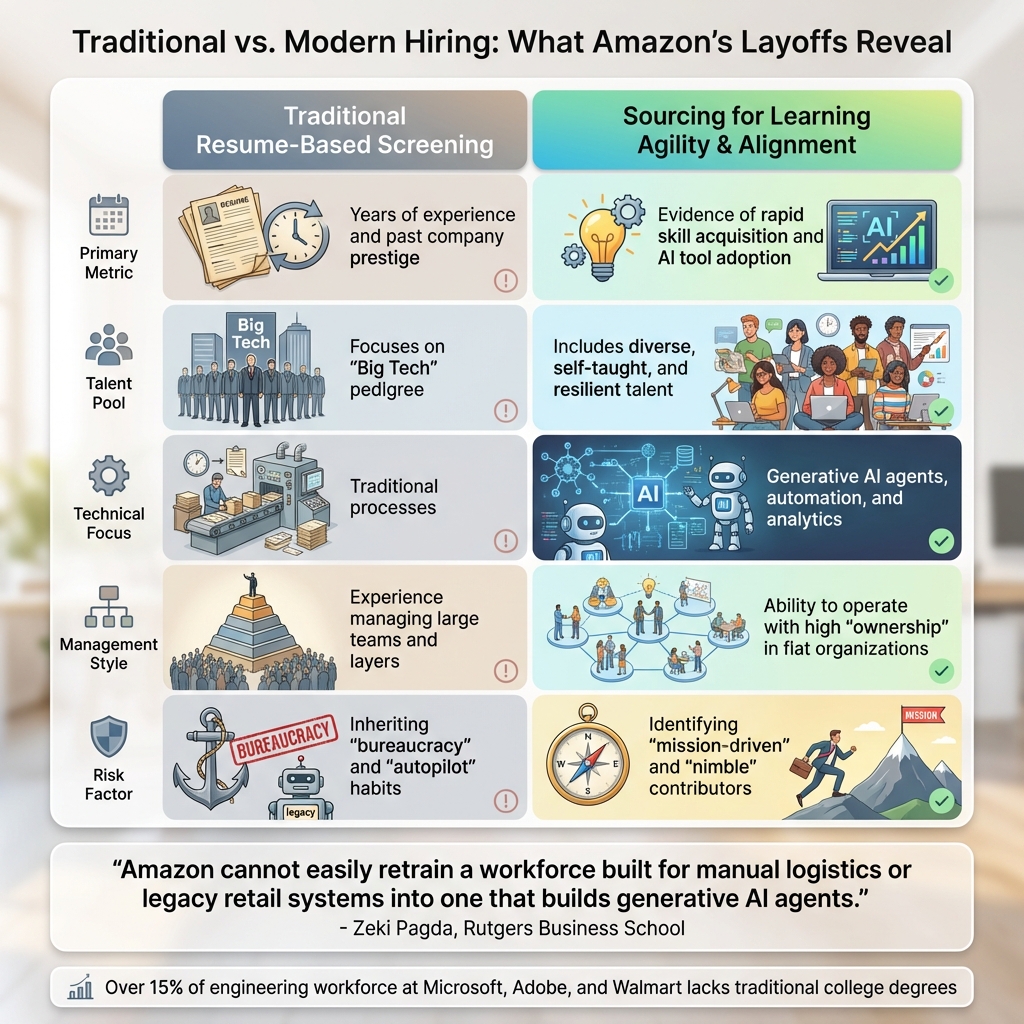 {Traditional Resume Screening vs Learning Agility-Based Hiring Approaches}
Problems with Resume-Based Screening
Relying solely on resumes can lead recruiters to fall into familiar traps, especially during periods of layoffs when the talent pool seems abundant. A key issue is that resumes, which often emphasize tenure and past roles, fail to showcase a candidate's ability to adapt to new challenges. This oversight was a critical factor in Amazon's recent layoffs, where the company attributed the cuts to cultural misalignment rather than purely financial reasons.
Jason Walker, CEO of Thrive HR, put it bluntly when discussing Amazon's approach:
"Is it really better for Amazon to publicly say we hired the wrong 14,000 people? If that's true, your hiring processes need an overhaul. Hiring the right people and assimilating them is literally the job of HR." Using a developer hiring checklist can help ensure these processes are robust and effective.
The problem is clear: recruiters risk repeating Amazon's mistakes by favoring impressive resumes that don't reflect the skills needed for today's fast-changing work environment. For instance, in Washington State, software engineers made up 25% of layoffs, while managers accounted for 20%, including mid-level engineers (SDE II). Despite strong credentials, many struggled to keep up with the increasing demand for AI-related skills . Meanwhile, data from companies like Microsoft, Adobe, and Walmart reveals that over 15% of their engineering workforce lacks traditional college degrees - evidence that practical skills are often more important than conventional qualifications .
This highlights the growing need for recruiters to move beyond outdated methods and embrace more agile hiring practices.
Old Methods vs. New Requirements
Traditional resume-based screening methods are increasingly misaligned with the needs of modern businesses. The gap between what companies require and how they evaluate talent has never been more apparent. Here's a breakdown of how conventional approaches compare to more dynamic strategies that prioritize adaptability and alignment with current demands:
| Feature | Traditional Resume-Based Screening | Sourcing for Learning Agility & Alignment |
|---|---|---|
| Primary Metric | Years of experience and past company prestige | Evidence of rapid skill acquisition and AI tool adoption |
| Talent Pool | Focuses on "Big Tech" pedigree | Includes diverse, self-taught, and resilient talent |
| Technical Focus | Traditional processes | Generative AI agents, automation, and analytics |
| Management Style | Experience managing large teams and layers | Ability to operate with high "ownership" in flat organizations |
| Risk Factor | Inheriting "bureaucracy" and "autopilot" habits | Identifying "mission-driven" and "nimble" contributors |
Zeki Pagda, Assistant Professor at Rutgers Business School, sums up the challenge:
"Amazon cannot easily retrain a workforce built for manual logistics or legacy retail systems into one that builds generative AI agents."
Recruiters who continue to prioritize traditional markers of success - like prestigious company names or years of experience - risk hiring candidates who may not be equipped for the demands of the future. Instead, companies need evaluation processes that uncover candidates with adaptability, forward-thinking skills, and the ability to thrive in rapidly evolving environments.
Hiring engineers?
Connect with developers where they actually hang out. No cold outreach, just real conversations.
How daily.dev Recruiter Solves This Problem
daily.dev Recruiter takes a fresh approach to developer hiring, addressing the limitations of traditional resume screening tools by focusing on real-time engagement and meaningful connections.
Connecting with Active, Engaged Developers
Instead of relying on static resumes, daily.dev Recruiter connects recruiters with developers who are actively learning and growing. The platform tracks real-time developer activity, highlighting engineers who are consuming technical content, experimenting with new frameworks, and showcasing adaptability - qualities that static resumes often fail to capture.
Each introduction is warm and double opt-in, meaning developers must express interest before recruiters can reach out. This ensures that every conversation happens with engineers who are genuinely open to exploring new opportunities. Unlike traditional methods that scrape outdated LinkedIn profiles or databases, daily.dev Recruiter prioritizes pre-qualified, actively engaged talent, focusing on their current skills and interests rather than just past achievements.
Features That Support Better Hiring Decisions
daily.dev Recruiter offers advanced targeting tools that allow recruiters to identify engineers based on specific technical needs, such as AI expertise, cloud infrastructure skills, or the ability to thrive in a fast-paced startup environment. Job briefs are crafted to resonate directly with engaged developers, making outreach more effective.
The platform also integrates seamlessly with developer hiring platforms and ATS, bridging the gap between identifying candidates and managing the hiring process. This reduces the time spent switching between tools and allows recruiters to focus on meaningful interactions with candidates. By emphasizing real-time engagement and adaptability, daily.dev Recruiter moves beyond the traditional resume-based approach, helping recruiters find talent that aligns with current technical priorities.
Why Warm Introductions Work Better
The trust-based approach of daily.dev Recruiter leads to higher response rates by ensuring mutual interest before outreach begins. Developers who have already expressed openness to new opportunities are more likely to engage in genuine conversations, creating a smoother and more productive hiring process.
Conclusion
What the Amazon Layoffs Teach Us
Amazon’s layoffs from October 2025 to January 2026 highlight a pivotal shift: businesses are evolving faster than traditional hiring practices can keep up. As CEO Andy Jassy explained:
"We will need fewer people doing some of the jobs that are being done today, and more people doing other types of jobs" .
The message is clear - staying relevant in the tech world requires more than just experience. Skills that once seemed indispensable can quickly become outdated. For recruiters, this means focusing on candidates who are adaptable and eager to learn. Amazon’s leadership has emphasized the importance of exploring artificial intelligence, participating in ongoing education through workshops, and experimenting with emerging tools to stay valuable in leaner, more efficient teams . This shift forces hiring strategies to evolve alongside organizational priorities.
Action Steps for Talent Teams
Amazon’s decision to cut 16,000 corporate roles in January 2026 wasn’t about eliminating redundancy - it was about realigning its workforce with a strategic focus on AI-driven efficiency and streamlined structures . For recruiters, this underscores the need to move beyond traditional resume-based hiring methods. Agile, real-time hiring practices are essential for identifying candidates who are actively engaged in learning and innovation.
Tools like daily.dev Recruiter offer a way forward by connecting talent teams with engineers who are already exploring new technologies and showcasing the curiosity that modern tech companies value. By prioritizing warm, opt-in introductions with developers who are genuinely open to new opportunities, recruiters can build teams that are not just prepared for today’s challenges but ready to adapt to future changes.
Amazon’s layoffs don’t reflect a surplus of talent - they point to the need for smarter, more forward-thinking hiring approaches.
FAQs
Why did Amazon’s 2026 layoffs focus on skill alignment instead of overhiring?
Amazon’s 2026 layoffs weren’t simply about an overabundance of engineers - they were about aligning skills with the company’s shifting priorities. As Amazon’s operations evolved faster than its internal structure, the emphasis moved toward finding engineers who could grow, learn, and remain relevant in an ever-changing landscape.
This underscores an essential truth: the ability to adapt and commit to ongoing learning is more crucial than ever. These traits often don’t stand out on a resume, but ignoring them can result in repeating the same hiring mismatches down the road.
How can recruiters focus on adaptability and learning potential instead of just resumes?
Recruiters can shift their approach to emphasize a candidate's ability to adapt and learn by moving beyond static resumes. Rather than focusing solely on job titles or a predefined skill set, they should evaluate how well candidates handle change, embrace new challenges, and remain relevant in today’s fast-evolving workplaces.
One effective way to do this is through behavioral interview questions. For instance, ask candidates to share examples of how they’ve navigated unexpected challenges or quickly picked up new tools and technologies. Another option is to incorporate assessments that evaluate problem-solving skills, curiosity, and a mindset geared toward growth.
By focusing on qualities like resilience and adaptability, recruiters can pinpoint individuals who are more likely to succeed in dynamic, ever-changing organizations.
How is AI influencing the skills needed for technical roles at Amazon?
AI is reshaping the landscape of technical roles at Amazon, especially as the company navigates rapid advancements in technology. Recent layoffs underscore the rising demand for AI expertise, as Amazon increasingly depends on AI to enhance workforce planning and improve operational efficiency.
To remain competitive, technical professionals are now expected to build skills in areas like machine learning, data analytics, and AI integration. These abilities are key to aligning with Amazon’s shifting priorities and using AI to push forward innovation and productivity. In this fast-evolving space, staying relevant requires a commitment to ongoing learning and adapting to emerging technologies.
.png)