Amazon's recent layoffs - 16,000 corporate employees in January 2026, with nearly 40% being engineers - highlight a critical hiring challenge. As AI reshapes the tech landscape, traditional hiring methods like keyword filtering and resume-based evaluations are falling short, making it harder to identify qualified technical candidates. Here's why:
- Resumes miss nuances: Job titles like "SDE II" don't reveal whether someone worked on cutting-edge AI or maintained legacy systems.
- AI tools complicate hiring: Automated filters often screen out qualified candidates due to mismatched keywords.
- Past roles ≠ future readiness: Rapid tech evolution means experience from even two years ago may not align with today's demands.
To hire effectively in 2026, companies must focus on current skills, recent projects, and learning speed. Tools like daily.dev Recruiter help by connecting with actively engaged engineers, filtering for real-time expertise, and ensuring meaningful conversations with candidates ready for modern challenges. Rethinking outdated hiring practices is no longer optional - it's essential to stay competitive.
Why Old Hiring Methods Don't Work Anymore
Hiring engineers today is no small feat. With thousands of candidates flooding the job market, recruiters often lean on familiar shortcuts like company names, keywords, and academic pedigree. But here’s the catch: these methods assume resumes can reliably predict a candidate’s potential. In reality, technology evolves far too quickly for past credentials to keep up. Just because someone worked at Amazon two years ago doesn’t mean they’re equipped to tackle today’s AI-driven challenges. This disconnect becomes glaringly obvious when you take a closer look at resumes and past roles.
Resumes Don't Show the Full Picture
Take two engineers, both listed as "SDE II" with three years at Amazon. On paper, they might seem identical. But dig deeper, and you could find that one was maintaining outdated systems while the other was building cutting-edge AI search infrastructure. Yet, traditional hiring processes often fail to capture these nuances. Automated filters, for example, reward resumes stuffed with buzzwords while overlooking critical skills. An engineer skilled in Kafka might get excluded from a search for "event streaming" simply because the exact term wasn’t used, even though the expertise is essentially the same .
The rise of AI-generated resumes has only made things murkier. A recent study revealed that 93% of job seekers now use tools like ChatGPT to craft their resumes and cover letters . Talent director Sofia Mishina from AI Digital puts it bluntly:
"I see resumes that are perfectly formatted and perfectly forgettable - the same buzzwords, same tone, no proof of work"
When every application looks polished but generic, it becomes nearly impossible to gauge how candidates achieved their results. Resumes, as static summaries of past roles, fail to provide the context needed to assess a candidate’s true potential in today’s fast-moving tech world.
Past Roles Don't Predict Future Performance
Here’s another problem: the tech industry evolves so rapidly that past roles often fail to predict future success. Many top tech recruiting platforms exacerbate this issue by relying on historical hiring data. Instead of identifying the skills needed for new challenges, they simply replicate past hiring patterns. As MIT Sloan Professor Emilio J. Castilla cautions:
"What appears to be an objective evaluation is really a rerun of old prejudices, stereotypes, and other hiring mistakes, now stamped with the authority of data science"
Amazon’s own misstep highlights this risk. The company once developed an AI recruitment tool that ended up penalizing resumes containing the word "women" . The problem? The algorithm was trained on flawed historical data. When hiring systems are built on outdated assumptions, they consistently overlook candidates who are well-equipped to handle modern technological shifts.
In a world where AI and innovation redefine the rules daily, relying on old hiring methods is like trying to solve today’s problems with yesterday’s tools. It just doesn’t work.
What Happens When You Hire the Wrong Way
Relying on outdated hiring practices can lead to more than just a few mismatched hires - it can create systemic issues within your team. These practices often result in teams that struggle to adjust, slow down project timelines, and rack up costly turnover expenses. The ripple effects include delayed decisions, missed opportunities, and teams bogged down by legacy problems instead of tackling current challenges.
Treating All Amazon Engineers the Same
Amazon is a massive company with engineers spread across a wide range of fields - everything from AWS cloud computing to advertising, retail, devices, and even video games . Assuming all Amazon engineers are interchangeable just because of their employer is a big mistake.
Take what happened in late 2025 as an example. Amazon's video game division cut roles at its San Diego and Irvine, California studios, affecting game designers, artists, and producers working on large-scale MMO games like the now-canceled "Lord of the Rings" project . Around the same time, layoffs hit Amazon's Visual Search and AI-shopping teams in Palo Alto, California, which focused on cutting-edge tools like Amazon Lens and Lens Live . While both groups were made up of Amazon engineers, their day-to-day work, skills, and potential contributions were worlds apart.
These cuts disproportionately impacted mid-level software roles, but they weren’t tied to individual performance. Instead, they stemmed from strategic decisions to scale back specific divisions, such as gaming and experimental consumer tech. Treating all these engineers as if they possess the same capabilities can lead to hiring missteps. Worse, it overlooks the specialized skills needed for fast-moving fields like AI.
Missing Engineers Who Can Handle AI Shifts
Old-school hiring methods often fail to identify engineers who can thrive in rapidly evolving tech landscapes. Rigid keyword filters, for example, may screen out candidates whose skills have outpaced traditional job descriptions. Bill Peppler, COO of Kavaliro, highlights this disconnect:
"The job descriptions have evolved faster than the skills of the available workforce. Someone who worked on Natural Language Processing models two years ago might not have hands-on experience with LLMs" .
Nick Derham, Director at Adria Solutions, adds:
"It really is often a case of companies chasing unicorns and then blaming the market when they can't find one" .
By demanding candidates with years of experience in technologies that have barely existed for months, you risk losing out on engineers with the adaptability and drive to excel in new roles.
This is especially concerning as industries like Amazon shift toward generative AI and more streamlined infrastructure . As Zeki Pagda, Assistant Professor at Rutgers Business School, points out:
"Amazon cannot easily retrain a workforce built for manual logistics or legacy retail systems into one that builds generative AI agents" .
Clinging to outdated hiring practices leaves your team ill-equipped to meet today’s challenges. Meanwhile, competitors who embrace modern strategies are already moving ahead.
How to Assess Engineers in 2026
The job market in 2026 is saturated with engineers due to widespread layoffs, making it more important than ever to evaluate candidates based on their current skills, adaptability, and compatibility with your technology stack.
Interview for Recent Work, Not Past Titles
When assessing engineers, focus on their recent projects - ideally those completed in the last 6 to 12 months. Dive into the challenges they tackled, the trade-offs they managed, and how quickly they adapted to new systems. This approach gives you a clearer picture of their current capabilities rather than relying on outdated job titles.
Amazon's Prime Video team has adopted this method. Girish Bajaj, Vice President of Core Tech at Prime Video Studios, describes their updated hiring process:
"This new approach gives candidates a more authentic glimpse into how Amazon engineers work. It's helping us identify great builders while giving them a chance to experience what it's like to build and invent at Amazon" .
One effective technique is the code review interview. Instead of abstract puzzles or whiteboard exercises, present candidates with subpar code and ask them to improve it. This method reveals their technical judgment, communication skills, and ability to identify critical architectural flaws .
Interestingly, 87% of candidates find AI-assisted coding assessments more relevant to the roles they’re pursuing . Allowing candidates to use tools like AI coding assistants during the interview mimics real-world conditions, providing a more accurate view of how they work on the job.
Beyond interviews, observing how candidates actively develop their skills can offer valuable insights.
Use Developer Networks to See What They're Learning
In a rapidly changing tech landscape, learning speed often outweighs past experience. Platforms like daily.dev provide a window into what engineers are exploring and how engaged they are with emerging technologies. This helps identify candidates who are evolving with the times versus those clinging to outdated practices.
Pay attention to "adjacency" in skills. For example, an engineer familiar with Kafka likely has a strong grasp of event-driven microservices. AI-powered tools that identify such adjacent skills can expand your talent pool by more than 20% .
The numbers support this approach: Candidates identified through AI-driven skill-matching are 24% more likely to succeed in their initial interviews . This is because these tools focus on capability and learning habits rather than just keyword matches.
To complement these insights, examine their actual contributions to code and projects.
Look at Code and Project Activity
Shifting away from traditional hiring practices, reviewing live code and project activity offers a more accurate picture of an engineer's current technical focus. Contributions on GitHub, involvement in open-source projects, and project velocity provide far more insight than a resume ever could. Leading companies like Microsoft, Adobe, and Walmart have embraced this approach - over 15% of their engineers don’t hold traditional college degrees, proving that skills outweigh credentials .
Also, look for "Being Glue" behaviors. These are engineers who document their work, share knowledge, and enhance team architecture. These actions amplify overall productivity . An engineer who writes clear documentation and fosters collaboration can often contribute more to a team’s success than someone who only focuses on individual feature delivery.
When reviewing their work, conduct live code walkthroughs to assess their understanding of the underlying logic. With AI coding assistants becoming standard tools, it’s important to confirm that candidates can articulate the reasoning behind their decisions, not just generate code . This ability helps distinguish engineers who can reduce technical debt from those who might inadvertently add to it.
Hiring engineers?
Connect with developers where they actually hang out. No cold outreach, just real conversations.
How daily.dev Recruiter Changes Developer Hiring
Hiring engineers, especially those displaced from Amazon, isn’t just about finding candidates - it’s about connecting with the right people at the right time. Traditional sourcing tools often rely on outdated profiles and impersonal outreach, leading to conversations with engineers who may not be interested or available. daily.dev Recruiter flips this approach, connecting you with developers who are actively engaged and open to meaningful conversations.
Only Talk to Developers Who Want to Engage
daily.dev Recruiter uses a double opt-in system, ensuring that only developers who are genuinely interested in opportunities will engage. This eliminates the frustration of sending out generic, unwanted messages. Instead of cold outreach, you’ll have real conversations with engineers who have signaled their interest. This approach is particularly effective in 2026, where LinkedIn data shows AI-generated recruitment messages are accepted 40% more often than traditional one-off recruiter messages . By cutting through the noise, daily.dev Recruiter helps you focus on meaningful connections.
Additionally, the platform fine-tunes candidate selection by prioritizing real-time learning and current skills, ensuring you’re speaking with developers who are actively growing in the areas you need.
Screen for Learning Speed and Current Skills
Unlike traditional platforms that rely on static profiles, daily.dev Recruiter allows you to filter candidates based on what they’re learning right now. Whether it’s advanced technologies like Rust or vector databases, you can focus on developers who are actively building the skills you need. Compare this to platforms like Indeed, where "active" profiles are simply those updated in the last 30 days . With daily.dev Recruiter, you’re working with real-time engagement data, giving you a clearer picture of a candidate’s current focus and learning speed.
This real-time screening is further enhanced by sourcing candidates from an active and engaged developer community.
Source from an Active Developer Community
daily.dev Recruiter taps into a thriving network of developers who are constantly reading, learning, and engaging with new technologies. This vibrant community ensures access to a dynamic talent pool, unlike traditional Applicant Tracking Systems that rely on keyword matching. Many candidates find such systems frustrating, as they often fail to capture the full scope of their skills . Even Amazon’s rigorous hiring process reportedly results in only a 2% success rate for applicants . By sourcing from a community where developers continually demonstrate their learning and engagement, daily.dev Recruiter significantly improves your chances of finding the right fit for your team.
Traditional Hiring vs. daily.dev Recruiter
::: @figure 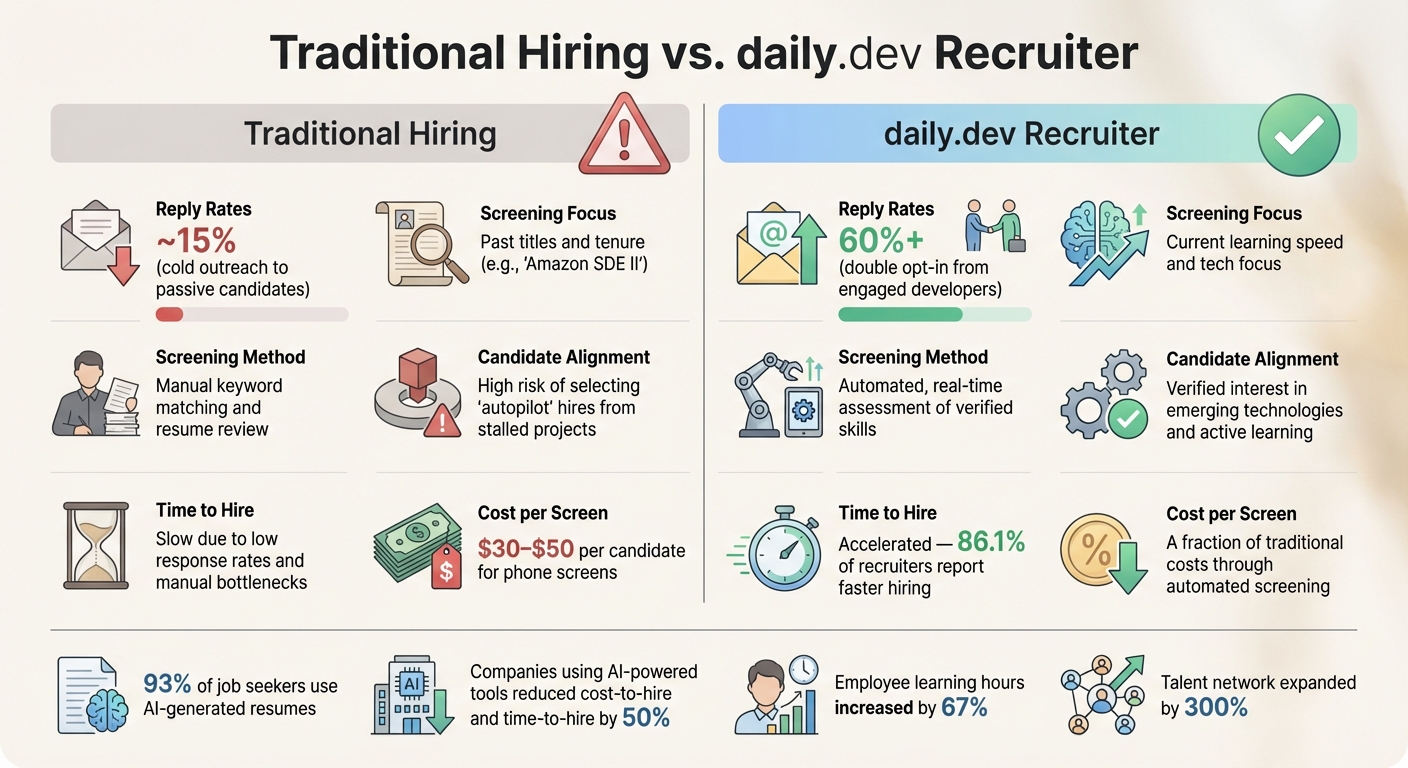 {Traditional Hiring vs daily.dev Recruiter: Key Metrics Comparison}
When hiring displaced Amazon engineers, traditional methods see reply rates of around 15%, along with slow, manual screening processes. In contrast, daily.dev Recruiter boasts reply rates exceeding 60%, thanks to automated, real-time skill assessments.
Side-by-Side Comparison
Here’s a quick breakdown of how the two approaches stack up:
| Metric | Traditional Hiring | daily.dev Recruiter |
|---|---|---|
| Reply Rates | ~15% (cold outreach to passive candidates) | 60%+ (double opt-in from engaged developers) |
| Screening Focus | Past titles and tenure (e.g., "Amazon SDE II") | Current learning speed and tech focus |
| Screening Method | Manual keyword matching and resume review | Automated, real-time assessment of verified skills using expert methods to vet technical skills |
| Candidate Alignment | High risk of selecting "autopilot" hires from stalled projects | Verified interest in emerging technologies and active learning |
| Time to Hire | Slow due to low response rates and manual bottlenecks | Accelerated - 86.1% of recruiters report faster hiring |
| Cost per Screen | $30–$50 per candidate for phone screens | A fraction of traditional costs through automated screening |
Traditional hiring methods often fail to distinguish engineers who worked on cutting-edge projects from those who simply maintained legacy systems . This is where daily.dev Recruiter stands out - it emphasizes real-time engagement with emerging technologies and evaluates candidates based on their ability to learn and grow.
Static resumes don’t tell the whole story. They miss an engineer's current skills and adaptability. daily.dev Recruiter bridges this gap by focusing on ongoing learning and active participation in the latest tech trends. For instance, companies using AI-powered tools like Vodafone have slashed their cost-to-hire and time-to-hire by 50%, while also boosting employee learning hours by 67% . Similarly, Eaton expanded its talent network by 300% and saw dramatic improvements in hiring efficiency . By sourcing talent from an engaged developer community, companies can hire faster and secure engineers prepared to tackle the challenges of tomorrow.
Conclusion
Amazon's layoffs opened up around 14,000 positions, with nearly 40% of those in engineering roles. This highlights a key point: even when candidates share similar qualifications on paper, their skills and experiences can differ greatly .
Traditional hiring practices often fall short in uncovering this potential. Today, 93% of job seekers use AI-generated resumes, cold outreach sees a meager 2–3% response rate, and automated screening systems frequently miss out on unconventional talent .
"I see resumes that are perfectly formatted and perfectly forgettable - the same buzzwords, same tone, no proof of work."
- Sofia Mishina, Talent Acquisition Director, AI Digital
daily.dev Recruiter changes the game by connecting you with developers who are already engaged in their craft. This platform focuses on current skills and active involvement, rather than just past job titles. By doing so, it achieves higher response rates and prioritizes qualities like learning speed and technical expertise.
In a fast-changing tech world, staying ahead means rethinking hiring strategies. The most sought-after engineers - those skilled in modern AI workflows and advanced tools - aren't passively waiting on job boards. They're actively improving, learning, and ready for the right opportunity.
FAQs
Why are traditional hiring practices struggling in today’s tech industry?
Traditional hiring methods are falling short because they lean too much on outdated ideas - like assuming someone's past job titles predict how they'll perform in the future. In today’s fast-moving tech world, shaped by AI advancements and constant shifts in technology, this mindset often misses the mark. It overlooks key qualities like the ability to adapt, learn quickly, and apply up-to-date expertise.
Sticking to these old ways means recruiters risk passing over great talent or bringing in candidates who seem perfect on paper but don’t have the skills to tackle modern challenges. To keep up, hiring strategies need to shift. The focus should be on evaluating candidates more broadly, emphasizing their potential to excel in a world that’s always changing.
How can companies accurately evaluate an engineer's current skills?
When assessing an engineer's abilities, relying on outdated methods like keyword searches or job titles often falls short. Instead, companies should shift their focus to dynamic assessments that showcase learning capacity, problem-solving abilities, and adaptability. These approaches paint a more accurate picture of an engineer’s current expertise and potential.
Some practical methods include:
- Project-based evaluations: Assign tasks that mirror real-world challenges to see how candidates apply their skills.
- Skill-specific tests: Target particular technical competencies to gauge proficiency.
- Problem-solving analysis: Observe how candidates tackle complex scenarios to understand their approach and thought process.
This shift is especially crucial in industries that evolve rapidly, where even engineers from the same organization may have vastly different experiences. By emphasizing contextual and evidence-based evaluations, companies can pinpoint individuals who are not only technically capable but also ready to excel in environments that demand innovation and adaptability.
How does using real-time engagement data improve hiring decisions?
Using real-time engagement data in hiring offers a sharper, more up-to-date perspective on a candidate's abilities, mindset, and potential. Instead of relying solely on traditional markers like previous job titles or company reputations, this method allows recruiters to evaluate a candidate's ability to adapt, current motivations, and how well they align with the company's immediate goals.
This is particularly important in fast-moving fields like tech, where yesterday's skills might not meet today's demands. Real-time data highlights candidates who are not just experienced but are actively learning and prepared to excel in constantly changing roles.
By prioritizing fresh, actionable insights, recruiters can spot candidates who are better equipped to meet the challenges of evolving positions. This approach minimizes hiring mismatches and improves the odds of finding the right fit, even in highly competitive and fast-paced markets.
.png)