Automation in recruitment can save time and improve efficiency, but it's not without challenges. Missteps like over-automating communication, ignoring bias in AI tools, and unclear goals can harm outcomes. Here's what you need to know:
- Balance automation with human touch: Candidates notice when processes feel robotic. Automate repetitive tasks but keep people involved in key decisions.
- Address bias in AI tools: AI can unintentionally exclude qualified candidates. Conduct audits and use diverse datasets to ensure fairness.
- Define clear goals: Without clear objectives, automation may waste resources. Focus on measurable outcomes like reducing time-to-hire or improving response rates.
- Ensure system integration: Tools must sync with existing systems like ATS to avoid inefficiencies.
- Prioritize user experience: Both candidates and recruiters need intuitive, user-friendly systems to succeed.
Automation works best when it supports - not replaces - human decision-making. Start small, test tools, and expand thoughtfully to streamline hiring while keeping it personal.
Common Mistakes in Recruitment Automation and How to Fix Them
::: @figure 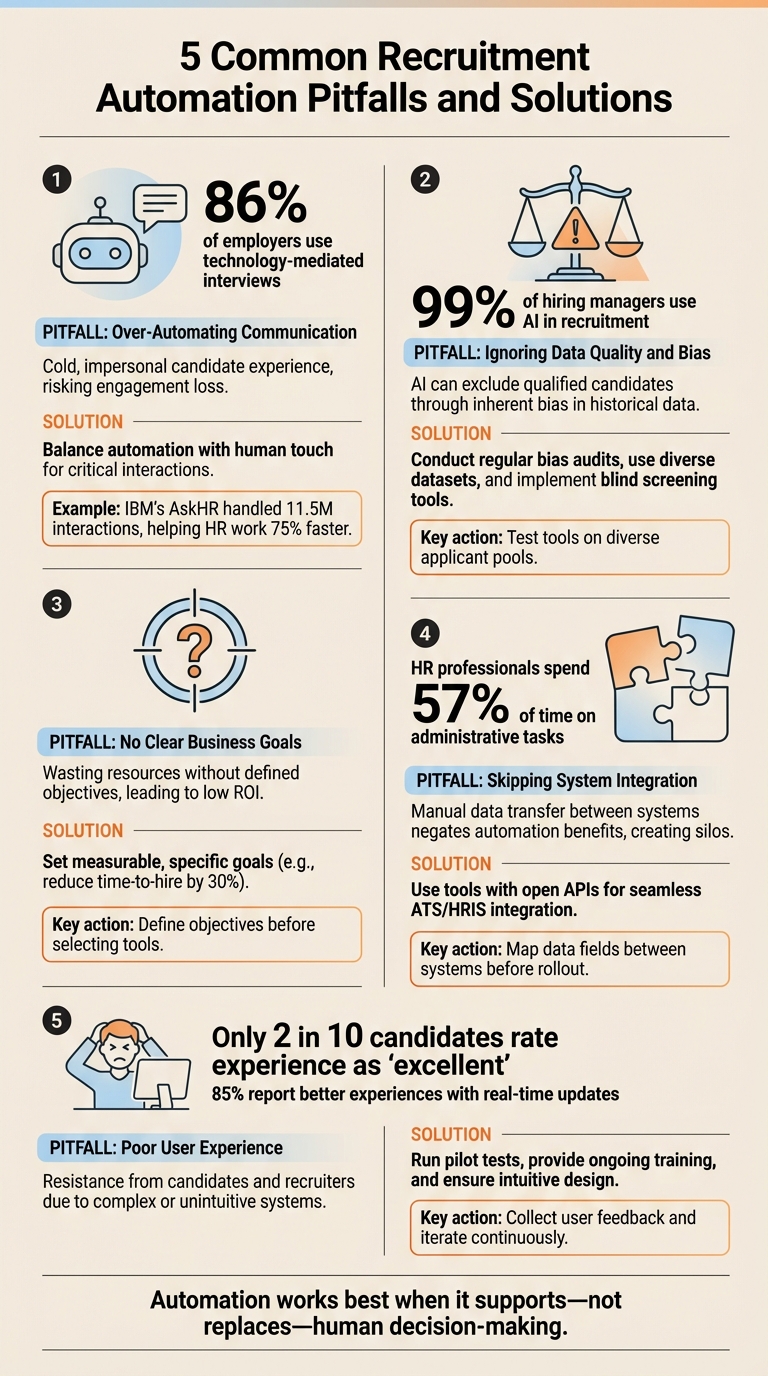 {5 Common Recruitment Automation Pitfalls and Solutions}
Automation has the power to revolutionize your hiring process - if you sidestep some common pitfalls that even seasoned recruiters can fall into. Let’s break down five key mistakes and how to address them effectively.
Over-Automating Candidate Communication
While 86% of employers use technology-mediated interviews , candidates still crave authentic human interaction. Over-relying on automation can leave your employer brand feeling cold and impersonal .
The solution? Strike a balance. For instance, Stanford Healthcare uses a chatbot to match candidates with jobs and handle basic inquiries, but escalates complex questions to human recruiters . Similarly, IBM’s "AskHR" AI agent managed 11.5 million interactions in 2024, helping HR teams work 75% faster while focusing on strategic tasks . As Antonio Gabric, Outreach Manager at Hunter, puts it:
"Hiring is not just about filling positions. It's also about understanding candidates' aspirations, dreams, and nuances... technology cannot assess any of this."
Automate repetitive tasks like scheduling and status updates, but keep humans involved in areas requiring empathy or judgment. For critical moments, such as final interviews, always offer candidates the chance to connect with a person .
Ignoring Data Quality and Bias
Even though 99% of hiring managers now use AI in recruitment , these tools can unintentionally exclude qualified candidates. Bias often creeps in through "learnt bias" (reflecting historical prejudices) or "inaccuracy" (tools performing poorly for certain demographics) .
Manish Raghavan and Solon Barocas from the Brookings Institution caution:
"On their surface, algorithmic screening tools seem to be entirely evidence-based... However, there is mounting evidence that such tools can reproduce and even exacerbate human biases."
To combat this, demand bias audits and training dataset documentation from vendors before purchasing any tool . Test the software on a diverse pool of applications to ensure it ranks candidates fairly across demographics . Monitor results after implementation and set benchmarks to track progress for underrepresented groups.
You can also use "feature stripping" to remove inputs that may proxy for protected traits. For example, if a resume-screening tool prioritizes "lacrosse" experience - a factor that may skew toward certain demographics - exclude it . Blind screening, which hides names, ages, and gender markers during initial reviews, is another effective way to reduce bias .
Using Automation Without Clear Business Goals
Adopting automation just because it’s trendy can backfire. Without clear objectives, you risk wasting time and resources or creating new problems.
Start by defining your goals. Are you trying to cut time-to-hire by 30%, boost candidate response rates, or handle more applications without adding staff? Your answers will guide your tool selection and help you measure whether the investment pays off.
Skipping System Integration
Automation tools that don’t sync with your existing systems can cause more headaches than they solve. For example, if your AI sourcing platform doesn’t integrate with your ATS, recruiters might end up manually transferring data - negating the very purpose of automation.
Wendy Makinson, HR Manager at Joloda Hydraroll, explains:
"Anything that is done manually will take longer and is more susceptible to human error. It is far more efficient, accurate, and cost-effective to set up automatic syncing between the systems."
Look for tools with open APIs that enable seamless data sharing between your ATS, HRIS, payroll, and other platforms . Before rolling out new software, map data fields between systems to prevent errors . With HR professionals spending 57% of their time on administrative tasks , smooth integration can save significant time.
Involve IT and HR teams early to ensure compatibility and troubleshoot any technical issues. Consolidating data into a single system can further simplify workflows and reduce manual entry .
Overlooking Candidate Experience and Recruiter Adoption
Even the best automation tools won’t succeed if candidates and recruiters resist using them. Currently, only 2 in 10 candidates rate their experience as "excellent" . Yet, 85% of candidates report better experiences with systems that provide real-time updates - but only when those systems are intuitive and user-friendly.
Run small pilot tests with select recruiters or job roles before a full rollout . Use this phase to identify technical glitches and gather feedback from both recruiters and candidates. Adjust your approach based on what you learn.
Provide ongoing training, not just a one-time session. Equip recruiters with resources like detailed SOPs, screenshots, or video tutorials to build confidence and reduce frustration . When recruiters see how automation simplifies their work, they’re more likely to embrace it.
For candidates, ensure automated communications feel personal and include clear options to reach a real person when needed . Offer accommodations for applicants with disabilities or neurodivergence, such as opting out of automated assessments in favor of manual reviews . These steps not only improve the candidate experience but also demonstrate respect for diverse needs.
Best Practices for Recruitment Automation
Now that you're aware of what to steer clear of, let’s dive into practical strategies to make recruitment automation work for your hiring process. These tips will help you implement tools effectively while keeping both your team and candidates satisfied.
Start Small and Expand Over Time
Begin with automating tasks that are high-impact but low-risk - like distributing job postings, screening resumes, or scheduling interviews . Look for areas where manual work tends to pile up or where bottlenecks slow down your current workflows .
For example, Rootquotient used a coding assessment platform to streamline their hiring process. This approach helped them cut their time-to-hire by 50%. Starting with a pilot program for one role or department allows you to test the waters - evaluating the tool’s accuracy, addressing technical glitches, and gathering feedback from both recruiters and candidates . Once you see success in one area, you can gradually expand automation to other functions. This step-by-step method reduces risks and ensures a smoother integration into your human-focused recruitment strategy.
Keep Humans Involved in Important Decisions
While automation can handle repetitive tasks, it’s crucial to reserve significant decisions for human judgment. Automation should act as a support system for recruiters, not a replacement. In fact, nearly 99% of hiring managers use AI in some capacity, but the most effective teams rely on these tools to assist decision-making rather than dictate outcomes .
Key decisions - like choosing a final candidate, negotiating compensation, assessing cultural fit, or delivering sensitive rejections - demand a human touch . As Emma Clary, Senior Content Marketing Manager at Lever, puts it:
"The goal of automation isn't efficiency for efficiency's sake - it's freeing your team up to focus on people-oriented work" .
Automated tools can’t grasp a candidate’s aspirations, handle complex negotiations, or deliver difficult news with empathy. To ensure fairness, consider regularly auditing automated outputs, such as reviewing a random sample of rejected resumes. This keeps the process balanced and ensures no qualified candidate is overlooked . By blending automation with human involvement, you can maintain a personalized and thoughtful candidate experience.
Use Platforms Built for Your Target Audience
After establishing a balance between automation and human input, choose tools tailored to your specific talent pool. Generic platforms often miss nuanced qualifications or rely too heavily on keyword matching. Instead, opt for specialized platforms that cater to specific roles - whether you’re hiring developers, writers, or designers. These tools typically offer more accurate assessments and help you connect with niche talent.
Take Redswitches, for instance. They struggled to find freelance writers through general job portals. Switching to Workello, a skill-testing platform for content creators, helped them hire 12 content writers in just one month.
Similarly, when recruiting developers, platforms built around active developer communities can give you an edge. These tools connect you with candidates in environments where they actively engage and learn. As Megan Buttita, Research Director at IDC, explains:
"Automation should make the recruiting process more efficient - allowing recruiters to spend more time as consultants and candidates to have a seamless and positive experience" .
Hiring engineers?
Connect with developers where they actually hang out. No cold outreach, just real conversations.
Using daily.dev Recruiter for Developer Hiring
When it comes to hiring developers, using a platform tailored to their habits and interests can make all the difference. daily.dev Recruiter takes a fresh approach by connecting you with developers where they naturally spend their time - engaging with technical content, learning, and staying updated. Instead of relying on outdated profiles or impersonal outreach, this platform uses warm, double opt-in introductions. This means you’ll only connect with developers who have actively opted in and shown genuine interest, creating a sense of trust right from the start and avoiding the all-too-common feeling of being "just another number" .
A key advantage of daily.dev Recruiter is how it addresses the limitations of traditional automation. Many systems rely on rigid keyword matching, which often overlooks qualified candidates with unconventional or non-linear career paths . By focusing on active and engaged developers, the platform ensures you’re connecting with individuals who are not only qualified but also open to the right opportunity. As Lesley Couper from Workplace puts it:
"Recruiting is fundamentally about people connecting with people. Technology enhances capabilities but never replaces the instinct to recognize talent and build meaningful relationships" .
This method transforms recruitment from impersonal outreach into a trust-based matchmaking process. You’re meeting developers in real time, in an environment they’re comfortable with, and through introductions that respect their time and preferences. The result? Higher response rates, richer conversations, and a hiring experience that reflects well on your employer brand.
For talent teams looking to upgrade their tools - 76% plan to refresh their tech stack within the next two years - daily.dev Recruiter offers a solution designed specifically for developer hiring. It’s automation done right: efficient, respectful, and tailored to engage developers. By integrating this platform into your strategy, you can leverage technology to meet your hiring goals while preserving the human connections that truly make a difference.
Conclusion
Automation has become a cornerstone of modern recruitment, with 99% of hiring managers now incorporating AI into their processes . The real challenge isn’t deciding whether to automate but figuring out how to do it effectively. The most successful recruiters use automation to handle repetitive tasks - like posting job ads, scheduling interviews, and updating applicant statuses - while reserving critical decisions, such as evaluating fit, negotiating offers, and nurturing relationships, for human judgment.
Before introducing any automation tool, take a step back to evaluate your workflow. Identify bottlenecks and set clear goals, whether it’s shortening time-to-hire or increasing candidate engagement. Start small - pilot the tool with a high-volume role to ensure it works before scaling up. This careful approach prevents automating flawed processes, which can amplify existing problems. This is particularly important when hiring developers, where precision and personalization matter most.
As Ben Eubanks, Chief Research Officer at Lighthouse Research & Advisory, aptly puts it:
"We can't let the human stuff go in HR, recruiting, or hiring because that is where we'll feel the loss the most."
Tools like daily.dev Recruiter illustrate this balance by using automation to streamline warm, double opt-in introductions, all while respecting a developer’s time and preferences. The objective isn’t to replace human judgment but to create room for it to thrive.
When done right, automation doesn’t replace human connections - it enhances them. By reducing administrative burdens, recruiters can focus on building relationships and making thoughtful decisions. This blend of technology and human insight leads to faster hiring, better candidate experiences, and a stronger employer brand. With automation as a support system, not a substitute, recruiters can accelerate processes while fostering meaningful connections throughout the hiring journey.
FAQs
How can recruiters effectively balance automation with personal interaction?
Striking the right balance between automation and personal interaction means using technology to handle repetitive, time-consuming tasks - think job postings, résumé parsing, and interview scheduling - while leaving tasks that require empathy and judgment, like relationship building, assessing fit, and guiding candidates, to humans.
Start by mapping out your hiring process. Identify steps that can be automated without losing the personal touch, and set clear points where human interaction is essential. For example, you could automate initial screenings but follow up with personalized outreach or provide tailored feedback after interviews. Regularly review automated systems to ensure they’re fair and accurate, and always give recruiters the ability to adjust or override AI-driven decisions when necessary.
Tools like daily.dev Recruiter are great examples of this approach. They use automation to match candidates efficiently while still enabling meaningful, personalized interactions that build trust. By blending smart technology with thoughtful human involvement, recruitment teams can scale their efforts without sacrificing the quality of hires or the candidate experience.
How can recruiters reduce bias in AI-powered hiring tools?
Reducing bias in AI-driven hiring tools starts with recognizing that these systems are only as fair as the data and assumptions they rely on. If the training data lacks diversity or reflects past prejudices, the AI can unintentionally reinforce those inequities. To counteract this, recruiters can take these essential steps:
- Conduct regular audits: Frequently review the data and AI-generated outcomes to spot and address any biased patterns.
- Use diverse training data: Ensure the datasets are balanced and representative to promote fairer results.
- Incorporate human oversight: Engage trained recruiters to review decisions and correct any biased recommendations.
By combining these strategies with openness and continuous learning, companies can leverage AI to build a more inclusive hiring process and broaden their talent pool.
Why is it important to define clear goals before using recruitment automation?
Defining clear goals is a must before diving into recruitment automation. Why? Because having a well-defined purpose ensures the technology you choose actually meets your hiring needs and delivers the results you’re aiming for. Without clear objectives, you could end up wasting valuable time and money on tools that don’t solve your specific challenges or improve your hiring process.
When you set clear goals, it becomes easier to pinpoint which parts of your recruitment workflow are worth automating. You can also establish measurable success criteria and keep your team on the same page about what to expect. This clarity not only helps you get the most out of your investment but also ensures a more seamless experience for everyone involved - recruiters and candidates alike.
.png)