Hiring developers from online communities can help you find skilled candidates who actively demonstrate their expertise. Platforms like GitHub, Stack Overflow, and Discord allow you to see how developers solve problems, collaborate, and contribute to technical discussions. Instead of relying solely on resumes, these spaces provide real-time insights into a developer's abilities and interests.
To succeed, focus on observing, contributing, and building trust in these communities before recruiting. Engage authentically by participating in discussions or supporting open-source projects. Avoid spammy tactics like mass messaging or posting jobs in the wrong channels, as these can damage your reputation.
Key Takeaways:
Top Communities: GitHub, Stack Overflow, daily.dev, Dev.to, Hashnode, Reddit, and Discord for general engagement. Rust, Go, React, and AWS groups for niche expertise.
Engagement Strategy: Spend 2–4 weeks observing norms, contribute meaningfully, and personalize outreach.
Avoid Pitfalls: Stay clear of inactive or spam-heavy communities and respect platform rules.
Measure Success: Track response rates, time-to-hire, and the quality of hires from each community.
By investing time and effort into these spaces, you can connect with high-quality developers who may not actively be job hunting but are open to the right opportunity. Focus on long-term relationship-building for better hiring outcomes.
::: @figure 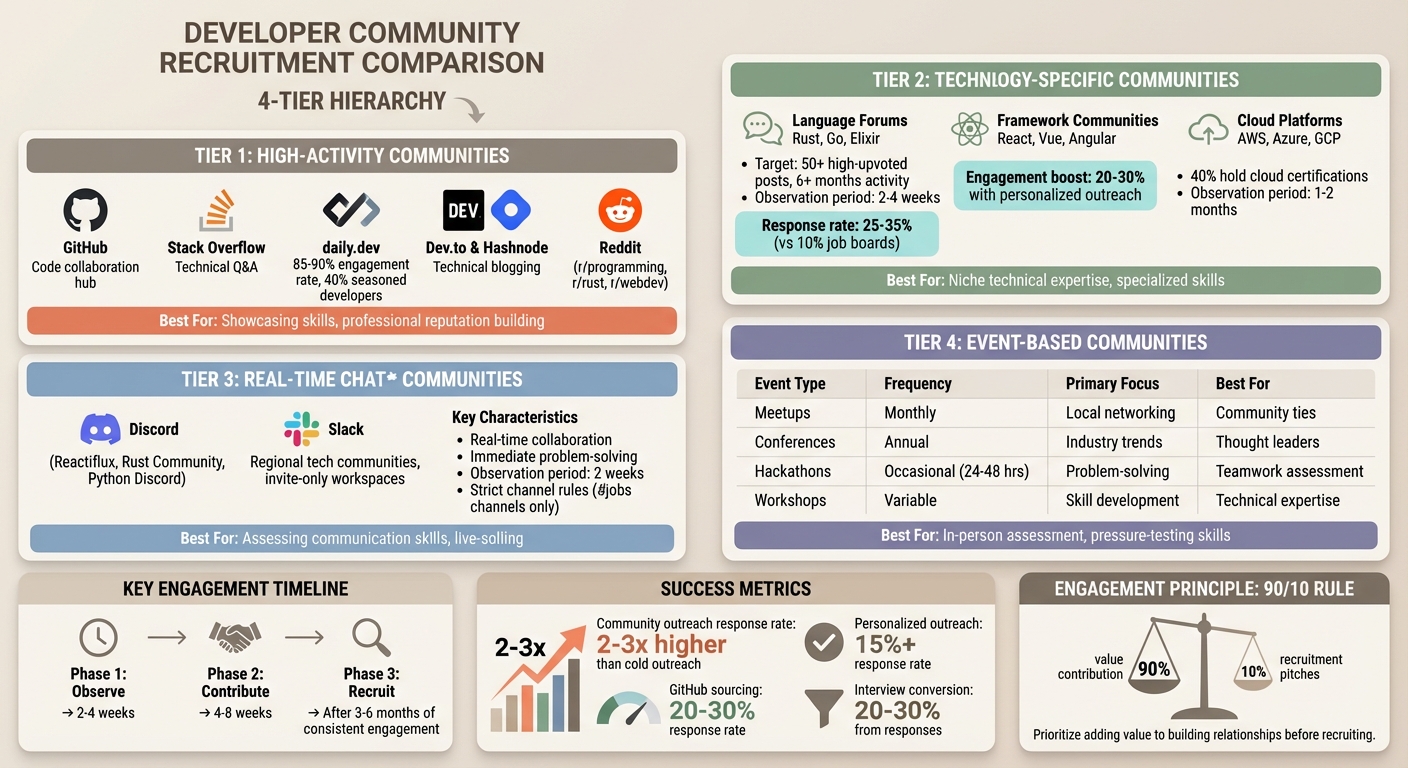 {Developer Community Tiers: Platforms, Engagement Strategies, and Response Rates}
Tier 1: High-Activity Communities
These platforms host some of the most active and engaged technical talent. Developers here showcase their skills and build professional reputations that often speak louder than resumes. To connect meaningfully, it’s essential to engage authentically - these are spaces where developers demonstrate their expertise. Understanding what developers want is the first step toward building that trust.
GitHub is the hub for code collaboration. Take a closer look at pull requests and commit messages. Developers who write clear, detailed commit messages - rather than vague notes - show a strong focus on documentation. Similarly, those who provide constructive feedback during code reviews (instead of just pointing out errors) demonstrate effective communication skills, which are critical for asynchronous and remote work environments.
Stack Overflow is a goldmine for gauging technical depth. Developers with high reputations who consistently break down complex concepts in easy-to-understand ways exhibit both expertise and a willingness to mentor. Pay special attention to contributors active in your specific tech stack - their ongoing engagement is a strong sign of passion and commitment.
On daily.dev, you’ll find active learners and experienced professionals open to conversations. With engagement rates between 85–90% through warm, double opt-in introductions, this platform connects you with receptive candidates. About 40% of them are seasoned developers or tech leaders who might not be actively job hunting but are open to the right opportunity.
Dev.to and Hashnode are platforms where developers share technical blogs, showcasing their ability to explain complex ideas clearly. This skill is invaluable in cross-functional teams, where clear communication can make all the difference.
Reddit's programming communities, like r/programming or r/rust, provide a window into how developers think and solve problems. Whether they’re giving thoughtful advice in r/cscareerquestions or debating technical decisions in r/webdev, these interactions reveal their problem-solving approaches and technical perspectives.
Up next, we’ll explore niche communities that cater to specific tech stacks and interests.
Hiring engineers?
Connect with developers where they actually hang out. No cold outreach, just real conversations.
Tier 2: Technology-Specific Communities
If you're looking to connect with developers who specialize in niche technical skills, focus on communities centered around specific programming languages, frameworks, and cloud platforms. These spaces are where highly skilled developers gather to discuss, debate, and refine their expertise - whether they're dissecting language features or finding ways to optimize performance.
Before jumping in, take some time to observe how these communities operate. Understand their norms and expectations, then start contributing by offering thoughtful answers or sharing helpful resources. Avoid direct job postings, as they can quickly get you banned. Instead, once you've learned how to hire in developer communities and built trust, personalized outreach can yield far better response rates than traditional job boards.
Language Communities: Rust, Go, Elixir Forums
Language-specific forums like users.rust-lang.org for Rust, forum.golangbridge.org for Go, and elixirforum.com for Elixir are excellent places to find skilled developers. These forums maintain a high-quality discussion environment, often moderated by core contributors who can directly validate the skills of participants.
Look for users who have 50+ high-upvoted posts and have been consistently active for at least six months. This kind of sustained engagement typically signals genuine expertise rather than casual interest. Spend two to four weeks observing the community before you start contributing. Once you’ve built some rapport, sending personalized messages that reference specific forum threads can achieve 25–35% response rates, far surpassing the typical 10% seen on job boards.
While language forums highlight a developer's foundational skills, framework communities show how they apply those skills in real-world scenarios.
Framework Communities: React, Vue, Angular
Framework-specific communities often reflect the unique characteristics of their technologies. For example:
React: Communities like Reactiflux Discord and forums.reactjs.org are fast-paced, with short, rapid interactions. These spaces are great for finding developers who excel in dynamic, ever-changing environments.
Vue: The Vue Forum (forum.vuejs.org) and Vue Land Discord offer more balanced discussions, often focused on simplicity and developer experience.
Angular: Angular forums and Discord channels (like those on angular.io) tend to attract developers with experience in enterprise-scale architectures, making them ideal for complex system projects.
To find the right candidates, use advanced searches for specific expertise, such as "React hooks expert", and review their pinned contributions or linked GitHub profiles. Engaging with their work - like forking shared code sandboxes - can boost your outreach success by 20–30% compared to cold messages.
Beyond frameworks, cloud platform communities offer a window into developers’ ability to solve real-world, production-level challenges.
Platform Communities: AWS, Azure, GCP User Groups
Cloud platform communities such as AWS re:Post (repost.aws), Azure Tech Community (techcommunity.microsoft.com), and Google Cloud Community (cloud.google.com/community) are treasure troves of expertise. Developers here often share detailed case studies, like "scaling to 1M users on EKS", or post Terraform modules aimed at cost optimization. These contributions highlight production-level knowledge, with around 40% of members holding cloud certifications.
Spend one to two months observing top discussions and threads. Contribute by answering certification-related questions or sharing useful infrastructure scripts. When reaching out, tailor your message to their contributions. For example, you could say, "I saw your Lambda optimization post - our team is tackling a similar challenge and could really use your expertise." Genuine, context-specific engagement like this goes a long way in building trust in these tightly-knit communities.
Tier 3: Real-Time Chat Communities
Real-time chat platforms like Discord and Slack bring a fast-paced energy to developer interactions. Unlike forums, where conversations may stretch over days, these platforms foster discussions that evolve in real-time. Developers collaborate on open-source projects, dive into technical debates, and troubleshoot live - all within hours. These spaces offer a unique window into how developers communicate, solve problems, and influence their peers, making them invaluable for assessing both technical skills and interpersonal dynamics.
What sets these communities apart is the immediacy and personal nature of engagement. Unlike forums, these platforms demand active participation, not passive observation.
Discord Servers: Framework and Language Channels
Discord servers often revolve around specific technologies. For example:
Reactiflux for React developers
Rust Programming Language Community for Rust enthusiasts
Python Discord for Python developers
These servers maintain a balance between casual conversation and focused discussions. Channels are typically organized by topics, ranging from beginner questions to advanced architecture debates.
To find relevant servers, check out directories like Disboard.org or top.gg. Spend a couple of weeks observing the activity to identify contributors who consistently add value - those who provide insightful answers, share resources, or coordinate open-source efforts. These individuals often stand out as top candidates.
Stick to the rules. Many servers have dedicated #jobs or #hiring channels. Posting job opportunities in the wrong place can result in being muted or even banned. Instead, focus on building genuine connections by contributing to discussions, sharing helpful articles, or offering career advice. When reaching out privately, reference their specific contributions to show you're engaged and not just spamming.
Slack Communities: Invite-Only and Public Workspaces
Slack communities complement Discord by offering a more professional and often regionally focused environment. Examples include Seattle Tech Slack or the Austin Startup Community. Invite-only Slack workspaces, which often require referrals to join, tend to host higher-quality discussions.
While Discord leans toward informal, tech-specific chatter, Slack is more structured and professional. To discover public Slack groups, use tools like slofile.com, which lists workspaces by region or technology. For invite-only groups, tap into your network for introductions - cold requests to join rarely work. Once you're in, spend time contributing before mentioning job opportunities. For instance, you could review resumes, share hiring insights, or connect members with useful career resources.
Peer-to-peer outreach works best. Developers in Slack communities are more likely to respond to messages from fellow engineers than from recruiters. Having a technical team member lead the conversation adds authenticity and increases the chances of meaningful interactions. Also, keep an eye on response times to gauge how active and engaged the community is.
Tier 4: Event-Based Communities
Events pack months of interaction into focused, real-time experiences. They allow you to observe how developers approach problems, communicate, and handle pressure - all in one setting. Unlike online interactions, these live events provide a clearer sense of a developer's technical expertise and interpersonal skills. They create a natural bridge between online profiles and actual abilities, making them an ideal setting for targeted engagement.
Meetup Groups: Local Developer Networks
Meetup groups often revolve around specific technologies or programming languages within a particular city or region. For instance, you might find Python meetups in Austin, React meetups in Seattle, or broader web development gatherings in cities across the U.S. These events, typically held monthly, attract a consistent local crowd. They combine technical presentations with networking opportunities, fostering meaningful connections while offering insights into developers' skills and how they might fit into your team.
To locate these groups, check Meetup.com by searching for specific technologies and locations. Focus on groups with regular attendance and recent activity. Building relationships with local organizers by supporting their efforts - whether through sponsorships or resources - can position your company as a trusted community ally.
Before diving into recruitment, establish yourself as a familiar face. Attend several meetups as a participant, engaging in discussions and taking part in conversations without mentioning job openings. Over time, your involvement will make transitioning into a recruiter role feel more natural and welcomed.
Conferences and Hackathons: Developers in Action
Large-scale events like conferences and hackathons offer another layer of insight into potential candidates. Conferences attract developers who are committed to advancing their skills and staying informed about industry trends. Look for speakers, workshop leaders, and active participants in Q&A sessions - these individuals often showcase strong communication abilities and a passion for growth. Events like PyCon, React Conf, or regional AWS Summits bring together a wide range of talent, allowing you to connect with many potential candidates in a short timeframe.
Hackathons, which typically last 24–48 hours , are a pressure-cooker environment where developers showcase their technical skills and teamwork. Don’t just focus on the winners - some of the most promising hires come from teams that excel in collaboration and creative problem-solving.
| Event Type | Primary Focus | Frequency | Best For |
|---|---|---|---|
| Meetups | Local networking & specific skills | Monthly | Building local connections & community ties |
| Conferences | Industry trends & networking | Annual | Spotting thought leaders & subject experts |
| Hackathons | Problem-solving under pressure | Occasional | Assessing teamwork, creativity, and resilience |
| Workshops | Skill development & deep dives | Variable | Showcasing your company’s technical expertise |
To build credibility, take a hands-on approach. For example, sending engineers to mentor hackathon teams or judge competitions creates a deeper connection than simply sponsoring the event. This involvement allows your team to assess candidates’ technical and interpersonal skills while also showcasing your company’s expertise.
Ashley Childress, a Senior Software Engineer at Home Depot, shared her hackathon experience: "I acted as manager, director, and chaos wrangler" .
Roles like these highlight abilities that don’t always come through on a resume. Use these events to cultivate a talent pipeline - invite standout developers to company-hosted tech talks or offer feedback on their open-source work. These small gestures can lay the groundwork for meaningful, long-term relationships.
How to Engage: Observe, Contribute, Then Recruit
When it comes to recruiting within developer communities, trust is your most valuable asset. If your approach feels transactional, it’s likely to backfire - developers can spot that a mile away. Instead, think of it as a gradual process: observe, contribute, and only then recruit. This three-step strategy ensures your efforts are seen as genuine and mutually beneficial, rather than opportunistic.
Start by observing the community for a few weeks - typically 2 to 4. On GitHub, take time to explore repositories, check out stars and forks, and follow discussions without jumping in. On Stack Overflow, focus on the questions and answers from high-reputation users to understand the depth of expertise and common challenges. If you’re on Reddit, in communities like r/programming or r/webdev, read through popular threads to pick up on recurring topics and the tone of interactions. Aim to track 10 to 20 interactions per platform to get a solid feel for how the community operates and what’s considered acceptable behavior .
Once you’ve got a good grasp of the community’s norms, it’s time to contribute meaningfully. On GitHub, this might mean providing thoughtful feedback on a commit or helping resolve open-source issues. On Stack Overflow, you could answer questions related to technologies your company uses. Platforms like Dev.to or Hashnode are great for leaving insightful comments on blog posts. The key here is to focus on adding value - don’t pitch jobs yet. By doing this, you establish yourself as a genuine participant, which builds credibility and trust for future conversations .
After 4 to 8 weeks of consistent observation and valuable contributions, you’ll be in a strong position to begin recruiting. This is where personalized outreach strategies comes in. Instead of sending generic messages, tailor your outreach to the individual. Reference a specific contribution they’ve made - something you genuinely admire - and explain how their expertise aligns with your team’s work. Be upfront about your role and respectful of their time. Approaching them this way makes the conversation feel natural, like a peer-to-peer exchange, rather than a cold pitch.
This method isn’t just about building goodwill - it delivers results. Response rates for community-driven outreach are 2 to 3 times higher than traditional cold outreach, and hires from these efforts tend to be more successful . The difference lies in your intent and timing. By prioritizing relationships and engaging as a peer first, your outreach becomes a continuation of an ongoing conversation, not an interruption. Always keep the focus on being a contributing member of the community before anything else.
Community Etiquette: What Builds Trust vs. What Gets You Banned
Developer communities are quick to distinguish between genuine participation and spammy behavior - and crossing the line often results in bans. To build trust, personalized outreach is key. For instance, referencing specific contributions like a GitHub project or a Stack Overflow answer shows that you’ve done your homework and genuinely respect the developer’s work. On the flip side, generic cold emails asking for resumes with no context make it clear you’re treating the community as a resource to exploit rather than a space to engage meaningfully .
Mass messaging and generic job posts are surefire ways to get banned. Take Reddit, for example - subreddits like r/programming frequently remove posts or ban accounts for self-promotion outside of designated threads. Similarly, on GitHub, unsolicited job pitches can quickly lead to your profile being flagged . Platforms like Discord and Slack are even stricter. Posting in general channels instead of dedicated #jobs or #hiring spaces - or worse, using @-mentions to pitch roles - can result in immediate removal.
To earn trust, you need transparency and a value-driven approach. Clearly state your role as a recruiter and include relevant details like salary ranges, tech stacks, and the interview process. This openness helps you transition from an outsider to a valued community participant. Beyond recruitment, contribute in ways that benefit the group - share answers, provide constructive feedback, or offer useful industry updates. For platforms like daily.dev, authentic engagement is crucial. Attempts to game the system, such as farming reputation through artificial interactions, often lead to suspensions or bans.
A good rule of thumb is the 90/10 principle: spend 90% of your time adding value (through resources, feedback, or insights) and only 10% on recruitment pitches. Keep an eye on your reputation using platform-specific metrics, like Stack Overflow kudos or daily.dev points. For example, suggesting approved sources on daily.dev earns +200 points, while banned posts cost you -100 . If your engagement metrics drop, take it as a sign to adjust your approach. Recruiters who are honest about not being engineers but can articulate the technical challenges their team is tackling tend to gain respect. Buzzwords and shallow attempts to feign expertise, on the other hand, are a quick way to lose credibility.
The ultimate goal is to establish yourself as a trusted member of the community who occasionally shares opportunities - not someone who views the platform as just another contact list. This reputation not only protects your access but also lays the foundation for meaningful engagement within the community.
Measuring Community Health: Activity, Quality, and Hiring Success
Before diving into a developer community, it’s important to evaluate its overall health. Focus on three key areas: activity levels, member quality, and hiring success. A thriving community shows consistent interaction, attracts skilled developers, and leads to meaningful hires.
Start with activity levels. Look at how responsive the community is - how quickly posts get replies. Check retention rates by tracking how many casual users become active contributors over time . Another useful measure is engagement, which you can gauge by monitoring unique developer contributions to projects .
When it comes to member quality, dig deeper. Review original repositories, impactful contributions, reputation scores, and thoughtful comments on pull requests. For example, on daily.dev, members with 250+ reputation points are seen as trusted and highly active. You can also analyze commit histories and contribution graphs to spot developers who show long-term involvement and growth. These indicators often point to candidates who are a better fit for your team.
To measure hiring success, track metrics like offer acceptance rates, reducing time-to-hire, and recruitment costs. For context, the average offer acceptance rate for U.S. software engineers is about 69% . If your rate falls below this, it might signal that the community isn’t aligned with your job expectations or compensation. Compare your time-to-hire against the U.S. average of 22.9 days , and keep an eye on recruitment costs. The average hiring cost is $4,129 per candidate , while unfilled technical roles can cost around $500 per day . Communities that help you hire faster and more efficiently are worth prioritizing.
Finally, watch for behavioral signals that indicate a candidate is open to new opportunities. Increased forum activity, updates to professional profiles, or patterns suggesting a higher "switch probability" can all signal hiring readiness. Considering that nearly 75% of professional developers are under 35 and prefer simple application processes , communities with slow responses or outdated discussions are less likely to yield strong candidates. By regularly monitoring these metrics, you can identify which communities offer the best return on your recruitment efforts and refine your strategies accordingly.
Building Relationships: Sponsorship and Long-Term Participation
The best way to recruit within a community is to already be a trusted member before you even start hiring. This means moving away from one-off outreach and instead focusing on genuine, ongoing involvement. By contributing code, offering thoughtful feedback, and sponsoring events, you lay the groundwork for recruiting through meaningful connections. This approach naturally follows earlier steps like observing and contributing, making recruiting feel like a natural progression.
One great starting point is monetary sponsorship. On GitHub, consider sponsoring open-source projects that align with your tech stack. This shows your company as a supporter, not just a user, and builds goodwill long before hiring conversations come up . Pair this financial support with actions that demonstrate your commitment - like hosting webinars, offering free tools, or creating educational content that solves real-world problems for the developers in that community.
Another powerful strategy is knowledge sharing. Sharing expertise can build your credibility faster than any job posting ever could. Engage by providing constructive comments on pull requests, answering questions on platforms like Stack Overflow (without attaching job links), and writing technical tutorials on sites like Dev.to. On GitHub, go deeper by offering thoughtful feedback on commits and participating in discussions. These actions show your technical depth and establish you as someone who helps first and recruits second.
Beyond online contributions, sponsoring events is another way to demonstrate your long-term commitment. Supporting meetups, funding hackathon prizes, or mentoring at conferences shows that you care about the community - not just about finding your next hire. Developers respect companies that adopt a "give first" mentality, and they can easily tell the difference between genuine involvement and opportunistic recruiting.
Instead of focusing solely on immediate hires, measure success through community engagement. Look for signs like increased mentions in discussions, inbound interest from developers, or invitations to collaborate on projects . When your team shares behind-the-scenes stories about solving tough technical problems, it strengthens your employer brand in an authentic way. Companies that prioritize long-term community relationships tend to attract candidates who already trust them. These organic connections not only validate your reputation but also lead to better recruiting outcomes.
Conversion Tactics: When and How to Start Recruiting
Start recruiting only after you've built genuine connections within the community. Experts suggest maintaining consistent contributions for at least 3–6 months before initiating outreach. This timeframe allows developers to see you as a trusted community member rather than someone with purely transactional intentions . Jumping into recruitment too soon can come across as opportunistic and damage the trust you've worked to establish. Once you've earned that trust, you can approach outreach in a way that feels natural and mutually beneficial.
When reaching out, personalization is key. Reference specific contributions, such as a recent pull request, a blog post, or an insightful Stack Overflow answer. For example, on GitHub, you might say: "I really liked your recent pull request on [project]; our team at [company] is working on similar Python features - would love to hear your thoughts on a quick call." This shows you've genuinely engaged with their work instead of just scraping their profile for data. Keep your message short, be upfront about the role, and focus on offering value - like feedback on a project or an invitation to a tech talk - rather than immediately asking for a resume.
Timing your outreach can also make a big difference. On platforms like Reddit, wait for developers to share job frustrations or career-related questions in subreddits like r/cscareerquestions before introducing role details. On platforms like Dev.to or Hashnode, engage with their content first, then follow up privately to start a meaningful conversation.
Metrics back up the effectiveness of this approach. Improving response rates through personalized outreach can yield results of over 15%, with 20–30% of those conversations leading to interviews . Sourcing through GitHub often results in 20–30% response rates, far outperforming generic cold emails, which typically see just 5% . To avoid overwhelming candidates or triggering spam filters, limit your outreach to 5–10 messages per week and always disclose your recruiter status upfront.
Red Flags: Dead Communities and Spam-Heavy Environments
Before diving into any developer community, take a moment to assess its activity level. Healthy communities buzz with daily or weekly discussions, and responses to posts typically show up within hours. If you notice that the last ten posts stretch across several months, it's a clear sign the community might be inactive.
Another key indicator is the signal-to-noise ratio. High-quality communities focus on meaningful exchanges - like sharing code, solving problems, and offering in-depth technical advice. On the flip side, low-quality spaces are often cluttered with promotional content, shallow questions, or outright spam. Be wary of job posts using terms like "rockstar" or "ninja"; these often point to communities flooded with spam. Similarly, threads filled with empty "thanks" comments or left with zero replies suggest a lack of genuine interaction. This often ties back to weak moderation.
Speaking of moderation, its absence can be a major red flag. Strong communities typically have clear standards, like a visible Code of Conduct or Contributing file, and active moderators who promptly remove spam. If you see spam posts lingering for days, it’s a sign of neglect. Additionally, take note of who participates - if the group is dominated by junior developers or recruiters, it might mean seasoned developers have already moved on.
For GitHub-based communities, dig into the "Insights" and "Contributors" tabs. A low frequency of commits or unresponsive maintainers can indicate stagnation. Don’t be fooled by polished contribution graphs; instead, focus on original repositories, as they better reflect authentic activity and skill levels. These checks can help you avoid wasting time in unproductive spaces.
Here’s a tip for recruiters: personalize your outreach to build credibility. According to research, 60% of developers have never landed a job through a recruiter . If your message feels generic or impersonal, it’s likely to be ignored - or worse, flagged as spam. Use a verified company email rather than personal accounts to build trust and credibility.
Conclusion
Community-first recruiting thrives because it replaces impersonal cold outreach with genuine, trust-driven relationships. By following the steps of observing, contributing, and then recruiting, you're doing more than just filling positions - you’re building connections with developers who already recognize that your company values both their expertise and the community they care about. This approach shifts recruiting from a numbers game to a relationship-focused process, leading to hires who are more engaged, stay longer, and perform better.
The data backs this up. Traditional methods like job boards and cold outreach often result in low response rates and high candidate drop-off. In contrast, community-based recruiting taps into passive candidates - those who may not be actively job-hunting but are open to the right opportunity. These individuals have already shown their abilities through coding contributions, technical discussions, and collaborative problem-solving, offering far more insight than a resume ever could.
Playing the long game pays dividends. Companies that actively sponsor communities, contribute to open-source projects, and engage authentically build lasting trust. Developers remember the organizations that consistently show up - not just when they’re hiring. This creates a positive feedback loop: strong engineers attract other strong engineers, and your reputation as a supportive and engaged member of the community becomes a powerful advantage.
Start small and focused. Choose one or two communities where your top developers are already active. Dedicate 4-12 weeks to observing and contributing before reaching out to potential candidates. Measure your success by tracking engagement-to-hire conversion rates, the quality of hires, and which communities yield the best results. Refine your approach based on actual outcomes rather than rushing for quick wins.
At its core, community recruiting is about giving and receiving value. When you approach developer communities with respect and a commitment to building long-term relationships, you’ll discover that the best talent is already there - ready to connect with companies that truly understand how to collaborate and create together.
FAQs
How do I identify developers worth messaging in each community?
Developers' contributions, engagement, and reputation within their community can reveal a lot about their skills and dedication. Meaningful activity - such as code commits, pull requests, discussions, or answers - is a strong indicator of verified expertise and genuine interest in their field. Platforms like GitHub and Stack Overflow are excellent places to gauge this. On GitHub, you can explore repositories and assess the quality of their contributions, while Stack Overflow showcases their reputation and participation through answers and discussions.
When evaluating talent, focus on those who consistently deliver high-quality contributions over time. This consistency often reflects reliability and a deeper level of skill, making them a valuable connection for your project or team.
What should my first outreach message include to avoid getting banned?
Outreach messages to developers should strike a balance between being informative and respectful. Start by including essential details right away - like the tech stack, salary range, and whether the role supports remote work. These specifics save time and show you value their priorities.
To make your message stand out, personalize it. Mention something relevant about their work, projects, or interests to avoid coming across as generic. Keep your tone professional yet approachable, and aim for brevity - no one wants to read a long, drawn-out message.
Finally, respect community norms and etiquette. Developers often receive numerous outreach messages, so focusing on mutual benefits and being transparent builds trust and increases the chances of a positive response.
What metrics show a community produces quality hires?
Key metrics to watch are the quality of hire, offer acceptance rate, and the conversion rate from engagement to successful placement. These numbers show how well the community connects employers with skilled and reliable candidates, while also building strong, impactful relationships.
.png)