Key Takeaways:
- daily.dev Recruiter: Focuses on real-time data from active developers and uses a double opt-in system for trust. Offers pay-per-result pricing with no hidden fees.
- LinkedIn Recruiter: Connects you to over 1 billion verified profiles, with advanced AI filters and tools for personalized outreach. Reply rates are 300% higher than standard emails, but pricing is less transparent.
- Hired.com: Provides pre-vetted candidates with clear salary expectations. Ideal for larger organizations but uses quote-based pricing, which may not suit smaller teams.
Quick Comparison Table:
| Platform | Signal Source | Trust Features | Reply Rates | Pricing Model |
|---|---|---|---|---|
| daily.dev | Real-time developer activity | Double opt-in, no spam | High (90% interaction) | Pay-per-result |
| Verified profiles, AI tools | Personalized outreach | 300% higher than email | Custom quotes | |
| Hired.com | Pre-vetted candidates | Salary transparency, blind review | High (active seekers) | Quote-based |
Each platform has strengths: daily.dev excels in trust and cost transparency, LinkedIn offers unmatched reach, and Hired.com is great for pre-vetted talent. Your choice depends on whether you prioritize engagement, network size, or pre-assessment tools.
::: @figure 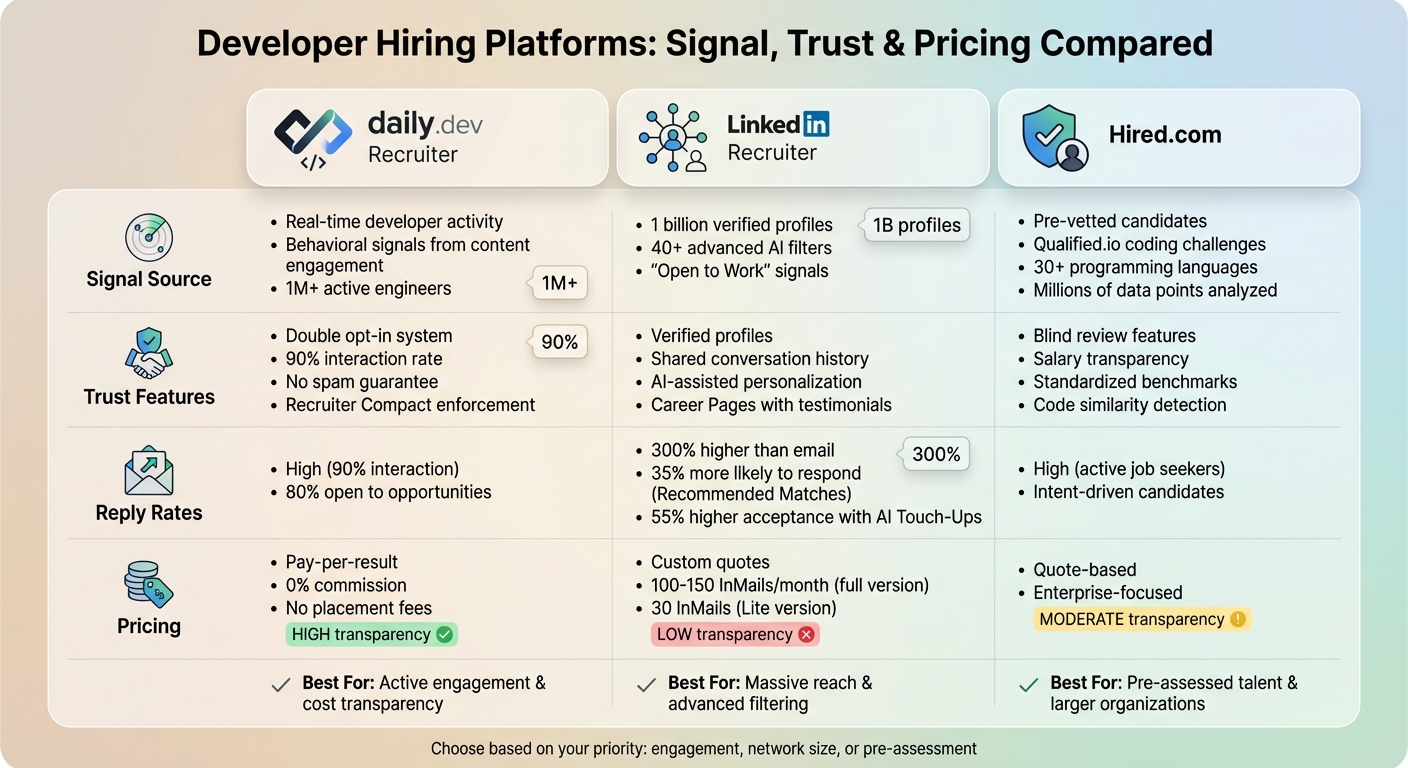 {Developer Hiring Platforms Comparison: daily.dev vs LinkedIn vs Hired.com}
1. daily.dev Recruiter
Signal Quality
daily.dev Recruiter steps away from traditional resumes by focusing on real-time behavioral signals. It tracks what developers are reading, the technical topics they engage with, and their participation in specialized groups called Squads. This dynamic approach ensures you're connecting with candidates who are actively involved in the relevant tech stack, setting the foundation for a recruitment process built on trust.
Job opportunities are seamlessly integrated into a developer's daily content feed instead of appearing as disruptive ads. This is key because daily.dev has become a daily ritual for over 1 million engineers across 13,000+ companies, serving as their browser homepage. This means you're reaching passive talent where they naturally spend their time, rather than competing on underused job boards.
Trust Mechanisms
daily.dev Recruiter operates on a double opt-in system. Developers must actively click "yes" to express interest in your role before you can reach out. This method tackles a common pain point: 43% of developers ignore recruiter messages because they feel spammy. To further enhance trust, the platform enforces a Recruiter Compact, promoting respectful and targeted outreach over generic, high-volume emails. CEO Nimrod Kramer explains it best:
"We built a place where engineers can turn off the noise. To enter this space, you don't need a hack. You need trust."
Reply Rates
Thanks to its trust-first approach, daily.dev Recruiter delivers strong reply rates. With 80% of developers on the platform open to new opportunities, the warm introduction model avoids the typical pitfalls of outreach - like the 19% of candidates who ignore messages lacking salary details - by allowing you to share key information upfront.
Take CloudMetrics, a San Francisco SaaS startup, as an example. In 2025, they used daily.dev Recruiter to assemble a global engineering team. By skipping traditional platform fees and utilizing daily.dev's 0% commission model, they saved $125,000. This allowed them to hire a senior US-based lead along with developers from Eastern Europe and Latin America, enabling them to launch their MVP within six months and maintain continuous development.
Pricing Transparency
daily.dev Recruiter emphasizes pricing clarity as part of its trust-building strategy. The platform boasts no placement fees. Unlike conventional recruiting platforms that charge per-seat licenses or take a percentage of salaries, daily.dev uses a straightforward pay-per-result or subscription-based model. For instance, PaySecure, a fintech company in London, saved between $8,370 and $211,500 in potential fees by paying developers directly through the platform instead of dealing with markups ranging from 5% to 100%.
2. LinkedIn Recruiter

Signal Quality
LinkedIn Recruiter connects you to a vast network of over 1 billion verified professionals . With AI-powered features like "Recommended Matches" and the "Hiring Assistant", it offers more than 40 advanced filters to refine searches by technical skills, job titles, and locations . These tools make it easier to target the right candidates with precision.
The platform also helps identify candidates genuinely interested in new opportunities by analyzing behavioral signals like "Open to Work" and "Interested in your company" . For instance, candidates suggested through "Recommended Matches" are 35% more likely to respond to InMails . In 2024, Siemens reported cutting their sourcing time in half by using LinkedIn's Hiring Assistant .
Trust Mechanisms
Even with AI integration, LinkedIn Recruiter keeps the process human-focused. A shared conversation history ensures that candidates aren’t contacted by multiple recruiters from the same company, avoiding redundancy . AI-assisted messaging tools, like "Touch-Ups", personalize outreach and improve InMail response rates by 55% compared to generic templates .
Companies can also create media-rich Career Pages to showcase their workplace culture and share employee testimonials, helping build trust with potential candidates from the start . This thoughtful approach to outreach encourages better engagement and responsiveness. Understanding what developers want is key to maintaining this engagement.
Reply Rates
Thanks to these trust-building efforts, InMails sent through LinkedIn Recruiter achieve a response rate that’s 300% higher than regular emails . Using features like "Spotlights" filters can further boost response rates by up to 20% . While AI helps streamline outreach, personalization remains a critical factor in fostering meaningful connections.
Pricing Transparency
LinkedIn Recruiter offers flexible pricing tailored to factors like seat count, company size, and specific hiring needs . The full version provides 100–150 InMails per month per seat, while Recruiter Lite is a scaled-down option ideal for individual recruiters or smaller hiring volumes, offering 30 InMails and access to 20+ filters .
3. Hired.com
Signal Quality
Hired.com, a part of LHH Recruitment Solutions, leverages data-driven insights to evaluate candidate quality. By analyzing millions of data points through its proprietary analytics, the platform transforms raw information into practical insights . It uses Qualified.io to test developers with coding challenges that mirror real-world scenarios. These challenges cover over 30 programming languages, including JavaScript, Python, Java, and Ruby, and feature automated scoring and code playback for streamlined reviews . The results create detailed profiles that highlight candidates' coding abilities, soft skills, and work styles . This thorough assessment process helps establish credibility with recruiters.
Trust Mechanisms
Hired.com prioritizes connecting talent with companies that align with their strategy and work environment . To promote fairness, the platform offers blind review features, removing identifying details from candidate profiles . It also uses standardized benchmarks to compare candidates against global software engineering metrics, giving recruiters objective performance insights . Additional best hiring tools for technical roles include code similarity detection and risk flagging to identify potential plagiarism, ensuring a fair and trustworthy evaluation process .
Pricing Transparency
Hired.com sets itself apart not only through candidate evaluation and bias reduction but also by offering clear pricing practices. Pricing is quote-based, requiring direct contact with their sales team . This structure is tailored to enterprise-level organizations with complex hiring needs, making it less suited for smaller teams seeking immediate hires. The platform also integrates seamlessly with leading Applicant Tracking Systems and provides automated workflows to advance candidates based on their assessment results .
Hiring engineers?
Connect with developers where they actually hang out. No cold outreach, just real conversations.
Advantages and Drawbacks
Every platform in tech recruiting brings its own set of strengths and challenges. Let’s take a closer look at how daily.dev Recruiter, LinkedIn Recruiter, and Hired.com stack up.
daily.dev Recruiter stands out with its real-time behavioral insights, capturing data from developers actively using the platform. This is paired with a warm, double opt-in model that achieves an impressive 90% interaction rate. On top of that, its pay-per-result pricing ensures there are no hidden costs.
Switching gears to LinkedIn Recruiter, it offers access to over 1 billion verified profiles and boasts 40+ advanced filters to fine-tune candidate searches. This precision can lead to reply rates up to 300% higher than traditional email outreach. However, LinkedIn’s pricing is less straightforward, often requiring sales consultations, which can be a hurdle for smaller teams.
Then there’s Hired.com, which focuses on delivering pre-vetted candidates with clear salary expectations. While this transparency is a plus, its quote-based pricing tends to be better suited for larger organizations rather than startups.
When comparing these platforms, it’s clear there are trade-offs in areas like signal quality, trust mechanisms, reply rates, and pricing transparency. For example, platforms that emphasize technical assessments, such as coding challenges, may provide strong insights into candidate skills but often lack data on engagement or reply rates. A case in point: in October 2025, Red Hat found that 63% of phase-one candidates were disqualified through developer assessment platforms . Similarly, in April 2025, Atlassian’s campus recruiting team successfully reduced plagiarism flags from 10% to 4% by incorporating AI-driven integrity features .
Here’s a quick comparison of the platforms:
| Platform | Signal Quality | Trust Mechanisms | Reply Rates | Pricing Transparency |
|---|---|---|---|---|
| daily.dev Recruiter | High (Real-time behavioral data) | Double opt-in; automated verification | High (90% interaction rate) | High (Pay-per-result) |
| LinkedIn Recruiter | High (40+ filters; AI matching) | Verified profiles (1B members) | 300% higher than email | Low (Custom quotes only) |
| Hired.com | High (Pre-vetted candidates) | Transparent salary/preferences; curated matching | High (Active job seekers) | Moderate (Quote-based) |
In today’s recruiting environment, features like robust integrity checks are critical to ensure candidates’ skills align with their assessments. However, challenges like opaque pricing models continue to complicate the decision-making process. Understanding these trade-offs is key to shaping an effective tech talent acquisition strategy.
Conclusion
When deciding on a recruitment platform, it’s all about the type of candidate signal you need and the level of trust you want to establish. daily.dev Recruiter stands out for its real-time engagement and straightforward pricing, making it great for connecting with developers actively engaging with the platform. If you're looking for broad access to a massive network of professionals, LinkedIn Recruiter offers advanced filtering and an extensive pool of profiles, though its pricing requires direct consultation. For fast-moving roles, especially in larger organizations, Hired.com shines with its pre-vetted candidates who come with clear salary expectations.
Each platform generates candidate signals differently. daily.dev Recruiter focuses on active engagement, LinkedIn relies on verified profiles, and Hired.com prioritizes candidates who are intent-driven and ready to move. Your choice depends on whether you're targeting active vs passive talent, scaling technical assessments, or quickly filling urgent roles.
Trust-building is another key factor. daily.dev Recruiter takes a developer-first approach, ensuring candidates feel respected and avoiding spammy tactics. LinkedIn leverages verified profiles for credibility, while Hired.com emphasizes transparency with salary expectations and curated matches. Platforms like CodeSignal and HackerRank add an extra layer of trust by validating technical skills. For instance, Asana scaled its recruitment efforts by 4x using CodeSignal , and Red Hat cut live technical interviews by 60% with HackerRank . Meanwhile, daily.dev Recruiter eliminates the need for cold outreach, connecting you directly with interested candidates.
FAQs
How does daily.dev Recruiter build trust with developers using its double opt-in system?
The double opt-in system used by daily.dev Recruiter is all about building trust and respecting developers' choices. Here's how it works: developers actively confirm their interest before their contact details are shared with recruiters. This ensures a transparent, consent-based process where developers remain in control. The result? Outreach feels less intrusive and more considerate.
This system also benefits recruiters by naturally filtering out less interested candidates. What’s left are individuals genuinely open to opportunities, providing recruiters with stronger, more promising leads. In a competitive tech hiring market like the U.S., these meaningful connections are invaluable. By prioritizing mutual agreement, the double opt-in system fosters respectful, productive interactions, paving the way for better engagement and smoother communication.
What are the key advantages of using real-time behavioral signals in tech recruitment?
Real-time behavioral signals give recruiters a window into a candidate's true skills, engagement, and fit for a role by analyzing their actions as they occur. Unlike static tools like resumes or traditional assessments, these signals capture dynamic behaviors - such as coding activity, software usage, or teamwork patterns - that paint a more accurate picture of technical abilities.
Using this data, recruiters can pinpoint top talent faster, move beyond surface-level qualifications, and reduce biases in hiring decisions. This method also brings transparency to the process, allowing for ongoing candidate evaluation and building trust through data-driven insights. In the end, real-time behavioral signals help align candidates with roles more effectively and make the hiring journey smoother for everyone involved.
Why might LinkedIn's pricing not work well for smaller recruitment teams?
LinkedIn's pricing tends to skew on the higher side, particularly for its premium and enterprise-level offerings. For smaller recruitment teams working with limited budgets, these costs can add up quickly, making it challenging to justify the expense.
On top of that, smaller teams often find themselves unable to make full use of the extensive features packed into these premium plans. This can lead to a situation where the investment feels less worthwhile compared to larger organizations that have greater hiring needs and can fully leverage the platform's capabilities.
.png)