Remote-first companies hiring in the UK and Australia face a tough challenge: finding skilled developers. With nearly half of UK software vacancies classified as skill-shortage roles and Australia projecting a 100,000-developer shortfall by 2024, competition is fierce. Salaries are increasing, and developers are fielding global offers, making recruitment more complex.
Here's the core takeaway: traditional methods like LinkedIn outreach are struggling, while behavioral sourcing strategies, such as analyzing GitHub activity or using platforms like daily.dev, are proving more effective.
Key insights:
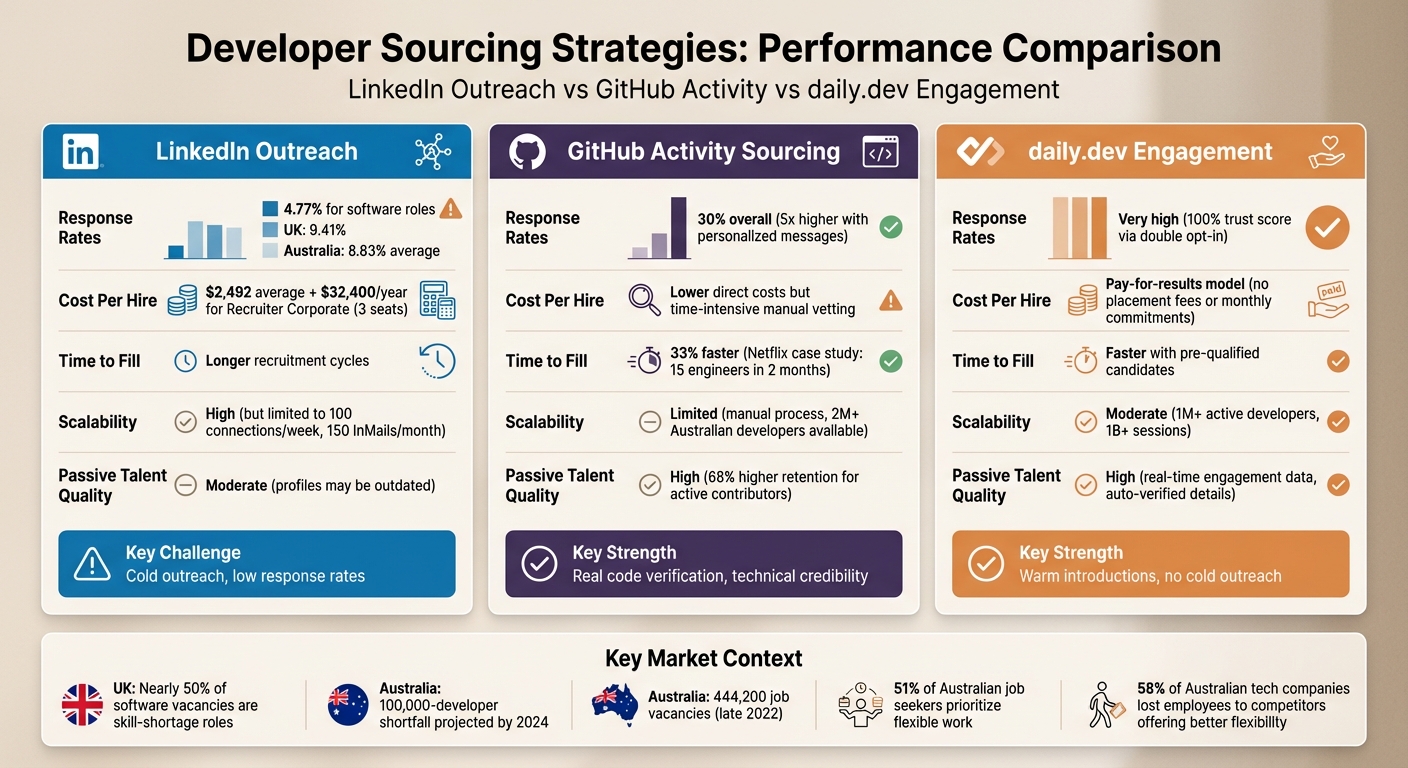
- LinkedIn Outreach: Low response rates (4.77% for software roles) and high costs per hire ($2,492 on average).
- GitHub Sourcing: Higher response rates (30%) and better skill verification through real code contributions.
- daily.dev Engagement: Double opt-in model ensures pre-qualified candidates and eliminates cold outreach inefficiencies.
Quick Comparison:
| Metric | LinkedIn Outreach | GitHub Activity Sourcing | daily.dev Engagement |
|---|---|---|---|
| Response Rates | Low | High with personalization | Very high |
| Cost Per Hire | High | Moderate | Pay-for-results model |
| Time to Fill | Longer | Faster with targeted roles | Faster with pre-qualified candidates |
| Scalability | High | Limited | Moderate |
| Passive Talent Quality | Moderate | High | High |
To stay competitive, companies should consider combining these methods for better results, leveraging GitHub and daily.dev for higher-quality hires while minimizing time to hire and costs.
1. LinkedIn Outreach
LinkedIn is often the go-to platform for technical recruiters, but its effectiveness in sourcing developers in regions like the UK and Australia comes with notable hurdles. In Northern Europe, which includes the UK, the average LinkedIn reply rate is 9.41%. Meanwhile, Australia and Oceania see a slightly lower average of 8.83% . For the software and SaaS industries, this drops even further to just 4.77% . These figures highlight the challenges of LinkedIn outreach in remote hiring, especially when compared to strategies focused on developers' actual engagement patterns.
Response Rates
Low response rates aren't just about the volume of messages sent - they're often tied to the quality of outreach. Generic, copy-pasted InMails frequently get ignored. Yuriy Boyko, Head of AM at Belkins, offers this advice:
If your primary goal is to expand your network, connection requests without a message perform just as well. However, if you aim to initiate conversations or generate leads, always include a short, relevant, and personalized message.
The data backs this up: personalized InMails under 400 characters result in 15% higher response rates compared to bulk messages and perform 22% better than longer ones . Warm introductions, such as those facilitated through "Messenger Campaigns", can further boost reply rates to 11.72%, thanks to the trust factor they bring . These insights underline the importance of thoughtful, targeted communication when reaching remote-first developers in the UK and Australia.
Cost Per Hire
The expense of LinkedIn outreach goes far beyond subscription fees. For example, LinkedIn Recruiter Corporate costs approximately $32,400 annually for three seats, with each seat capped at 150 InMails per month . On top of that, recruiters spend an average of 7.3 hours per week - or 380 hours annually - searching for candidates manually. This equates to about $12,614 in labor costs per recruiter . Altogether, LinkedIn recruitment costs average $2,492 per hire . For remote-first companies hiring in the UK and Australia, these costs can quickly add up, especially when 76% of recruiters cite attracting quality candidates as their biggest challenge for 2026 . These financial considerations make it essential to assess whether such investments are yielding the desired results.
Scalability
Scaling LinkedIn outreach has its own set of challenges. The platform limits connection requests to around 100 per week to curb spam . Overstepping this limit can lead to account flags, particularly if the acceptance rate falls below 20% or if candidates frequently report, "I don't know this person" . InMails, while offering direct access to inboxes, are also restricted - recruiters are capped at 150 InMails per month, which translates to reaching about 35 developers per week on average. While strategies like multi-account setups and automation tools can increase outreach volume, they come with risks. Over 70% of LinkedIn users report account restrictions due to excessive automation . These challenges are even more pronounced when recruiting across UK and Australian time zones and navigating compliance requirements. Such constraints often push recruiters to consider alternative, engagement-driven sourcing methods.
2. GitHub Activity Sourcing
GitHub activity sourcing focuses on actual technical contributions rather than self-reported skills. Instead of relying on polished LinkedIn profiles, recruiters can dive into real code repositories, commit histories, and pull requests to evaluate a candidate's expertise before initiating contact. This method is particularly effective for remote-first companies hiring in regions like the UK and Australia, where 83% of technical hiring managers trust GitHub profiles more than traditional resumes .
Response Rates
Outreach through GitHub delivers a 30% response rate, according to Codility's Technical Recruiter Ruslan Khalilov. He highlights that personalized messages referencing specific GitHub contributions can achieve 5x higher response rates compared to generic outreach . Dropping the typical recruiter jargon and instead focusing on a developer's real work - like mentioning a particular commit or repository - can make a huge difference. Interestingly, having hiring managers or senior engineers send the initial message often increases technical credibility and improves response rates .
Time to Fill
GitHub sourcing can cut down hiring timelines by allowing recruiters to assess technical skills upfront using public repositories. For example, Netflix leveraged targeted GitHub searches to hire 15 senior engineers in just two months, achieving a 33% faster time-to-hire and a 27% higher offer acceptance rate . Similarly, a Berlin-based fintech startup used GitHub metrics to build its engineering team within 8 weeks, maintaining a 90% retention rate after 18 months .
Quality of Passive Talent Hires
GitHub is an excellent tool for finding passive developer candidates - developers who aren’t actively job hunting but are still contributing to projects. Teams hiring active GitHub contributors (those with 3+ weekly commits) report 68% higher retention rates . Facebook discovered that developers with pull requests merged in 3 or more repositories before hiring received 40% better performance reviews compared to those without such activity . Additionally, commit messages and README files can provide a glimpse into a developer’s communication skills and ability to explain complex ideas. As Peter Hutterer points out:
Commit messages can show whether a developer is a good collaborator .
Moreover, developers with 10+ starred repositories are four times more likely to receive interview invitations than those with fewer stars .
Scalability
GitHub offers unparalleled reach for remote hiring, especially in markets like Australia. With over 2 million active developers on the platform, Australia saw a 21.6% increase in new GitHub accounts in 2025, adding 367,000 developers in just one year . These developers contributed to over 10.7 million open-source projects in 2025 . Globally, GitHub now hosts a community of more than 180 million developers . Recruiters can use advanced search filters like pushed:>YYYY-MM-DD and followers:50..500 to zero in on engaged and active talent . With 90% of Fortune 100 companies using GitHub for collaborative development , the platform remains a powerful resource for sourcing top-tier remote talent. Beyond GitHub, other platforms provide additional ways to connect with remote developers.
3. daily.dev Engagement Sourcing
daily.dev takes developer engagement to the next level by focusing on real-time behavior rather than outdated profiles. Instead of relying on cold outreach or keyword searches, the platform taps into a global network of over 1 million developers who use daily.dev daily to stay updated on tech trends. This strategy is built around what developers are actively reading, learning, and engaging with at the moment, offering a more dynamic and relevant approach to sourcing talent . At its core is a double opt-in model, where developers must express interest in a role before recruiters can connect. This ensures warm, meaningful introductions rather than cluttered inboxes filled with unsolicited messages .
Response Rates
The double opt-in approach guarantees a 100% trust score, as developers see opportunities only after they’ve opted in. This eliminates the typical issues of ghosting and low response rates that plague traditional cold outreach methods . Nimrod Kramer, CEO and Co-Founder of daily.dev, highlights the importance of trust in this process:
Trust is the only hack. Engineers already come to daily.dev to grow. They already trust the platform... When your role shows up inside that flow, it doesn't feel like outreach. It feels like an opportunity .
By connecting only with candidates who have actively shown interest, recruiters save time on manual screening and maintain their professional reputation . This trust-first system naturally leads to higher-quality interactions and better hiring outcomes.
Quality of Passive Talent Hires
daily.dev excels at connecting recruiters with passive vs active talent - developers who aren’t actively job hunting but are open to the right opportunity. The platform automatically verifies key details like timezone, location, tech stack, and seniority level before making introductions . Unlike resumes that may be outdated, daily.dev reflects what developers are currently learning and engaging with, offering a snapshot of their active skillset . Job briefs are tailored to emphasize technical challenges and growth opportunities, aligning with what developers value most. This approach creates a direct path to sourcing top-tier talent without unnecessary guesswork.
Scalability
With over 1 billion developer sessions logged from engineers across 13,000+ companies, daily.dev provides extensive reach for remote-first hiring . Its distributed team, which includes engineers in regions like the UK and Australia, demonstrates its effectiveness in highly competitive markets . For example, as of March 2026, the UK alone has over 9,000 active remote job openings, making high-impact platforms like daily.dev essential for cutting through the competition .
Unlike traditional seat-based licensing models, daily.dev uses a pay-for-results pricing model, meaning companies only pay when they successfully connect with qualified candidates. There are no placement fees or monthly commitments, making it a cost-efficient solution that scales seamlessly as hiring demands grow . This flexible structure ensures businesses can adapt their hiring strategies without incurring unnecessary overhead.
Strengths and Weaknesses
Each recruitment method comes with its own set of advantages and challenges. LinkedIn outreach offers access to an enormous professional network, making it ideal for large-scale sourcing. However, its broad reach often requires extensive profile screening, and cold outreach methods tend to yield lower response rates. On the other hand, GitHub activity sourcing provides a clear view of technical skills by showcasing actual coding contributions and collaboration patterns. The downside? It’s a manual process, which limits its scalability for larger hiring needs.
daily.dev engagement sourcing takes a different approach. Its double opt-in model ensures that every interaction is with a developer who has already shown interest. This reduces the likelihood of being ignored, which is common with cold outreach. Plus, its pay-for-results pricing means you only spend money when you successfully connect with qualified candidates.
Here’s a quick comparison of these methods:
| Metric | LinkedIn Outreach | GitHub Activity Sourcing | daily.dev Engagement |
|---|---|---|---|
| Response Rates | Lower due to cold outreach | Variable; improves with personalization | High, thanks to the double opt-in process |
| Cost Per Hire | High, with licensing fees and manual effort | Lower direct costs but time-intensive | Cost-effective with pay-for-results pricing |
| Time to Fill | Longer recruitment cycles | Faster for targeted roles | Quick, with pre-qualified candidates |
| Scalability | Highly scalable via a large database | Limited due to manual vetting | Moderately scalable with an engaged network |
| Quality of Passive Talent | Moderate; profiles may not reflect current skills | High, with real-time technical insights | High, based on active engagement data |
These comparisons highlight the trade-offs between scale and precision when recruiting remote-first developers. Your choice will depend on factors like hiring volume, budget, and whether you prioritize broad reach or stronger, trust-based connections. For remote-first companies, combining targeted engagement with platforms that build trust often delivers the most effective results.
Conclusion
Remote-first companies hiring developers in the UK and Australia face stiff competition, especially as 51% of Australian job seekers prioritize flexible working arrangements when considering opportunities . While traditional methods like social media and cold email outreach provide broad reach, sourcing talent through GitHub offers deeper technical insights. These strategies work, but there's room for a more targeted and engaging approach.
That's where behavioral sourcing through daily.dev Recruiter comes in. This platform connects you with developers who are already engaged and open to discussions. Its double opt-in model ensures you’re only interacting with candidates who have expressed interest. This is a game-changer in tight talent markets like Australia, where there were 444,200 job vacancies as of late 2022 . LinkedIn may work for reaching large numbers, and GitHub is ideal for niche technical roles. But if your goal is high response rates with passive talent who are pre-qualified, behavioral sourcing through daily.dev Recruiter is the most efficient option.
The Australian market highlights the urgency: 58% of Australian tech companies have lost employees to competitors offering better flexible work options . Remote-first work is no longer a perk - it’s an expectation. To succeed, you need to connect with developers where they’re already active and exploring opportunities.
Given the challenges discussed earlier, a hybrid strategy can balance both scale and quality. Starting with warm, pre-qualified connections through behavioral sourcing not only accelerates results but also reduces recruiter fatigue in the competitive UK and Australian markets.
FAQs
How do I start GitHub sourcing without wasting engineer time?
To make the most of GitHub when sourcing talent, take advantage of advanced search features like Boolean strings to pinpoint developers with the skills and contributions you're looking for. Spend time reviewing their profiles and repositories to evaluate the quality of their code and projects. When reaching out, craft personalized messages that reference their work - generic messages can come across as impersonal and may get ignored. This thoughtful and focused approach not only shows respect for engineers' time but also increases your chances of connecting with highly qualified candidates.
What should I reference in a GitHub message to boost replies?
To boost reply rates, focus on specific details from the recipient's GitHub activity. Bring up their projects, recent commits, or repositories to add a personal touch. By acknowledging their technical skills or contributions, you show that you've taken the time to research them, making your message feel more thoughtful and relevant.
How can daily.dev Recruiter fit into my UK/AU remote hiring funnel?
daily.dev Recruiter helps improve your remote hiring process in the UK and Australia by connecting you with passive developer talent through a community-focused approach. It identifies potential candidates based on behavioral signals, such as activity on GitHub and participation in developer communities. By using double opt-in introductions, it ensures a personalized and trust-based connection. Plus, it integrates smoothly with your ATS, allowing you to engage top-tier developers in competitive markets with data-backed strategies that align with their interests.
.png)