Recruiting tech talent is easier and faster when your ATS (Applicant Tracking System) integrates with developer networks. Here's why and how:
- Efficiency: No more manual data entry. Candidate profiles sync automatically.
- Accuracy: Real-time updates keep candidate information current, reducing errors.
- Engagement: Centralized data ensures consistent communication, avoiding duplicate outreach.
- Insights: Track hiring metrics like time-to-hire and conversion rates effortlessly.
- Security: Protect sensitive data with encrypted connections and compliance measures.
For example, tools like daily.dev Recruiter simplify integration with platforms like Greenhouse and Lever, syncing profiles of engaged developers directly into your ATS. This eliminates cold outreach and lets recruiters focus on meaningful connections.
Want better hiring results? Start by connecting your ATS with developer networks through API-based integrations, automated syncing, and secure protocols.
Benefits of Connecting ATS with Developer Networks
Linking your ATS with a developer network simplifies the way data flows between systems. Profiles can be exported with just one click, eliminating the need for tedious manual data entry. This integration ensures that candidate information is always up-to-date, as data from the developer network syncs directly with your ATS, keeping everything aligned and consistent.
But the advantages go beyond data management. Automating repetitive tasks frees recruiters to focus on what truly matters - engaging with top-tier talent. As Jon Gitlin, Content Strategist at Workato, explains:
By reducing time sucks that harm your recruiting processes, such as re-entering candidate data manually across your apps, your recruiters can focus more on the activities that allow them to recruit candidates successfully .
This shift not only improves response times but also creates a smoother, more professional experience for developers exploring opportunities with your company.
Real-time synchronization plays a key role in avoiding costly mistakes - like accidentally sending rejection emails to candidates who’ve already advanced in the hiring process. Features such as "In-ATS Indicators" let recruiters know when a developer is already in the system, cutting down on redundant outreach and ensuring a more organized approach.
Additionally, integrated systems provide instant access to hiring metrics that guide smarter decision-making. Having up-to-date data at your fingertips allows you to track critical metrics like time-to-hire, cost-per-hire, and candidate conversion rates. With an ATS that automatically pulls data from developer networks, you can pinpoint which sourcing strategies yield the best results and address potential biases in your pipeline before they escalate.
Simplified Candidate Sourcing
Integrating your ATS with a developer network transforms sourcing from a time-consuming chore into an efficient process. A candidate’s profile can be imported into your ATS with a single click, complete with real-time updates on their skills and projects. This ensures you’re always working with the most current information, enabling you to tailor your outreach to recent developments - like a new certification or contribution to an open-source project.
Take the example of Gem’s 2025 integration with SmartRecruiters. This connection allowed recruiters to seamlessly access existing candidate data and add new prospects to the ATS without duplication. It also ensured outreach efforts were based on the latest candidate status. Similarly, BreezyHR’s integration with HackerRank automated technical assessments by triggering test invitations and syncing results back into the ATS.
Better Candidate Engagement
Building trust with candidates starts by respecting their time and avoiding unnecessary outreach. When your systems are connected, you eliminate the "noise" caused by uncoordinated recruiting efforts. A centralized interaction history helps your team maintain consistent messaging and prevents multiple recruiters from contacting the same candidate.
Integrated systems also accelerate feedback loops, improving the candidate experience. When interview scorecards, technical assessments, and hiring manager notes sync automatically to your ATS, decisions are made faster. Developers value prompt responses, and an integrated system makes this possible.
As Ashley McCann, Content Contributor at Workable, points out:
ATS integrations take all of the benefits automation has to offer to the next level... resulting in a software solution that can promote better candidate engagement .
By automating routine tasks, recruiters can dedicate more time to building meaningful connections with candidates. Beyond engagement, having real-time data enables fair, informed hiring decisions.
Data-Driven Hiring Decisions
When your ATS is integrated with a developer network, you gain instant access to the most current candidate information. This ensures hiring decisions are based on accurate data, avoiding mismatched expectations or wasted interview time.
Automated data syncing also reduces errors in critical areas like salary offers, candidate statuses, or contact information - errors that can skew metrics like offer acceptance rates and time-to-hire. With seamless data flow between systems, your dashboards reflect reality, giving you confidence in your hiring insights.
This real-time data is invaluable for diversity and inclusion efforts. It allows you to monitor pipeline demographics in the moment, identifying and addressing biases before they affect outcomes. High-context profiles that include skills, interview feedback, and application history enable more strategic decision-making. For instance, when a candidate isn’t the right fit for one role but might excel in another, having a complete view of their background allows you to explore internal opportunities rather than losing them entirely.
Best Practices for ATS and Developer Network Integration
::: @figure 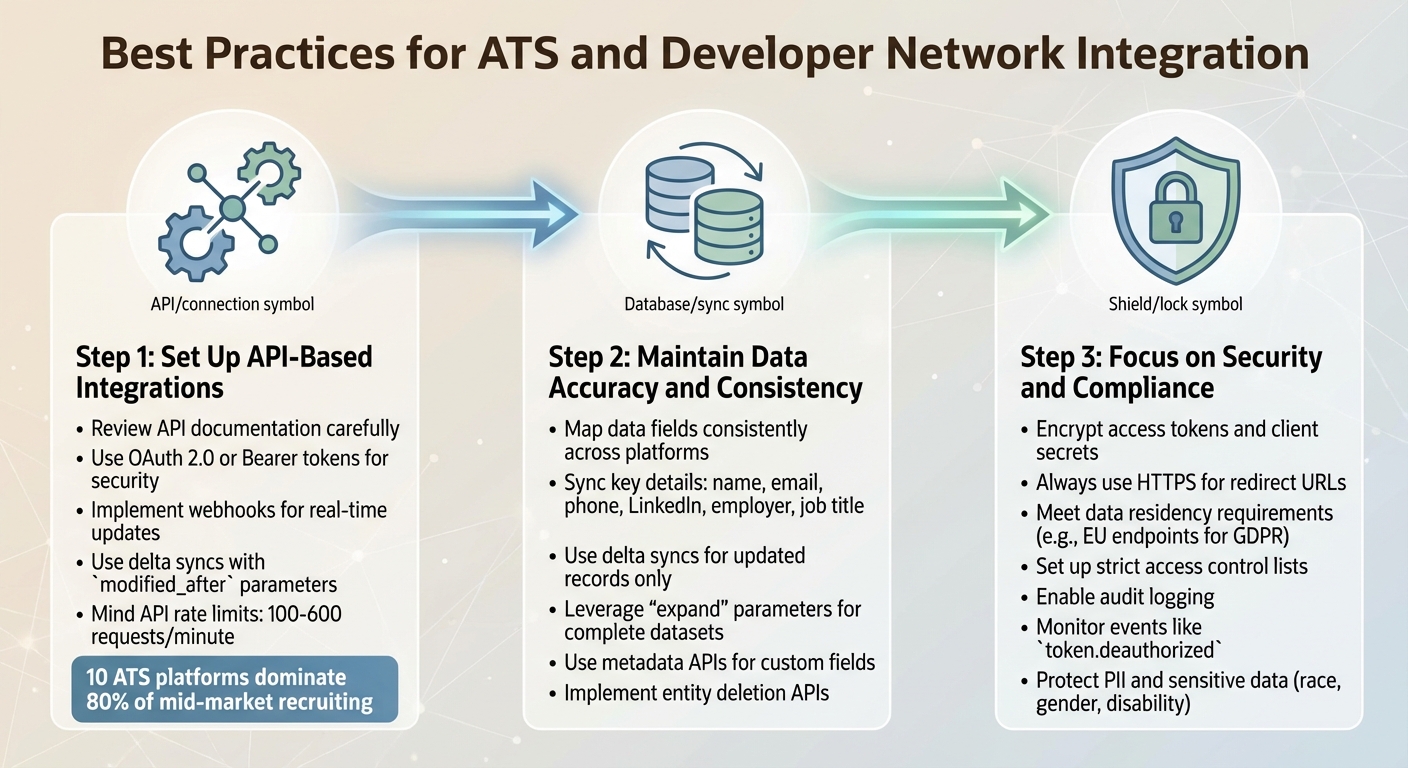 {Best Practices for ATS and Developer Network Integration: 3-Step Implementation Guide}
Integrating ATS platforms with developer networks ensures a secure and efficient flow of data, making recruitment processes smoother. Here’s how to achieve effective integration.
Set Up API-Based Integrations
Start by reviewing the API documentation carefully - terminology might differ across platforms (e.g., "prospects" versus "leads"). Use secure authentication methods like OAuth 2.0 or Bearer tokens to protect data during integration.
For real-time updates, implement webhooks to get instant notifications on status changes. For periodic data syncing, parameters like modified_after can help retrieve only updated records, saving time and resources.
A unified API can streamline integration across multiple ATS platforms, which is especially useful since about 10 ATS platforms dominate 80% of the mid-market and enterprise recruiting space . Keep API rate limits in mind (typically 100–600 requests per minute) and incorporate retry logic to handle these constraints effectively .
Maintain Data Accuracy and Consistency
Once the connection is established, focus on keeping your data accurate and consistent. Carefully map data fields across platforms to avoid discrepancies. Key candidate details - like name, email, phone number, LinkedIn profile, current employer, and job title - should be synced consistently to ensure recruiters have a complete view of each profile.
Use delta syncs to pull only recently updated records, reducing errors and speeding up the process. When working with related data, leverage "expand" parameters to fetch entire datasets - such as a candidate and all their applications - in one request, preserving relational integrity.
Metadata APIs are invaluable for capturing custom fields unique to each provider. Additionally, entity deletion APIs ensure that when a candidate is removed from one system, their record is deleted across all platforms. This prevents awkward situations, like contacting candidates who have already been rejected. Clean and reliable data enables recruiters to engage with candidates effectively and make informed decisions quickly.
Focus on Security and Compliance
Protecting candidate data is critical for both operational efficiency and maintaining trust. Store access tokens and client secrets securely with encryption, and always use HTTPS for redirect URLs during authentication to mitigate risks like Cross-Site Request Forgery.
For compliance, meet data residency requirements by using region-specific API tenants. For example, hiring in Europe may require EU-based API endpoints to keep data within GDPR-compliant boundaries. Additionally, set up strict access control lists to ensure only authorized personnel can view sensitive candidate details, notes, or application histories.
Enable audit logging to monitor access and changes to sensitive information. For example, listen for events like token.deauthorized to trigger automatic cleanup of data when an integration is disconnected. Treat personally identifiable information (PII) and sensitive data - such as race, gender, and disability status - with the highest level of confidentiality. Use specialized storage or access controls to safeguard this information. Some platforms even require manual credentialing before access is granted, ensuring that data requests are justified and legitimate.
Hiring engineers?
Connect with developers where they actually hang out. No cold outreach, just real conversations.
Using daily.dev Recruiter for Developer Network Integration
When you're ready to link a developer network with your ATS, daily.dev Recruiter simplifies the process by syncing engaged developer profiles directly into your hiring system. It builds on established integration practices to create a recruiting experience tailored to developers.
Warm, Double Opt-In Introductions
The double opt-in model transforms how candidate data enters your ATS. Instead of importing a bulk list of unverified contacts, you’re syncing profiles of developers who have already reviewed your job opportunity and shown genuine interest. This means every record you receive is from a pre-qualified candidate.
When a developer opts in, their profile - including details like technical skills, current interests, and professional background - automatically syncs with your ATS. All relevant fields are mapped correctly, allowing recruiters to skip cold outreach and dive straight into meaningful conversations. This approach not only reduces friction but also enhances the efficiency of your ATS workflow.
Access to Real-Time Developer Profiles
daily.dev Recruiter gives you access to active developer profiles, updated based on daily engagement data. When these profiles are synced with your ATS, you gain real-time insights into what technologies developers are working with, what they’re exploring, and their current professional focus.
This real-time data eliminates common recruiting headaches, like reaching out to candidates whose skills or availability have shifted. Instead, your ATS stays updated with the latest information, helping recruiters engage candidates more effectively and with greater confidence.
Direct Integration with ATS Platforms
The platform takes care of the technical challenges of ATS integration, so you don’t have to worry about building or maintaining custom connections. Using a unified API, daily.dev Recruiter integrates seamlessly with major ATS platforms like Greenhouse, Lever, and Workday - all through a single connection point. This eliminates the need for separate, time-consuming integrations, which can typically take over four weeks and cost around $10,000 per integration .
Candidate profiles, statuses, feedback, and notes flow effortlessly between daily.dev Recruiter and your ATS thanks to bi-directional synchronization. A webhook-based system ensures updates are reflected instantly across both platforms, ensuring data accuracy and efficiency.
Security is a key focus of this integration. The platform uses stateless, pass-through requests that interact directly with the source API, avoiding the need to store candidate data at rest. This design minimizes compliance risks and simplifies adherence to regulations like GDPR and SOC2. As Unified.to explains:
Unified.to never stores your customers' candidate data. All requests are stateless and pass through to the ATS platforms directly .
This architecture ensures sensitive developer data stays secure while still enabling the real-time data flow recruiters need to stay competitive.
Conclusion and Key Takeaways
Connecting your ATS with developer networks changes the game for recruitment. It eliminates the need for manual data entry, reduces errors, and makes the hiring process much smoother. By automating how candidates are synced, recruiters save valuable time - time better spent engaging with developers who are genuinely interested in the roles offered. This efficiency leads to quicker hiring cycles and fewer administrative headaches.
Here’s a key stat to consider: 78% of recruiters say automation and real-time data syncing reduce errors and speed up hiring . With fewer mistakes and a more accurate tracking system, you’re less likely to lose candidates in the shuffle.
On top of that, tools like daily.dev Recruiter take it a step further. By using a double opt-in model, they ensure that every synced profile belongs to a developer who has already shown interest. This means no more cold outreach - just warm, meaningful introductions.
Data security is also a top priority. With secure protocols like OAuth 2.0, sensitive information stays protected while enabling seamless, real-time syncing.
The takeaway? Focus on API-based integrations and automated syncing to keep your data accurate and your processes efficient. Choose tools that align with how developers actually engage with opportunities. By doing so, you’ll create a secure, well-connected recruiting system that not only attracts top developer talent but also keeps them engaged.
FAQs
How can integrating an ATS with developer networks enhance recruiting efficiency?
Integrating an ATS (Applicant Tracking System) with developer networks simplifies the hiring process by automating essential tasks. Things like updating candidate statuses, transferring applicant information, and generating hiring reports become seamless. This automation minimizes manual work, breaks down data silos, and speeds up workflows significantly.
With real-time, consistent recruiting data flowing through a unified system, recruiters can shift their attention from repetitive administrative duties to connecting with candidates on a deeper level. The result? A faster, more efficient hiring process that benefits both recruiters and developers alike.
What are the recommended security practices for integrating an ATS with a developer network?
When connecting an applicant tracking system (ATS) with a developer-focused network like daily.dev Recruiter, keeping candidate data secure should be your top priority. Start by confirming that your ATS provider meets your organization's security requirements and follows industry-standard API security practices. This means using strong, frequently rotated API keys or OAuth 2.0 tokens, applying role-based or least-privilege access controls, and syncing only the data fields necessary for your workflow. It's also critical to validate all incoming and outgoing requests to block malicious payloads and implement proper error-handling to avoid exposing sensitive system details.
Ensure that all data in transit is encrypted using TLS 1.2 or higher, and whenever possible, secure data at rest on both platforms. Limit the shared data to what’s absolutely essential - stick to identifiers and job-related details, steering clear of sensitive personal information unless it’s unavoidable. Regularly rotate credentials, keep logs of API activity, and maintain audit trails to track any unauthorized access. Adding rate limiting can help prevent abuse, and setting up alerts for unusual activity patterns ensures quick detection of potential security threats.
Take advantage of the security tools that modern ATS platforms offer. Features like encryption-at-rest, multi-factor authentication, and compliance with certifications such as SOC 2 or ISO 27001 provide an additional layer of protection. These measures work together to safeguard candidate information throughout the integration process.
Why is real-time data syncing crucial for recruitment success?
Real-time data syncing plays a crucial role in recruitment by ensuring that everyone involved - recruiters, hiring managers, and candidates - has access to the latest information. This eliminates delays, minimizes errors from manual updates, and enables teams to make quicker, more informed decisions. For instance, when an applicant's status or interview feedback is updated instantly, teams can respond promptly without worrying about outdated or conflicting details.
Platforms like daily.dev Recruiter take this a step further by enabling recruiters to view a developer's most recent activity, project updates, or expressed interest right as they reach out. This real-time insight allows for personalized, double-opt-in introductions that resonate with candidates, leading to stronger engagement and a better overall experience. Plus, automating data flow reduces repetitive tasks like updating records, freeing up recruiters to focus on building meaningful connections with top talent.
By seamlessly integrating tools, real-time syncing simplifies the entire hiring process. Assessment results can be instantly shared, interviews scheduled without hassle, and offers generated quickly - all without unnecessary delays. This streamlined approach eliminates friction, keeps information accurate, and helps teams hire faster and more efficiently.
.png)