Integrating your ATS with sourcing tools can save time, reduce errors, and improve hiring efficiency. Without integration, recruiters face repetitive manual tasks and scattered candidate data. By automating workflows, syncing candidate information, and consolidating data into a single source, you can:
- Save time: Automate tasks like data entry, resume parsing, and interview scheduling.
- Reduce costs: U.S. companies spend an average of $4,700 per hire - integration helps cut duplicate work and speeds up hiring.
- Enhance hiring efficiency: Companies report up to a 40% reduction in screening time with ATS integrations.
- Improve candidate experience: Automated updates and smoother communication keep candidates informed and engaged.
- Boost data accuracy: A single source of truth eliminates duplicate records and ensures consistent information.
To succeed, focus on system compatibility, data mapping, and strong security measures. Test integrations with pilot programs, automate key tasks, and monitor performance regularly. This ensures smoother recruitment and better outcomes for both recruiters and candidates.
::: @figure 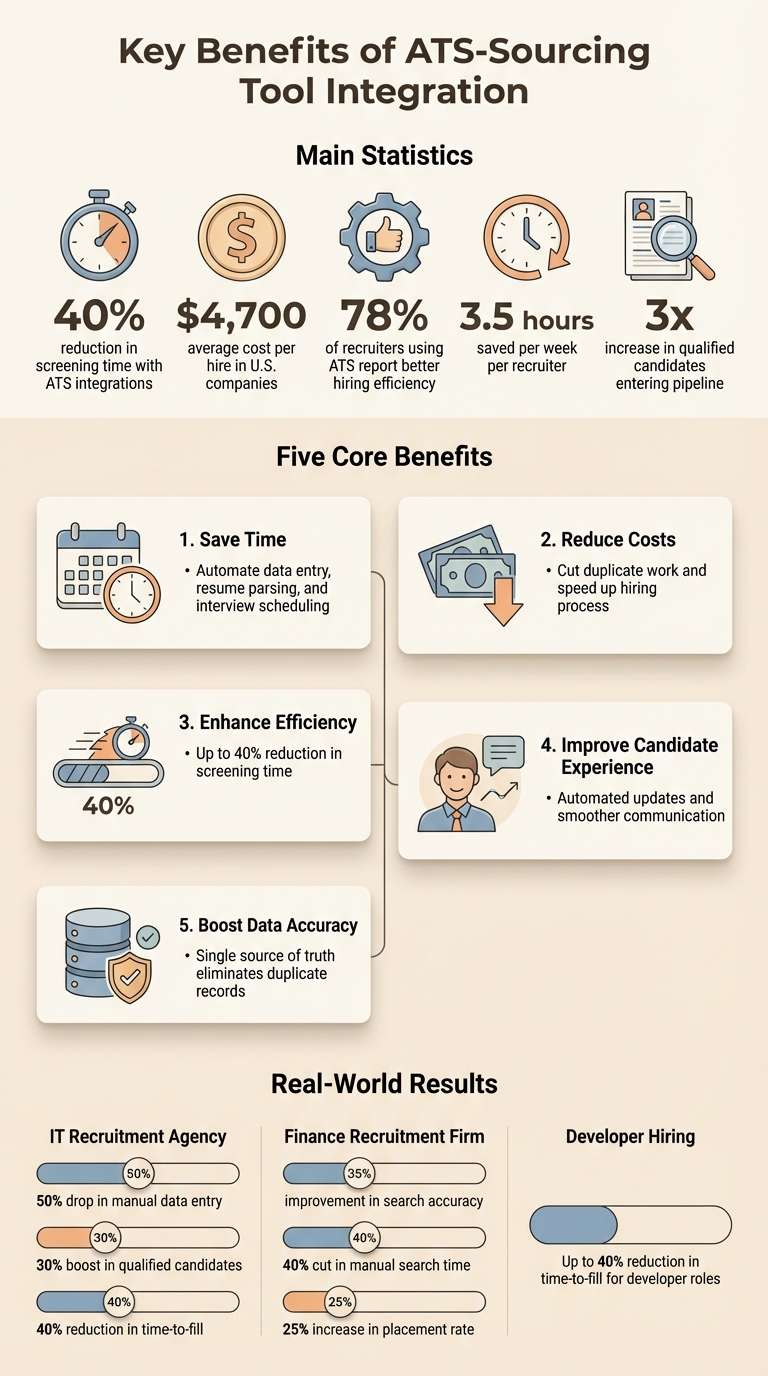 {Key Benefits and ROI of ATS-Sourcing Tool Integration for Recruiters}
Why Integrate Your ATS with Sourcing Tools
When your Applicant Tracking System (ATS) and sourcing tools work together, the recruitment process becomes seamless rather than scattered. Without integration, candidate data is often spread across different platforms, leading to inefficiencies and missed opportunities. Integration changes this by automating workflows and ensuring candidate information flows smoothly between systems. For instance, a mid-sized IT recruitment agency saw some impressive results after connecting their job board integration with their ATS: a 50% drop in manual data entry, a 30% boost in qualified candidates, and a 40% reduction in time-to-fill for IT roles .
But it’s not just about speed. Efficiency improves significantly when everything - candidate interactions, interview feedback, and engagement history - is stored in one easy-to-access database. In fact, 78% of recruiters using an ATS report better hiring efficiency . Nikita Saini from Xobin sums it up well:
"ATS integration connects your Applicant Tracking System with HR tools... to eliminate manual work, sync candidate data, and create seamless hiring workflows."
Candidates also benefit. Integration leads to quicker responses and clearer communication. For example, a finance recruitment firm achieved a 35% improvement in candidate search accuracy, cut manual search time by 40%, and increased their placement rate by 25% after integrating Boolean search and sourcing tools .
The financial benefits are just as compelling. With U.S. companies spending around $4,700 per hire , cutting down on duplicate work and speeding up decision-making directly impacts the bottom line. Integration doesn’t just make hiring faster - it makes it smarter, more consistent, and more personalized. These improvements set the stage for exploring specific automation benefits.
Automated Workflows
Integrating your ATS with sourcing tools eliminates repetitive, time-consuming tasks. For example, when a candidate applies through LinkedIn or another platform, their profile, resume, and contact details can automatically transfer into your ATS. This prevents errors like misspelled names or incorrect salary details .
Modern integrations go beyond basic data transfer. They can handle tasks like distributing job postings across multiple boards, parsing resumes to extract key details into structured fields, and even triggering calendar invites or background checks when candidates reach the interview stage. Companies using ATS integrations with assessment tools report cutting candidate screening time by nearly 40% .
By automating these tasks, recruiters can focus on what really matters - building relationships and engaging with candidates - while the system handles updates and logs interactions in real time.
Single Source of Candidate Data
When your ATS and sourcing tools don’t communicate, you risk creating duplicate candidate records or dealing with inconsistent information. Integration solves this by making your ATS the central hub for all candidate data. Resume parsing helps extract structured details like skills, work history, and education into standardized fields, making it easier to compare applicants . Tools like LinkedIn Recruiter ensure candidate profiles stay updated with their latest professional information .
Having a single, updated source of truth simplifies decision-making and provides measurable integration metrics. It also ensures that recruiters and hiring managers access the same real-time data, from interview feedback to engagement history, reducing communication gaps. As Metaview puts it:
"Your ATS is only as powerful as the tools it connects with."
Better Candidate Experience
Integration significantly improves the candidate experience throughout the hiring process. Automated tracking keeps applicants informed with timely updates like "Application Received", "Under Review", or "Interview Scheduled" via email or SMS . This transparency helps reduce the frustration job seekers often feel.
Every interaction - whether it’s applying via LinkedIn, completing an assessment, or attending a video interview - gets consolidated within the ATS, creating a smooth and professional journey . Features like LinkedIn's "Apply Connect" allow candidates to submit applications without leaving the platform and stay updated on their status .
Automation also prevents common errors, such as sending rejection emails to candidates still under consideration or asking them to re-enter information they've already provided . Workato highlights the impact:
"As your team reviews candidates faster and gives them feedback sooner, you're more likely to deliver experiences that delight candidates - or at the very least, frustrate them less."
| Integration Feature | Impact on Candidate Experience |
|---|---|
| Automated Status Updates | Keeps candidates informed in real time, reducing anxiety |
| Resume Parsing | Saves applicants from re-entering data already in their resumes |
| Assessment Integration | Ensures a smooth transition from application to testing |
| Interview Scheduling | Lets candidates book slots directly, avoiding back-and-forth emails |
These benefits not only streamline the hiring process but also set the stage for practical steps to achieve successful integration, which are covered in the next sections.
Steps for Successful Integration
Successfully integrating an ATS with sourcing tools takes careful planning and technical setup. This involves ensuring API compatibility, aligning data structures, and implementing strong data security measures throughout the workflow.
Check System Compatibility
First, confirm that your ATS supports modern REST APIs and secure authentication methods like OAuth 2.0 or Bearer tokens .
Pay attention to API rate limits, which define the number of requests your systems can handle per minute. For example, LinkedIn’s Recruiter System Connect allows up to 10,000 records per minute and 100,000 requests per day .
Ensure your ATS and sourcing tools share standardized data objects like Candidates, Applications, Jobs, Interviews, and Scorecards . A real-world example: When Oracle Fusion Cloud Recruiting integrated with LinkedIn in 2025, users had to create specific LinkedIn client_ids for each environment (staging, test, and production) to avoid data corruption. Additionally, the integration included a scheduled "Synchronize LinkedIn Data" process that ran hourly to keep data accurate .
Decide whether you need real-time updates using webhooks or periodic polling, as full synchronization can take anywhere from six hours to several days .
Once compatibility is confirmed, the next step is to align your data structures.
Map and Standardize Data Fields
After confirming system compatibility, align the data fields between your ATS and sourcing tools. Start with mandatory fields like firstName, lastName, and emailAddresses, which are essential for candidate matching .
Map differences in terminology between systems. For instance, "Jobs" on one platform might be called "Opportunities" on another. Similarly, distinguish between terms like "Requisitions" (job templates), "Jobs" (specific openings), and "Postings" (public listings), as these definitions can vary significantly across platforms .
"Requiring your recruiters or clients to copy and paste information to and from an ATS manually can introduce a host of costly errors... such as marking a candidate as rejected when they're actually still in process." - Shensi Ding, CEO and Co-founder, Merge
Use consistent date formats, such as UTC Epoch Milliseconds, for all timestamped data to avoid synchronization issues . Map candidate sources to a predefined list (e.g., LINKEDIN, REFERRAL, AGENCY, CAREER_SITE) for cleaner analytics . To improve efficiency and stay within API rate limits, submit data in batches of no more than 100 records per call .
With your data standardized, the next priority is securing your integration endpoints.
Protect Data Privacy and Security
Once your data is aligned, focus on safeguarding it with strong privacy measures. Use OAuth 2.0 or token-based authentication to control access to sensitive candidate data . Store API keys and secrets securely in a Key Management Service (KMS) or AWS Secrets Manager, rather than embedding them directly in your application .
Ensure Access Control Lists (ACLs) are properly configured so that sensitive data is only visible to authorized users. Update these permissions immediately when users are added or removed from security groups . Use regional API endpoints (e.g., EU or APAC tenants) to comply with local data protection laws and keep candidate information within specific geographical boundaries . Look for integrations that meet compliance standards like SOC 2 Type II, GDPR, and CCPA to ensure data protection .
"Integrations are arguably the most important aspect of any tech stack, particularly when it comes to a seamless user experience and the protection of employee and candidate data." - Greenhouse
To handle "right to be forgotten" requests, integrate entity deletion APIs. This ensures that when a candidate is removed from one system, their data is automatically deleted across all connected platforms . Finally, restrict API access to trusted IP addresses to block unauthorized external requests .
Implementation Best Practices
Once you've ensured system compatibility and completed data mapping, the next step is integration testing. This phase connects your setup efforts to practical recruitment outcomes. To make integration successful, focus on thorough testing, strategic automation, and consistent monitoring to maintain seamless operations.
Run a Pilot Test First
Before launching your integration across the entire organization, start with a smaller-scale pilot. Test the connection within a single department or hiring project to confirm that candidate data, assessments, and reporting sync properly. This method helps identify issues like mismatched fields or authentication errors early on.
"Think of it as building a central nervous system for recruitment. Just like neurons transmit signals across the human body, applicant tracking system integration ensures that candidate information... [is] instantly available across platforms." - Nikita Saini, Author, Xobin
During the pilot, prioritize areas with the most manual updates or duplicate entries. Once the pilot confirms that the core functionality works as intended, you can confidently expand automation to cover more recruitment tasks.
Automate Core Recruitment Tasks
After the pilot proves successful, it's time to automate the tasks that take up the most time for recruiters. Start with AI-powered resume parsing to extract structured data, eliminating the need for manual entry and reducing errors.
Set up automated status updates that trigger changes in candidate stages (like moving from "Under Review" to "Interview Scheduled") and send real-time notifications via email or SMS. Integrating ATS systems with assessment tools can significantly speed up candidate screening, which in turn reduces hiring costs. For context, U.S. companies spend an average of $4,700 per new hire.
Automation can also streamline job postings, contact information syncing, and interview feedback collection, leading to immediate time and cost savings. For high-volume positions, automated screening tools are effective, while executive roles might need more tailored processes. Additionally, connecting your ATS to HR and payroll systems (like Workday or BambooHR) can automate new hire data transfers and trigger digital onboarding workflows.
"Requiring your recruiters or clients to copy and paste information to and from an ATS manually can introduce a host of costly errors." - Shensi Ding, CEO and Co-founder, Merge
To avoid hitting rate limits, use batch calls of up to 100 records at a time. Platforms like LinkedIn's Middleware, for instance, have daily throttle limits of 100,000 requests and 10,000 records per minute.
Once automation is in place, keep a close eye on performance to ensure the system remains efficient and reliable.
Track Integration Performance
Monitoring your integration isn’t a one-and-done task - it requires ongoing attention. Schedule monthly or quarterly data reviews to ensure teams maintain good data practices. Use dashboards with searchable logs and automatic issue detection to quickly spot and resolve errors.
Keep an eye on both technical and recruitment performance metrics. On the technical side, track API rate limits, sync frequency, and system latency. For recruitment, focus on metrics like time-to-hire, source-to-close speed, and the number of qualified candidates per opening. Also, check how frequently data is fetched - daily or in real time - to ensure it aligns with your team's workflow needs.
| Recruiting KPI | Purpose in Integration Tracking |
|---|---|
| Qualified candidates per opening | Checks if sourcing integrations deliver quality talent |
| Source-to-close | Measures how quickly candidates move through the funnel |
| Candidate survey results | Assesses if the experience is professional and smooth |
| Offer acceptance rate | Evaluates the effectiveness of the final recruitment stages |
Regular audits of parsed data outputs can help identify misclassified information or errors that might compromise your ATS database. To protect sensitive candidate data, implement role-based access controls (RBAC) and encryption, ensuring compliance with GDPR and EEOC standards during data transfer.
Common Integration Challenges and How to Fix Them
Integration issues can throw a wrench into recruitment workflows. Even with a solid system setup, challenges like data mapping errors, API rate limits, and compliance tracking can still crop up. These issues often tie back to the data standardization and security principles we touched on earlier.
Resolve Data Mapping Errors
Data mapping errors happen when different systems use mismatched terms or formats. For instance, one ATS might label an open position as a "Requisition", while another system calls it a "Job Opening." Similarly, terms like "Prospects", "Leads", and "Candidates" can create confusion if they aren’t aligned across platforms.
Some ATS platforms only accept specific values for fields like "Source Category" (e.g., LINKEDIN, REFERRAL, AGENCY). If you use non-standard values, errors are inevitable. To avoid this, pre-map custom fields, validate them against your ATS’s accepted values, and enforce unique identifiers to prevent duplicate or overwritten records. A unified API layer can help standardize data models, ensuring consistency across platforms. Additionally, when updating records, include all fields if the API uses "replace" logic instead of "patch" logic. For example, APIs like LinkedIn's Middleware will set omitted fields to null during updates.
Managing API Rate Limits and Downtime
Once data mapping is under control, the next hurdle is managing API limitations. API rate limits vary depending on the provider and subscription plan. For example, Merge’s Unified API allows 100 requests per minute at the Launch tier, 400 for Professional, and 600 for Enterprise, all measured per linked account. LinkedIn’s Middleware Platform caps usage at 100,000 requests per day and 10,000 records per minute.
To stay within these limits, batch processing is key. Sync no more than 100 records at a time in sequential order. Use delta syncing with modified_after to reduce the number of API calls needed. Take advantage of field expansion to fetch complete objects in a single request.
For asynchronous tasks like profile matching, implement retry logic with a 60-second wait to handle null returns. Monitor the rate limit headers returned by the API and adjust request frequency dynamically to avoid hitting the dreaded 429 (Too Many Requests) error. Whether you need real-time updates or periodic syncs, choose a frequency that balances your business needs with your rate limits.
Tracking Compliance and Consent
When handling candidate data, compliance with regulations like GDPR and CCPA is a must. Under GDPR, you need a legal basis for processing data from EU residents, and consent must be clear, specific, and revocable. Non-compliance can lead to fines of up to 4% of global annual revenue or €20 million, whichever is higher. For CCPA, penalties range from $2,500 per unintentional violation to $7,500 for intentional ones.
Automate consent tracking by adding specific flags to your data schema, such as a doNotContact boolean, to honor candidate preferences across integrated systems. When a candidate requests to be forgotten, trigger API deletion commands across all connected systems. Use encryption and strict access controls to meet GDPR standards. Implement region-specific data retention policies to automatically purge or anonymize data as required. If your platform supports it, use regional API endpoints to ensure data stays compliant with local regulations.
Sensitive demographic data, like race, gender, or disability status, should be stored in separate objects with restricted access. Role-based access controls can ensure only authorized recruiters can view this information. Regular audits and automated compliance checks will help maintain a strong integration framework.
Hiring engineers?
Connect with developers where they actually hang out. No cold outreach, just real conversations.
How to Integrate daily.dev Recruiter with Your ATS
Setup and Configuration Steps
Connecting daily.dev Recruiter to your ATS is straightforward. For platforms like Greenhouse, Lever, or Ashby, you can use one-click OAuth. If you're using systems such as Workday, BambooHR, or Workable, integration happens through a partner network that supports over 30 ATS platforms.
Once connected, your ATS job openings will automatically sync with daily.dev Recruiter, keeping your sourcing pipeline up to date. When a developer accepts your request and a match is confirmed, their profile, resume, and contact details are seamlessly transferred to your ATS - no manual data entry required. The system also includes auto-deduplication to avoid duplicate candidate entries and conserve outreach credits. You can track the sync process through the "Export Queue" in daily.dev Recruiter. Additionally, the platform automatically manages candidate opt-in status and consent logs, ensuring compliance with GDPR and CCPA regulations.
This efficient setup ensures your hiring process is smooth and ready for action.
Advantages for Developer Hiring
With this integration, you can bring warm, double opt-in candidates directly into your ATS. These candidates have already shown interest in your opportunities, which can result in better response rates. Developer-specific details - like GitHub profiles, tech stacks, and portfolio links - are transferred into your ATS, giving you the technical context needed for evaluations. Source tracking tags candidates with daily.dev, making it easy to measure how effective this sourcing channel is. Together, these features streamline your recruitment process and help you engage with developers more effectively.
How to Measure Integration Success
Once your ATS and sourcing tools are integrated, it's time to evaluate their impact. Focus on metrics that reflect faster hiring processes, better candidate engagement, and cleaner data. These measurements will help confirm the efficiency gains and enhanced candidate experience discussed earlier.
Faster Time-to-Hire
One key metric to monitor is "Source-to-Close", which tracks the median number of days from a candidate's entry into the system to their hire. ATS integrations have been shown to reduce screening time by nearly 40% .
"By eliminating (or minimizing) time sucks that harm your recruiting processes, such as re-entering candidate data manually across your apps, your recruiters can focus more on the activities that allow them to recruit candidates successfully."
– Jon Gitlin, Content Strategist, Workato
Break down the hiring process further by measuring time spent in specific stages like screening, assessments, and interviews. This can help identify any automation bottlenecks. Keep in mind that updated metrics in integrated reporting systems may take up to 72 hours to reflect candidate actions . Alongside faster hiring, improved candidate engagement serves as another indicator of successful integration.
Higher Candidate Engagement
Candidate engagement can be measured through the Offer Acceptance Rate . A seamless ATS integration minimizes delays and ensures clear communication, which often leads to higher acceptance rates.
You can also use candidate surveys to collect feedback on their interview experiences . Comparing your funnel conversion rates to industry benchmarks can help pinpoint where engagement drops off . Many ATS platforms provide historical data - sometimes up to two years - allowing you to track long-term trends in how candidates move through the hiring process .
Cleaner Candidate Data
Data quality is another critical area to evaluate. Measure Source Data Quality by calculating the percentage of applications tagged with a standardized source instead of "null" or "other" . A properly integrated system should automatically tag candidates with their source, reducing errors from manual data entry.
Another metric to track is Source Quality, which looks at the percentage of candidates from each source who progress to the interview stage . This not only reflects data accuracy but also shows how effective your sourcing channels are at delivering qualified candidates. Regular data audits - conducted monthly or quarterly - can help maintain high data quality and ensure your system stays reliable .
Conclusion
Bringing your ATS and sourcing tools together transforms recruiting into a seamless, data-driven process. This integration can save recruiters up to 3.5 hours per week, reduce screening time by nearly 40%, and triple the number of qualified candidates entering the pipeline .
To achieve these results, it’s essential to approach integration strategically. Start by mapping out how data flows between systems and automating repetitive tasks like resume parsing, interview scheduling, and job board postings. Opt for platforms with open APIs (such as REST or JSON) to ensure scalability, and always run a pilot program before committing to a full rollout .
"Your ATS is only as powerful as the tools it connects with. Integrations turn your applicant tracking system into a dynamic command center for all recruiting activity." – Metaview
Integration becomes even more critical when it comes to technical hiring. For example, platforms like daily.dev Recruiter can cut the time-to-fill for developer roles by up to 40% . These tools connect you with passive, pre-qualified developers in spaces where they’re already active. By automatically consolidating developer-specific data - like GitHub profiles, assessment scores, and tech stacks - into a single candidate record, you eliminate manual data entry and dramatically improve matching accuracy.
FAQs
What are the best practices for integrating my ATS with sourcing tools?
To connect your ATS with sourcing tools effectively, aim for a smooth, data-focused integration. Begin by confirming that both systems support a well-documented API, such as REST or GraphQL. Then, align critical fields - like candidate information, job titles, and statuses - using a consistent schema. Stick to standardized data formats, like ISO 8601 for dates and U.S. number formatting, to minimize errors and prevent duplicate entries.
Set up real-time sync methods like webhooks or polling to ensure updates between your ATS and sourcing tools are instant and accurate. Regularly check for data inconsistencies, monitor for any errors, and establish clear protocols for managing API or schema changes. This keeps both systems in sync as your hiring processes grow and change.
Involve both recruiters and engineers throughout the integration process. Assign clear responsibilities for field mapping, agree on update timelines (e.g., updates within 5 minutes), and document backup procedures for potential issues. With these steps in place, your ATS and tools like daily.dev Recruiter will integrate seamlessly, creating a reliable and efficient recruitment workflow.
What are the best steps to automate recruitment tasks using ATS and sourcing tools?
To make recruitment tasks more efficient through automation, begin by pinpointing repetitive activities that can be streamlined. Common examples include resume parsing, candidate profile creation, interview scheduling, and status updates. Once identified, choose tools and an applicant tracking system (ATS) that offer strong integration capabilities, ensuring they support secure API connections for smooth data sharing.
After selecting your tools, map out the data fields - such as resumes, job IDs, and candidate statuses - between systems. Set up automated workflows to handle tasks like converting resumes into profiles or syncing status updates in real time. It’s essential to test these integrations thoroughly, keep an eye out for errors, and fine-tune the process to minimize manual intervention. Once the foundational tasks are running smoothly, you can enhance the system by connecting additional tools, like payroll software or communication platforms, to build a fully integrated hiring ecosystem.
By automating these steps, recruiters can save valuable time, minimize errors, and ensure consistent data across platforms - making the hiring process more efficient and seamless.
What’s the best way to track the success of integrating an ATS with sourcing tools?
To gauge how well your ATS and sourcing tool integration is working, it’s essential to define clear KPIs upfront. Focus on metrics like time-to-fill, cost-per-hire, source-of-hire conversion rates, and candidate quality. Before diving into the integration, establish a baseline for these metrics so you can track changes and improvements over time.
Keep a close eye on these numbers and calculate the ROI by looking at tangible benefits, such as shorter hiring timelines or better candidate matches. Make it a habit to review and tweak your processes regularly to ensure the integration is delivering noticeable improvements in your recruiting efforts.
.png)