Screening developer candidates effectively is critical for hiring success. A structured process ensures faster hiring, better candidate quality, and higher engagement. With only 21 applicants per software engineering role on average and a poor hire costing around $30,000, companies must refine their approach. Here's what works:
- Set Clear Criteria: Define "Must-Have" vs. "Nice-to-Have" skills to avoid wasting time on unqualified candidates. Collaborate with engineering managers for role-specific benchmarks.
- Assess Technical Skills: Prioritize programming languages, frameworks, debugging, and system design. Include practical skills like API development and familiarity with tools like Docker or AWS.
- Evaluate Soft Skills: Test communication, problem-solving, and teamwork through behavioral questions and pair programming.
- Use Modern Tools: Implement developer assessment tools, AI-powered evaluations, and tools like daily.dev Recruiter for pre-qualified candidates.
- Ensure Consistency: Standardized rubrics and benchmarks help eliminate bias and objectively compare candidates.
::: @figure 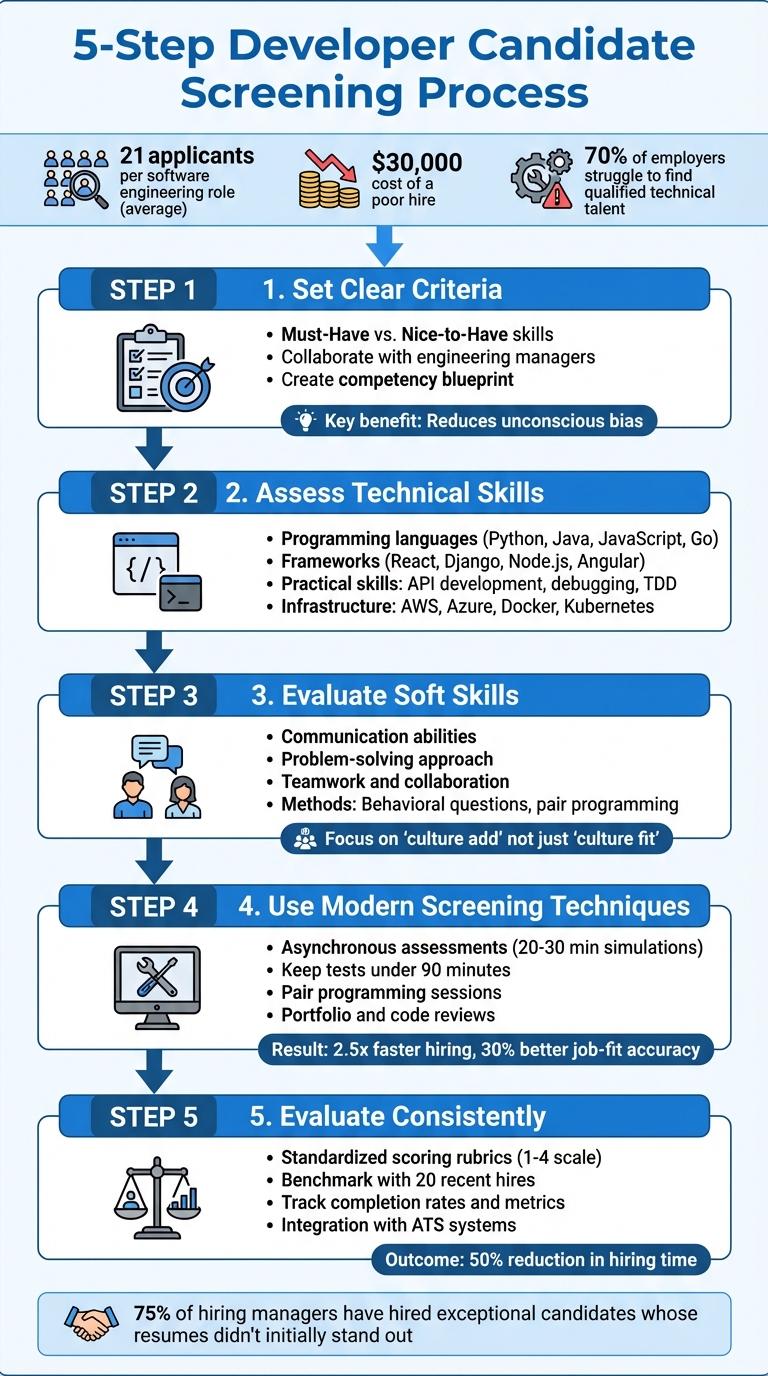 {5-Step Developer Candidate Screening Process with Best Practices}
Set Clear Screening Criteria
Before diving into candidate screening, establish clear and consistent criteria. Around 70% of employers report challenges in finding qualified technical talent , often due to vague or inconsistent hiring benchmarks. Without a solid framework, you risk wasting valuable engineering time on candidates who don’t meet the role’s needs.
Collaborate with engineering managers to create a detailed competency blueprint for the role. Clearly distinguish between "Must-Have" and "Nice-to-Have" skills. For instance, a backend developer role might require expertise in Go and PostgreSQL as non-negotiable skills, while familiarity with Python or GraphQL could be considered beneficial but not critical .
Standardizing your criteria not only streamlines the process but also helps reduce unconscious bias. By evaluating candidates against measurable benchmarks instead of subjective impressions, you can uncover talent that might otherwise be overlooked. Once the criteria are set, focus on identifying the technical skills that are essential for day-to-day success.
Technical Skills and Experience
When screening candidates, prioritize the skills that directly impact the role’s responsibilities. Look for proficiency in key programming languages like Python, Java, JavaScript, or Go, as well as frameworks such as React, Django, Node.js, or Angular. Foundational knowledge in algorithms, data structures, and system design is critical for most technical roles.
Beyond coding, practical engineering skills should also be assessed. These include debugging, modular code structuring, test-driven development (TDD), and API development (e.g., RESTful or GraphQL). Additionally, experience with infrastructure tools - such as database management (SQL/PostgreSQL or NoSQL), cloud platforms (AWS, Azure), and CI/CD pipelines - is increasingly important. Familiarity with project management methodologies like Agile, Scrum, or Kanban, as well as tools like Docker and Kubernetes for containerization, can also set candidates apart. Tailor your technical evaluations to align with your team’s specific tech stack and workflow.
Soft Skills and Cultural Fit
Technical expertise is just one piece of the puzzle. Developers also need strong communication skills, creative problem-solving abilities, and the flexibility to adapt to evolving technologies. To assess these qualities, incorporate behavioral interview questions and scenario-based exercises. For example, ask candidates to describe how they’ve resolved team conflicts or explained a complex technical decision to non-technical stakeholders. Pair programming sessions can also provide valuable insights into how candidates collaborate and respond to feedback in real-time.
Zappos offers a fascinating example of how cultural alignment can be a priority. They separate technical assessments from cultural evaluations, ensuring both are given equal weight. New hires undergo a four-week immersion in the company’s philosophy and are then offered $2,000 to quit if they feel the culture isn’t a fit. This approach has helped Zappos maintain a turnover rate of 18–20% for call center roles, far below the industry average of 30–45% .
Isabelle Fahey, Head of Growth at Cloud Devs, emphasizes the importance of a well-rounded assessment:
"A well-designed developer skills assessment is more than just a test; it's a preview of the collaborative and problem-solving environment a candidate can expect if they join your team" .
When hiring, aim for "culture add" rather than just "culture fit." While alignment with core values is key, bringing in diverse perspectives strengthens the team and prevents stagnation . Focus on shared work ethic and essential values, rather than relying solely on subjective personality traits.
Screening Techniques That Work
Once you've established clear screening criteria, the next step is choosing methods that effectively assess technical skills and collaboration without coding tests. Modern screening approaches now lean toward practical, job-focused evaluations rather than outdated whiteboard exercises.
Asynchronous Technical Assessments
Asynchronous assessments allow candidates to tackle tasks at their convenience, giving you a clearer picture of their actual abilities. A popular method involves job simulations - sandbox environments lasting 20 to 30 minutes where candidates work on real-world tasks like debugging APIs. To keep engagement high, ensure these tests stay under 90 minutes, as longer durations often lead to higher dropout rates . For initial screenings, standardized quizzes can confirm a candidate's theoretical programming knowledge.
AI is also reshaping these evaluations in two ways: some assessments restrict AI tools to test core skills, while others integrate them to see how well candidates use modern resources . Features like detailed code playback, which tracks a candidate’s approach step by step, can provide valuable insights into their problem-solving and debugging processes . Implementing these realistic assessments can speed up your hiring process by as much as 2.5 times .
These self-paced evaluations work well alongside interactive methods, laying the groundwork for live collaboration.
Pair Programming Sessions
Pair programming builds on asynchronous evaluations by offering real-time insights into a candidate’s thought process, communication style, and teamwork. Using a collaborative IDE that mirrors your team’s actual tools - rather than a whiteboard or basic text editor - makes these sessions more relevant .
"The goal is to work with the expert panel to create a library of interview questions that can be shared with the rest of the organization" .
During these sessions, ask candidates to refine or expand on code from earlier assessments, explaining their reasoning and discussing trade-offs. Structure tasks to resemble real job responsibilities, using tools like Jira or Asana as templates. If your team regularly uses resources such as Google, StackOverflow, or AI assistants, let candidates do the same to create a realistic scenario . You might also include moments of focused, independent work to give candidates time to gather their thoughts without the pressure of constant interaction. With the rise of remote hiring, tools for virtual interviews have seen a 200% increase in usage, according to HackerRank .
Portfolio and Code Reviews
Reviewing a candidate’s portfolio or code is an excellent way to evaluate their practical experience. GitHub repositories, open-source contributions, and personal projects can reveal their approach to real-world challenges. Look for clean, modular code that adheres to the DRY (Don’t Repeat Yourself) principle, with proper abstractions and logical organization. Pay attention to details like indentation, spacing, and variable naming, as these reflect coding discipline .
Test-driven development (TDD) and solid test coverage are additional indicators of strong technical habits . Well-documented code that is easy for team members to understand without immediate clarification is another sign of quality . Make sure their work aligns with the specific technologies and architectural patterns your team uses .
To ensure fairness, use standardized rubrics to evaluate candidates objectively. As Ihor Shcherbinin, VP of Recruiting at DistantJob, puts it:
"A rubric transforms the subjective art of interviewing into a data-driven science by providing a consistent framework for assessment across all candidates" .
Technical assessments like these can improve job-fit accuracy by up to 30% , and 75% of hiring managers report finding exceptional candidates whose resumes might not have initially stood out .
Modern Screening Tools
Modern screening tools have transformed the hiring process into a streamlined, data-focused system. These platforms now do much more than just parse resumes - they let you simulate real job tasks, minimize unconscious bias, and work seamlessly with your existing hiring software.
When choosing a screening tool, focus on platforms that allow you to align tasks with the role and create short, engaging assignments to keep candidates interested . Tools with features like code playback can give you a step-by-step view of how a candidate approaches problem-solving .
Integration is a key factor. Connecting your screening tools with Applicant Tracking Systems (ATS) like Greenhouse, Workday, or Ashby can automate processes and cut hiring times by up to 50% . Also, look for tools that offer blind screening options to help reduce bias .
Before deploying an assessment, test it with 20 recent hires in similar roles . This helps confirm that the difficulty level and time limits are both fair and realistic. By following this structured approach, you can set the stage for tools like daily.dev Recruiter, which enhance candidate engagement even further.
Using daily.dev Recruiter
daily.dev Recruiter connects you with pre-qualified developers who are open to meaningful conversations. Through warm, double opt-in introductions, both you and the candidate agree to connect before any interaction begins. This eliminates cold outreach and ensures mutual interest from the very start.
What makes daily.dev Recruiter different is its community-driven approach to sourcing. It connects you with developers actively engaging with professional content. These are passive candidates who aren’t browsing job boards but are open to the right opportunity. The platform is especially effective for reaching senior-level professionals and engineering leaders, who often steer clear of traditional hiring channels. It’s particularly useful for roles in forward-looking fields like AI, blockchain, and cloud-native technologies.
You can set up to three custom screening questions that candidates must answer before being introduced. These questions help you assess "must-have" skills or qualities that might not be obvious in a standard job description. For instance, you could ask about their experience with a specific framework, their method for conducting code reviews, or how they approach remote teamwork.
daily.dev Recruiter also integrates directly with your ATS, syncing candidate results, avoiding duplicates, and keeping your workflow smooth. Unlike pay-per-assessment pricing models, the platform offers clear pricing based on access to its curated network and delivering quality introductions. Use it to source and pre-qualify motivated candidates through its community connections, and then validate their technical skills with the assessment methods discussed earlier in this guide. By combining technical evaluations with this community-driven sourcing approach, daily.dev Recruiter speeds up your hiring process while aligning with the best practices outlined above.
Hiring engineers?
Connect with developers where they actually hang out. No cold outreach, just real conversations.
Evaluate Candidates Consistently
After sourcing and pre-screening candidates, the next step is ensuring your hiring team evaluates them in a consistent way. Without a unified approach, you risk wasting time and potentially losing strong candidates. A structured framework helps measure everyone against the same standards.
Standardized Scoring Rubrics
A scoring rubric gives your team a shared blueprint for evaluating candidates. Instead of relying on vague impressions, rubrics focus on specific, observable behaviors tied to the job. For instance, rather than labeling a candidate as "smart", you might note whether they "optimized the algorithm for time complexity" or "wrote modular, testable code" .
The goal is to keep the focus on job-relevant behaviors. As the Karat Team explains:
"If a competency is on the interview rubric it's signal. If it's not, then it's noise."
This means interviewers should disregard irrelevant factors like filler words, shyness, or rising intonation - traits that don’t actually predict job performance but can unconsciously influence decisions .
Focus on the skills that matter most for the role. For example, when hiring a senior backend engineer, competencies like problem-solving and systems design might outweigh front-end expertise. Assigning numerical scores to each category allows for objective comparisons during debriefs . To ensure your rubric is effective, test it with about 20 recent hires to confirm it aligns with your performance expectations .
Take Zalora as an example: in 2024, the fashion e-commerce brand cut its recruitment cycle in half by using HackerEarth Assessments. The platform’s standardized coding environments and automated scoring made it easier and faster to evaluate candidates compared to manual code reviews . This kind of consistency is exactly what rubrics can bring to your hiring process.
Benchmark Candidate Performance
Rubrics are essential, but benchmarking takes consistency a step further by providing context for candidate performance. Start by establishing an internal baseline - have around 20 current employees or recent hires complete the same assessment you’ll be using for candidates . This helps define what "good" looks like within your organization.
Many modern assessment platforms offer more than just final scores. They track detailed metrics like how efficiently candidates solve problems, whether they frequently switch tabs (potentially indicating reliance on external help), and even flag potential plagiarism . Some tools also provide percentile rankings to compare candidates against a broader pool .
Using a 4-point scale (1: Strong No Hire, 2: Leaning No Hire, 3: Leaning Hire, 4: Strong Hire) eliminates the ambiguity of a "middle" or "average" score . Keep assessments under 90 minutes - longer tests can deter top candidates who are likely juggling multiple opportunities .
Regularly review the health of your assessments by tracking metrics like click rates, attempt rates, and completion rates . If only 30% of candidates are finishing your test, it might be too long or overly difficult. After about 100 candidates have completed the test, revisit your benchmarks to ensure they still align with your expectations . As HackerRank points out:
"Resumes aren't a reliable indicator of technical skills. Opportunities to overstate (or understate) skills make it easy to mis-sort candidates."
This highlights why objective, data-driven measures are so important in the hiring process.
Summary
Creating an effective screening process requires a blend of structure, fairness, and trust. Relying solely on resumes won't cut it - 75% of hiring managers have hired outstanding candidates who didn’t have standout traditional resumes . Instead, focus on skills-based assessments that evaluate what candidates can actually do, rather than relying on their self-reported claims.
Start by defining clear criteria that balance technical expertise with essential soft skills like communication and flexibility. A multi-stage workflow works best, combining technical tests with opportunities to assess collaboration. Keep assessments concise - ideally under 90 minutes - to ensure high completion rates while respecting candidates' time . This structured approach helps connect technical capabilities with team alignment.
Using standardized rubrics and internal benchmarks ensures a fair evaluation process. These tools help eliminate bias by applying consistent standards to every candidate. Dr. Melissa Harrell, Hiring Effectiveness Expert at Google, emphasizes this point:
"Structured interviews are one of the best tools we have to identify the strongest job candidates (i.e., predictive validity). Not only that, they avoid the pitfalls of some of the other common methods."
Equally important is providing a positive candidate experience, which strengthens the entire screening process. Treating candidates with respect and fostering genuine interest is key. For example, daily.dev Recruiter facilitates warm, double opt-in introductions, ensuring you're connecting with candidates who are genuinely interested in the opportunity. This trust-centered approach eliminates the feeling of being spammed and creates meaningful interactions.
FAQs
What are the best ways to ensure fairness and consistency when screening developer candidates?
To promote fairness and consistency in hiring, begin with a standardized screening framework. This means evaluating every candidate based on the same criteria, such as technical expertise, problem-solving skills, and the quality of their code. Incorporate reusable tools like coding challenges or project-based simulations, and use a well-documented scoring guide to ensure objectivity. Adding measures like randomizing question order and setting consistent time limits can further reduce any unintended advantages.
Addressing unconscious bias is equally important. Consider reviewing candidates anonymously and reminding evaluators to watch out for common bias pitfalls. Regularly analyze pass-rate data and adjust scoring methods to uncover and address disparities. Tools like daily.dev Recruiter can simplify this process by connecting you with pre-vetted developers through a trusted, double opt-in system, making the hiring process both fairer and more efficient.
How can modern tools improve the efficiency of screening developer candidates?
Modern tools have reshaped how developers are screened, making the process faster and more efficient by automating tasks that used to take up a lot of time. Take standardized coding assessments and real-world project simulations, for instance. These allow recruiters to evaluate technical skills quickly without having to rely solely on resumes or tedious manual reviews. With features like AI-powered evaluations and asynchronous coding tests, the process becomes not only quicker but also more secure and fair, benefiting both candidates and hiring teams.
In addition to assessments, tools like daily.dev Recruiter simplify candidate sourcing and engagement. They connect employers with pre-qualified developers who are already part of an active professional network. Instead of cold outreach, recruiters get warm, meaningful introductions to candidates who have already expressed genuine interest. By combining smarter sourcing with automated assessments, companies can cut down on the effort spent screening, make better hiring decisions, and speed up the process of finding the perfect fit.
Why is it crucial to assess both technical and soft skills when screening developer candidates?
When hiring, it's crucial to assess not just technical expertise but also interpersonal and communication skills. While technical know-how ensures a candidate can handle the job's core responsibilities, their ability to collaborate and communicate effectively is just as important for fostering teamwork and smooth project execution.
By emphasizing both skill sets, you can pinpoint developers who not only excel in coding but also fit well within your company’s culture. This balanced approach minimizes the chances of costly hiring mistakes and boosts the likelihood of successful project outcomes.
.png)