Tech hiring in 2026 is challenging: 70% of the workforce is passive talent, and AI-optimized resumes make manual screening harder. With an average hiring cost of $4,700 and 31 days to fill a position, companies risk losing top candidates or making costly hiring mistakes. Specialized recruiting tools can solve these issues by offering better talent pools, faster matching, and improved candidate experiences. Below are six platforms that stand out:
- daily.dev Recruiter: Focuses on engaged developers through a double opt-in system; $99/month.
- Toptal: Pre-vetted top 3% of freelance talent; project-based pricing.
- Arc.dev: Global remote talent, pre-vetted; hourly rates or 20% of salary for full-time hires.
- Upwork: Large marketplace with AI tools for quick matching; pay-as-you-go model with 5–10% fees.
- Gun.io: Senior developers with a "developers hiring developers" model; hourly rates or 20% of salary for full-time.
- Turing: Global talent with advanced AI matching; custom pricing with a two-week trial.
Each platform has unique strengths, making them suitable for different hiring needs. Below is a quick comparison to help you decide.
::: @figure 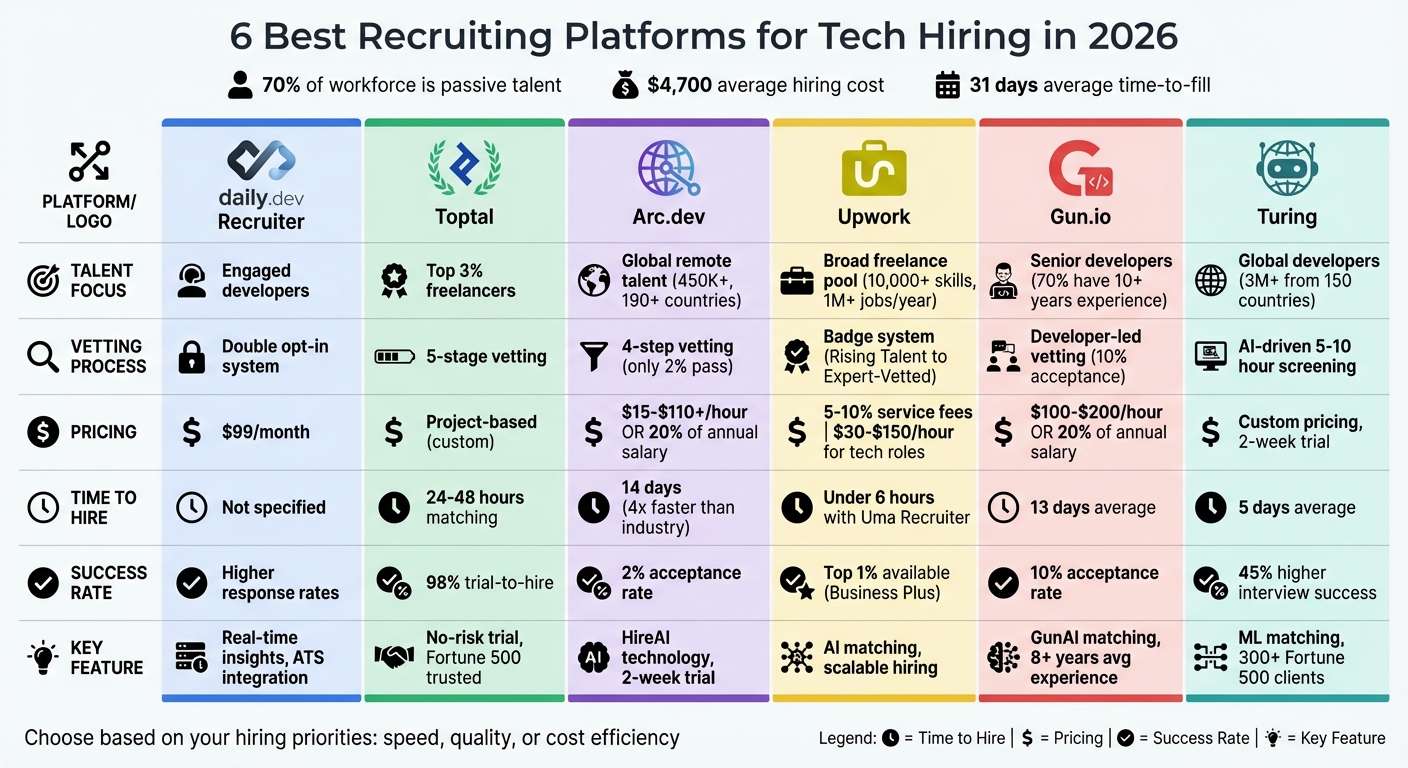 {Recruiting Platform Comparison: Features, Pricing & Vetting Process}
Quick Comparison
| Platform | Talent Focus | Vetting Process | Pricing Model | Key Features |
|---|---|---|---|---|
| daily.dev | Engaged developers | Opt-in system | $99/month | Real-time insights, ATS integration |
| Toptal | Top 3% freelancers | 5-stage vetting | Project-based | 24-48 hour matching, no-risk trial |
| Arc.dev | Global remote talent | 4-step vetting | Hourly or 20% of salary | HireAI tech, 14-day hiring time |
| Upwork | Broad freelance pool | Badge system | 5–10% fees | AI tools, scalable hiring |
| Gun.io | Senior developers | Developer-led vetting | Hourly or 20% of salary | GunAI matching, 13-day hiring time |
| Turing | Global developers | AI-driven vetting | Custom, two-week trial | Machine learning matching |
Choose based on your hiring priorities - speed, quality, or cost efficiency.
1. daily.dev Recruiter
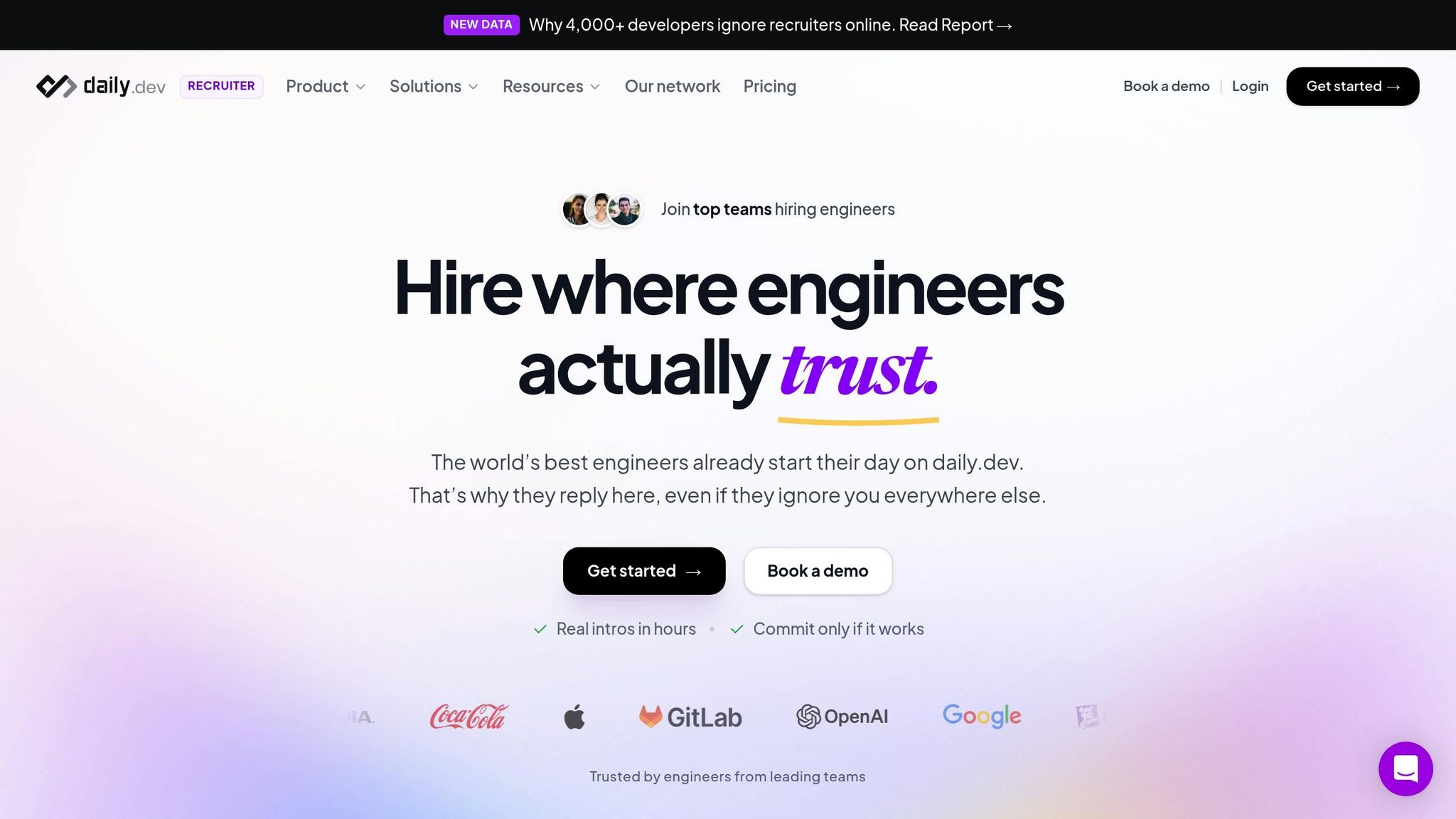
daily.dev Recruiter offers a fresh way to connect with software engineers who are deeply involved in technical learning and open-source projects. Instead of relying on outdated profiles or cold outreach, this platform taps into a network of developers who are actively honing their skills. Let's dive into what makes its talent pool, matching process, and pricing stand out.
Talent Pool Quality
daily.dev Recruiter takes a different approach to connecting with candidates by using a double opt-in system. This means developers must actively agree to receive messages from recruiters, ensuring that your outreach is welcome and not perceived as intrusive. This mutual agreement naturally leads to higher response rates compared to traditional methods.
What’s more, the platform keeps things current. It provides real-time insights into what developers are engaging with - whether it’s new technologies or specific skill areas. This allows recruiters to align their messaging with a candidate’s current interests, creating conversations that feel relevant and show that you genuinely understand their career path.
Matching Process
The matching process is designed with developers in mind. Instead of corporate buzzwords, job briefs focus on what engineers care about: technical challenges, specific tools, and opportunities to grow. By highlighting these aspects, daily.dev Recruiter helps filter out candidates who aren’t a good fit and connects you with those who are genuinely excited about the role. It’s a straightforward way to attract talent that aligns with your needs.
Pricing and Value
For $99 per month, you get access to ATS integration and coding-focused candidate sourcing tools, streamlining your hiring process. Everything is centralized, making it easier to manage candidates and track the performance of your recruitment campaigns. It’s a simple, effective way to keep your workflow organized while focusing on finding the right talent.
2. Toptal
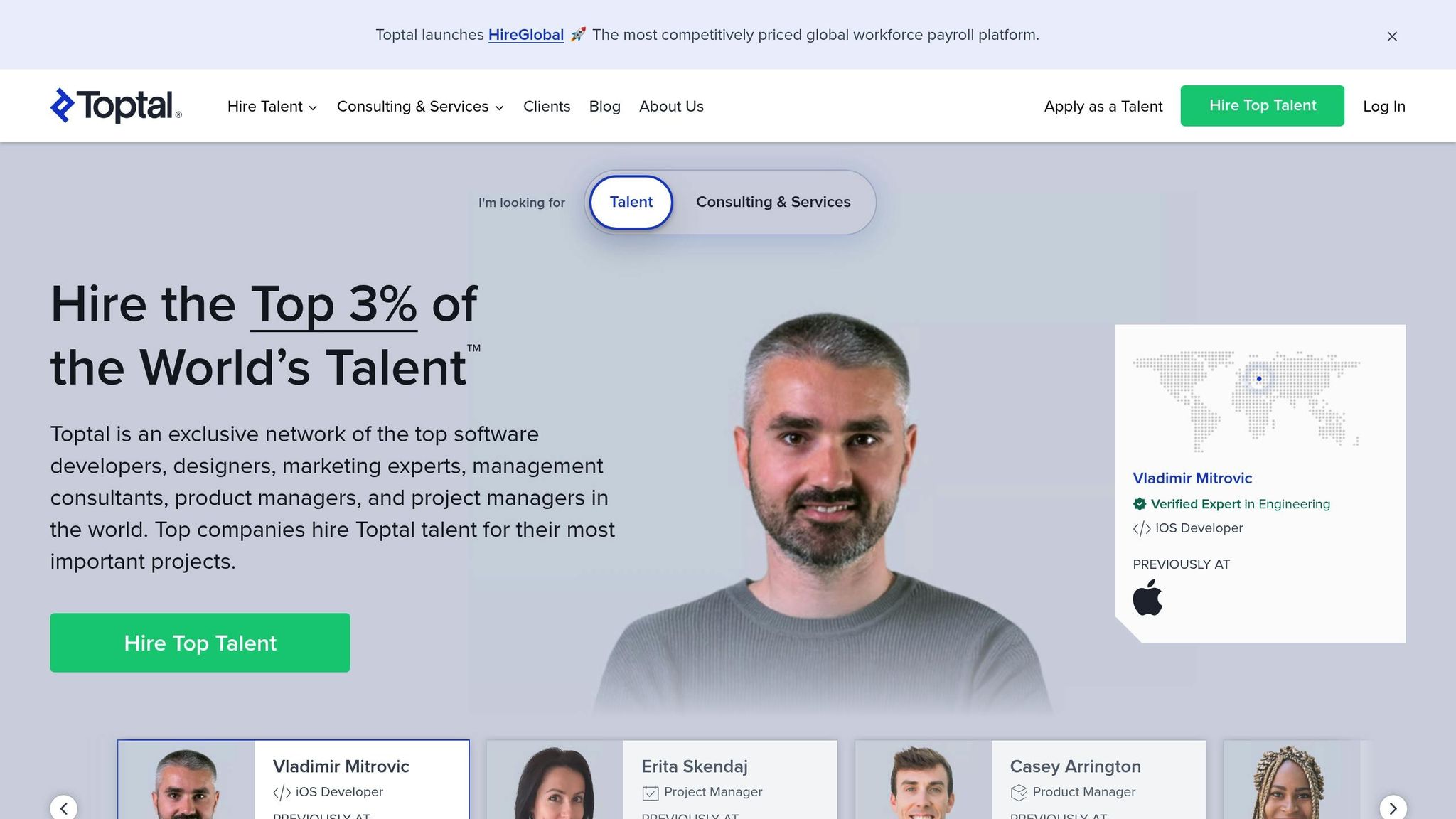
Toptal focuses exclusively on providing the top 3% of freelance talent worldwide through developer-centric platforms . Thanks to its rigorous selection process, the platform offers a pre-vetted pool of skilled professionals, including software engineers, coders, and architects. These freelancers excel in a wide range of technologies, spanning areas like AI, blockchain, and cloud services .
Talent Pool Quality
Toptal's vetting process is famously tough, featuring five distinct stages that narrow down candidates to just 3% by the end . This multi-step evaluation ensures that every developer in their network not only has exceptional technical skills but also excels in solving real-world challenges. The result? A talent pool that's ready to deliver high-quality solutions.
Matching Process
Toptal's matching system is designed to improve hiring by saving time without compromising quality. Their industry experts work directly with you to understand your technical requirements and team dynamics . Once that's done, they can deliver carefully matched candidates within 24 to 48 hours . Plus, they offer a no-risk trial period, so you only pay if you're satisfied with the freelancer . With a 98% trial-to-hire success rate, their approach has proven highly effective .
"With Toptal, we are able to find talented developers in a matter of weeks instead of months. The quality of talent they supply is extremely high as the developers are able to immediately onboard and ramp incredibly fast." - Zac Carman, CEO, ConsumerAffairs
Pricing and Value
Toptal works on a project-by-project basis to negotiate engagement terms . Thanks to the no-risk trial period, you can assess a developer’s fit without any upfront financial commitment. Their flexible engagement models - ranging from hourly contracts to full-time arrangements - make it easy to adjust your team size as your needs evolve . With over 30,000 clients across 140+ countries and an average rating of 4.9/5 from 39,751 reviews, Toptal has earned the trust of Fortune 500 companies and fast-growing startups alike .
3. Arc.dev
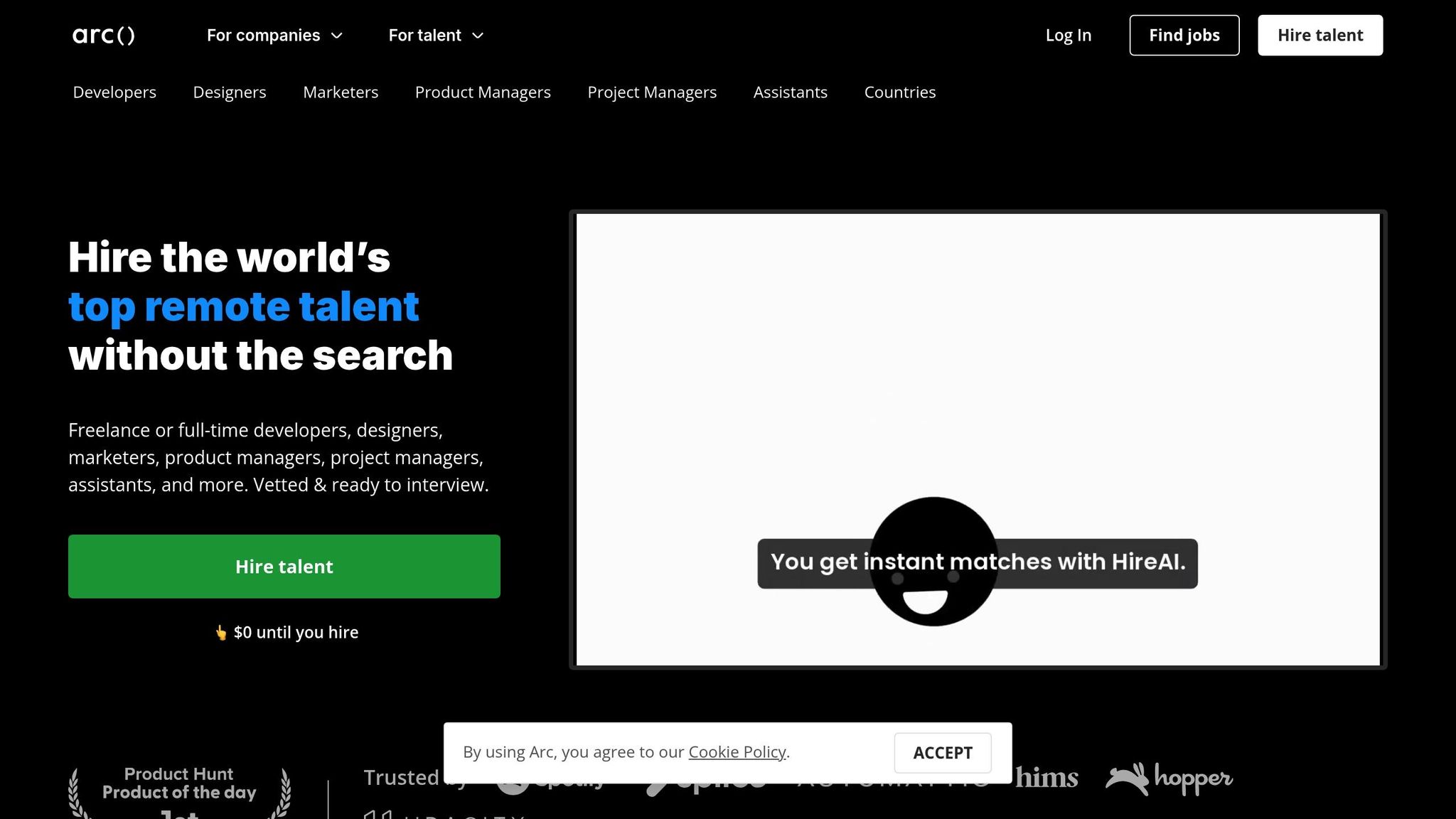
In a world where fast hiring and global talent diversity are more important than ever, Arc.dev steps in as a game-changing platform. It connects businesses with a vast network of over 450,000 professionals, including developers, designers, and marketers, spanning more than 190 countries . Specializing in mid- to senior-level remote talent, Arc.dev ensures all candidates are pre-vetted for technical expertise, English proficiency, and their ability to work remotely . By going beyond traditional tech hubs, the platform opens access to a truly global talent pool .
Talent Pool Quality
Arc.dev’s vetting process is no walk in the park. It’s a four-step system designed to identify only the best candidates. Here’s how it works:
- Initial Profile Review: This step examines the candidate’s work history and background.
- Communication Assessments: Tests for language skills and time zone compatibility.
- Role-Specific Technical Interviews: Focused on the candidate’s expertise in their field.
- Final Review: A thorough evaluation to ensure readiness.
The numbers speak for themselves: only 2% of applicants make it through this rigorous process . While 55% pass the initial profile review and 14% clear the communication stage, just 2% survive the technical interview . The network also includes over 350,000 mentors from the Codementor community, alongside accomplished professionals like former Google employees and PhDs . This high standard ensures that the platform delivers top-notch talent quickly and efficiently.
Matching Process
Arc.dev’s HireAI technology takes the guesswork out of hiring. It automatically screens applications and handpicks the best candidates for specific roles, eliminating the need for manual resume reviews . For more tailored needs, companies can work with dedicated recruiters to create custom candidate lists .
The platform claims to reduce hiring time by up to four times compared to traditional methods. Freelancers are typically hired within 14 days, a significant improvement over the industry average of 58 days . Arc.dev also offers peace of mind with a two-week trial period for freelance hires and a three-month satisfaction guarantee for full-time placements. If the fit isn’t right, the platform provides free rematches .
"I've been so impressed with Arc. I've sourced former founders, senior engineers, and even CMOs in less than 72 hours. Working with the Arc team feels like an extension of our own."
– Chris Bakke, Founder and CEO, Laskie
Pricing and Value
Arc.dev keeps costs transparent and manageable. Contractor rates range from $15 to $110+ per hour, with no hidden fees . For full-time hires, there’s a one-time fee equal to 20% of the candidate’s annual salary .
The platform’s value isn’t just about cost savings - it’s about smart hiring. In 2023, BAXUS used Arc.dev to hire a founding full-stack developer from Colombia. This decision saved the company $50,000 annually compared to U.S. salary standards, all while maintaining top-tier technical and interpersonal skills . For international hires, Arc.dev also simplifies compliance by partnering with trusted Employer of Record services .
Arc.dev’s combination of speed, quality, and cost-efficiency makes it a standout choice for companies looking to build strong, diverse teams.
4. Upwork
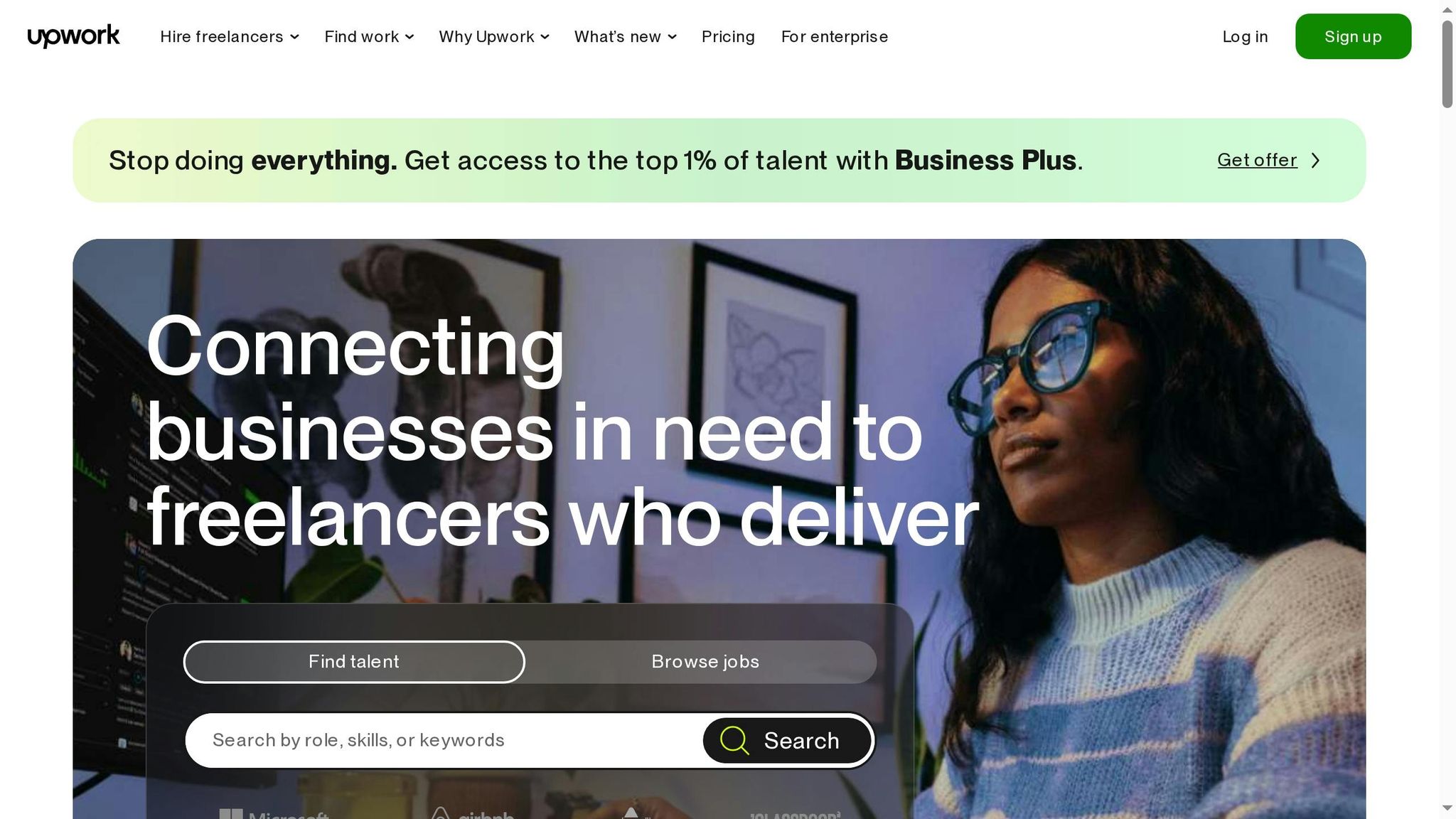
Upwork is a well-known freelance marketplace boasting over 10,000 skills and hosting more than 1 million job postings each year . It's a go-to platform for companies looking to hire tech professionals on a project basis, whether they hire freelance AI and machine learning experts, web developers, or designers. Upwork serves as a flexible, large-scale solution alongside more niche hiring tools.
Talent Pool Quality
With a massive talent pool, Upwork ensures quality through its tiered badge system and premium access options. Freelancers are categorized with badges like Rising Talent, Top Rated, Top Rated Plus, and Expert-Vetted, making it easier for recruiters to identify skilled professionals . For those seeking the best of the best, the Business Plus tier provides access to the top 1% of pre-vetted freelancers - though this premium service comes with higher fees . Without such premium features, recruiters may face the challenge of sorting through a large number of applicants, sometimes exceeding 100 candidates for a single role, which can be time-intensive .
Matching Process
Upwork leverages AI to simplify the hiring process. Its Uma Recruiter tool, available to Business Plus users, acts as a virtual hiring assistant, delivering a curated list of top freelancers in under 6 hours . For Basic plan users, the Quick Invites feature provides a shortlist of the top eight suitable profiles immediately after a job is posted . Additional tools like an AI-driven job post generator, screening questions, and video interview options further streamline the process of evaluating candidates .
Pricing and Value
Upwork follows a pay-as-you-go model, eliminating the need for upfront subscription fees . Basic users are charged a 5% service fee (3% with ACH payments), while Business Plus users pay 10% (8% with ACH) . For specialized tech roles, such as LLM, machine learning, or NLP projects, hourly rates generally range from $30 to $150, depending on the freelancer’s location and experience . Additionally, new Business Plus clients can benefit from a $500 credit after spending $1,000 on service contracts within the first 60 days of activation . Upwork's focus on scalable, flexible hiring makes it a great option for companies needing quick turnarounds - whether for short-term experiments or fractional tech talent .
Hiring engineers?
Connect with developers where they actually hang out. No cold outreach, just real conversations.
5. Gun.io
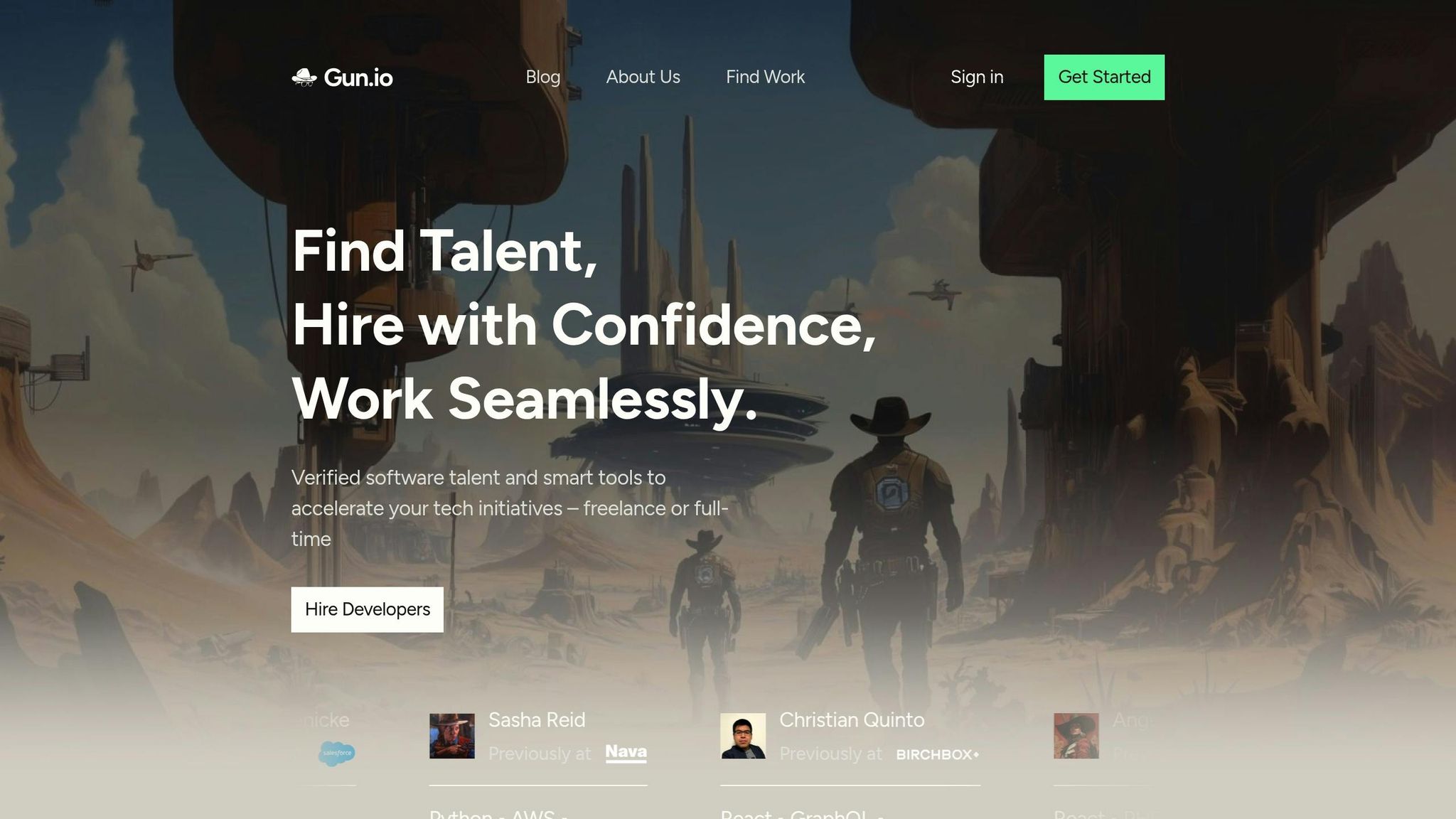
Gun.io is a specialized marketplace designed for senior-level software developers. It primarily caters to U.S.-based companies seeking remote contract or full-time tech talent. What sets Gun.io apart is its "developers hiring developers" model, where experienced engineers manage the vetting and matching process.
Talent Pool Quality
The platform is known for its highly skilled talent pool. Around 70% of the developers placed have over 10 years of experience, with the average being more than 8 years. Gun.io is highly selective - only 10% of applicants pass its rigorous screening process. The network includes a strong base of developers, featuring 3,950 JavaScript experts, 3,412 React developers, and 2,820 Python specialists .
"Gun.io significantly streamlined our talent acquisition. They connected us with skilled, innovative professionals who aligned with our project needs and company culture" – Kyle Hudson, Founder of Stacks, Inc.
Matching Process
Gun.io’s matching process is built on its robust talent pool and advanced tools. The platform uses its proprietary GunAI technology to analyze job descriptions, focusing on roles, skills, frameworks, geographic preferences, and industry experience. This data-driven approach creates a customized shortlist of candidates through its Discover Talent Search feature. In-house experts further ensure each candidate is a strong technical and cultural fit.
Clients typically receive a curated shortlist within 3–5 business days. The average time-to-hire is just 13 days, and Gun.io provides comprehensive support throughout the process, including interview coordination, contract negotiations, onboarding, and managing cross-border payroll in over 100 countries .
Pricing and Value
Gun.io uses a pay-on-hire model, meaning you pay only once the candidate begins work. For freelance roles, hourly rates range from $100 to $200, with all-inclusive pricing clearly outlined upfront to avoid hidden fees. For full-time hires, a one-time fee equal to 20% of the developer’s first-year salary applies. Additionally, the platform offers free talent swaps for freelance engagements if the match doesn’t work out.
"Gun.io saved us an enormous amount of time and money by listening to my vision and then placing us with a highly qualified group of engineers to build exactly what we needed" – Nathan Parkey, Founder and CEO of ZipLiens
6. Turing
Turing is a global talent marketplace that connects companies with over 3 million developers from 150 countries. By December 2021, the platform achieved unicorn status after raising $153 million and now serves more than 300 Fortune 500 companies . Let’s take a closer look at how Turing ensures high-quality talent, efficient matching, and competitive value.
Talent Pool Quality
Turing sets the bar high when it comes to vetting developers. Each candidate undergoes a rigorous 5–10 hour screening process that includes technical and soft skill evaluations, and a detailed work experience survey. This survey features 57 calibrated questions that assess areas like project impact, engineering expertise, communication skills, leadership, and strategic direction .
To maintain integrity, the platform integrates machine learning tools and cheating detection algorithms during the vetting process. Developers who surpass Turing's machine learning threshold are over 45% more likely to succeed in interviews compared to those who fall below it . This meticulous process ensures developers meet Turing’s "Silicon Valley standard" for technical ability, language proficiency, and interpersonal skills .
Matching Process
Turing’s matching system is powered by advanced machine learning models, including gradient boosting decision trees, logistic regression, and transformers, to predict how well a developer will perform in a specific role .
"We use gradient booster, decision trees, logistic regression, and a few other techniques to predict the probability whether a developer will be successful in a job with a customer."
The platform evaluates three key data categories: developer-specific features (e.g., hourly rates, notice periods, and skills), job-developer compatibility (like test performance), and job-specific requirements (such as client needs). Importantly, demographic factors are excluded to minimize bias. Thanks to this data-driven approach, Turing boasts an average hiring time of just 5 days .
Pricing and Value
Turing combines efficiency with competitive pricing. The platform offers a custom pricing model tailored to project requirements, with no upfront fees for talent searches. Developers set their own hourly or project rates, and every hire includes a two-week trial period - clients only pay if they decide to continue with the hire.
Beyond matching, Turing provides additional tools like the "Turing Virtual Machine", which includes built-in IP protection, productivity tracking, and tools to monitor hours worked and deadlines. To ensure smooth collaboration, developers are aligned with the client’s timezone, guaranteeing at least a 4-hour overlap during the workday.
On SelectSoftware Reviews, Turing holds a 3.8 out of 5 rating from 18 reviews. Users often highlight the platform’s speed in recruitment and the quality of pre-vetted candidates, though some have mentioned occasional delays in customer service responses .
Strengths and Weaknesses
Here’s a breakdown of the key strengths and trade-offs for each platform, helping you identify which one aligns best with your hiring goals and constraints.
daily.dev Recruiter stands out with its double opt-in model, connecting you to developers who are actively engaged. This approach leads to higher response rates and encourages meaningful conversations, making it a great fit for tackling today’s tech hiring challenges. If you're struggling with low engagement, learning how to fix common developer hiring issues can help refine your approach.
Toptal is known for its access to top-tier freelance talent, thanks to its rigorous vetting process. However, its premium pricing might make it less appealing for teams working with tighter budgets.
Arc.dev provides flexible engagement options, making it easier to match technical roles with skilled candidates efficiently.
Upwork offers a massive talent pool and quick hiring through its AI-powered tools. That said, its open marketplace means you’ll need to invest more time in screening candidates, as the quality can vary widely.
Gun.io is a dependable option for sourcing technical talent, offering a straightforward and predictable pricing structure.
Turing leverages machine learning to improve recruitment outcomes and simplify candidate evaluations, making it especially useful for offshore hiring. However, outsourcing technical hiring can present timezone challenges for teams requiring closer collaboration.
This overview highlights the trade-offs of each platform, helping you choose the one that aligns best with your hiring needs and priorities.
Conclusion
For small teams, enterprise-grade platforms often come with hefty implementation demands that may not align with your needs or resources . Instead, it’s better to opt for tools that suit your actual hiring volume and operational complexity.
If your main challenge is speed, prioritize platforms that automate tasks like scheduling and candidate screening. On the other hand, if quality is your concern, focus on tools offering strong skills assessments or access to pre-qualified talent pools . For instance, daily.dev Recruiter streamlines the process by connecting you with engaged developers through warm, double opt-in introductions, completely bypassing the hassle of cold outreach.
Financial considerations are equally important. Startups should evaluate the total cost of ownership, factoring in fees and integration costs . Tools that automate processes and reduce time-to-hire can cut hiring expenses by as much as 40% per hire .
Before fully committing to a platform, run a pilot with a few recruiters over a 2–4 week period . Use this trial to simulate your candidate journey, checking for mobile compatibility and overall user experience . This helps identify and fix drop-offs in your pipeline before they impact your hiring goals. Make sure the tool integrates smoothly with your existing HR systems to avoid issues like duplicate records or manual data entry .
FAQs
What should I look for in a recruiting tool for my company?
When selecting a recruiting tool, it's essential to focus on features that match your hiring priorities. Look for tools that can simplify job postings, organize candidate pipelines, and automate repetitive tasks like resume screening or scheduling interviews. It’s also important that the tool integrates smoothly with your current HR or ATS systems and can adapt as your hiring needs expand.
On top of that, consider platforms that provide detailed analytics to track hiring performance, ensure data security and compliance, and improve the candidate experience. A tool that eases the onboarding process and aligns with your team’s workflow can play a key role in meeting your recruitment objectives.
How do recruiting platforms maintain high-quality talent pools?
Recruiting platforms maintain high-quality talent pools by leveraging advanced technology to verify and regularly update candidate information. They use a mix of AI-driven validation and automated data enrichment to gather details from sources like resumes, social media profiles, and public databases. This approach eliminates outdated or duplicate entries, ensuring the talent pool stays accurate and reliable.
On top of that, AI-powered tools help rank candidates by analyzing job requirements, previous hiring successes, and alignment with company values. Custom screening rules - such as specific experience levels or certifications - automatically filter out unqualified candidates. Many platforms also incorporate feedback from hiring managers to fine-tune their algorithms, improving the precision of matches over time. Together, these tools ensure talent profiles are both detailed and consistently up-to-date.
What are the main advantages of using AI in recruiting tools?
AI-powered recruiting tools bring a host of advantages that transform how hiring teams operate. By automating time-consuming tasks like scanning resumes, enriching contact details, and drafting outreach messages, these tools free up recruiters to focus on what matters most - connecting with candidates and evaluating their potential. With the help of predictive models, they can quickly zero in on the best-fit candidates, cutting down screening time and enabling smarter, faster hiring decisions.
These tools also improve the quality of hires. Features like advanced matching algorithms and bias-reduction technology ensure candidates not only meet the job requirements but also align with the company’s values and work environment. Automation enhances the candidate experience too, offering quicker responses and tailored communication that leave a positive impression and boost the employer’s brand. Altogether, AI has become a game-changer for today’s recruiting teams, streamlining processes and delivering better outcomes.
.png)