Engineering hiring is tough - top developers accept offers in as little as 10 days, leaving many companies scrambling. The solution? Build a talent pipeline that proactively identifies, nurtures, and engages developers before roles open up. Instead of relying on resumes, this approach uses tools like GitHub analysis, AI-driven CRMs, and technical assessments to create a network of pre-qualified candidates.
Key Takeaways:
- Why pipelines matter: Avoid last-minute hiring chaos by building a pool of developer candidates ready to engage when needed.
- Pipeline stages: Sourcing, screening, technical assessment, interviews, and offers - each tailored to engineering needs.
- Tools to use: CRMs for passive candidates, ATS for active hiring, and platforms like daily.dev Recruiter to find developers where they are.
- Scalability: Start small with basic tools for 5-10 hires, then expand with AI screening, CRMs, and analytics for 50+ hires annually.
"You can't out-spend Big Tech, but you can out-nurture them." - Anastasia Dontova, Index.dev
This article explains how to create an engineering-first hiring process with the right technical hiring tools and strategies.
What is an Engineering Talent Pipeline
::: @figure 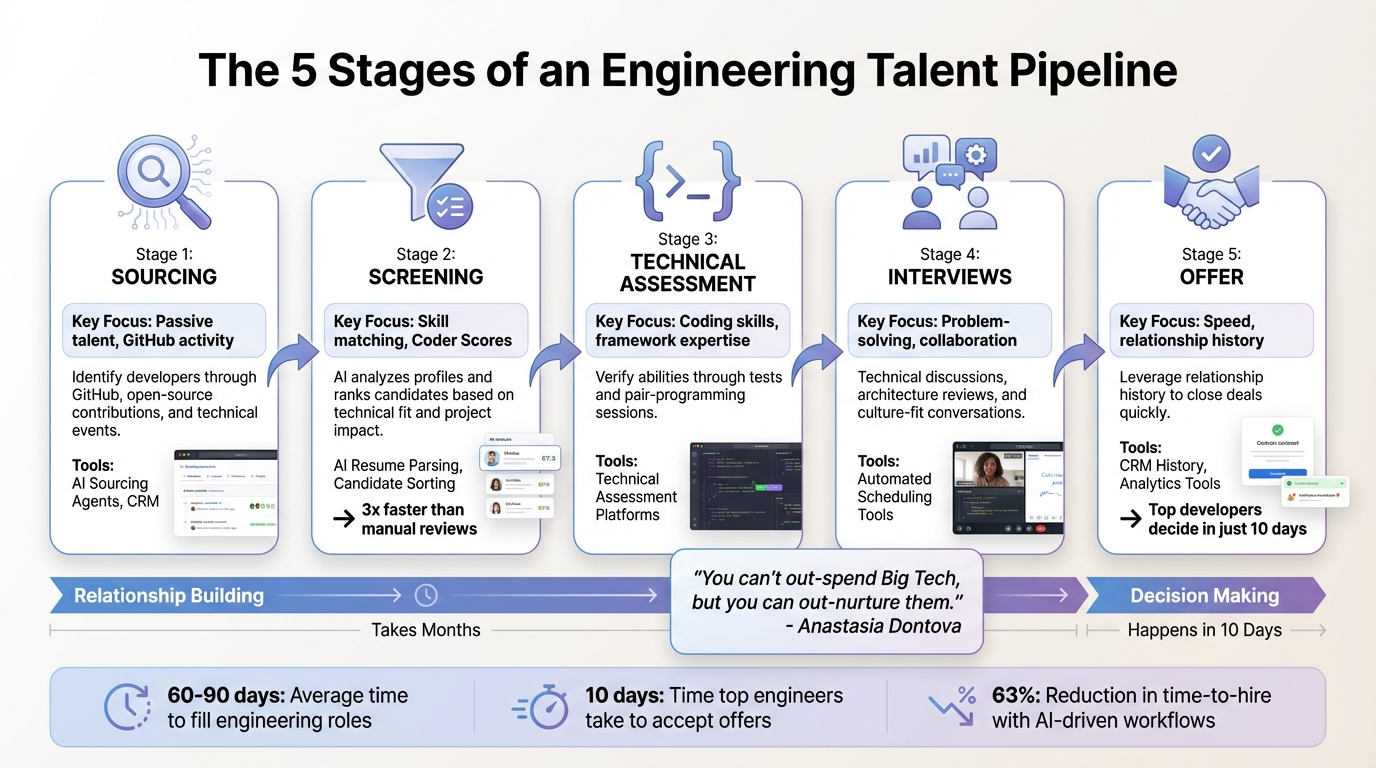 {The 5 Stages of Engineering Talent Pipeline: From Sourcing to Offer}
An engineering talent pipeline is a forward-thinking approach to recruiting that focuses on identifying, engaging, and building relationships with technical candidates well before job openings arise. By maintaining a "warm bench" of pre-qualified developers, companies can avoid the chaos of last-minute hiring. These developers are already familiar with your mission, tech stack, and workplace dynamics, making the process more streamlined. This proactive method replaces the outdated "post and pray" strategy with a relationship-first approach that nurtures potential hires over time .
What sets engineering pipelines apart from general recruitment are three key factors: more in-depth technical evaluations, longer recruitment cycles, and a focus on passive candidates. Engineering roles demand assessments of coding skills, contributions to platforms like GitHub, and expertise in specific frameworks - areas where traditional scoring systems often fall short . Filling technical roles typically takes 60 to 90 days, about 10 days longer than business roles, due to these specialized needs. However, once top engineers decide to make a move, they can accept offers in as little as 10 days .
"You can't out-spend Big Tech, but you can out-nurture them." - Anastasia Dontova, Technical Sourcer, Index.dev
Unlike traditional hiring pipelines that rely on Applicant Tracking Systems (ATS) to manage active job seekers, engineering talent pipelines use Candidate Relationship Management (CRM) tools. These tools engage passive candidates - developers who aren’t actively job hunting but are open to the right opportunities. Instead of bombarding them with job offers, the focus is on delivering value through technical insights, open-source collaboration, or invitations to exclusive communities . Leveraging AI-driven workflows can reduce time-to-hire by 63% without compromising on quality .
Below, we’ll explore the stages of an engineering talent pipeline and the tools that make it work.
Why Standard Hiring Pipelines Don't Work for Developers
Traditional hiring pipelines often fall short when it comes to recruiting engineers. They focus too heavily on active applicants and lack the technical depth needed to evaluate and engage passive candidates. Most top engineers are already employed and require months of relationship-building before they’ll even consider a new role. Standard pipelines also risk mismatches by relying on resumes without verifying hands-on skills .
Another challenge is the "speed paradox." While the relationship-building phase with developers can take months, the decision-making process is often lightning-fast. A candidate who has been engaged for six months might decide to accept an offer within just 10 days . Standard systems are either too slow to build trust or too rigid to act quickly when a candidate becomes available.
Technical assessments add yet another layer of complexity. Engineering roles demand specialized evaluations, such as testing for framework expertise, conducting pair-programming sessions, and assessing problem-solving approaches. These are areas where generic interview templates simply don’t cut it . For example, business-focused hiring processes can’t determine whether a developer can design a microservices architecture or debug a distributed system .
The 5 Stages of an Engineering Talent Pipeline
To address these challenges, an engineering talent pipeline takes a structured, stage-based approach. Each stage is tailored to the unique needs of technical hiring and supported by specialized tools.
Sourcing
The first step is identifying passive talent through platforms like GitHub, open-source contributions, and technical events . This isn’t about posting job ads - it’s about discovering developers based on their actual work, whether it’s code, conference talks, or community involvement. AI-driven tools help surface candidates who meet your technical needs but aren’t actively job hunting.
Screening
AI tools can analyze complex developer profiles and rank candidates based on technical fit and "Coder Scores" that measure real-world project impact . This stage is about filtering for technical intent and evaluating portfolios or README files, and it’s significantly faster and more accurate than manual reviews .
Technical Assessment
This stage involves verifying a candidate's coding abilities, framework knowledge, and problem-solving skills through tests or pair-programming sessions . The goal is to go beyond surface-level claims and probe deeper into their expertise .
Interviews
Instead of traditional Q&A sessions, engineering interviews often focus on collaboration. Candidates might engage in technical discussions with team members, architecture reviews, or culture-fit conversations. These sessions reveal how a developer approaches complex problems and communicates their thought process .
Offer
The final stage is all about speed and precision. Once a developer is ready to make a move, they often decide quickly - sometimes in just 10 days. This is where the relationship history and alignment with your mission play a crucial role in closing the deal .
| Pipeline Stage | Key Engineering Focus | Supporting Tool Category |
|---|---|---|
| Sourcing | Passive talent, GitHub activity | AI Sourcing Agents, CRM |
| Screening | Skill matching, Coder Scores | AI Resume Parsing, Candidate Sorting |
| Assessment | Coding skills, framework expertise | Technical Assessment Platforms |
| Interviews | Problem-solving, collaboration | Automated Scheduling Tools |
| Offer | Speed, relationship history | CRM History, Analytics Tools |
This stage-by-stage approach ensures that engineering recruitment is both thorough and efficient. Each step is designed to address the unique challenges of hiring technical talent, laying the groundwork for a robust recruitment tech stack. The next section will dive deeper into the tools that power these stages.
The Engineering Recruiting Tech Stack
Recruiting engineers today requires a well-oiled machine of tools, each serving a specific purpose within the hiring pipeline. These tools - sourcing platforms, ATS (Applicant Tracking Systems), candidate CRMs, technical assessment tools, and analytics dashboards - work together to make the process more efficient and effective. Here's how it all fits:
- Sourcing platforms bring passive talent into your funnel.
- Candidate CRMs keep developers engaged over time, building relationships.
- ATS systems organize and manage the interview process.
- Technical assessment tools ensure candidates have the skills they claim.
- Analytics dashboards pinpoint bottlenecks and highlight the most effective hiring channels.
This interconnected system reduces manual work and ensures no candidate data gets lost in the shuffle. For example, when your sourcing platform syncs with your CRM and ATS, you maintain a complete record of every interaction, making it easier to re-engage candidates down the line.
Sourcing Platforms for Passive Developer Candidates
Rather than waiting for applicants, sourcing platforms help you find developers where they already are - on GitHub, in tech communities, or even through their blog posts. One standout option is daily.dev Recruiter, which takes a fresh approach by connecting with developers directly within a platform they already use. Over 1 million developers visit daily.dev for technical content and industry trends. When you post a job through their recruiter tool, it appears to relevant developers based on their expertise and interests.
This approach works because top engineers often aren’t actively job hunting. Instead of sending cold emails, daily.dev Recruiter creates warm, opt-in introductions, sparking interest from developers genuinely curious about your role. It’s particularly useful for startups without an ATS, though larger teams can integrate it into their systems seamlessly.
The platform’s precision targeting goes beyond job titles. You can reach developers based on their preferred programming languages, frameworks, or even the specific articles they’ve read. This ensures your job posting lands in front of the right people at the right time.
"You can't out-spend Big Tech, but you can out-nurture them." - Anastasia Dontova, Technical Sourcer, Index.dev
By using tools like daily.dev Recruiter, you gain access to a talent pool your competitors might not even know exists.
Applicant Tracking Systems for Engineering Hiring
Once a candidate moves from passive interest to active consideration, your ATS becomes the hub for managing their journey. It handles interview scheduling, scorecards, and all candidate data in one place. For engineering roles, an ATS must integrate with technical assessment tools and support longer, more complex hiring cycles.
The best systems for engineering teams offer features like custom scorecards for technical evaluations, automated scheduling across time zones, and detailed pipeline reporting. AI-powered tools now make resume parsing and candidate screening faster and more accurate. For instance, automated resume parsers can achieve over 95% accuracy in identifying technical skills , while AI screening can be three times faster than manual reviews with approximately 87% accuracy .
Look for an ATS that supports engineering-specific interview formats, such as pair programming, system design discussions, or take-home projects. This ensures you’re capturing the right data to make informed hiring decisions.
Candidate CRM Tools for Long-Term Nurture
While your ATS manages active candidates, a CRM focuses on building long-term relationships with passive developers. Think of it as moving beyond a static contact list to a dynamic system designed to engage and nurture talent over time.
A candidate CRM automates outreach with personalized content, such as technical insights or event invitations, keeping your company top-of-mind. This way, when a developer decides to explore new opportunities, your company is their first call.
"Gem seems to have been built intentionally for recruiters to not only become more efficient and optimize their top-of-funnel workflow, but also to leverage data and make smarter decisions." - Joe Gillespie, Head of Tech Recruiting
Modern CRMs go a step further by continually updating candidate records. As developers change jobs, learn new skills, or relocate, the system refreshes their profiles automatically . CRMs also allow you to segment talent pools with precision, targeting groups like “Rust developers with distributed systems expertise” or “frontend specialists interested in accessibility.” This makes your outreach feel relevant and personal.
When integrated with your ATS, a CRM ensures a seamless transition from nurture to active recruitment. With one click, you can move a candidate into your hiring pipeline while preserving the full history of interactions - context that’s invaluable during interviews and negotiations.
Technical Assessment Platforms
Technical assessment tools are critical for verifying that candidates can perform the tasks their resumes suggest. These platforms help weed out candidates who may interview well but struggle with practical challenges.
The best tools focus on real-world problem-solving rather than academic exercises. For example, instead of testing theoretical algorithms, you might assess how a developer debugs a distributed system, designs an API, or refactors legacy code. Tailoring assessments to the actual work ensures you’re evaluating the skills that matter most.
Modern platforms often integrate with your ATS, automatically scoring assessments and flagging top performers. This saves time and prevents your team from getting bogged down with unnecessary interviews.
Pipeline Analytics and Reporting Tools
Analytics tools give you a clear view of your hiring pipeline, showing where candidates drop off and which sources bring in the best hires. Without this data, it’s hard to make informed decisions.
Key metrics include:
- Pipeline velocity: How quickly candidates move through each stage.
- Stage conversion rates: The percentage advancing from one stage to the next.
- Source-of-hire ROI: Which channels produce the most successful hires.
"Gem alerts me to who's waiting on feedback, whom we need to take action on... At a glance, I have an immediate sense of how an open role is trending." - Kyle Ijichi, Senior Technical Recruiter
While many ATS platforms include basic analytics, standalone tools often offer deeper insights. These metrics are essential for identifying bottlenecks and planning future hiring strategies. Together, they help refine and scale your recruiting process effectively.
How to Build and Scale Your Tech Stack
Creating a recruiting tech stack isn’t about grabbing every tool on the market. It’s about aligning your tools with your hiring needs and growth plans. A startup bringing on its first five engineers requires a completely different approach than a company aiming to hire 50+ people annually. The secret? Start small and focused.
Building a Minimum Viable Tech Stack
If you’re hiring your first 5-10 engineers, keep it simple. An all-in-one platform that combines basic ATS (Applicant Tracking System) and CRM (Customer Relationship Management) functions is your best bet. This avoids the chaos of juggling multiple tools, a common issue known as "tech stack bloat" . Many of these platforms even offer free versions tailored for startups, making it easy to test them out without any upfront costs .
Here’s what your initial stack should include:
- An ATS to organize candidate profiles.
- A browser extension to save developer profiles directly from platforms like LinkedIn or GitHub.
- A way to track conversations over time, offering basic CRM functionality.
That browser extension is a game-changer. It lets you capture promising candidates without the hassle of switching tabs or copying information manually .
"Switching to Loxo has felt like a real investment in our recruitment process. It's more than just saving time - it's about having a partner that's thinking ahead for us." - Cristina Sacco, VP of Marketing, Protis Global
At this stage, skip standalone tools like advanced technical assessments or analytics. Stick with simple coding challenges and track metrics in a basic spreadsheet. Prove your hiring process works before layering on more complexity. Once you’ve successfully hired your first few engineers, you’ll have a clearer idea of where your bottlenecks are and which tools to add next.
With this lean setup, you’ll be ready to adapt as your hiring needs grow.
Scaling Your Pipeline for 50+ Hires Per Year
When your hiring needs jump to 50+ engineers annually, it’s time to upgrade your tech stack. This is when you move from reactive hiring - waiting for applications - to active vs passive developer recruitment . Expanding your stack at this stage involves three key upgrades: a dedicated CRM, interview scheduling automation, and advanced analytics.
A dedicated CRM is crucial for managing hundreds of passive candidates at various levels of interest. You’ll need to organize developers by their expertise (e.g., "Rust enthusiasts" or "frontend specialists"), seniority, and availability (ready now vs. later) . Modern CRMs automatically update candidate profiles as they gain new skills or change jobs, saving you from tedious manual updates .
Interview scheduling automation is another must-have. Tools like Paradox Olivia or GoodTime can cut your time-to-hire by up to 63% by handling the back-and-forth of scheduling interviews . This lets your team focus on engaging with candidates instead of managing calendars.
At this scale, AI-powered screening becomes indispensable for handling the influx of applications. AI can screen candidates three times faster than manual reviews while maintaining roughly 87% accuracy . It also helps you rediscover "silver medalists" - high-potential candidates already in your database - before launching new searches .
Lastly, implement Service Level Agreements (SLAs) for candidate feedback. When hiring at high speed, it’s easy for candidates to get stuck in the process. SLAs ensure timely updates for every applicant, protecting your reputation as an employer even during busy periods . These tools quickly pay off by speeding up hiring cycles and boosting offer acceptance rates. Implementing these strategies for reducing time to hire ensures your team remains competitive in a fast-moving market.
Designing a Developer-First Pipeline
Even the most advanced tools won't succeed if your outreach feels like spam. Developers tend to ignore generic, mass-sent messages. A developer-first pipeline flips the script by focusing on trust, transparency, and genuine value rather than sheer volume. Personalized outreach helps you connect with high-quality developers instead of blanketing inboxes with impersonal emails.
While this approach takes more effort upfront, it creates a living pipeline of engaged candidates. These are developers who may not be actively job hunting but are open to the right opportunity when approached thoughtfully . As Anastasia Dontova, Technical Sourcer at Index.dev, wisely notes:
"You can't out-spend Big Tech, but you can out-nurture them" .
This section explores how to align your outreach strategy with a developer-first mindset.
Avoiding Spam and Respecting Developer Privacy
Personalized outreach isn't just a nice-to-have - it's essential for building credibility with developers. Generic templates fall flat. Developers can spot a mass email a mile away, especially when it references the wrong tech stack or overlooks their actual work. Hyper-personalization is the key to standing out. This means investing time to research each candidate: highlight their open-source contributions, reference a conference talk they gave, or mention recent activity on their GitHub profile .
Respecting developers' time is just as important. Avoid overwhelming them with constant messages. A quarterly engagement cycle works well: share a technical insight in Week 1 (e.g., "How we scaled Kafka at 5 billion messages per day"), invite them to review an open-source PR in Week 6, and check in casually about their current projects in Week 12 . If you're automating parts of this process, make sure to include a personal human follow-up at least once per quarter. This reminds candidates they're valued individuals, not just another entry in your database .
To maintain strong relationships, establish Service Level Agreements (SLAs) for follow-ups. If a candidate responds to your outreach or completes an interview, ensure they receive timely feedback. This not only protects your employer brand but also shows you respect their time and effort .
Using Warm Introductions Instead of Cold Emails
Warm introductions consistently outperform cold emails because they start with context and mutual interest. Instead of diving straight into job offers, consider inviting passive candidates to technical meetups, private Slack groups, or knowledge-sharing roundtables . These interactions build trust without pressuring developers and give them a chance to experience your company culture before discussing roles.
Platforms like daily.dev Recruiter take this concept to the next level by embedding your opportunities directly into the tools developers already use. Each introduction is double opt-in and context-rich, ensuring candidates engage only when genuinely interested.
Incorporating warm introductions into your sourcing strategy can streamline hiring and improve candidate quality. A "warm bench" strategy focuses on maintaining a curated list of pre-qualified engineers who have already interacted with your content or expressed interest in your mission . When a role opens, you're not starting from scratch - you’re reaching out to people already familiar with your company. This approach can cut time-to-hire by around 30% while increasing the likelihood of offer acceptance. For top technical candidates, who often make decisions within 10 days , having a pre-warmed pipeline gives you a crucial edge.
Conclusion
Building an effective engineering talent pipeline isn’t about piling on more tools - it’s about selecting the right ones and ensuring they work seamlessly together. Moving away from reactive "emergency hiring" to a proactive approach can cut your time-to-hire by 30% while boosting the quality of candidates. By maintaining a pre-qualified pool of developers, you eliminate the need to start from scratch every time a new role opens.
The backbone of a successful tech stack lies in sourcing platforms that prioritize developer privacy, an ATS designed for engineering workflows, and a CRM that views nurturing as an ongoing relationship rather than a one-time transaction. With AI-driven automation handling tasks like resume parsing and interview scheduling, recruiters can dedicate more time to fostering connections with technical talent. This balance between developer hiring platforms vs ATS and CRM tools is crucial at every stage of the recruitment process.
At its heart, quality sourcing drives the pipeline. Tools like daily.dev Recruiter integrate job opportunities directly into the platforms developers use every day, creating warm, double opt-in introductions instead of impersonal cold outreach. Pairing this with thoughtful nurturing strategies and data-backed pipeline analytics fosters a system where developers feel engaged, not pursued.
As industry experts emphasize:
"You can't out-spend Big Tech, but you can out-nurture them." - Anastasia Dontova, Technical Sourcer, Index.dev
FAQs
Do I need a separate CRM if I have an ATS?
Yes, having both systems is usually necessary. An ATS (Applicant Tracking System) manages the immediate hiring process, such as tracking and organizing applicants. On the other hand, a CRM (Candidate Relationship Management) system is designed for fostering long-term connections and building a talent pool for future needs. When used together, these tools streamline recruitment workflows and help maintain meaningful relationships with candidates over time, boosting overall efficiency.
What's the best ATS for engineering hiring?
When it comes to choosing the best ATS for engineering hiring in 2026, the right pick depends on your team’s size and hiring objectives. Greenhouse is a strong option if you’re looking for well-organized and structured hiring workflows. Lever works well for growth-stage companies that need scalability. For startups that prioritize quick setup and automation, newer AI-powered tools like Prepzo can be a game-changer. Assess your team’s specific needs to find the platform that fits your hiring pipeline.
How many touchpoints should a developer nurture sequence have?
A well-crafted developer nurture sequence generally includes 7 to 8 touchpoints. Many industry professionals advocate for sending at least 7 emails to effectively engage potential candidates. Others suggest going up to 8 emails to enhance the chances of progressing candidates through the pipeline. The key is to deliver meaningful value at every step, keeping candidates interested and encouraging them to take the next action.
What pipeline conversion rate should I target?
A solid pipeline conversion rate to target is approximately 18% when engaging with qualified candidates. To boost hiring efficiency, aim for rates exceeding 20%, as stronger response and conversion rates can make a noticeable difference in your recruitment success.
.png)