Recruiters in 2026 face unique challenges: AI-generated resumes, "easy-apply" floods, and candidates fine-tuning applications with tools like ChatGPT. Traditional systems often fail, rejecting qualified candidates or letting unfit ones slip through. The result? 70% of candidates reaching technical assessments are underqualified, costing companies $1,400 per 40 applicants in wasted time.
Here's a breakdown of five tools that help recruiters screen better and faster:
- daily.dev Recruiter: Focuses on senior-level developers and passive talent. Cost: $350/month per role.
- Truffle: Simplifies high-volume hiring with AI match scoring. Cost: $99/month (annual plan).
- MokaHR: Enterprise-ready, AI-powered screening for large-scale hiring. Pricing: Custom quotes.
- Manatal: Combines AI scoring with social media data for detailed candidate profiles. Cost: Starts at $15/user/month.
- Zoho Recruit: All-in-one ATS with AI resume parsing and coding assessments. Cost: Flexible plans, including a free option.
Each tool tackles inefficiencies like manual screening, inaccurate filtering, and time-consuming assessments. Using the best developer assessment tools alongside these screening platforms can further validate technical competency. Below is a quick comparison to help you choose the right one.
Quick Comparison
| Tool | Best For | Starting Price | Key Feature | ATS Integration |
|---|---|---|---|---|
| daily.dev Recruiter | Senior-level, passive candidates | $350/month | Trust-based introductions | Yes (60+ systems) |
| Truffle | High-volume hiring | $99/month | AI match scoring | Limited |
| MokaHR | Enterprise-scale hiring | Custom quotes | Candidate rediscovery | Yes (LinkedIn, Lark) |
| Manatal | Small to mid-sized teams | $15/user/month | Social media enrichment | Yes (20+ platforms) |
| Zoho Recruit | All-in-one solution | Free plan available | AI resume parsing | Yes (200+ integrations) |
These tools help recruiters save time, reduce costs, and focus on qualified candidates. Read on for detailed insights into each platform's features and integrations.
::: @figure 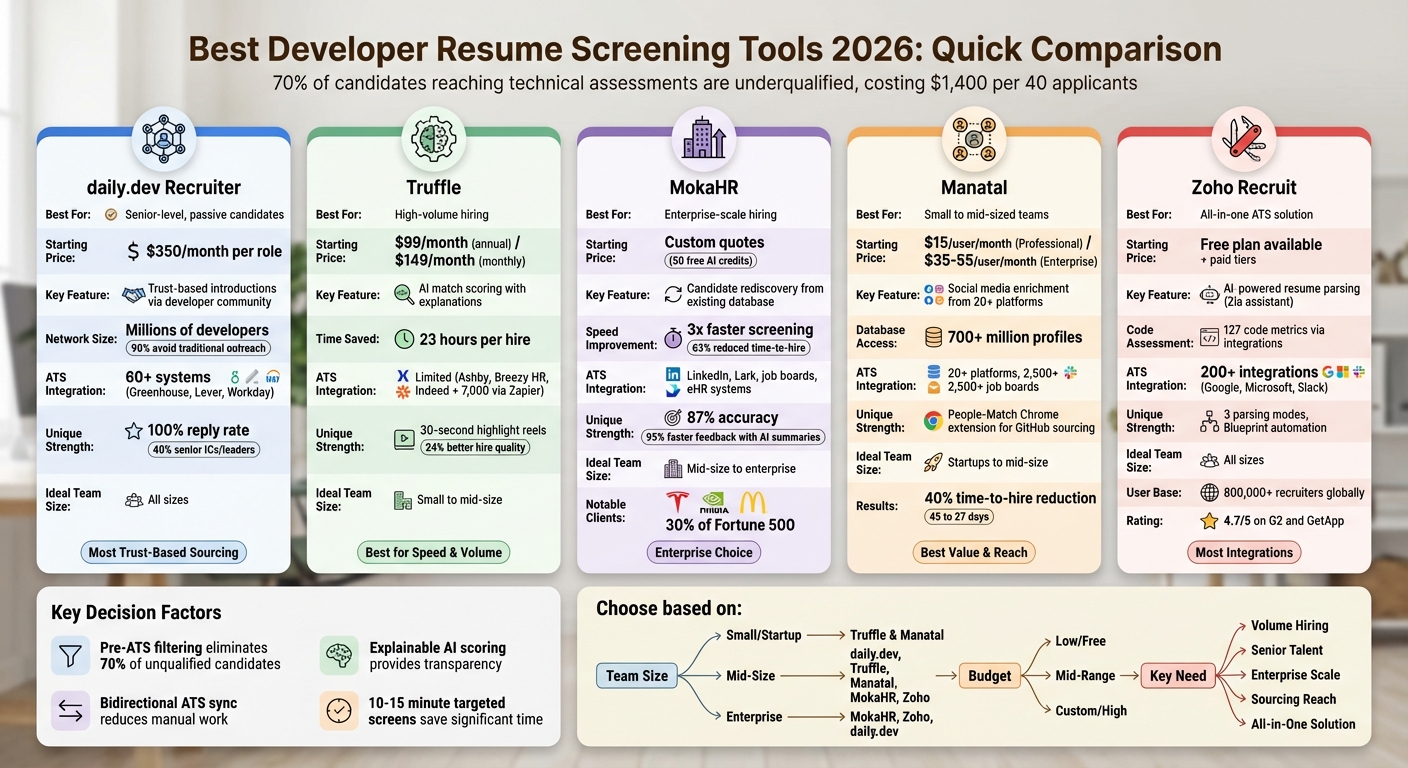 {Developer Resume Screening Tools Comparison 2026: Features, Pricing & Best Use Cases}
1. daily.dev Recruiter
Best For
This platform is tailored for tech recruiters, engineering managers, and founders who are looking to hire passive, senior-level developer talent. It’s ideal for roles like Senior ICs, Staff Engineers, and Tech Leads in specialized areas such as AI/ML, Core Engineering, and Infrastructure. Impressively, about 40% of its network consists of senior individual contributors or engineering leaders, and 85-90% are already employed. That means you're engaging with professionals who aren’t actively job hunting but could be open to the right opportunity .
Starting Price (US$)
The cost is straightforward: $350 per role, per month. There are no placement fees, hidden charges, or annual contracts - you can cancel anytime. This price includes unlimited seats and unlimited introductions each month .
Key Strength
The platform stands out for its community-first trust model, which connects with developers in their natural online spaces (averaging 200 monthly visits). Jobs are shown privately and ONLY to those who express interest, eliminating spam and achieving an almost 100% reply rate .
"We built a place where engineers can turn off the noise. To enter this space, you don't need a hack. You need trust." - Nimrod Kramer, CEO & Co-Founder, daily.dev
This trust-driven engagement is amplified by access to a large, active developer community.
Developer Network Access
daily.dev Recruiter provides access to millions of developers, with 90% avoiding traditional outreach methods . The platform has recorded over 1 billion developer sessions, and the average user engages with it more than six times daily. This high level of activity ensures you're connecting with a verified and engaged pool of talent.
Screening Accuracy
The tool uses "Full Picture Matching" to evaluate candidates. It goes beyond just resumes, analyzing their CVs, reading habits, projects, and networks. A Fit Score is calculated based on technical alignment, and you can set up to three custom screening questions for candidates to answer. Real-time engagement metrics add another layer of validation, ensuring you're targeting the right talent . These features integrate seamlessly with your existing recruitment processes.
ATS Integration
daily.dev Recruiter works effortlessly with your existing systems. It integrates with 60+ Applicant Tracking Systems (like Greenhouse, Lever, and Workday) via the Merge Unified API. This ensures candidates are automatically added to your workflows, while duplicates are filtered out before they reach you .
Hiring engineers?
Connect with developers where they actually hang out. No cold outreach, just real conversations.
2. Truffle
Truffle offers a streamlined way to handle early candidate assessments, making it ideal for high-volume hiring scenarios.
Best For
Truffle is tailored for teams managing a large influx of candidates. It’s particularly helpful for skipping the tedious process of first-round phone screens. If your team is overwhelmed by the manual effort of screening, Truffle steps in to simplify the workload [2, 19].
Starting Price (US$)
Pricing starts at $99 per month (billed annually) or $149 per month on a monthly plan. This flat-rate model includes unlimited users and avoids per-candidate fees, keeping costs steady even during busy hiring periods. Plus, there’s a 7-day free trial to test the waters [2, 17, 19].
Key Strength
One of Truffle’s standout features is its AI Match Scoring system, which doesn’t just spit out a percentage. Instead, it explains why a candidate received their score, using employer-defined criteria rather than generic keyword matching [17, 19].
"As a marketing agency owner, I don't have time to screen every applicant. Truffle has saved hundreds of hours." - Laura Williams, Founder & CEO, InSync Media
The platform combines resume highlights, one-way video transcripts, and assessments into a single workflow. This comprehensive approach saves recruiters time - on average, 23 hours per hire are spent on manual resume screening. Structured pre-employment assessments can improve hire quality by 24% and reduce first-year turnover by 36% [2, 19].
Screening Accuracy
Truffle prioritizes privacy and fairness by relying solely on transcript-based AI analysis. It avoids using facial recognition, biometrics, or tone scoring, reducing bias while safeguarding candidate privacy. The tool generates 30-second highlight reels from interviews, showcasing key moments and providing clear AI explanations. This means you can review candidates in minutes instead of watching lengthy interview recordings [2, 17].
It also offers tools like personality tests (Big Five/IPIP), situational judgment tests, and evaluations for environmental fit. Most teams can set up a screening link from a job description in under 15 minutes [17, 19].
ATS Integration
Truffle seamlessly integrates with popular ATS platforms like Ashby, Breezy HR, and Indeed. Through Zapier, it connects to over 7,000 applications, automatically syncing screening results - including transcripts, summaries, and scores - back to candidate profiles. You can even automate workflows, such as sending a Truffle assessment link when a candidate moves to the "Screening" stage in your ATS [2, 17, 18]. These integrations make it easier to identify top talent quickly and efficiently.
3. MokaHR
MokaHR offers enterprise-level AI screening tailored for organizations handling large-scale technical hiring. Trusted by over 30% of Fortune 500 companies and more than 3,000 enterprises globally - including Tesla, Nvidia, McDonald's, Nestlé, and Schneider Electric - it’s designed to manage high volumes of developer applications with precision and efficiency .
Best For
MokaHR is ideal for large enterprises and multinational companies that require seamless cross-timezone collaboration and high-capacity AI screening. With support for over 10 hiring scenarios, it’s flexible enough to address complex recruitment needs across various departments and regions .
Starting Price (US$)
MokaHR operates on a quote-based pricing model tailored to enterprise needs. While exact pricing details are not disclosed, the platform provides 50 free AI screening credits, allowing teams to evaluate its performance before committing .
Key Strength
One standout feature of MokaHR is its "candidate rediscovery" tool, which identifies qualified candidates already in your database who may have been previously overlooked . The platform screens candidates three times faster than manual processes, cutting time-to-hire by up to 63% with an accuracy rate of 87% .
"Moka boosts efficiency with LinkedIn and Lark integrations, and its AI-powered tools learn from our hiring decisions to deliver smarter, more accurate recommendations." – Tongtong Li, Group Cofounder & Group CHRO, Advance Intelligence Group
Its AI-powered interview summaries speed up feedback by 95%, bridging the gap between HR and technical hiring teams. The platform also features an explainable scoring system, offering clear insights into candidate ratings, which helps recruiters make informed, data-driven decisions . These tools integrate seamlessly with existing recruitment systems, enhancing overall efficiency.
ATS Integration
MokaHR connects with LinkedIn, Lark, job boards, eHR systems, and various calendars . Using a REST-based Open API and proactive Webhooks, it syncs candidate data, interview schedules, and feedback with external systems . The platform ensures secure data exchange via Basic Auth or OAuth2.0 and provides a Standard Delivery Integrated Development Solution for customizing integrations with existing HR tech stacks . Additionally, it integrates with tools like Microsoft Teams, Lark, and WhatsApp, enabling automated screenings and delivering AI-generated interview summaries directly into your workflow . The API suite includes modules for Candidate, Talent Pool, Position, Interview, Offer, and Onboarding, offering a comprehensive solution for enterprise recruitment .
4. Manatal
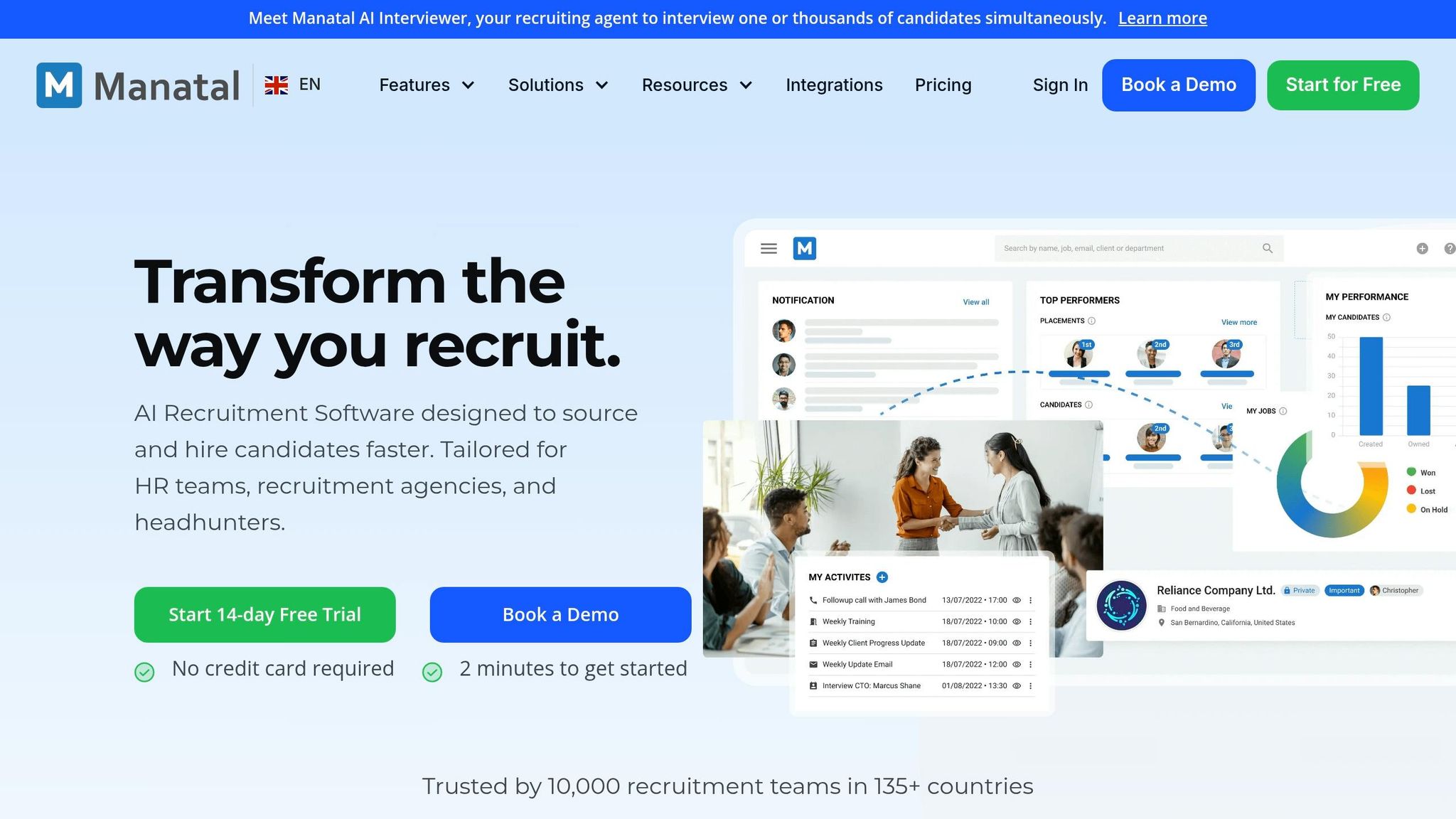
Manatal leverages AI scoring and social media data to uncover developer talent. By gathering information from over 20 sources - including GitHub, Medium, and LinkedIn - it provides a detailed look at a candidate's technical expertise. Used by more than 10,000 recruitment teams across 135+ countries, the platform reduces manual screening while enhancing candidate quality .
Best For
With its data-driven approach, Manatal is ideal for small to mid-sized recruitment teams and agencies searching for an affordable, AI-powered resume screening solution. The platform offers access to over 700 million profiles, making it particularly useful for teams hiring developers at scale. Its AI Interviewer feature further simplifies the process by conducting automated video interviews 24/7 in multiple languages, such as English, French, German, and Spanish .
Starting Price (US$)
Manatal’s Professional plans start at $15 per user/month (billed annually), while Enterprise plans range from $35–$55 per user/month and include features like Open API access and ChatGPT integration. The Professional plan supports up to 15 active job postings, a database of 10,000 profiles, AI candidate scoring, social media enrichment, and the People-Match Chrome extension, which allows recruiters to source developers directly from platforms like GitHub and LinkedIn .
Key Strength
One of Manatal's standout features is the People-Match AI Chrome extension. This tool simplifies technical talent sourcing by pulling GitHub repositories and contributions directly into the ATS. For example, in 2025, TechCore Solutions reduced their time-to-hire from 45 to 27 days, cut hiring costs by 35%, and improved candidate quality by 40%. A reviewer on G2 highlighted this benefit:
"The AI candidate matching is a game changer for our agency. It saves us hours of manual screening every single week." – RecruitPro_London, Verified G2 Reviewer
David Faustino, CEO of AdvanceWorks, also praised the platform, noting that its automation and sourcing tools increased team productivity by 20% and boosted positive candidate responses by 25% . These features integrate seamlessly with Manatal’s ATS capabilities, making it a powerful tool for recruiters.
ATS Integration
Manatal’s integration capabilities complement its AI-driven sourcing tools, creating a smooth recruitment workflow. It functions as a standalone ATS and connects with coding assessment tools like Codility and Testlify, enabling recruiters to send technical tests directly from the platform and sync scores to candidate profiles. Additionally, it integrates with over 2,500 job boards for one-click job postings and syncs with Gmail, Outlook, and major HRIS systems. The Enterprise Plus plan includes Open API access for custom integrations, and the platform meets SOC 2 Type II certification standards, as well as GDPR, CCPA, and PDPA compliance .
5. Zoho Recruit
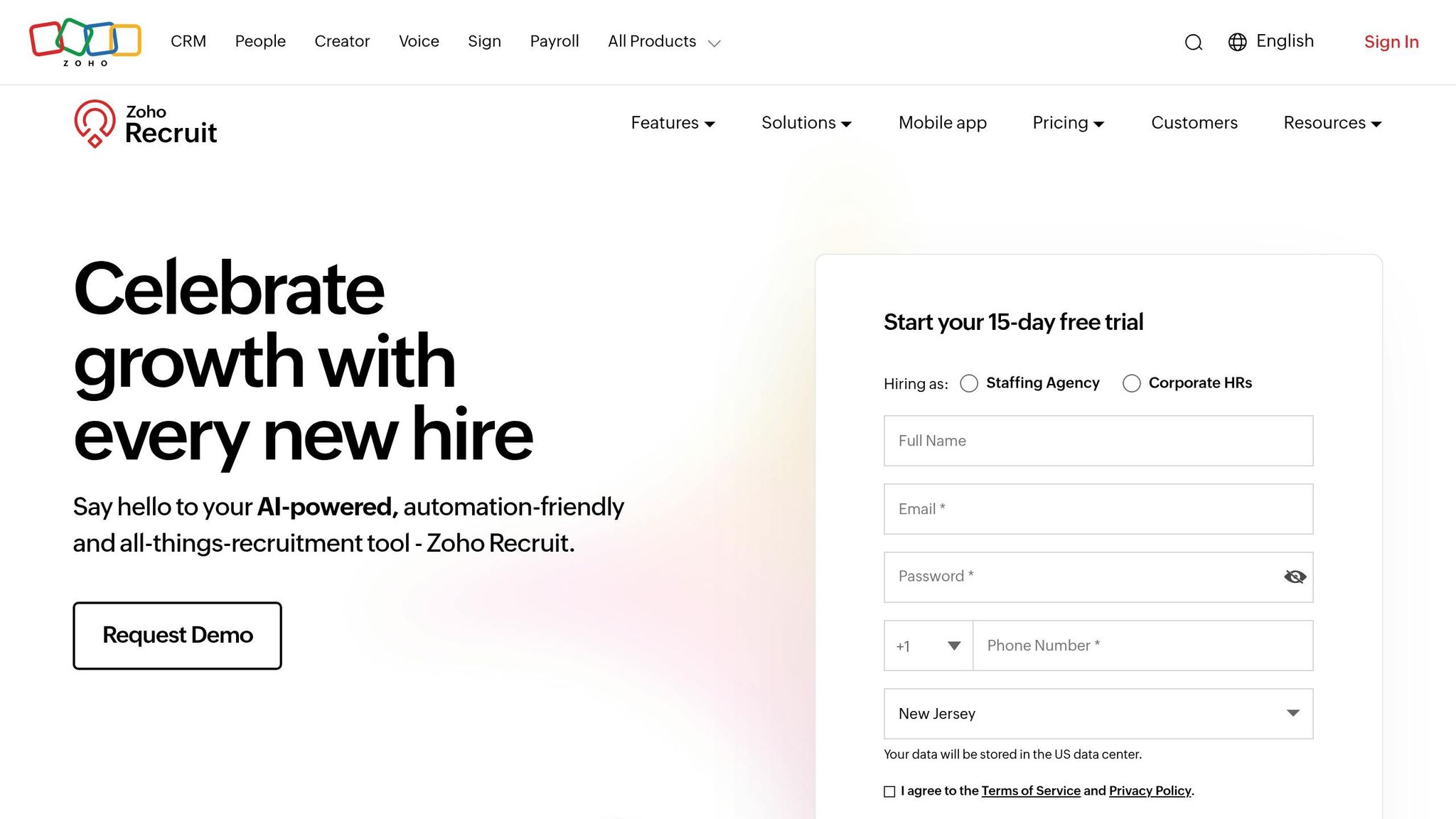
Zoho Recruit uses AI-driven tools to simplify the hiring process for developers, offering technical assessment features that save time and effort. Its AI assistant, Zia, handles tasks like sourcing candidates, shortlisting them, and conducting technical evaluations. With a global user base of over 800,000 recruiters, Zoho Recruit combines ATS (Applicant Tracking System) and CRM (Customer Relationship Management) functionalities into one platform, making it a versatile option for hiring teams .
Best For
Zoho Recruit is a great fit for HR teams and staffing agencies looking for a customizable, all-in-one solution. Its flexible pricing structure and wide range of integrations make it suitable for businesses of any size, from small recruitment firms to large organizations .
Starting Price (US$)
The platform offers a free plan and a 15-day free trial without requiring a credit card. Paid plans use a per-user pricing model that adjusts based on the needs of your business [36,40].
Key Strength
Zoho Recruit stands out for its advanced AI features and flexible pricing. One highlight is its context-aware resume parsing, which goes beyond simple keyword matching to analyze the actual content of resumes. It offers three parsing modes - Lenient, Moderate, and Strict - to reduce errors in identifying technical skills .
The platform’s Blueprint automation is another standout feature, streamlining the hiring process by automating steps like sending assessment invites based on candidate status changes. Results are synced directly to candidate profiles. Additionally, integrations with tools like CoderScout and Codejudge allow for micro-project assessments, analyzing up to 127 code metrics for a deeper understanding of a candidate’s skills [38,39]. These capabilities help cut hiring costs by half, speed up the process threefold, and increase application rates sevenfold. Zoho Recruit has earned a 4.7/5 rating on platforms like G2 and GetApp .
ATS Integration
Zoho Recruit ensures smooth integration with external tools and services. As a built-in ATS, it connects with over 200 third-party applications, including Google Workspace, Microsoft 365, Slack, and MS Teams. It also supports posting job openings to more than 75 job boards and social media platforms, streamlining candidate assessments and data management. For technical hiring, the platform integrates with coding test platforms like HackerRank, Mercer Mettl, and TestGorilla, syncing test results effortlessly. It adheres to compliance standards like GDPR, HIPAA, SOC, and ISO, ensuring data security throughout the recruitment process [36,37,41].
Strengths and Weaknesses
Each platform brings its own mix of advantages and challenges. daily.dev Recruiter shines by connecting recruiters with developers through warm, double opt-in introductions. This eliminates the need for cold outreach, resulting in more meaningful interactions and full pipeline visibility. However, its focus on quality over quantity may limit the platform’s ability to handle high-volume screening.
Truffle takes a unique approach by analyzing GitHub contributions and pull request histories to gauge technical expertise. While this is great for assessing coding depth, it relies heavily on candidates having open-source contributions, which may not apply to everyone.
MokaHR simplifies team collaboration with visual pipeline management and customizable workflows. That said, organizations with complex hiring processes might find the initial setup time-consuming.
Manatal excels at enriching candidate profiles by pulling data from LinkedIn and over 20 other platforms, creating a detailed view of each candidate. However, this feature might overwhelm smaller teams that don’t need such extensive data.
Zoho Recruit offers powerful tools like its AI assistant Zia and context-aware resume parsing. While these features are valuable, the platform’s broad functionality can make it harder for new users to get started.
Here’s a side-by-side comparison of these tools:
| Tool | Best Strength | Key Limitation | ATS Integration | Ideal Team Size |
|---|---|---|---|---|
| daily.dev Recruiter | Warm developer introductions | Network-dependent reach | Yes, with major ATS | All sizes |
| Truffle | GitHub code analysis | Depends on candidates' open-source contributions | Limited | Small to mid-size teams |
| MokaHR | Visual pipeline management | Setup complexity | Yes, standard integrations | Mid-size to enterprise |
| Manatal | Social profile enrichment | Can overwhelm smaller teams | Yes, 20+ platforms | Startups to mid-size teams |
| Zoho Recruit | AI-powered resume parsing | Steeper learning curve | Yes, 200+ integrations | All sizes |
These tools illustrate how tailored pre-ATS filtering can make recruitment more efficient. Features like explainable scoring, where AI provides clear reasoning rather than vague match percentages, and bidirectional ATS sync, which updates candidate data in real time, reduce manual tasks while maintaining transparency.
Pre-ATS filtering, in particular, has proven to be a game-changer. By using short, targeted screens lasting 10–15 minutes, recruiters can eliminate up to 70% of unqualified candidates, saving significant time and resources. This streamlined approach allows recruitment teams to focus their energy on top-tier candidates while keeping the hiring process efficient.
Conclusion
Matching your screening tools to your specific hiring challenges is essential. For companies overwhelmed by a high volume of applications, using pre-qualification assessments with quick 10–15 minute filters can weed out up to 70% of unqualified candidates. This allows recruiters to spend their time on applicants who meet the necessary technical and interpersonal criteria.
For positions requiring specialized technical skills, advanced evaluations offer a closer look at a candidate's expertise. As development practices shift, it's increasingly important to assess modern abilities - like familiarity with AI tools and coding in dynamic, real-world environments - to identify the best talent.
It's also important to align your tools with your budget and hiring strategy. Ensuring the features of your recruitment tools meet both your financial plan and hiring needs will lead to better results.
With its focus on fostering meaningful connections and seamless workflows, daily.dev Recruiter simplifies the hiring process. By linking you to a network of engaged, pre-qualified software engineers who are active in their field, and using double opt-in introductions, it helps you zero in on what matters most: hiring the right developers for your team.
FAQs
How do I spot AI-generated or inflated developer resumes?
To spot resumes that might be AI-generated or exaggerated, consider using AI detection tools. These tools are designed to analyze language patterns, flagging signs of automation or overstatement. Common red flags include:
- Repetitive phrasing
- Overly rounded numbers
- Generic or vague language
While these tools can be helpful, don't rely on them entirely. A manual review can catch inconsistencies or unusual claims that automated systems might miss. Combining both approaches ensures a more accurate and confident evaluation of resumes.
What’s the best way to pre-screen developers in 10–15 minutes?
The quickest way to pre-screen developers - taking just 10–15 minutes - is by leveraging AI-powered tools designed to evaluate practical skills tied to the role. These tools present candidates with structured coding challenges that mimic real-world scenarios. Candidates can complete these tasks on their own schedule, giving hiring teams instant feedback on technical skills, problem-solving abilities, and coding approaches. This method streamlines the process, cuts down on manual work, and ensures that only the most capable candidates advance to the next stage.
How can I avoid rejecting qualified developers with automated filters?
To make sure you're not missing out on talented developers, it’s important to set flexible thresholds in your AI screening tools. For example, consider hiring candidates who meet 70% of the key criteria and offering training to fill in the gaps.
It’s also crucial to regularly review and adjust your filters. This helps account for a variety of skills and experiences that might not fit neatly into predefined categories.
Lastly, incorporate human oversight into the screening process. This step can help identify potential biases or misclassifications, making sure qualified candidates aren’t unfairly excluded.
.png)