Senior engineers don’t want flashy pitches or over-the-top promises. What they value is purpose, meaningful work, and honest communication. Instead of trying to sell a role, focus on understanding their goals and showing how the position aligns with their career path. Here’s how to connect with them effectively:
- Highlight Challenges and Growth: Emphasize technical problems they’ll solve and clear paths for advancement.
- Be Transparent About Work Environment: Share details on flexibility, team dynamics, and leadership approach.
- Focus on Long-Term Impact: Explain how the role fits into the company’s mission and leverages their skills.
- Personalize Outreach: Research their work and tailor communication to their interests and expertise.
- Communicate Clearly and Honestly: Skip the buzzwords, share specifics like salary and tech stack upfront, and encourage open dialogue.
Recruiting senior engineers isn’t about persuasion - it’s about building trust through transparency and mutual respect. This approach not only attracts top talent but also lays the groundwork for long-term professional relationships.
What Senior Engineers Look for in a Role
To effectively attract senior engineers, it’s crucial to understand what motivates them. These professionals are often driven by opportunities that align with their goals and values. Let’s break down the key aspects they prioritize when evaluating a role.
Career Growth and Technical Challenges
Senior engineers thrive on tackling complex problems that stretch their skills. They’re not just looking for a job - they want work that challenges them and keeps them engaged. Entering a flow state, where they’re fully immersed in solving intricate problems, is a hallmark of the kind of work they value . As Rebecca Mattina from Achievers explains:
Stagnation is a dealbreaker for high performers. If people don't see a path forward, they'll start building one somewhere else .
To attract these engineers, highlight opportunities for growth. This might include solving tough technical problems, like optimizing systems to handle millions of daily requests, or mentoring junior developers. They’re also keen to see a clear progression path - what does it take to move from senior engineer to staff engineer or technical lead at your company? Providing these details can make all the difference.
Work-Life Balance and Team Culture
Practical factors like autonomy, flexibility, and a healthy work environment carry significant weight . Senior engineers want clarity on remote work policies, working hours, and whether the company avoids burnout-inducing practices like crunch culture.
Team dynamics are equally important. They’re asking themselves: Will I be part of a high-performing team that challenges me? Can I trust leadership to make sound decisions? According to a 2019 Glassdoor survey, over half of engineers would take a pay cut to work for a company with an excellent culture or brand . They’re looking for signs of maturity, such as thorough code reviews, automated testing, and well-defined methodologies. These factors signal a team and workplace that values quality and collaboration.
Alignment with Personal Values and Long-Term Impact
For many senior engineers, it’s not just about technical challenges - it’s about making a meaningful impact. They evaluate two key areas: the company’s mission and whether the role effectively utilizes their unique skills . Tanner Christensen, Co-founder of HelloShape, sums it up well:
I think a key to a happy and successful career might be simply working somewhere you're wanted... if your abilities are underutilized you'll just burn out doing things nobody appreciates .
Christian Sutherland-Wong, President and COO of Glassdoor, echoes this sentiment:
Job seekers want to be paid fairly but they too want to work for a company whose values align with their own and whose mission they can fully get behind .
When presenting a role, it’s important to understand what drives the candidate. Are they drawn to solving technical puzzles, or are they motivated by a mission that resonates with their values? By identifying their priorities early, you can tailor your pitch to show how your company aligns with their goals - even if your industry isn’t their first choice .
How to Present a Role Without Using Sales Tactics
Senior engineers can spot a sales pitch a mile away, so skip the buzzwords and automated tone. Instead, craft a personalized introduction that feels like an invitation rather than a cold call. This means doing your research and showing genuine interest in how the role aligns with the candidate's passions and priorities. By focusing on authenticity, you set the stage for meaningful conversations - from your initial outreach to discussing the role's challenges.
Research the Candidate for Personalized Messaging
Start by digging into public profiles to learn about the candidate’s technical contributions. Check GitHub READMEs, technical blogs, or open-source projects to understand the problems they’re solving and the tools they enjoy using. Platforms like daily.dev Recruiter can provide real-time insights into developers' current interests, helping you move beyond outdated resumes. Use this information to reference their recent work, turning a generic message into a tailored conversation.
When reaching out, be specific. For example, if they recently worked on a distributed systems project, mention it. Highlight how your team is tackling similar challenges and how their expertise could make an impact. Avoid corporate jargon - this is your chance to show you understand and appreciate their work.
Emphasize Role Challenges and Growth Opportunities
Once you've done the research, shift the focus to the challenges the role offers. Senior engineers care more about solving meaningful problems than just ticking off skills on a tech stack. Instead of listing requirements, explain the real issues your team is working to address. Whether it’s optimizing systems for high-scale traffic or modernizing legacy infrastructure, these details resonate far more than a generic job description.
As Adil Ajmal, CTO of LendingHome, explains:
"The secret to closing isn't offering the most equity... It's really closely listening to and noticing what's motivating each candidate during the entire process, and then explaining precisely how your company will serve those needs."
Be clear about the 6–12 month vision for the role. What skills will they develop? What types of projects will they lead? If the candidate values growth, highlight mentorship opportunities or the chance to work on cutting-edge projects. Ask them directly, "What technical challenges excite you most?" Then connect their answer to what your role offers .
Show How the Role Fits the Team and Company Mission
Senior engineers often look for roles that align with their values and long-term goals. Explain how the position contributes to the company’s mission and creates a meaningful impact for users. How does this role help improve people’s lives over the next five to ten years? Whether they value autonomy, scalability, or user impact, draw a clear line between those priorities and the opportunities your company provides .
Be upfront about the challenges, too. Mention aspects like maintaining legacy code or dealing with tight deadlines. Transparency builds trust and shows you’re not sugarcoating the realities of the job. When candidates see their values reflected in the role and understand both the opportunities and the obstacles, they’re better equipped to decide if it’s the right fit for them - and that’s exactly what you want.
Communicate Honestly and Directly
::: @figure 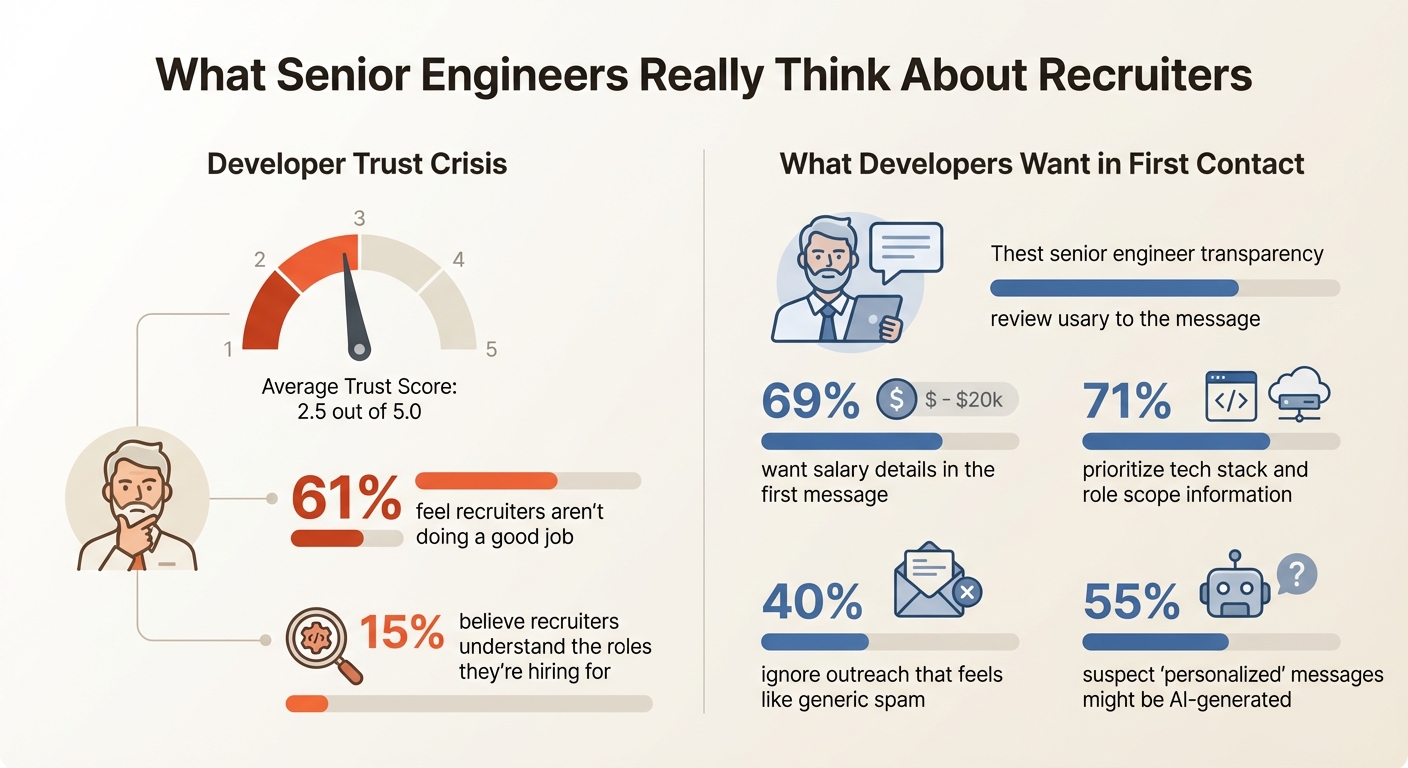 {Developer Trust in Recruiters: Key Statistics on What Senior Engineers Want}
After presenting the role and its challenges, shift gears to a clear and honest conversation. Senior engineers have heard every pitch under the sun, and they can spot insincerity from a mile away. The numbers back this up: 61% of developers feel recruiters aren't doing a good job, and only 15% believe recruiters understand the roles they're hiring for. Even worse, the average trust score developers give recruiters is just 2.5 out of 5.0. These stats make one thing crystal clear - developers want straight talk, not a sales pitch disguised as an opportunity.
The fix? Keep it simple. Speak plainly, skip the corporate buzzwords, and respect their time. Focus on what matters most to them and create space for genuine dialogue. When you communicate in a way that’s transparent and backed by facts, you lay the groundwork for trust and align your message with the realities of the role.
Use Clear Language and Developer Platforms
Get straight to the point. For example, 69% of candidates want salary details in the first message, and 71% prioritize information about the tech stack and role scope. If you delay sharing these essentials, you risk losing their attention. On top of that, 40% of developers ignore outreach that feels like generic spam, and 55% suspect even "personalized" messages might be AI-generated.
Start with the essentials - tech stack, salary range, and work model - right in the opening line. For instance: "Hiring Senior Backend Engineer for distributed systems with Go and Kubernetes. Salary: $160,000–$200,000. Fully remote." This approach shows you understand their priorities and aren’t here to waste their time.
Accuracy is key when using technical terms. Tools like daily.dev Recruiter can help you reach developers on platforms they already trust, making your outreach feel more relevant and less intrusive.
Support Your Claims with Evidence
If you’re making claims, back them up with hard data. Vague promises like "growth opportunities" or an "innovative culture" won't cut it with senior engineers - they need specifics. For example, if you highlight technical challenges, include measurable details to support your point. When discussing the tech stack, explain why those tools were chosen and the problems they address.
When talking about equity or compensation, provide realistic scenarios. As Adil Ajmal, CTO of LendingHome, puts it:
The secret to closing isn't offering the most equity... It's really closely listening to and noticing what's motivating each candidate during the entire process, and then explaining precisely how your company will serve those needs.
Be upfront about growth projections and any risks that come with them. This level of detail shows you’ve done your homework and respect their decision-making process.
Encourage Questions and Two-Way Conversation
Once you’ve laid out the role transparently, shift to fostering an open dialogue. The best recruiting conversations are two-way streets, not monologues. Invite candidates to ask questions, share concerns, or even challenge your points. Simple phrases like "tell me more" or "explain what you mean" can encourage deeper responses instead of quick yes-or-no answers. This shows you genuinely value their input.
Use open-ended questions to uncover what truly motivates them. For example, the "5 Whys" technique can help you dig deeper. If a candidate says they’re interested in consumer-facing products, keep asking "why" until you understand whether it’s about scale, brand recognition, or user impact.
Also, be upfront about where the role might fall short of their expectations. For instance, if a candidate is passionate about cutting-edge technology but your team works with legacy systems, say so. This honesty not only builds trust but also helps them make a well-informed decision about the opportunity.
Follow Up with Respect and Honesty
Once you've made an honest and personalized connection, the follow-up phase becomes crucial. It's easy to lose a candidate's interest with poorly handled follow-ups, especially when dealing with senior engineers. A respectful approach here not only keeps the conversation alive but also reinforces the trust you've already built.
The trick is to maintain communication without overwhelming the candidate. Assign a candidate confidant - a dedicated team member who can address the candidate's concerns without any pressure or agenda. This confidant's role is to provide clarity and context, ensuring the candidate feels supported rather than sold to.
With this foundation in place, focus on delivering the extra details that candidates often seek.
Share Additional Information When Requested
When candidates ask for more details, treat it as an opportunity to provide clear, thoughtful answers. Adil Ajmal, CTO of LendingHome, highlights the importance of this approach:
I spend as much time educating candidates as they want. People are extremely appreciative. I don't set up a 30-minute call and say, 'Oh, sorry, our time's up.' That's not compelling.
One way to address their inquiries is by offering an "Engineering Sell Sheet." This document can outline technical challenges (like scaling or data volume), your engineering principles (such as test-driven development), and the unique strengths of your company. If equity becomes a topic of discussion, don't shy away from explaining realistic growth scenarios, like the difference between 5x and 10x multiples, and be upfront about the current valuation. Transparency here builds trust.
Another thoughtful gesture is having interview panel members send short, personalized notes within 24 hours of the offer. Highlight a specific, positive takeaway from their conversation to show genuine engagement and appreciation for their expertise. Keep follow-ups concise and limit them to two attempts if you don't hear back. Each follow-up should offer something of value, like a relevant blog post or a case study about your tech stack.
After providing all the necessary information, give the candidate the space they need to make their decision.
Give Them Time to Decide
Instead of imposing rigid deadlines like "exploding offers" that demand a decision within 24 or 72 hours, take a more open and understanding approach. Claudia Lemke, Client Partner at Pacific International, suggests:
I make sure to contact candidates at least once a week, even if there's no update. A simple message saying, 'You're still in process, and I'll update you as soon as I know more,' keeps them informed and reassured.
This kind of communication shows respect for their decision-making process while keeping them in the loop. Schedule offer calls or follow-ups at the end of the day, ensuring there's no rush or hard stop. This gives candidates the time they need to ask questions and feel heard.
The main goal is to eliminate uncertainty, which is often a significant stressor for senior candidates. By providing clear updates and leaving room for thoughtful consideration, you create a supportive environment where candidates can evaluate the opportunity at their own pace.
Conclusion
Recruiting senior engineers isn’t about delivering a polished sales pitch - it’s about earning trust and showing authentic alignment with their goals. The most effective strategies focus on building meaningful relationships, treating senior engineers as equals, and emphasizing how they can influence and shape a role, rather than just fill a vacancy.
At the heart of this approach is a simple but powerful principle: transparency and honesty. Being upfront about challenges - whether it’s dealing with legacy code, navigating technical debt, or offering a realistic view of equity - doesn’t push top talent away. Instead, it earns their respect. Recruitment built on trust prioritizes what matters to the candidate, like career growth and meaningful work, over simply filling a position.
Shift the focus to what truly resonates: technical challenges, opportunities for impact, and shared values. Avoid high-pressure tactics or generic perks. Start conversations by asking, “What does your ideal role look like?” instead of diving into a pitch. Use assessments rooted in real-world scenarios rather than abstract puzzles. Share your company’s journey - where you’ve been, where you are, and how the candidate can help shape the future.
Moving from a transactional recruitment model to a trust-based approach means replacing mass outreach with personalized communication, being upfront about compensation, and fostering a mutual discovery process. Even when a candidate decides to pass, a respectful and thoughtful process can lead to future opportunities or valuable referrals. This isn’t just about hiring the right person - it’s about building long-term goodwill and connections.
FAQs
What’s the best way to approach senior engineers about a role without being pushy?
To engage effectively with senior engineers, focus on three key principles: personalization, clarity, and respect for their time and expertise. Begin by referencing their specific accomplishments - whether it's noteworthy projects, open-source contributions, or technical blogs. This shows that you’ve done your homework and genuinely value their expertise. Generic messages won’t cut it; tailor your outreach to reflect their unique skills and career journey.
Be transparent about the essentials from the get-go. Share details like salary range, tech stack, and work model upfront. This level of openness helps establish trust and ensures that you’re aligned on expectations right away. Keep your communication brief and professional - avoid over-the-top language or pushy sales tactics. Instead, focus on how the role aligns with their professional goals, offers meaningful challenges, and provides opportunities to make a real impact.
By sending thoughtful, clear messages and respecting their time, you pave the way for genuine connections and increase the chances of a positive response.
What key details about the work environment should I share with senior engineers?
When engaging with senior engineers about the work environment, focus on the aspects that resonate with their professional goals and values. Start by highlighting team dynamics - whether the team thrives on collaboration or operates more independently. This helps them understand how they might fit into the group. Be sure to discuss work flexibility, such as remote work options or adaptable schedules, as these are often key considerations for experienced professionals. Sharing information about the technologies and tools in use is also crucial, allowing them to gauge if the role aligns with their expertise and interests.
Additionally, emphasize the company’s dedication to professional growth and innovation. Talk about opportunities to make a meaningful impact, as well as the leadership style and overall culture of the organization. If there are mentorship programs or paths for leadership development, mention these too - they can be a big draw for senior-level candidates. Above all, be honest and straightforward in your communication. This approach helps candidates assess whether the role is a good fit for them, without feeling like they’re being given a hard sell.
How can I discuss role challenges with a senior engineer without sounding pushy?
To discuss role challenges with a senior engineer without sounding pushy, focus on honesty and framing the situation as a chance for growth and meaningful contribution. Instead of dwelling on the negatives, emphasize how their skills and experience uniquely position them to tackle these challenges and make a difference.
Keep the conversation natural and straightforward to build trust. Senior engineers appreciate directness, so being open about the complexities and importance of the challenges shows you value their expertise. When you present these obstacles as opportunities to lead, solve key problems, or drive progress, it highlights the role’s potential for meaningful impact - something they’re likely to find appealing. This approach feels sincere and avoids any hint of a hard sell.
.png)