Your Boolean search isn’t failing - it’s your data. Poor data quality in recruitment systems leads to missed opportunities with top candidates and costly hiring mistakes. Here’s why:
- 71% of recruiters miss qualified candidates due to outdated or incomplete data.
- 74% of employers hire the wrong person because of inaccuracies in their systems.
- Issues like duplicate records, missing skills, and outdated contact details derail even the best search strategies.
Boolean searches rely on precise data. If your database is messy, no amount of tweaking will help. Clean, accurate, and up-to-date candidate information is the key to effective hiring.
Key data problems:
- Duplicate and fragmented profiles (e.g., same person listed multiple times).
- Outdated or incomplete profiles, hiding qualified candidates.
- Inconsistent terminology across platforms, confusing search results.
- Irrelevant or low-value data cluttering your system.
Fix your data:
- Audit your database for errors and gaps.
- Automate data cleaning and enrichment.
- Use tools to merge duplicates and validate contact details.
- Set clear governance rules to maintain data quality.
Clean data improves hiring efficiency, reduces time-to-fill for tech roles, and ensures Boolean searches deliver the right results.
::: @figure 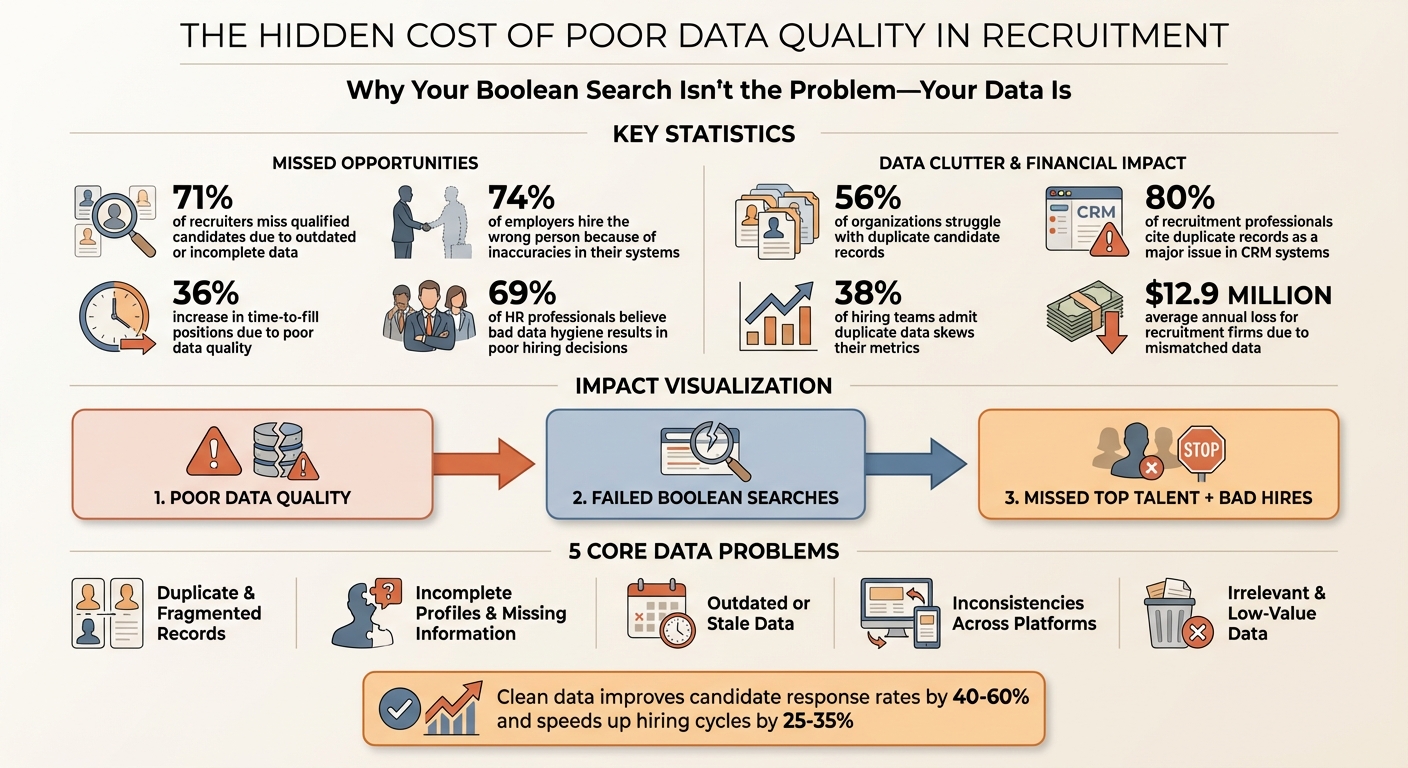 {The Cost of Poor Data Quality in Recruitment: Key Statistics}
Why Data Quality Matters in Developer Recruitment
The success of your recruitment strategy hinges on the quality of your data. When your candidate database is accurate, complete, and up-to-date, Boolean searches can deliver spot-on results. But if the data is flawed, even the most advanced search techniques fall flat.
Organizations that neglect data hygiene face serious setbacks: a 23% drop in hiring efficiency and a 36% increase in the time it takes to fill positions . Poor data doesn’t just slow you down - it actively hinders your ability to find and connect with top developer talent.
Recruitment outcomes rely on five key data attributes: accuracy (correct skills and work history), completeness (all necessary details included), consistency (uniformity across platforms), timeliness (current candidate information), and relevance (details tailored to specific roles) . When any of these elements are lacking, your search process takes a hit. This lays the groundwork for understanding how bad data disrupts candidate identification and engagement.
What Happens When Candidate Data Is Poor
Inaccurate or incomplete candidate data creates a domino effect of problems, wasting time and derailing hiring efforts. These errors often lead to bad hiring decisions, which can increase turnover and hurt team productivity.
The trouble starts with identification. When profiles include outdated job titles, missing skills, or incomplete work histories, qualified candidates may never appear in your search results. Imagine a senior engineer with vague skill descriptions or a full-stack developer whose profile hasn’t been updated in years - they’re likely to stay hidden from your radar.
Engagement becomes another hurdle when contact details are wrong. Just one incorrect digit in a phone number or an outdated email address can sever your connection with a promising candidate. On top of that, 56% of organizations report struggling with duplicate candidate records . This leads to awkward situations, like contacting the same person multiple times or overlooking an existing applicant entirely.
The resource drain is immense. Recruiters end up spending hours sorting through irrelevant applications or chasing candidates who are no longer available. In fact, 69% of HR professionals believe poor data hygiene directly contributes to bad hiring decisions .
These issues don’t just slow down candidate discovery - they also make even the most precise Boolean search logic ineffective.
Why Boolean Search Can't Compensate for Bad Data
Boolean search works on a simple principle: a candidate either matches your criteria or they don’t. While this precision is powerful with clean data, it becomes a liability when the information is flawed or incomplete. If a candidate’s profile doesn’t include the exact keywords you’re searching for, Boolean logic will exclude them - no matter how qualified they actually are.
Here’s how poor data quality undermines different Boolean operators:
| Operator | Impact of Poor Data Quality | Resulting Problem |
|---|---|---|
| AND | Missing keywords in profiles | Qualified candidates are excluded (False Negatives) |
| OR | Inconsistent terminology across profiles | Searches become too broad, pulling in irrelevant candidates |
| NOT | Outdated job titles or skills | Relevant candidates with updated experience are filtered out |
| " " (Quotes) | Variations in how titles are written | Exact matches fail if "Project Manager" is listed as "PM" |
The rigidity of Boolean search is the core issue - it can’t adapt to nuances like career shifts, hybrid skills, or soft skills unless they’re explicitly documented . For instance, a marketing specialist with SQL expertise applying for a developer role might never show up in your results because Boolean strings often miss these hybrid profiles .
Even the time-saving potential of Boolean search disappears when bad data is involved. While skilled recruiters can reduce screening time by 28% using Boolean logic , this advantage is lost if flawed data leads to irrelevant results. That forces recruiters to spend more time manually searching for overlooked candidates.
"Bad or incomplete data yield reports that are misleading at best and valueless at worst." - Phillip R., Datapeople
Boolean search’s transparency - showing exactly why a candidate appears in your results - only works when the underlying data is solid. Without reliable data, your recruitment strategy is built on shaky ground.
5 Data Quality Problems That Hurt Your Recruitment
Let’s dive into the specific data quality issues that can derail your recruitment efforts, even more than your search techniques.
Duplicate and Fragmented Candidate Records
Duplicate entries are a recruiter’s nightmare. Imagine a software engineer showing up multiple times in your database from different sources - it creates the illusion of a much larger talent pool than you actually have. 80% of recruitment professionals cite duplicate records as a major issue in their CRM systems .
Take the example of Newbury Partners: in January 2026, two of their recruiters unknowingly reached out to the same software engineer for the same role just days apart. Why? Fragmented profiles prevented them from seeing prior outreach. This not only wasted time but also damaged the candidate’s trust in the agency .
Beyond the embarrassment, duplicate records mean extra manual work and unreliable reporting. 38% of hiring teams admit that duplicate data skews their metrics . Worse, sending multiple messages to the same candidate could get your emails flagged as spam . Recruitment firms are losing an average of $12.9 million every year because of mismatched data .
"Duplicate records are not just entries on a spreadsheet... they are like background noise in a conversation: What makes you miss important details?" - Newbury Partners
Incomplete Profiles and Missing Information
Data gaps are just as problematic. If a candidate’s profile is missing key details - like technical skills, years of experience, or updated contact info - they might slip through the cracks of automated filters. 74% of employers admit to hiring the wrong candidate due to incomplete or inaccurate data in their recruiting tools .
Hasty data entry only makes things worse, with placeholder information hiding qualified candidates. 71% of recruiting leaders say they’ve missed out on top-tier talent because of messy or incomplete data .
Outdated or Stale Data
Old data is a resource drain. Reaching out to a developer who’s already moved on to a new job or using an outdated email address wastes valuable time. Poor data hygiene can lead to a 36% increase in time-to-fill positions and a 23% drop in hiring efficiency .
And it’s not just about time - 69% of HR professionals believe bad data hygiene results in poor hiring decisions, which can lead to higher turnover and lower productivity .
"Data is the lifeblood of any organization. It propels every function from sales to marketing to operations, and recruiting is no exception." - Loxo
Inconsistencies Across Sourcing Platforms
Even when data is available, inconsistencies across platforms can muddy the waters. Different sourcing tools often use varying formats and terms, making it tough to consolidate candidate information. For example, one system might list someone as a "Software Engineer II", while another calls them a "Senior Developer." This lack of standardization can throw off search logic.
Manual errors, like typos in email addresses or inconsistent naming conventions, only add to the mess. 56% of organizations face duplicate candidate records because inconsistent data prevents deduplication tools from recognizing identical entries .
Irrelevant and Low-Value Data
Excess noise in your database wastes time and energy. A search for "Python developer" might return profiles where Python is barely mentioned or candidates who applied for outdated roles . Evergreen job postings - those left open indefinitely - can pile up outdated applications, making it harder to gauge current hiring performance . This lack of clarity makes it difficult to optimize recruitment funnel conversion rates effectively.
"Bad or incomplete data yield reports that are misleading at best and valueless at worst. With sketchy reports, you get incorrect assumptions and bad strategic decisions." - Phillip R., Datapeople
When candidate records are shuffled between job requisitions without proper tracking, their connection to the original source is often lost. This makes it nearly impossible to measure the effectiveness of your sourcing channels . Whether it’s duplicates, incomplete profiles, or irrelevant data, these issues all disrupt Boolean search accuracy, proving that the real challenge lies in the quality of your data - not your search methods.
How to Find Data Quality Issues in Your Workflow
Clean data is the backbone of reliable search results, making it essential to identify and fix data quality problems. The good news? You don’t need pricey consultants or high-end software to get started. A structured audit of your tech hiring stack can quickly highlight where your data might be falling short.
Audit Your Candidate Database
Start by digging into your candidate database. Check for incomplete profiles - missing contact details, candidate sources, or key skills can all signal gaps in your data. For instance, if your "Candidate Quality by Source" report shows a large number of candidates listed as "Not Specified", it’s a clear sign that your data collection process needs attention .
You can also filter your applicant tracking system (ATS) for active candidates assigned to closed jobs. This will help you spot uncleaned or rejected data lingering in your system . Another critical step is reviewing user access permissions to ensure only authorized individuals can modify records. This precaution minimizes the risk of accidental data corruption . Additionally, take note of roles that have been open for an unusually long time - these so-called "evergreen" roles can distort performance metrics and make it harder to assess the effectiveness of previous hiring efforts . To stay on top of things, assign someone to handle monthly database clean-ups .
Once you’ve tackled general data issues, turn your attention to one of the biggest culprits: duplicate and redundant records.
Find Duplicate and Redundant Records
Duplicates can sneak into your database in subtle ways - think slight variations in spelling or formatting, like "John Smith" versus "J. Smith." Spotting these manually can be a nightmare, so use tools with fuzzy matching logic to identify and merge duplicates efficiently .
Most ATS platforms include a "Show Potential Duplicates" filter. This feature is especially useful for finding candidates who’ve applied to multiple roles, allowing you to consolidate their profiles into one accurate record . Another tip? Keep an eye on email deliverability. Sending monthly email campaigns can help you identify outdated or incorrect records - just update or delete any entries that bounce back .
After cleaning up gaps and duplicates, it’s time to measure your progress with some key metrics.
Set Up Baseline Metrics
To improve your data quality, you need to track it. Start by setting specific metrics that will help you monitor changes over time. For example, keep tabs on email bounce rates and missing source data to assess the accuracy of your database .
When evaluating pipeline speed, use median calculations instead of averages. This approach prevents outliers - like internal hires or internships - from skewing your data . You should also watch for oddities in "Time to Hire" or "Time to Fill" reports. These anomalies could point to issues such as incorrect application dates or evergreen roles that haven’t been properly closed . Baseline metrics not only provide a snapshot of your current data quality but also help you track improvements as you refine your process.
How to Improve Data Quality in Recruitment
Once you've pinpointed the issues with your recruitment data, the next step is taking action. Addressing these challenges isn’t a one-and-done task - it’s an ongoing process. It requires consistent validation, solid governance, smart tools, and regular monitoring. But the effort pays off: clean, enriched data can boost candidate response rates by 40–60% and speed up hiring cycles by 25–35% when compared to working with outdated or incomplete information .
Validate and Enrich Candidate Data
Recruiters often spend as much as 70% of their time manually gathering data, leaving less time for strategic recruiting . To reclaim that time, automation is key. By automating data validation and enrichment, you can ensure your database stays current without overburdening your team.
Start by integrating real-time email verification APIs to confirm email deliverability and tools for phone number validation to ensure proper formatting . When adding new data, rely on enrichment tools that provide confidence scores. Set thresholds to accept, flag, or reject data based on its accuracy. Top-tier tools typically hit accuracy rates of 85% to 95% for essential contact details .
Schedule automated updates to keep your data fresh - monthly for active candidates and quarterly for passive ones . Use webhooks to track "intent signals" like job title changes, promotions, new certifications, or "Open to Work" updates. This way, you’re working with real-time career data rather than outdated résumés .
Here’s a useful tip: avoid making too many data fields mandatory during manual entry. When recruiters are forced to fill out excessive fields, they might enter placeholder data just to move forward, which can clutter your database . Instead, focus on collecting essential contact and availability details early in the process, when candidates are more likely to provide accurate information . Once enrichment is automated, strong governance practices will help maintain data quality over time.
Set Up Data Governance Practices
Good data doesn’t happen by chance - it requires clear rules and accountability across your recruitment team.
"Data hygiene depends on solid data cleaning practices from all members of the hiring team at all times." – Phillip R., Datapeople
Start by establishing standardized naming conventions for data sources, using unique requisition IDs, and ensuring that "evergreen" roles are properly closed to avoid performance tracking errors . Develop a written process map that outlines how roles should be opened, updated, and closed. This ensures consistency, even when team members change .
Designate a data manager or rotate the responsibility for maintaining the database . Make data hygiene a part of recruiter performance evaluations to encourage accountability . Regularly audit user permissions to ensure only authorized team members can modify critical data fields . These governance measures help maintain high-quality data and ensure your tools integrate effectively with your processes.
Use Data Integration and Deduplication Tools
Fragmented profiles can make it harder to find the right candidates. To avoid this, aim for a single source of truth by implementing robust deduplication and integration tools.
Set up multi-field deduplication rules that compare email, name, and phone number details . When duplicates are found, use a "survivor policy" to select the most recently updated record as the primary one. Merge skills, consent information, and communication history from duplicate entries into the main profile .
Your tools should also standardize varied terms. For instance, consolidate similar job titles like "Software Engineer", "SWE", and "Software Dev" into one searchable term so Boolean searches capture all relevant candidates . Many modern ATS and CRM systems include automatic duplicate detection and will alert users when a new entry might already exist . Weekly data audits can help identify recurring issues and clean up your database quickly .
Monitor Data Quality Continuously
Maintaining data quality isn’t something you can "set and forget." Without regular monitoring, even the best-managed databases will degrade over time.
Use webhooks to update your database instantly when candidates change roles or earn new certifications . Track engagement metrics, such as email open rates, to identify outdated contact information . Conduct monthly reviews of your top 50 skills and job titles to add new synonyms and retire terms that are no longer relevant . This ongoing attention helps prevent data decay, ensuring your database remains a reliable resource for effective recruitment strategies.
Conclusion
The issue isn’t your Boolean search - it’s the quality of your data. Even the most carefully crafted search strings can’t overcome challenges like outdated profiles, duplicate entries, or incomplete records. With 74% of employers acknowledging they've hired the wrong person due to inaccurate data in their recruiting software, it’s clear that strong data quality is the backbone of effective developer recruitment . No search strategy can succeed if the underlying data is flawed.
Bad data doesn’t just hurt accuracy - it impacts efficiency in a big way. It can reduce hiring effectiveness by 23%, increase time-to-fill by 36%, and waste countless hours on irrelevant candidate reviews .
The solution? Make data quality a priority. Regular audits, automated tools for data enrichment, and strict governance practices don’t just improve search results - they reshape your entire recruitment process. By maintaining accurate, up-to-date candidate information, you turn your database into a reliable tool rather than a source of frustration. With clean data, Boolean search becomes a powerful ally, helping you pinpoint the right talent without unnecessary noise.
FAQs
How can I find and resolve duplicate candidate profiles in my database?
To tackle duplicate candidate profiles, start by leveraging unique identifiers like candidate IDs or email addresses. These can help differentiate between individual records and reduce confusion. Regularly auditing your database - whether through automated tools or manual checks - can uncover duplicates caused by issues like inconsistent name spellings or formatting.
When duplicates are found, merge them into a single, accurate profile, ensuring all critical details are combined. Standardizing data, such as names, contact information, and formatting, can also help avoid future duplication. Implement clear data entry protocols and consider using specialized de-duplication tools to keep your database clean and reliable. Consistent maintenance is essential for improving data quality and achieving better hiring results.
How can I automate cleaning and enriching recruitment data for better results?
To streamline data cleaning and enrichment in recruitment, start by ensuring candidate profiles are accurate and current. Regularly clear out duplicate entries, outdated information, and errors to keep your database reliable. Focus on gathering only the most essential candidate details to minimize incomplete or incorrect records.
Leverage automation tools like AI-powered platforms or applicant tracking systems (ATS) to simplify the process of updating data. These tools can automatically refresh profiles with new information, such as updated contact details or recent career moves. You can also schedule automated audits to spot and fix outdated or inconsistent data. Adopting these strategies will save you time, cut down on manual work, and improve your hiring efficiency.
How does poor data quality impact hiring the right candidates?
Poor data quality can throw a wrench into the hiring process. When information about candidates is outdated, incomplete, or just plain wrong, recruiters may accidentally overlook highly qualified individuals or focus on those who no longer align with the job’s needs. The result? Missed opportunities, mismatched hires, and a lot of wasted time.
Things like duplicate profiles, missing key details, or inconsistent formatting only add to the chaos. These issues make it harder to assess candidates properly and can lead to decisions based on unreliable data. And when hiring mistakes happen, the ripple effects can be costly - higher turnover rates, reduced productivity, and missed chances to strengthen the team.
Focusing on accurate, up-to-date candidate data can make all the difference. It helps recruiters zero in on the most qualified individuals, improving hiring outcomes and building stronger teams.
.png)