Developers are tired of spammy outreach. 43% mute recruiters, and 40% ignore messages that feel generic. Worse, 64% believe messages are copy-pasted, and 55% think AI generates "personalized" outreach. Trust is at an all-time low, with recruiters scoring just 2.5/5 on trustworthiness. The solution? Ditch mass messaging. Focus on clear hiring needs, personalized communication, and connecting with developers where they already engage. Tools like daily.dev Recruiter enable warm, opt-in introductions, avoiding cold spam tactics. By prioritizing respectful, meaningful connections, you can build a talent pool that aligns with your company’s needs - without damaging your reputation.
::: @figure 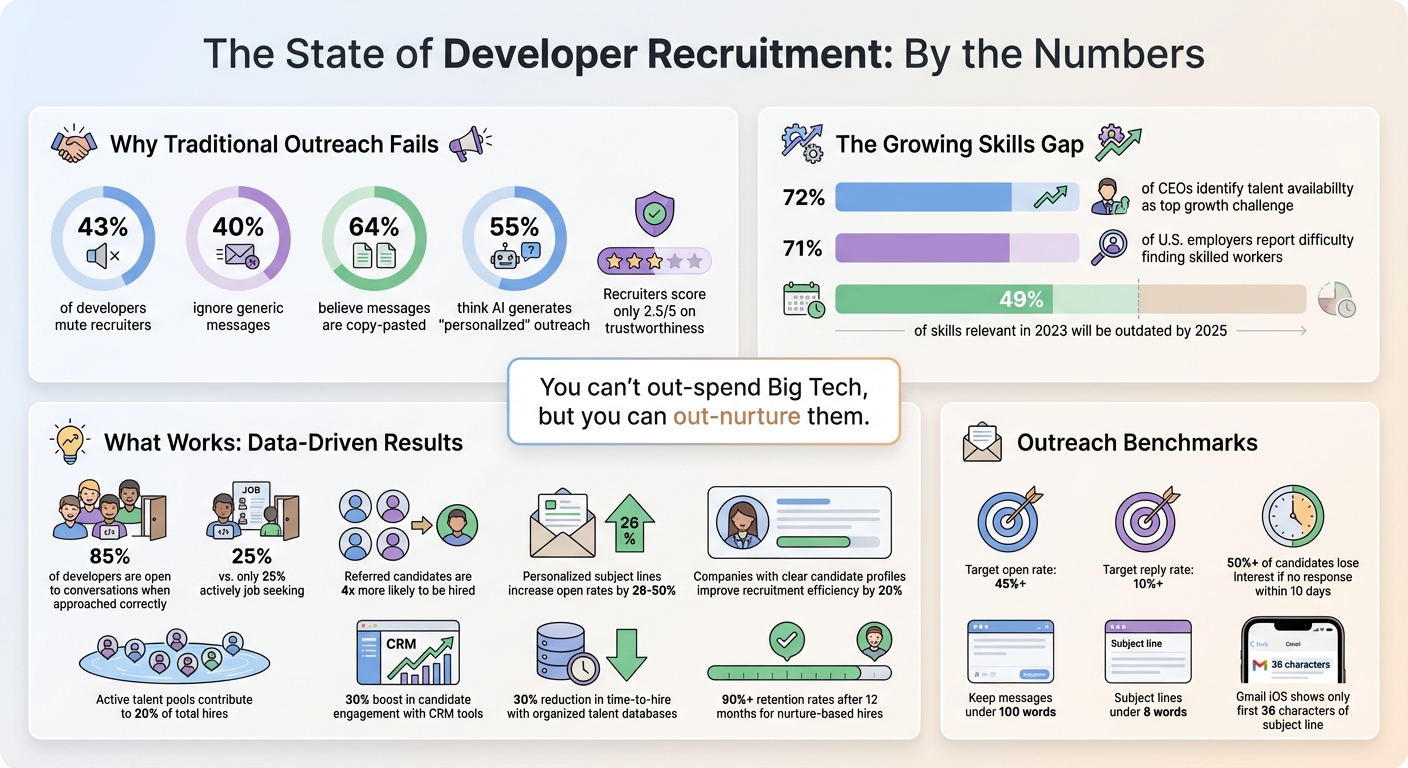 {Developer Recruitment Statistics: Trust Crisis and Outreach Effectiveness}
Define Your Developer Hiring Requirements
When it comes to hiring developers, clarity is everything. You need to pinpoint the specific technical skills and experience levels that your projects demand. This isn't about creating an endless wishlist of abilities - it's about focusing on what will truly drive your projects forward. Without clear hiring criteria, you'll waste time on mismatched candidates and risk coming across as unprepared. A well-defined approach ensures respectful, targeted communication with potential hires.
The statistics paint a clear picture: 72% of CEOs identify talent availability as a top growth challenge , and 71% of U.S. employers report difficulty finding skilled workers . Even more striking, 49% of skills relevant in 2023 are expected to be outdated by 2025 . This means your hiring strategy must address not only immediate needs but also future demands.
Identify Skills and Roles You Need
Start by conducting a skills gap analysis. What programming languages, frameworks, tools, or roles are missing from your team? Compare your current team's abilities to the requirements of upcoming projects. Go a step further by interviewing your top performers to understand the skills they rely on daily - these insights often go beyond what's listed in their formal job descriptions .
Take a page from Dropbox. They created standardized talent pools for key technical areas such as mobile development, security engineering, and machine learning. This allowed their recruiters and hiring managers to quickly access candidates aligned with their ongoing needs . Similarly, Enigma, a Series C Data-as-a-Service company, built dedicated pools for software engineers and data scientists. By focusing on core technical areas, they avoided redundancy in their hiring processes .
Planning a shift to cloud-native infrastructure? Expanding your capabilities in AI or machine learning? Make sure your talent pool reflects these forward-looking goals, not just your current gaps.
Build Developer Profiles
Detailed candidate profiles are essential for efficient hiring. These profiles should outline technical skills (specific languages, frameworks, and their required proficiency levels), experience levels (junior, mid, senior, or lead), relevant qualifications (such as industry experience and project types), and work preferences (remote, hybrid, or in-office). Don’t forget to include career interests and growth aspirations . Such profiles not only speed up the hiring process but also signal to candidates that you understand their needs.
"A well-defined candidate persona helps recruiters target the right talent by outlining ideal qualifications, skills, and cultural fit for each role." - Brendan McConnell
Think of these profiles as living documents. For roles you hire for frequently - like frontend developers or DevOps engineers - standardize the profiles. This ensures that your entire recruiting team operates with a shared understanding of what "qualified" means . It also saves time and reduces inconsistencies.
The payoff is real: companies that clearly define their Ideal Candidate Profiles can improve recruitment efficiency by up to 20% . When you know exactly who you're looking for, you can craft personalized outreach that resonates - tailoring your approach to what motivates a senior DevOps engineer versus a junior frontend developer.
With these profiles in place, you're ready to connect with talent on the platforms they trust.
Connect With Developers on Platforms They Use
Developers tend to ignore unsolicited messages, but they actively engage in trusted communities and with meaningful content. The key to reaching them lies in meeting them where they already spend their time. This approach can make the difference between building a strong talent network and having your outreach efforts go unnoticed.
The secret here is context. By connecting with developers on platforms they use daily, you’re stepping into their professional world rather than disrupting it. This creates a natural environment for engagement, allowing you to reach developers who are not only active in their field but also open to relevant career opportunities. With well-crafted profiles and a thoughtful approach, you can target developers in their own spaces, fostering trust and paving the way for personalized and respectful interactions.
Use daily.dev Recruiter for Warm Introductions
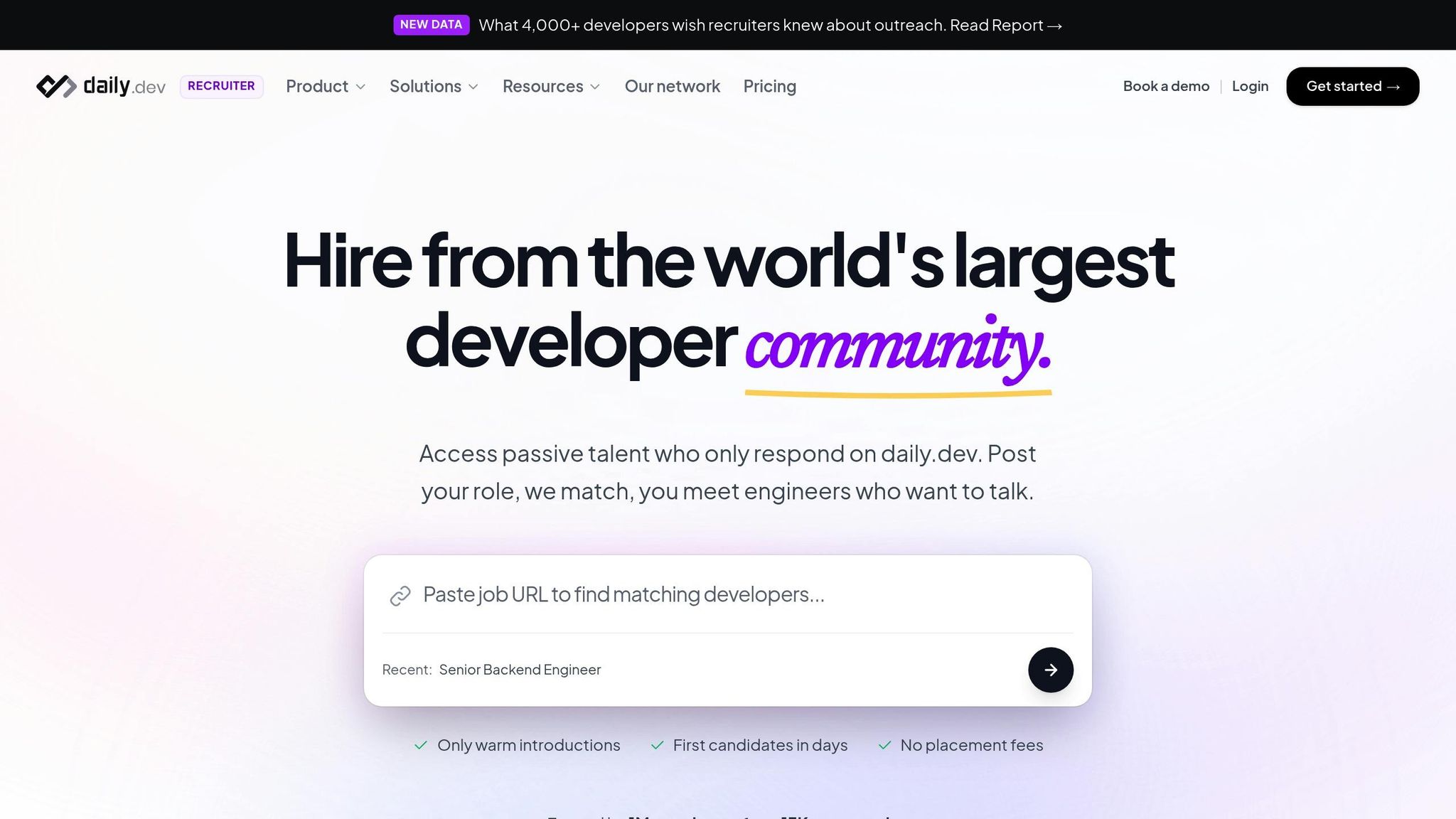
daily.dev Recruiter offers a double opt-in system that ensures every connection is meaningful. Both you and the developer express interest before starting a conversation. This means you’re only engaging with developers who have already shown an openness to learning about your opportunities.
The platform integrates seamlessly into the spaces where developers are already active. Instead of relying on outdated profiles or sending mass cold messages, you connect with engaged, active developers who are committed to their professional growth. Your job briefs are delivered in a way that feels natural, not intrusive, resulting in higher response rates and conversations that start with mutual interest. By combining these tools with genuine community involvement, you can further establish your credibility as a recruiter.
Participate in Developer Communities
Engaging with developers isn’t limited to recruiting platforms. Being an active participant in developer communities can build lasting trust and credibility. Whether it’s contributing to open-source projects on GitHub, answering questions on forums like Stack Overflow, or attending and sponsoring developer meetups and conferences, these efforts show that your company values the developer community.
When you reach out to developers you’ve connected with through these channels, you’re no longer a stranger - you’re a trusted name in their network. This approach also taps into the power of referrals, which are statistically more effective: referred talent is four times more likely to be hired than candidates from other sources . By participating authentically in forums, contributing to projects, and following up thoughtfully (once after a week and again after two months), you can create genuine connections without resorting to gimmicky subject lines or forced humor .
Use Personalized, Respectful Outreach Methods
The way you communicate can make or break developer engagement. Developers receive over 126 emails daily on average , so your message needs to stand out without coming across as spam. The difference between getting a response and being ignored often lies in how much effort you put into personalizing your outreach and respecting their time.
Every message you send uses up a bit of your brand's reputation. Osman (Ozzie) Osman puts it well: "Every time you reach out to a candidate you are consuming some of your company's brand equity" . Avoid generic, cookie-cutter messages that risk damaging your credibility. Instead, take the time to craft messages that show you’ve done your homework and genuinely value their work. Let’s dive into some actionable ways to achieve this.
Write Clear, Technical Job Descriptions
Vague job descriptions with phrases like "modern tech stack" or "competitive pay" won’t impress developers. They want specifics. If you offer competitive compensation, be upfront about the salary range: "$140,000-$170,000". Instead of "modern tech stack", list the actual tools and technologies: "React 18, Go, Kubernetes". This level of transparency not only respects their time but also helps developers self-qualify before responding.
Honesty about role expectations matters too. If the job involves maintaining older code alongside new projects, say so. Developers value straightforwardness over marketing buzzwords, and being upfront avoids mismatched expectations later. With top technical candidates often accepting offers in as little as 10 days , clear communication can speed up decisions on both sides. By setting the right tone here, you make your future outreach efforts more effective.
Share Helpful Content and Resources
Instead of diving straight into a pitch, consider sharing something useful. This could be a technical article they might find interesting, an invitation to a developer meetup your company is hosting, or feedback on an open-source project they’ve worked on. This approach - focusing on offering value first - shows you care about the developer community, not just filling a position, and gives you a natural way to start a conversation.
For example, instead of a generic subject line like "Exciting Opportunity at Acme Inc", try something more tailored like "Question about your [Project Name] on GitHub" . It’s specific, relevant, and less likely to be flagged as spam. Plus, emails with personalized subject lines are 26% more likely to be opened .
Personalize Every Message
Developers can spot generic outreach a mile away, and it’s the quickest way to get ignored. Keep your messages short - under 100 words - and reference something specific, like a recent pull request, conference talk, or blog post they authored. Use a concise subject line (fewer than 8 words) to immediately grab their attention. Avoid overused phrases like "I hope this email finds you well", which often scream automated spam .
It’s also worth noting that the Gmail iOS app only shows the first 36 characters of a subject line . This means your opening words need to be sharp and relevant. Focus on why their specific skills or achievements caught your eye instead of just boasting about your company. This "you-centric" approach helps build genuine connections and reinforces the respectful outreach principles discussed earlier.
| Outreach Element | Traditional Approach (Avoid) | Developer-First Approach (Adopt) |
|---|---|---|
| Subject Line | "Exciting Opportunity at Acme Inc" | "Question about your [Project Name] on GitHub" |
| Personalization | Name and current company only | Reference to a specific PR, talk, or tech stack |
| Job Details | "Modern tech stack", "Competitive pay" | "React 18, Go, Kubernetes", "$140,000-$170,000 range" |
| Call to Action | "Apply here" or "Send resume" | "Interested in a 15-minute technical discussion about our API scaling?" |
| Tone | Corporate/Formal or Overly Familiar | Professional, peer-to-peer, and transparent |
Lastly, make sure your email complies with CAN-SPAM laws by including a physical business address and a clear opt-out option . If you’re following up, keep the conversation within the same email thread for context. In later follow-ups, consider involving a hiring manager or senior team member to add credibility and increase your chances of a response .
Organize Your Developer Talent Database
Once you've nailed personalized outreach, the next step is keeping your talent database in top shape. A well-organized database ensures you’re not just collecting information but actually using it effectively.
Research shows that while 73% of companies use talent pools, nearly 30% struggle to make the most of them due to tech and staffing challenges . The key difference? How well you categorize and manage your database. When done right, you can match the right opportunities to the right people - without spamming your entire contact list.
Group Developers by Skills and Experience
Start by building talent pools around skills that are always in demand, like frontend, backend (Java, Go, Python), DevOps, security, or machine learning . Then, go deeper by tagging candidates with details like their seniority (junior, mid-level, senior, lead) and their availability (immediate, 6–12 months, or passive) .
But don’t stop at technical skills. Add tags for relationship history - like "silver medalists" (final-round candidates who weren’t hired), former employees open to returning, past interns, or referrals . Referred candidates, in particular, are 4x more likely to be hired than those from other sources , making these connections worth prioritizing. You can even tag niche interests such as "Rust enthusiasts", "open-source maintainers", or "Diversity in Tech advocates" .
Instead of creating endless separate pools, use broad categories (e.g., "Java developers") and filter by specifics like location or experience when needed . This keeps your database lean and avoids duplication. Standardize naming conventions - like starting with "TP" (Talent Pool) followed by a clear descriptor - so your team can easily search and understand the system .
| Categorization | Examples of Tags | Purpose |
|---|---|---|
| Evergreen Skills | Frontend, Backend (Java/Go), DevOps | For roles that are always in demand |
| Seniority | Junior, Mid-level, Senior, Lead | To match candidates with job requirements |
| Relationship | Silver Medalists, Boomerangs, Interns | To tap into warm, vetted talent |
| Interests/Niche | Rust enthusiasts, Open-source coders | For more personalized communication |
| Timing | Immediate, 6–12 months, Passive | To prioritize outreach based on readiness |
Connect Your ATS and CRM Tools
Once your database is organized, the next step is automation. Sync your ATS (Applicant Tracking System) with your CRM (Customer Relationship Management) tool to keep candidate data centralized and up-to-date . This integration eliminates manual data entry and ensures every interaction - like email opens, clicks, and replies - is tracked in one place .
For example, when a strong candidate isn’t hired, they can automatically move from the ATS to a CRM nurture pool for future opportunities . Tools like daily.dev Recruiter simplify this by parsing candidate data and syncing it with your existing systems.
Companies using CRM tools report a 30% boost in candidate engagement and a 20% reduction in time-to-hire . These tools let you track which candidates are "warm" and ready for re-engagement based on their activity scores .
"A CRM without a communication plan is just a sophisticated contact database." - Index.dev
Regular updates are also crucial. Keep candidate profiles current by adding certifications, project updates, and new contact details . Assign team members to manage specific talent segments - one person might oversee "Machine Learning" while another handles "DevOps" . This shared responsibility ensures the database stays fresh and relevant.
With 80% of future recruiting expected to happen through talent CRMs rather than traditional ATS systems , investing time in setting up this infrastructure now will save you effort down the road.
Hiring engineers?
Connect with developers where they actually hang out. No cold outreach, just real conversations.
Build Ongoing Relationships With Developers
A talent pool only provides value when it's nurtured thoughtfully - without overwhelming candidates. Research highlights that while just 25% of developers are actively seeking jobs at any time, a striking 85% are open to conversations if approached the right way . This means replacing impersonal cold outreach with genuine, long-term relationship-building.
Get Permission Before Each Contact
Always secure a candidate's permission before adding them to your talent pool. For example, if a strong candidate falls short in the final hiring round, use the rejection conversation as an opening. Ask something like: "Would you like us to keep you in mind for future roles that align with your skills?" This simple question can turn a "no" into a warm lead for the future .
Another great tactic is adding a talent community signup form to your careers page. This allows developers who aren’t ready to apply to stay connected. Be transparent about what they’re signing up for - like monthly updates on your products or engineering insights, not constant job postings. You can also use exit interviews with departing employees, interns, or contractors as an opportunity. Ask if they’d be open to hearing about roles as their careers progress.
Once you’ve gained their consent, focus on delivering updates that provide real value to keep these relationships alive.
Send Regular Updates on Hiring Progress
With permission secured, stay in touch through regular, meaningful updates. Monthly nurture emails work well . This frequency ensures you remain relevant without being intrusive. Instead of just job listings, share things like technical blog posts, team challenges, or insights into industry trends .
"The task of recruiting has moved from the reactive filling of requisitions to proactively courting high-quality talent." - Josh Bersin, Ten Top Actionable Talent Acquisition Trends
Customize your messages based on factors like tech stack, seniority, or location. For instance, avoid sending Node.js roles to React developers. Use your CRM to track engagement - monitor who’s opening emails, clicking links, or replying - and prioritize personalized outreach for those showing the most interest .
Strategic talent pools can have a direct impact on hiring success. In fact, companies that actively maintain these relationships report that 20% of their hires come directly from their talent pools . This proves that consistent, respectful communication leads to measurable results.
Track and Improve Your Recruitment Results
Once you've built strong, ongoing relationships, the next step is to measure your recruitment effectiveness. Without tracking your efforts, you’re essentially working in the dark, which can lead to missed opportunities and inefficient processes. Building a developer talent pool requires constant refinement based on data.
Track Response Rates and Hire Quality
Start by evaluating engagement metrics like open rates, reply rates, and interest levels. These numbers help you gauge whether your messaging is hitting the mark . For proactive outreach campaigns, aim for an open rate of at least 45% and a reply rate of 10% or more . If your results fall short, it might be time to rethink your subject lines or overall approach.
Personalization is key. Subject lines tailored to the recipient can increase open rates by 26% to 50%, and referencing something specific - like a recent project or achievement - can boost response rates by 47% . This is where A/B testing becomes invaluable. Experiment with different subject lines, tones, and calls to action to identify what resonates best .
"The difference between a great sourcer and a sub-par sourcer is in how much discipline someone has in following up... Response rates on that initial outreach might be 15%, but they might be 50% on the follow-up." – Angela Miller, Head of Talent Acquisition, Moloco
Beyond initial engagement, track how candidates progress through your pipeline and convert into quality hires. Long-term metrics, like 12-month retention rates (ideally 90% or higher) and performance reviews, are critical indicators of hire quality . If you notice high turnover within the first year, it may signal issues with your talent pool or interview process. Pair these metrics with direct feedback from developers to gain a fuller picture.
Adjust Based on Developer Feedback
While metrics provide the "what", developer feedback reveals the "why." Surveys and interviews with candidates can uncover areas for improvement that numbers alone can’t show . Ask successful hires about their experience to identify what worked well and what felt unnecessary. Similarly, reach out to candidates who declined your offer or dropped out of the process to understand their reasons - common issues include slow response times, unclear technical requirements, or mismatched compensation.
Tracking rejection reasons in a database can help you identify patterns. For instance, if multiple developers mention concerns about your tech stack or the lack of remote work options, you’ll know exactly where to focus your efforts. Exit interviews with departing employees can also provide valuable insights - like whether they’d consider returning as "boomerang" hires and what might make that possible.
Even small adjustments based on feedback can lead to noticeable improvements. For example, over 50% of candidates lose interest if they don’t hear back within 10 days . If your data shows delays in follow-ups, prioritize faster responses. Similarly, if candidates express a desire for more technical details upfront, adjust your messaging to highlight specifics about your tech stack and the challenges they’ll work on, rather than relying on generic perks or benefits. These small but targeted changes can make a big difference.
Conclusion
Building a strong developer talent pool doesn’t have to mean resorting to aggressive or spammy outreach tactics. The real key lies in fostering trust and respect - treating developers as the skilled professionals they are. By focusing on genuine engagement rather than sheer volume, you can create meaningful relationships that benefit both sides. Developers gain access to opportunities that align with their interests, while you build a pipeline of candidates who already understand and appreciate what your company offers.
Shifting from cold outreach to warm, relationship-driven connections makes a significant difference. Approaches rooted in community, such as daily.dev Recruiter, tap into existing networks and shared contexts. This ensures every introduction is a double opt-in, eliminating the spam factor entirely. The result? Conversations with candidates who are genuinely interested in engaging with you.
The benefits of a nurture-based recruitment strategy are clear. Candidates hired through these pipelines boast retention rates of 90% or higher after 12 months, compared to reactive hires who may struggle to fully connect with your company’s mission or technical environment . Additionally, maintaining a pre-vetted talent pool can cut time-to-hire by up to 30%, turning recruitment into a proactive, strategic process rather than a constant scramble . In a competitive market - where 71% of U.S. employers are expected to face talent shortages by 2025 - this approach provides a true advantage .
"You can't out-spend Big Tech, but you can out-nurture them." – Anastasia Dontova, Technical Sourcer, Index.dev
FAQs
What’s the best way to personalize outreach to developers?
To connect with developers in a meaningful way, focus on being genuine and relevant. Go beyond just addressing them by name - mention specific aspects of their work, skills, or interests. A thoughtful reference to their background shows you’ve done your homework and helps build trust right from the start.
Aim for a tone that’s professional but still friendly. Avoid sounding too stiff or overly casual. Clearly explain how your opportunity ties into their expertise or career aspirations, and make it obvious why your message is worth their time. Reaching out on platforms they’re already active on, like GitHub or Stack Overflow, is another smart move. By engaging with their work or contributing to discussions there, you can establish credibility within their community.
At its core, personalization means demonstrating real interest, respecting their technical knowledge, and offering interactions that feel meaningful to them.
Why should you use a double opt-in system when building a talent pool?
A double opt-in system requires candidates to actively confirm their interest in being part of your talent pool. This extra step helps ensure you're connecting with individuals who are genuinely interested, fostering a more engaged and reliable relationship. It also minimizes the chances of unwanted or spam-like outreach.
By emphasizing consent and maintaining transparent communication, you strengthen your reputation and draw in candidates who are more likely to be committed and responsive. Ultimately, this approach makes your recruitment process smoother and more dependable.
What’s the best way to keep a developer talent pool updated and effective?
To keep your developer talent pool sharp and ready to meet your needs, staying organized and consistent is key. Start by building dedicated talent pools tailored to specific roles or skill sets. This focused approach makes it easier to connect with the right candidates when an opportunity opens up. Don’t forget to regularly update your pool - reaching out to past candidates and refreshing their details ensures your database stays relevant and useful.
Leverage candidate relationship management (CRM) tools to simplify communication and build stronger relationships over time. These tools can help you stay in touch and nurture connections seamlessly. Another smart move? Segment your talent pool based on in-demand skills or candidate personas that match your long-term hiring strategy. With a mix of clear organization, consistent outreach, and the right technology, you’ll have a talent pool that’s always ready to support your hiring goals.
.png)