Diverse engineering teams aren't just a "nice-to-have" - they're essential for innovation, better decision-making, and financial success. Companies with diverse management see 19% higher revenue from innovation, while teams with racial and ethnic diversity outperform industry norms by 35%. Yet, challenges in sourcing, screening, and retaining diverse talent persist.
Here’s how to fix it:
- Expand sourcing: Partner with HBCUs, coding bootcamps, and community organizations.
- Reduce bias: Use structured interviews, skills-based assessments, and diverse interview panels.
- Attract talent: Write inclusive job descriptions and share salary ranges for transparency.
- Retain employees: Foster psychological safety, provide mentorship, and ensure fair promotions.
Platforms like daily.dev Recruiter help connect with underrepresented talent by focusing on skills and interests, not resumes. The key takeaway? Building diverse teams requires intentional action at every stage - from hiring to retention.
::: @figure 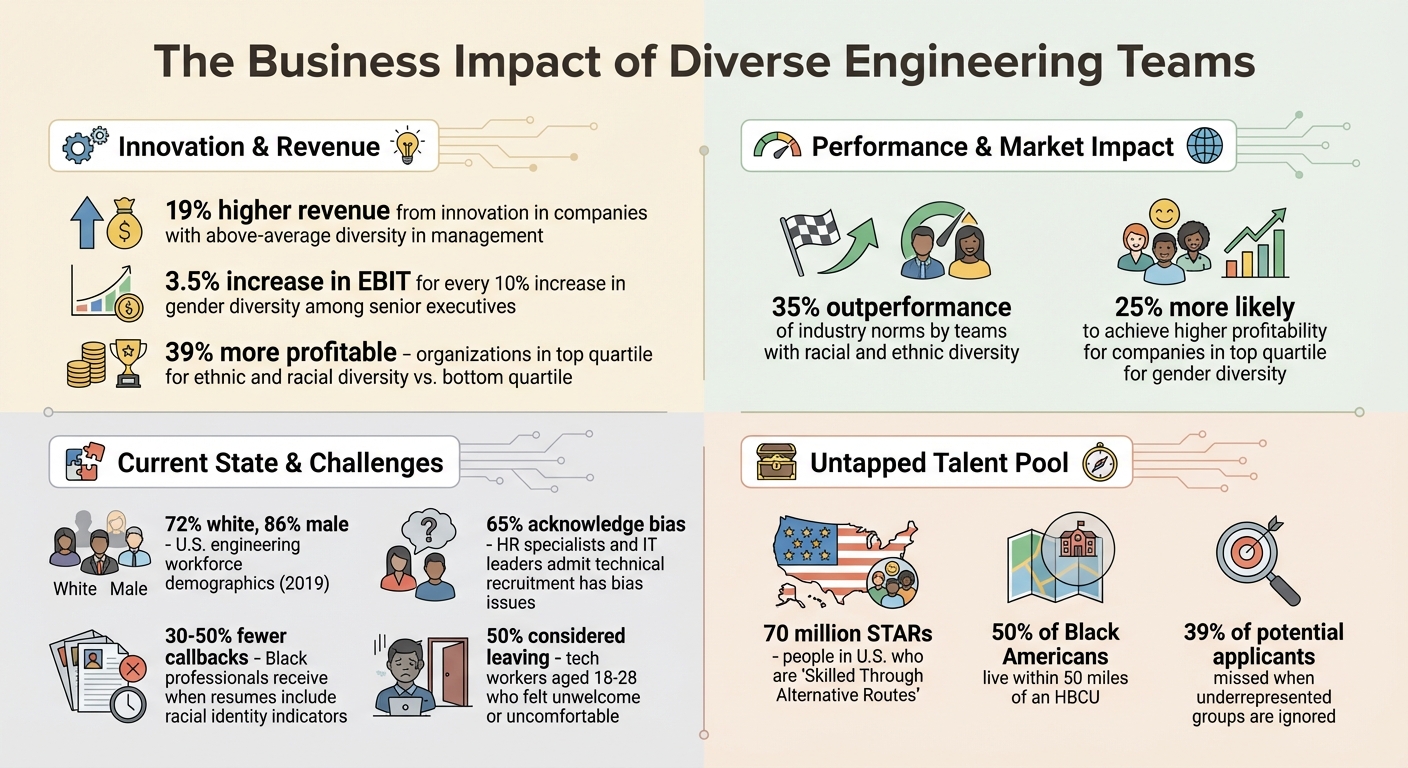 {The Business Impact of Diverse Engineering Teams: Key Statistics}
The Business Case for Diverse Engineering Teams
How Diverse Perspectives Drive Innovation
Diverse engineering teams bring together a mix of perspectives that spark ideas and creativity in ways homogeneous teams simply can't. When you combine individuals from different demographics and experiences, you create an environment that fosters innovation - and this directly impacts financial success.
Consider this: companies with above-average diversity in management see 19% higher revenue from innovation compared to those with lower diversity levels . Plus, for every 10% increase in gender diversity among senior executives, EBIT (earnings before interest and taxes) rises by 3.5% . Even more striking, organizations ranked in the top quartile for ethnic and racial diversity are 39% more profitable than those in the bottom quartile .
Engineers from various backgrounds often identify overlooked needs, like designing for low-connectivity environments or improving accessibility. These insights can turn into standout product features. Beyond sparking innovation, diverse teams also challenge the comfort zones of more uniform groups, leading to sharper, more thoughtful decision-making.
Reducing Groupthink and Improving Decisions
Homogeneous teams may feel easier to manage, but that ease comes with a downside - they tend to fall into groupthink. Familiarity can reinforce shared assumptions and blind teams to critical flaws. Diverse teams, on the other hand, introduce "disfluency", or constructive conflict, which pushes teams to think more critically.
This tension encourages teams to process facts more thoroughly and make decisions grounded in data rather than gut feelings. For example, a study on GitHub found that code written by women had a higher acceptance rate than code written by men - but only when the gender of the coder was unknown. This highlights how bias can cloud technical judgment .
"Diverse teams may present more of a challenge when it comes to communication and collaboration. However, they make up for this with more creativity, better ideas and better outcomes." - Gabrielle Tang, Director of Community, SheSharp
Psychological safety is the foundation for this dynamic. Teams need to welcome dissenting opinions - those "squeaky wheels" who question assumptions and point out flaws. When dissent is encouraged, teams collaborate more effectively, focusing on accuracy and problem-solving rather than just maintaining harmony. This approach reduces blind spots and ensures products better align with the needs of a diverse customer base.
Better Market Coverage and Customer Understanding
The benefits of diverse perspectives naturally extend to understanding your market more effectively. Your customers come from all walks of life - shouldn't your engineering team reflect that? Gender-diverse teams, for instance, are better equipped to anticipate customer needs, design intuitive products, and identify emerging trends because they mirror the marketplace they serve .
The numbers back this up: companies with racial and ethnic diversity outperform industry averages by 35% . This isn't luck - it's about being in tune with market demands. Teams built with a variety of socioeconomic backgrounds, educational paths, and life experiences are better positioned to spot opportunities that others overlook.
However, there's a big challenge here: engineering teams often lag behind other departments in diversity. Traditional hiring practices, like relying on resumes, tend to favor conventional candidates over those with nontraditional but valuable skills. This creates a bottleneck, stifling innovation and limiting market potential. The solution? Move beyond assumptions about underrepresented groups. Actively seek feedback from diverse candidates and use objective skills assessments to identify top talent, no matter where it comes from.
Hiring engineers?
Connect with developers where they actually hang out. No cold outreach, just real conversations.
Where the Hiring Pipeline Breaks Down
Tech companies often lose diverse candidates at predictable stages in their hiring process. The main issues arise during sourcing, evaluation, and the offer stage. Pinpointing where these breakdowns occur is the first step toward addressing them.
Sourcing Challenges: Limited Networks and Platforms
Recruiters tend to rely on familiar platforms like LinkedIn, Twitter, and personal networks to find candidates. The downside? These networks often reflect the demographics of the people using them. If a hiring manager's network is dominated by white, top-tier CS graduates, that’s who ends up in the pipeline.
As of 2019, 72% of the 192,270 engineers in the U.S. were white, and 86% were male . This isn’t because diverse talent doesn’t exist - it’s because traditional sourcing methods often exclude it. Overemphasizing "prestige" markers like specific universities can overshadow qualified candidates from coding bootcamps, community organizations, or unconventional career paths.
"Being a graduate of a certain university or connected via past work experience is not a culture, it is an excuse for homogeneity." - Juan Guardado, Senior Engineering Manager
These sourcing habits set the stage for further bias during the evaluation process.
Bias in Screening and Interviews
Even after sourcing, bias continues to shrink the pool of diverse candidates. In fact, 65% of HR specialists and IT leaders acknowledge that technical recruitment is riddled with bias . The often vague standard of "culture fit" tends to exclude candidates who don't mirror the existing team.
Interview structures can make things worse. Whiteboard-style tests often measure performance anxiety rather than actual coding ability, and homogeneous interview panels amplify "similarity bias", where interviewers favor candidates who remind them of themselves . This bias has real consequences: Black professionals are 30% to 50% less likely to receive callbacks when their resumes include indicators of racial identity . Eliminating these biases is essential for creating a fairer hiring process.
Offer Stage Problems and Equity Gaps
Even when diverse candidates make it through interviews, the offer stage introduces new hurdles. Without clear, standardized criteria, hiring managers often default to subjective judgments, favoring candidates from elite institutions or their personal networks. This leads to inequities in compensation and job titles.
The recruiting process itself can feel alienating for underrepresented candidates. Without transparent communication about evaluation criteria and expectations, candidates often feel excluded. Half of tech workers aged 18–28 have considered leaving or have left a job because they felt unwelcome or uncomfortable, with even higher rates among Asian, Black, and Hispanic respondents . If candidates don’t see themselves reflected in leadership or feel unsure about their belonging, they’re likely to reject an offer - no matter how attractive the salary might be.
How to Expand Your Talent Sourcing
Once you’ve pinpointed where traditional hiring methods fall short, it’s time to rethink your approach. The aim? To connect with skilled engineers who aren’t in your current pipeline - not because they don’t exist, but because your methods haven’t reached them yet.
Partner with HBCUs, Bootcamps, and Community Organizations
Historically Black Colleges and Universities (HBCUs) represent an underutilized resource for tech recruiters. Did you know that 50% of Black Americans live within 50 miles of an HBCU ? Yet, many companies overlook these institutions entirely. The issue often stems from a lack of familiarity and genuine engagement.
"Industry leaders often do not have direct experiences with HBCU campuses, so they need to work intentionally to grasp the full magnitude of what HBCUs offer." - Julian Thompson, Senior Director of Strategy Development, UNCF Institute for Capacity Building
Building meaningful relationships with HBCUs goes beyond attending an annual career fair. For instance, in 2023, Zoom demonstrated its commitment by placing a leader on Claflin University’s Board of Trustees . Similarly, Adobe collaborated with HBCU 20x20 in 2026 to host a fully funded, four-week professional development fellowship for 40 rising juniors, offering workshops and mentorship sessions to prepare them for careers at Adobe . U.S. Bank also introduced a four-week Technology Fellowship focusing on fintech innovation, encouraging participants to apply for paid internships the following summer .
These efforts succeed because they bridge the gap between academia and industry. Many HBCU faculty members lack direct insight into the skills companies are seeking, so collaborating with professors can help align curricula with market needs . Organizations like the UNCF Institute for Capacity Building and the Thurgood Marshall College Fund can connect you with networks of institutions, saving you the effort of establishing individual relationships .
Beyond HBCUs, coding bootcamps and groups like Women Who Code and Blacks in Technology offer access to diverse talent pools. Engaging with active developer communities can also help you discover passive candidates who are often missed by traditional sourcing methods.
Engage Developer Communities for Better Reach
While partnerships with institutions can widen your pipeline, developer communities offer a direct line to passive talent - those not actively job hunting but open to the right opportunity. Unlike platforms like LinkedIn or job boards, these communities are where developers discuss ideas, learn, and connect - not polish their resumes.
Tools like daily.dev Recruiter capitalize on this dynamic. Instead of relying on cold outreach or scraped databases, it connects companies with developers through their daily online activities. Every introduction is warm and double opt-in, ensuring that both parties are genuinely interested. This approach turns recruiting into a trust-based process, replacing impersonal cold emails with meaningful connections.
What makes this method so effective? It focuses on skills, interests, and activity rather than job titles or educational backgrounds. This naturally expands your reach to include underrepresented talent that traditional platforms often miss.
Use Data to Identify Diverse Candidate Pools
Data isn’t just a tool for spotting diverse talent - it’s also key to identifying and addressing biases in your hiring process. Start by comparing your workforce demographics to national benchmarks. For instance, unemployment rates for disabled individuals are at 12.6%, while veterans face rates between 6.5% and 6.7% . If your team doesn’t reflect these figures, it’s a sign your sourcing strategy may be unintentionally excluding these groups.
Track your recruitment channels against diversity benchmarks and apply the "70% Rule": if a candidate meets 70% of your requirements, consider the remaining 30% as skills they can develop . This prevents you from dismissing talented individuals who may not check every box but have the potential to excel. By linking sourcing data to retention and performance metrics, you can identify which channels consistently bring in high-quality, diverse talent. Ignoring underrepresented groups means missing out on 39% of potential job applicants - a significant loss that data can help you recover.
Additionally, audit your job descriptions with data-driven tools to ensure they’re inclusive, using proven methods for technical recruitment. Words like "ninja", "competitive", or "dominant" have been shown to discourage women and people of color from applying . Use skills-based assessments designed by Industrial-Organizational (IO) Psychologists to reduce unconscious bias during the initial screening process .
"By using measurable data to improve diversity in your hiring practices, you can increase your company's hiring pool and improve overall performance." - Crosschq
Reducing Bias in Technical Interviews
Even with improved sourcing strategies, bias can still creep into technical interviews. Nearly half of HR managers - 48% - acknowledge that bias influences their hiring decisions . And the consequences? They’re costly. A bad hire can set a company back around $17,000, not to mention the 26% of a manager’s time spent coaching someone who isn’t the right fit . Addressing this issue is essential. The goal isn’t to remove human judgment entirely but to create a fair and structured process that gives every candidate an equal chance. Building on earlier improvements in sourcing and screening, this section explores how to make interviews more equitable.
Structured Interviews and Standardized Tests
One of the best ways to minimize bias is through structured interviews. This means asking every candidate the same questions in the same order. When interviewers stray from a script, they might unintentionally give some candidates tougher questions or let others off easy. A structured approach ensures everyone is evaluated using the same criteria .
"Humans' unconscious bias will play a role in any interview, especially if it's not standardized." – Guillermo Corea, Managing Director, SHRMLabs
Start by identifying the key competencies the role requires before drafting interview questions. Then, create a series of questions that build on a single scenario, progressing in difficulty. This not only helps candidates feel more confident but also mimics how real-world coding challenges evolve. Train interviewers to provide consistent hints and avoid questions tied to specific cultural or regional knowledge - like sports trivia - that could disadvantage some candidates. This structured approach lays the groundwork for assembling diverse interview panels.
Build Diverse Interview Panels
The makeup of your interview panel is just as important as the questions you ask. A great example comes from Intel, which introduced a policy in 2014 requiring interview panels to include at least two women or members of underrepresented groups. The results? Diverse hires jumped from 31% to 45% within a few years . Panels like these help counter unconscious tendencies to favor candidates who feel familiar while also showing applicants that your company values inclusivity.
However, representation must be meaningful. Don’t assign a junior engineer to a senior-level panel just to check a diversity box - candidates can tell when representation isn’t genuine. If your team lacks diversity, consider involving HR professionals or external consultants to ensure fairness in the process. Establish clear, skills-based evaluation criteria and avoid vague concepts like "cultural fit." Instead, focus on assessing cultural alignment through objective rubrics and shared values. Also, be mindful not to overburden underrepresented employees with frequent panel responsibilities, as this can lead to burnout.
Prioritize Skills Over Credentials
Requiring a four-year degree for every engineering role shuts out a massive pool of talent - about 70 million people in the U.S. are "Skilled Through Alternative Routes" (STARs), gaining expertise through bootcamps, self-learning, or hands-on experience . Research shows that skill-based hiring predicts job performance five times better than focusing on degrees . Yet, only 13% of college graduates are considered job-ready upon graduation .
In 2021, the U.S. White House limited educational requirements for federal IT roles, recognizing that degree-based hiring excludes skilled workers and disrupts labor-market efficiency . Companies like Goldman Sachs have followed suit, allowing applicants to apply directly to skill areas instead of traditional job titles, using online tests to match them with roles . Similarly, IBM, Dell, Accenture, and Amazon have reduced degree requirements across various roles .
To adopt this approach, review job descriptions and remove unnecessary degree requirements. Replace them with standardized assessments like coding challenges, troubleshooting scenarios, or portfolio reviews to evaluate real-world skills. Highlight transferable abilities, such as problem-solving and adaptability, and consider trial projects to address any lingering doubts before making permanent offers. By shifting the focus from credentials to skills, companies can create a more inclusive and effective hiring process.
Writing Job Descriptions That Attract Diverse Candidates
Job descriptions play a critical role in shaping diverse engineering teams. They act as a filter before resumes even reach recruiters, and the language you use sends a clear message about who belongs at your company. Overusing terms like "rockstar" and "ninja" can unintentionally signal exclusivity, discouraging women and underrepresented groups from applying. Instead, focusing on clear, straightforward descriptions of the actual work tends to draw a more diverse and qualified pool of applicants.
Words That Attract vs. Repel Diverse Candidates
The words you choose in a job posting can either invite or exclude candidates. Phrases like "rockstar", "aggressive", or "digital native" are often gender- or age-coded, deterring underrepresented groups from applying. Research shows that removing such coded language can increase application rates by 29% and lower the cost-per-application by 41%. Interestingly, job postings that led to hiring a man contained nearly twice as many masculine-tone phrases compared to those where a woman was hired .
"The words in your posting are filtering candidates before a recruiter ever sees a resume." – Kieran Snyder, CEO, Textio
Language matters beyond gender and age. Phrases like "fast-paced" or "excellent multitasker" can unintentionally alienate neurodiverse candidates by implying a lack of structure. Instead, try more specific and clear alternatives, such as "dynamic environment with clear priorities" or "manages 3–4 concurrent projects" . For disability inclusion, focus on outcomes. For example, say "must be able to travel to client sites" rather than "must have a valid driver’s license", which excludes those who rely on alternative transportation .
Keep the list of requirements concise - stick to 3–5 essentials - and move any additional qualifications to a "Nice to Have" section. Use "you" instead of gendered terms like "he/she" to make the role feel inclusive. Tools like Gender Decoder and Appcast Gender Bias Decoder can help identify problematic phrasing, while enterprise solutions like Ongig Text Analyzer (starting at $17,900 annually) offer deeper analysis .
These adjustments align with broader inclusive hiring strategies and help foster a welcoming tone.
Emphasize Growth and Your Commitment to Inclusion
Refining language is just one step. Showing a genuine commitment to candidate growth strengthens an inclusive hiring process. Generic equal opportunity statements buried at the bottom of a posting often fail to resonate. On the other hand, a thoughtful diversity statement - one that acknowledges candidates may not meet every requirement but encourages them to apply - leaves a much stronger impression. In fact, 71% of candidates view such statements positively, compared to 44% for generic language . Place these statements prominently and include specific details about the support you offer.
Transparency is key. With 16 U.S. states now requiring salary ranges in job postings as of early 2026, and 61% of applicants prioritizing salary information, including this data builds trust with candidates who may have faced discrimination elsewhere . Additionally, sharing details on remote work policies, the interview process, and accommodations for candidates with disabilities reinforces your commitment to inclusivity. Highlighting mentorship programs, learning stipends, and clear career paths further demonstrates your investment in long-term growth.
Notably, job descriptions written in gender-neutral language are filled two weeks faster on average . This shows that inclusive language not only attracts diverse talent but also speeds up the hiring process, making it a win-win for both companies and candidates.
Retention: The Real DEI Metric
Hiring diverse talent is just the beginning. The real challenge - and the true measure of success in diversity, equity, and inclusion (DEI) - is retention. Keeping diverse engineers on board shows that your commitment goes beyond surface-level efforts. Companies in the top quartile for gender diversity are 25% more likely to achieve higher profitability . The real question isn’t what your careers page looks like; it’s whether diverse employees see a long-term future with your company.
Create a Workplace Where Everyone Belongs
Psychological safety is a key factor in team success. When engineers feel safe to admit mistakes, voice differing opinions, and take risks without fear of backlash, they’re far more likely to stay . For instance, Zenjob introduced transparent gender-balance reporting and structured mentorship programs in 2021. These initiatives helped women make up 32% of their engineering team and 33% of their engineering leadership .
Employee Resource Groups (ERGs) also play a big role in fostering a sense of belonging. SoundCloud, for example, has ERGs like WINE (Women in Engineering) and "Clouds of Color." These groups supported their Developer Bridge program, which focuses on nurturing junior talent from marginalized communities . It’s no surprise that about 90% of Fortune 500 companies now utilize ERGs .
Another critical strategy is conducting regular reviews of performance and compensation. By addressing potential biases in management decisions, companies can prevent diverse talent from feeling undervalued or overlooked . A workplace culture that combines support with clear career advancement opportunities ensures that employees not only feel valued but also see a future with the company.
Provide Clear Growth Paths for Underrepresented Talent
Retention often falters when underrepresented engineers don’t see a way to grow within the organization. Twitter offers a good example of how to address this. In May 2021, they promoted Joy Su to VP of Product Foundation and Jessie Link to VP of Team Development. These promotions not only recognized their contributions but also sent a strong message about the importance of visible career progression for retaining top talent .
"Why groom diverse talent for someone else to show them more appreciation via promotion and leveling?" - Dr. Maisha Gray-Diggs, VP of Talent Acquisition at Twitter
Structured mentorship programs are another powerful tool. Pairing underrepresented engineers with senior leaders for at least six meetings over six months can significantly boost career growth . Providing dedicated learning budgets for events like FemTechConf further supports professional development . Additionally, transparent promotion processes - where opportunities are openly announced rather than quietly offered to select individuals - help reinforce a culture where advancement is based on merit, not connections. This kind of transparency strengthens trust and underscores the company’s commitment to DEI .
Measuring Progress Without Tokenizing
Once you've built strong retention practices, the next step is figuring out how to measure progress without reducing your workforce to mere statistics.
Track Representation, Retention, and Leadership
The metrics you choose to monitor will reveal whether your DEI (Diversity, Equity, and Inclusion) efforts are meaningful or just for show. Vanity metrics might look good on paper but fail to reflect real progress. For example, some companies inflate their diversity numbers by including non-engineering staff, like administrative assistants, in their engineering team counts - a tactic that skews the data and undermines trust .
Instead, focus on tracking data across the full employee lifecycle. This includes demographic breakdowns, promotion rates, and attrition at every stage of hiring and employment. Leadership metrics are especially telling - monitor the percentage of employees reporting to managers from underrepresented groups and examine the demographic composition of your Board of Directors . If women and people of color are missing from leadership roles, it’s a red flag, even if overall diversity numbers look good .
Compensation equity is another critical area. Analyze salaries, bonuses, raises, and equity distributions by demographic groups. To illustrate, Salesforce has invested more than $22 million since 2015 to conduct pay equity audits, addressing disparities as they arise . Companies with over 200 employees should consider publishing diversity reports annually, while those experiencing rapid growth should aim for biannual updates .
But numbers alone aren’t enough. What truly matters is how these metrics translate into leadership opportunities and a workplace culture that supports everyone.
Avoid Performative DEI: What Developers Actually Notice
Developers tend to assess a company’s commitment to DEI by looking at its leadership rather than its marketing materials. Photos on a careers page won’t cut it - what matters is whether leadership visibly reflects diversity. This aligns with a broader trend: 76% of job seekers and employees prioritize a diverse workforce when considering job offers . They also pay attention to whether underrepresented engineers are advancing into senior and leadership roles.
To avoid tokenization, apply the "rule of five" when reviewing metrics. Only analyze data for demographic groups with at least five members to protect individuals’ privacy and prevent them from being singled out in small teams . Regular employee engagement surveys can also provide insight into organizational health and help identify factors that lead to dissatisfaction or turnover . The ultimate goal isn’t just hiring diverse talent - it’s creating an environment where they feel they belong and can grow.
When your metrics align with real changes in workplace culture and leadership, your DEI efforts evolve from surface-level to something truly impactful.
How daily.dev Recruiter Reaches Underrepresented Talent
Most traditional recruitment platforms rely heavily on resume databases and cold outreach, which often reinforce existing biases and overlook non-traditional candidates. daily.dev Recruiter flips this script by connecting employers with developers in the spaces where they naturally spend their time - learning, collaborating, and engaging with a vibrant professional community. This approach opens doors to diverse talent pools that might otherwise be missed.
Built on a Developer Network, Not a Resume Database
Instead of scraping profiles or relying on outdated resumes, daily.dev Recruiter operates within an active developer network. Developers on the platform engage over 200 times per month, creating a dynamic space for interaction. The platform has earned impressive recognition, including 20,000+ stars on GitHub, being named "Product of the Year" on Product Hunt, and maintaining an outstanding 4.8/5 rating from over 2,500 reviews.
As Nimrod Kramer, CEO & Co-Founder of daily.dev, puts it:
"We built a place where engineers can turn off the noise. To enter this space, you don't need a hack. You need trust."
Interestingly, 85–90% of daily.dev users are already employed and not actively job hunting . By embedding recruitment within this thriving network, the platform promotes more inclusive hiring practices and reaches talent that traditional methods often miss.
Warm Introductions Replace Cold Outreach
With daily.dev Recruiter, cold outreach is a thing of the past. The platform uses a double opt-in system, privately showing your job listings to developers who are already aligned with your needs based on their interests, activities, and expertise - not just keywords on a resume. This ensures you connect only with developers who have expressed interest in your role.
To further refine the process, the platform allows up to three screening questions and verifies candidates' activity to confirm they meet your technical requirements before making an introduction . This thoughtful approach saves time and ensures meaningful connections.
Target Passive Talent with Behavior-Based Filters
Beyond warm introductions, daily.dev Recruiter uses advanced behavioral filters to identify top candidates. By analyzing real-time engagement - such as the content developers read, the groups they join (e.g., "Frontend Architects"), and the technologies they follow - the platform surfaces candidates with relevant skills and interests, even if they come from non-traditional backgrounds.
For instance, you might find developers exploring GenAI topics, contributing to open-source projects, or engaging with specific technical discussions. These signals go deeper than typical keyword searches, making it easier to discover talent that might otherwise go unnoticed. Plus, the platform integrates with your existing ATS to automatically filter out duplicates, streamlining your hiring process.
The cost? $350 per role per month, with no placement fees or long-term contracts .
Conclusion: Taking Action to Build Diverse Teams
Building diverse engineering teams is about more than just appearances - it's about creating an environment where inclusive leadership is the norm. Developers can easily discern whether diversity efforts are authentic or merely surface-level. The real measure of success? Underrepresented talent seeing themselves in decision-making roles.
A common pitfall in diversity efforts is poor management. Dr. Maisha Gray-Diggs, VP of Talent Acquisition at Twitter, highlights this issue perfectly:
"Why groom diverse talent for someone else to show them more appreciation via promotion and leveling?"
To address this, diversity recruiting must be a shared responsibility. Both recruiting teams and engineering managers need to commit to inclusive hiring practices. This "sliding door" approach ensures that everyone plays a role in fostering diversity .
Taking action starts with practical steps. Review your job descriptions to remove gendered language. Implement a 70-30 hiring rule to balance experience with potential, and invest in mentoring programs to close skill gaps . Transparency is key - posting clear salary bands can attract underrepresented candidates . Even small changes, like providing interview feedback within 48 hours, can make a big difference, reducing candidate drop-off rates from 28% to 14% .
Retention is just as critical as recruitment. Focus on addressing workplace imbalances that contribute to higher turnover among women and other underrepresented groups. This means fostering psychological safety, ensuring transparent promotion processes, and prioritizing diversity in leadership .
Of course, recruitment strategies must align with these internal efforts. Platforms like daily.dev Recruiter offer solutions by connecting companies with engaged developers in a trusted community space. With a double opt-in system and behavioral filters, this service helps you expand your sourcing efforts. At $350 per role per month and no placement fees, it's a cost-effective way to build the diverse team your company needs .
FAQs
Where should I start if my engineering team is not diverse today?
Expanding your sourcing efforts is a critical first step in creating a more inclusive hiring process. Don’t limit yourself to your current network - branch out to connect with underrepresented communities. For example, you can collaborate with Historically Black Colleges and Universities (HBCUs), coding bootcamps, and local community organizations. These partnerships can help you tap into a wider pool of talented candidates who might not otherwise cross your radar.
By reaching out to these groups, you address potential gaps in your pipeline at the sourcing stage, ensuring that inclusivity is baked into your hiring process from the very beginning.
How can we make technical interviews fair without lowering the bar?
To create a fair environment in technical interviews without compromising on quality, it’s crucial to focus on the core requirements of the role and evaluate candidates based on their unique strengths. A helpful approach is the 70-30 rule: prioritize hiring candidates who meet 70% of the qualifications, with the understanding that the remaining 30% can be developed through training and on-the-job learning.
Using structured interviews and standardized questions is another effective way to minimize bias. This method ensures consistency across interviews and places emphasis on a candidate’s potential, rather than rigidly sticking to a predefined checklist. By adopting this approach, you can expand your talent pool while still maintaining high standards.
What metrics show our DEI efforts are working without tokenizing people?
To gauge the impact of DEI initiatives without falling into tokenization, focus on tracking metrics such as hiring diversity, retention rates, and overall representation across your organization. Leverage data-driven dashboards to observe trends and measure progress over time, emphasizing broader team outcomes instead of singling out individual identities. Start by establishing baseline data and setting specific, actionable goals to create a foundation for meaningful and measurable improvements.
.png)