Developer cost-per-hire is the total expense of filling one developer role, including internal and external recruitment costs. For tech roles, this metric averages $6,200, but hiring specialized or senior developers can exceed $15,000 to $30,000. Tracking this helps you manage your hiring budget, identify inefficiencies, and make better decisions about recruitment spending.
Key Formula:
Cost-Per-Hire (CPH) = (Internal Costs + External Costs) ÷ Total Number of Hires
Examples of Costs:
- Internal Costs: Recruiter salaries, time spent by hiring managers, referral bonuses, software fees.
- External Costs: Agency fees, job board postings, developer assessment tools, relocation expenses.
Why It Matters:
- Helps forecast hiring budgets (e.g., $4,000 CPH × 20 hires = $80,000).
- Reveals inefficiencies like over-reliance on agencies or underperforming job boards.
- Guides investment in better developer sourcing tools or strategies.
While lowering CPH is important, balancing cost with candidate quality ensures long-term success. Use this metric alongside others like retention rates and quality-of-hire to optimize your recruitment process.
::: @figure 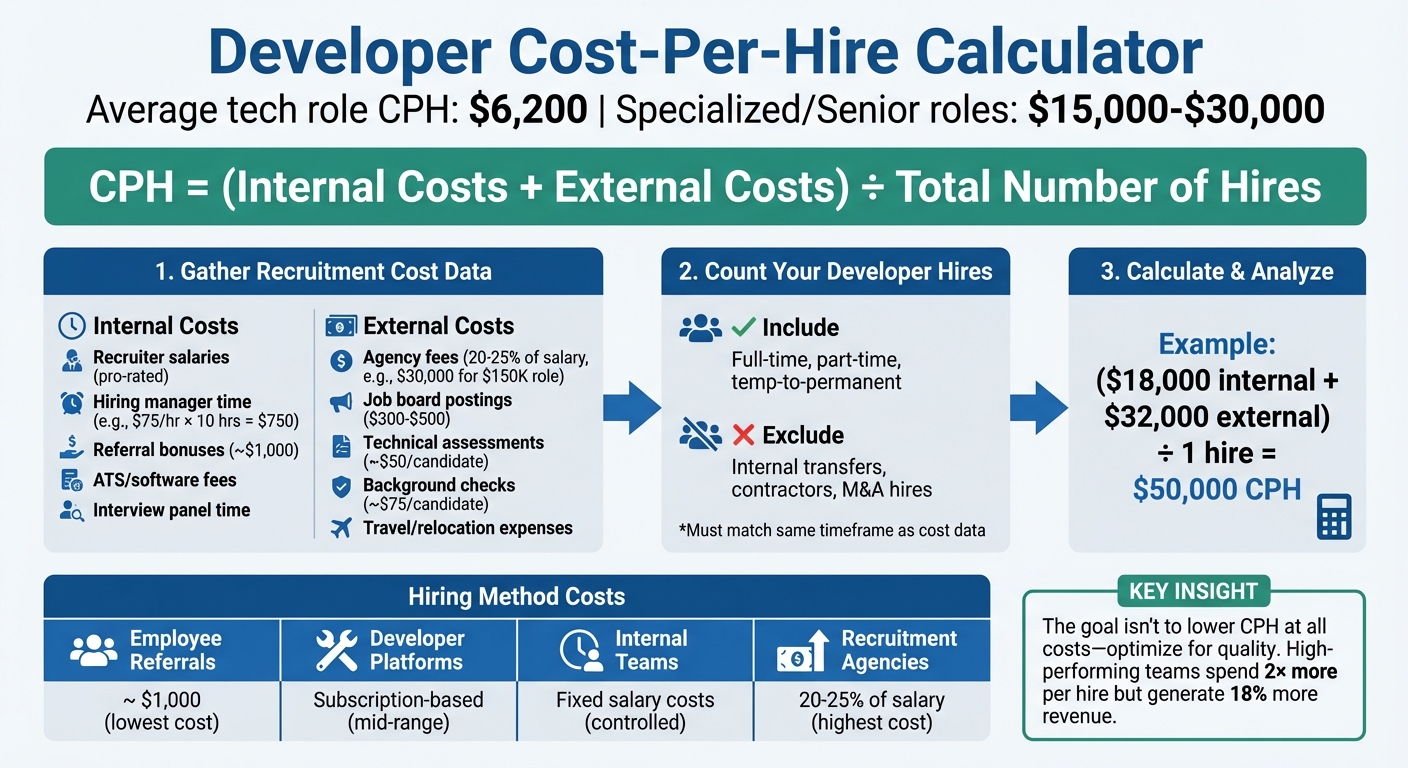 {How to Calculate Developer Cost-Per-Hire: 3-Step Formula and Breakdown}
What is Developer Cost-Per-Hire?
Cost-per-hire (CPH) is a recruitment metric that calculates the average total cost involved in filling a single job vacancy . This includes expenses like recruiter salaries, job board fees, and the time senior engineers dedicate to interviews. For developer roles, the cost often exceeds the general industry average of $4,700, with specialized developer positions potentially surpassing $50,000 .
Hiring developers requires tailored sourcing strategies, technical evaluations, and significant time from key team members. For instance, if a CTO earning $200 per hour spends five hours interviewing a candidate, that alone adds $1,000 to your internal recruitment costs.
The Basic Cost-Per-Hire Formula
The Society for Human Resource Management (SHRM) and the American National Standards Institute (ANSI) established a standardized formula for CPH in 2012 :
CPH = (Internal Recruiting Costs + External Recruiting Costs) / Total Number of Hires
- Internal costs include recruiter salaries, referral bonuses, applicant tracking system (ATS) fees, and the time hiring managers and senior engineers spend on screenings and interviews .
- External costs cover agency fees (usually 20–25% of a developer's salary), job board postings, coding assessment tools, and candidate travel or relocation expenses .
It's important to note that CPH does not account for post-hire expenses like onboarding, training, or equipment .
"One of the most common mistakes I see is companies only counting the recruiter's salary. The truth is, the combined time of the interview panel and hiring manager can easily dwarf the recruiter's time." - Klearskill
By understanding this formula, companies can not only quantify their recruiting investment but also make data-driven adjustments to improve their hiring strategies.
Why Cost-Per-Hire Matters for Developer Recruitment
Tracking CPH goes beyond managing budgets - it helps you make better strategic decisions. Knowing your CPH allows you to forecast recruitment expenses with precision. For example, if your average CPH is $4,000 and you plan to hire 20 developers, you can confidently allocate $80,000 for recruitment . This metric also helps talent acquisition teams demonstrate their return on investment to boards and investors .
Additionally, CPH can reveal which sourcing methods provide the best candidates at the lowest cost and highlight inefficiencies in the hiring process when paired with metrics like time-to-fill . Considering that recruitment costs often represent 15% of total HR spending , improving CPH can significantly affect your overall budget.
However, the goal isn't simply to lower CPH at all costs. Mature talent acquisition teams may spend twice as much per hire as less mature ones but often generate 18% more revenue overall .
"Cost per hire is less a goal you need to meet and more a tool for optimizing your hiring process." - 100Hires
Internal and External Recruiting Costs Explained
When figuring out your developer cost-per-hire, it’s essential to break it down into two main categories: internal costs and external costs. Each category highlights different parts of your recruitment spending, giving you a complete view of the overall investment.
Internal Recruiting Costs
Internal costs cover the resources you’ve already allocated to recruitment efforts. A major chunk of this comes from recruiter salaries, calculated based on the time they spend hiring developers. For example, if a recruiter earns $80,000 annually and spends 40% of their time hiring developers, $32,000 of their salary would count as a recruitment cost .
Other internal costs come from hiring managers and interviewers. Let’s say a senior engineer earns $75 per hour and spends 10 hours interviewing candidates - that’s an additional $750 per hire . Beyond this, you’ll also account for referral bonuses, recruitment software, training sessions, recruitment success metrics, and administrative overhead . Don’t forget developer-specific activities, like hackathons or tech meetups, which add to the total .
These internal expenses make up one half of your recruitment budget.
External Recruiting Costs
External costs, on the other hand, are the out-of-pocket expenses paid to third-party services . The largest contributor here is typically agency fees, which often range from 15% to 30% of a developer’s first-year salary. For instance, hiring a senior developer with a $150,000 salary at a 20% agency fee would cost you $30,000 .
Other external costs include job board postings, which can range from $300 to $500 for premium or niche listings. Technical assessment tools might cost around $50 per candidate, while background checks typically run about $75 per candidate . Additional expenses could involve recruitment advertising, reimbursing candidates for travel, or even relocation packages.
Understanding these costs is key when applying the cost-per-hire formula. If you’re aiming to cut back on pricey agency fees while still accessing qualified candidates, platforms like daily.dev Recruiter can be a game-changer. They connect you directly with pre-qualified, engaged developers in an active professional network - cutting out cold outreach and reducing the time spent on screening.
With these details in hand, you’ll be well-prepared to calculate and fine-tune your developer cost-per-hire.
How to Calculate Developer Cost-Per-Hire: Step-by-Step
Here’s a straightforward three-step process to figure out your developer cost-per-hire.
Step 1: Gather Recruitment Cost Data
Start by collecting all recruitment-related expenses for the same period. Make sure your costs and hires align within the same timeframe .
For internal costs, include recruiter salaries and benefits (pro-rated for the time spent on developer hiring), employee referral bonuses, ATS and recruitment software fees, and the time hiring managers and engineers spend interviewing. To calculate the "cost of time", multiply an employee’s hourly rate by the hours they spend on hiring tasks. For example, if a senior engineer earns $75 per hour and spends 10 hours interviewing, that’s $750 in internal costs .
For external costs, account for job board fees (including premium listings), various sourcing channels, third-party agency commissions, coding assessment platform fees, background checks, candidate travel reimbursements, and relocation packages. Don’t overlook specialized developer expenses like technical assessment tools - they can add up fast .
Once you’ve gathered all this data, you’re ready to move on to Step 2.
Step 2: Count Your Developer Hires
Now, count how many developers joined your company during the same period you tracked costs. This includes full-time and part-time hires, as well as temporary staff who transitioned to full-time roles. Exclude internal transfers, contractors, consultants, and employees brought in through mergers or acquisitions .
It’s crucial that your hire count matches the timeframe for your cost data. For instance, if you tracked costs for Q1 2025, only include developers who started during Q1 2025.
Step 3: Calculate and Analyze Your Cost-Per-Hire
With your costs (Step 1) and hire count (Step 2) ready, apply this formula:
(Total Internal Costs + Total External Costs) ÷ Total Number of Hires .
For example, if you spent $18,000 on internal costs and $32,000 on external costs for one hire, your cost-per-hire would be $50,000 . Compare this figure to industry benchmarks to gauge your efficiency. In the tech industry, the average cost-per-hire is $6,200 .
However, a lower cost-per-hire isn’t always better. As Klearskill points out:
"The goal isn't just to lower your cost per hire - it's to optimize it. True success means finding that sweet spot where you're investing just enough to attract and land the best people for the job, efficiently" .
Cutting expenses too much can hurt candidate quality and lead to higher turnover, which ends up being more costly in the long run.
For a deeper dive, calculate your Recruiting Cost Rate (RCR) by dividing your total recruiting costs by the total annual compensation of new hires, then multiplying by 100. This metric helps justify higher spending on senior developers who bring more value to your team .
Developer Cost-Per-Hire Benchmarks
After determining your recruitment costs, it's helpful to put those numbers into perspective. Comparing your data with tech recruiting benchmarks can highlight areas where adjustments might be needed and show whether your spending aligns with typical market trends.
Average Cost-Per-Hire for Developers
Hiring developers is notably more expensive than filling most other roles. In 2024, the average cost-per-hire for developers was $28,548 - substantially higher than the U.S. overall average of $4,700 . General tech roles average closer to $6,200 , with entry-level hires costing between $1,000 and $2,000 , and executive positions ranging from $15,000 to $30,000 . Specialized developer roles tend to drive up costs further due to extensive technical evaluations, competitive compensation packages, and longer hiring cycles.
Factors like seniority and location significantly impact these costs. For example, hiring in San Francisco can increase expenses by about 1.4 times the national average .
There are also hidden costs to consider. Matt Watson, CEO of Full Scale, points out:
"The true cost of developer hiring includes 15 hidden factors that inflate budgets by 40-70%"
A real-world example illustrates this: In August 2025, a 50-person B2B SaaS company in Austin, TX, set aside $975,000 to hire five senior developers. However, they ended up spending $1,475,000 - a $500,000 overrun. The additional costs came from higher recruitment fees, delays extending the six-month hiring timeline, onboarding expenses, and the need to replace a developer who departed shortly after being hired .
To get a more precise estimate for your specific needs, you can use a tech hiring budget calculator. Next, let’s explore how different hiring methods can influence these costs.
Cost Comparison by Hiring Method
Some hiring methods are more cost-effective than others. Employee referrals, for instance, often represent the most affordable option. Offering a referral bonus of around $1,000 typically results in costs that are five times lower than using recruitment agencies .
Recruitment agencies, while useful for filling senior or specialized roles, come with steep fees - usually 20% to 25% of the hire’s annual salary. For a developer earning $120,000, this means paying between $24,000 and $30,000 per placement .
Developer-focused platforms like daily.dev Recruiter offer a more balanced approach. These platforms connect you with pre-screened, engaged candidates through warm, double opt-in introductions. This streamlines the hiring process, cutting down on both the time and costs associated with traditional methods like cold outreach or extensive screening.
| Hiring Method | Typical Cost | Key Advantage |
|---|---|---|
| Employee Referrals | ~$1,000 bonus | High retention; significantly lower costs |
| Developer-Focused Platforms | Subscription-based | Access to pre-qualified, engaged talent |
| Recruitment Agencies | 20%–25% of salary | Best for niche or senior positions |
| Internal Teams | Fixed salary costs | Greater control over the hiring process |
Conclusion
Calculating the cost-per-hire for developers is a straightforward process. Begin by defining the time frame you want to analyze. Then, add up your internal expenses - like recruiter salaries, hiring manager time, and referral bonuses - along with external costs such as job board fees, agency commissions, and background check services. Once you’ve got the total, divide it by the number of hires during that period. For deeper insights, break down the results by role type or seniority level.
This calculation does more than help with budgeting; it also sheds light on areas where your hiring process can improve. But keep in mind, the goal isn’t just to lower your cost-per-hire - it’s to strike the right balance between cost and quality. A low cost-per-hire won’t mean much if your new hires don’t stick around or fail to meet performance expectations.
Leveraging specialized tech sourcing tools can make a big difference. For instance, tools like daily.dev Recruiter claim to cut engineering cost-per-hire by 15% while also improving candidate quality. By offering warm, double opt-in introductions to pre-qualified developers, these tools help you avoid the inefficiencies of cold outreach and unqualified applicants. Considering that around 57.6% of developers are passive candidates , targeting them where they already spend their time is both financially and strategically smart.
To get the full picture, pair your cost-per-hire data with metrics like quality-of-hire and retention rates. High-performing recruitment teams often spend more per hire but deliver significantly better outcomes - such as 30% higher revenue per employee . By consistently monitoring these metrics and investing in the right tools and processes, you can achieve hiring results that justify and exceed the initial costs.
FAQs
How can I lower my developer cost-per-hire without compromising on quality?
To bring down your developer cost-per-hire (CPH) without compromising on quality, start by taking a closer look at your current CPH. Pinpoint the areas where you're spending the most - things like advertising, agency fees, or drawn-out hiring processes. One smart move? Tap into employee referrals. They’re often a more affordable way to find great candidates. Another tip: streamline your hiring process. Automate screening steps, cut down on excessive interview rounds, and stick to clear, consistent evaluation criteria. This can help you make faster decisions without lowering your standards.
For a more focused strategy, try using a developer-first talent network like daily.dev Recruiter. It connects you directly with pre-qualified and engaged developers, cutting out the need for pricey ads or third-party agencies. By blending smarter sourcing methods, efficient hiring workflows, and a developer-centric platform, you can reduce your CPH while still bringing in top-notch talent.
What mistakes should I avoid when calculating developer cost-per-hire?
Calculating the cost-per-hire for developers can feel like navigating a maze. Even small mistakes can throw your numbers off, making it harder to get a clear picture of your hiring expenses. Here are a few common errors to keep in mind:
Overlooking important expenses: It's easy to focus on obvious costs like recruiter salaries or job board fees, but there's more to the equation. Be sure to account for internal labor (like the time recruiters and managers spend), external services (such as agency fees or background checks), and onboarding costs (equipment, training sessions, etc.).
Mismatched time frames: To get accurate results, your costs and hires need to align within the same time frame - whether that's a quarter, a year, or another consistent period. Mismatched data can lead to skewed calculations.
Forgetting onboarding expenses: Hiring costs don’t stop at the job offer. Onboarding, training, and resources for new hires - especially for senior or highly specialized roles - should all be factored in.
By keeping an eye on these potential missteps, you’ll be better equipped to calculate cost-per-hire accurately and make more informed hiring decisions.
How do internal and external recruiting costs influence the cost-per-hire calculation?
The cost-per-hire (CPH) is determined by combining internal recruiting costs - such as recruiter salaries, employee referral bonuses, and internal tools - with external recruiting costs, which include expenses like job board postings, agency fees, and candidate travel. Once these costs are totaled, they are divided by the number of hires made during a given time period.
If either internal or external costs rise, the overall CPH will increase. Breaking down these components allows you to better manage your hiring budget and pinpoint opportunities to cut costs without sacrificing efficiency.
.png)