Bad hiring experiences cost you top talent and hurt your brand. Here’s why fixing candidate experience is critical:
- 72% of candidates share negative experiences online.
- 54% abandon applications over poor communication.
- 77% of rejected candidates tell others to avoid your company.
The tech hiring process is riddled with issues like ghosting, irrelevant tests, and drawn-out interviews. These mistakes not only frustrate candidates but also damage your reputation, shrink your talent pool, and increase hiring costs.
Key fixes include:
- Stop ghosting. Provide timely updates and clear rejections.
- Respect candidates' time. Limit tests to 3 hours and avoid excessive rounds.
- Be transparent. Share salary ranges, timelines, and clear expectations upfront.
Treat every candidate as a potential advocate, customer, or future hire. Even rejected candidates can boost your brand if treated respectfully.
::: @figure 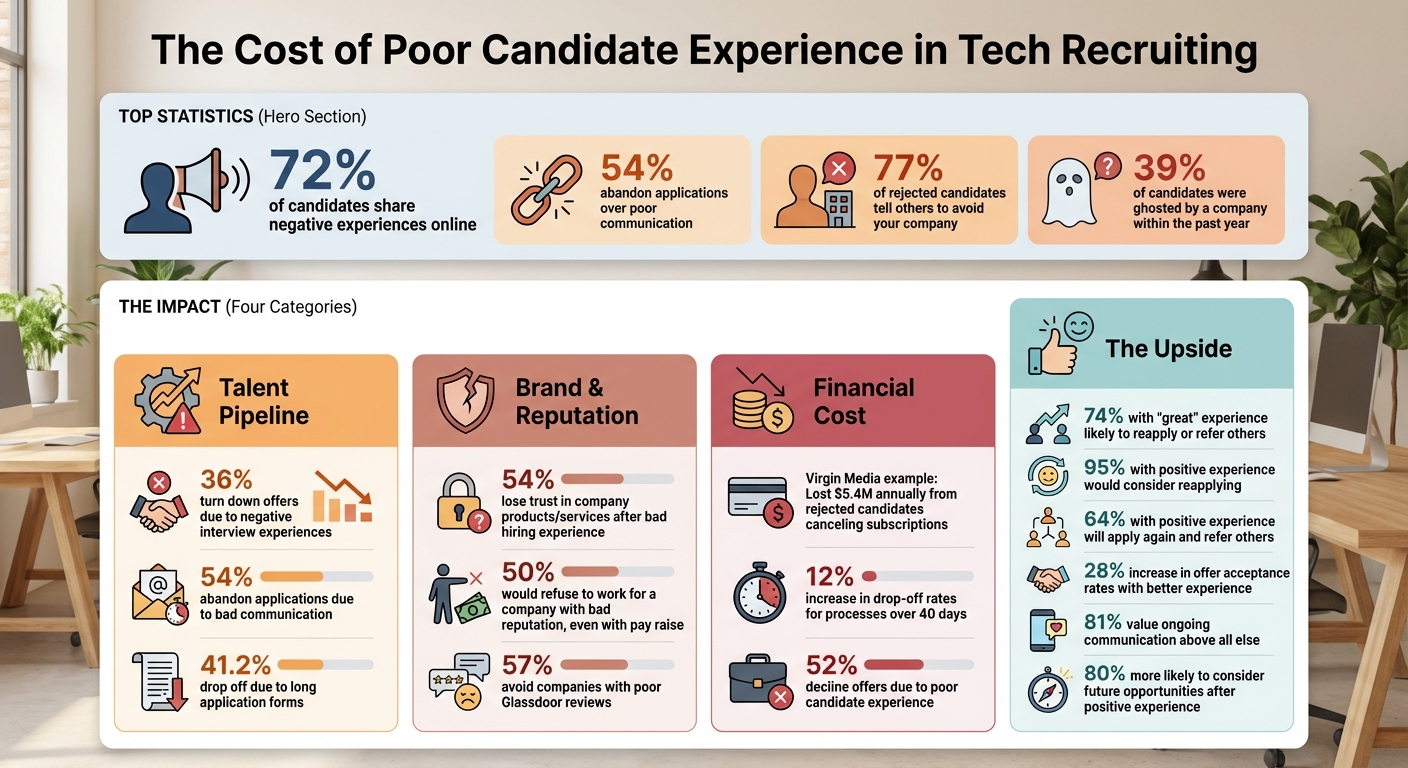 {The Cost of Poor Candidate Experience in Tech Recruiting}
The Candidate Experience Crisis in Tech Recruiting
The tech hiring process has hit a rough patch. A developer survey highlighted 66 complaints about the "torched trust" caused by current hiring practices . The issues range from overly complex interview loops - sometimes 10 times harder than the job itself - to lengthy six-round interview processes for positions offering as little as $220/month .
Among all these problems, ghosting takes the crown as the most damaging. Candidates often face radio silence after interviews or applications, leaving them frustrated and disillusioned. In fact, 39% of candidates reported being ghosted by a company within the past year . This lack of communication turns candidates into detractors. As Nimrod Kramer, CEO of daily.dev, aptly states:
"Silence is the fastest way to turn a neutral candidate into a detractor. Even a two-line 'no and why' beats the black hole."
What Poor Candidate Experience Costs You
These missteps in the hiring process don’t just frustrate candidates - they actively undermine your ability to recruit effectively. Poor communication is a dealbreaker for many. A staggering 54% of candidates have abandoned a job application due to bad communication , and 36% have turned down offers because of negative interview experiences . When you ghost candidates or put them through unnecessary hurdles, you’re not just losing one person - you’re losing everyone they share their experience with.
But the damage doesn’t stop there. A poor hiring experience can tarnish your company’s reputation beyond recruitment. Over half of candidates (54%) say a bad experience during hiring makes them lose trust in the company’s products or services . If your process feels chaotic or disrespectful, candidates assume your internal culture is even worse. To them, the hiring process is a reflection of what working at your company would be like.
The financial toll is hard to ignore, too. A poor candidate experience often forces companies to rely on costly outbound sourcing and recruiting agencies. Communication breakdowns also lead to longer time-to-fill metrics and higher cost-per-hire. In specialized tech fields, where word spreads quickly, a bad reputation can shrink your talent pool before potential candidates even consider applying.
| Impact Category | Effect of Poor Candidate Experience |
|---|---|
| Talent Pipeline | Fewer and lower-quality applicants; higher "no-show" rates |
| Financial Cost | Increased reliance on paid ads and agencies; higher costs |
| Business Operations | Longer time-to-fill, creating more strain on current teams |
| Brand Loyalty | Candidates (who may also be customers) stop supporting your brand |
Why Every Candidate Matters to Your Brand
The consequences of a poor hiring process extend far beyond recruitment. Every candidate who interacts with your company - whether they get the job or not - becomes part of your brand’s story. Over 72% of candidates share negative hiring experiences, either online or directly with their professional networks . That one rejected candidate could be venting on Reddit, leaving a scathing Glassdoor review, or warning their entire engineering team to steer clear of your company.
On the flip side, positive experiences can do wonders. About 74% of candidates who rate their experience as "great" are likely to reapply or refer others to your company . Even rejected candidates can become advocates if they’re treated respectfully and given clear feedback.
This is especially critical in tech, where communities are tight-knit. Top developers aren’t hanging out on traditional job boards anymore - they’re active in learning communities . If your company becomes known for wasting developers’ time with pointless algorithm tests or overly complicated processes, that reputation will spread like wildfire. As Nimrod Kramer cautions:
"If your process feels like hazing, great people will self-select out. Not because they can't do it. Because they won't."
Every interaction with a candidate is a chance to strengthen your employer brand. Treating candidates with respect - even those you reject - can leave a lasting impression. It can turn them into future employees, loyal customers, or the very people who recommend your company to the perfect hire when you need it most.
Hiring engineers?
Connect with developers where they actually hang out. No cold outreach, just real conversations.
Mapping the Developer Candidate Journey
To understand where your hiring process might be falling short, it’s important to map out the entire path a developer takes as they engage with your company. This process highlights the moments where trust can be solidified - or lost. Typically, the journey unfolds across five key stages: initial outreach, application submission, screening and technical assessment, interviews, and the final hiring decision. Each stage is a chance to either build credibility or risk losing candidates entirely.
The journey begins with outreach and discovery, where developers first encounter your company through job ads, social media, or your employer branding efforts. This critical first impression often stumbles when job postings are vague. For example, descriptions that demand unrealistic years of experience or omit key details - like salary ranges or the tech stack - immediately raise red flags. Developers are quick to move on if they sense their time isn’t being respected, even before clicking "apply."
The application stage is another frequent trouble spot, especially when the process feels unnecessarily complicated. Research shows that around 41.2% of candidates abandon applications because forms are too long or require creating an account to proceed . Developers favor streamlined options, like one-click applications or LinkedIn uploads. If your application process takes more than five minutes, you’re likely losing top talent before they even reach the screening phase.
The 5 Stages: Outreach to Offer
The screening and technical assessment phase is where many hiring processes falter. Companies often rely on Data Structures and Algorithms (DSA) tests, which may have little to no relevance to the actual job. Imagine a senior developer with years of production experience failing an interview because they couldn’t recall an obscure language-specific behavior under pressure. Worse, assessments lasting over 15 minutes can drive drop-off rates above 45% .
During interview rounds, timing and structure are critical. Companies with hiring processes that stretch beyond 40 days see a 12% increase in candidate drop-off rates . On average, time-to-hire hovers around 31 days , but many developers expect to receive offers within two weeks. Larger companies tend to average 28 days to fill a role, while smaller firms often take closer to 36 days . Adding too many interview rounds - especially six or more - signals disorganization and leads to candidate burnout.
Finally, the decision and offer stage can make or break the experience. Miscommunications at this point amplify distrust. Alarmingly, 61% of candidates reported being ghosted after an interview in 2024, marking the highest rate in over a decade . How you handle this stage determines whether candidates will consider your company in the future - or warn others to avoid it.
Where Developer Hiring Goes Wrong
The weak points in the hiring process are often predictable, and thankfully, avoidable. For instance, during the outreach phase, "ghost jobs" - roles that are posted repeatedly but never filled - and impersonal automated messages destroy trust before meaningful conversations even begin . Screening processes often fall into "trivia traps", where candidates are tested on irrelevant or overly specific knowledge rather than practical problem-solving .
Technical assessments, in particular, can feel unnecessarily stressful. Developers fail live coding challenges 90% of the time, not because they lack skills, but due to the anxiety of being observed . Jean Santana, a Senior Full-Stack Developer, summed it up perfectly:
"These types of stressful hiring process can never judge the talent and experience of a professional. I'M NOT A ROBOT" .
Take-home assignments also create friction when they demand excessive time - like projects that consume entire weekends - without clear evaluation criteria or compensation. This signals a lack of respect for candidates’ time . Another common issue is the disconnect between what’s tested and what the job actually requires. For instance, using LeetCode-style puzzles for senior roles that need systems thinking sends a clear message that the process is misaligned.
Here’s a breakdown of common failures by stage:
| Stage | What Developers Experience | Why It Fails |
|---|---|---|
| Outreach | Vague job descriptions with no salary info | High bounce rate; immediate distrust |
| Application | Long forms requiring account creation | 41.2% drop-off rate |
| Screening | Irrelevant DSA tests and trivia questions | Top talent opts out; feels like hazing |
| Interviews | Six or more rounds with poor scheduling | Candidate fatigue and withdrawal |
| Decision | Radio silence after interviews | Turns neutral candidates into detractors |
With these challenges identified, the next step is to explore how to rebuild trust at each stage of the developer hiring process.
How to Fix Common Candidate Experience Problems
Improving the candidate experience often boils down to addressing specific, recurring issues with intentional, thoughtful changes. These adjustments don’t require massive budgets or complicated tools - just respect for candidates’ time and clear communication. Here’s how to tackle the most frequent complaints developers have about technical recruiting.
Stop Ghosting Candidates
Silence is the fastest way to lose a candidate’s trust. Use your recruitment CRM or ATS to send automated updates at every stage of the hiring process . These updates don’t need to be fancy - a simple message like, “We’ve received your application and are reviewing it” can go a long way in keeping candidates informed.
For candidates who’ve reached the interview stage, automation alone won’t cut it. A short, personalized response shows respect for their effort. If someone has spent hours preparing for your interview, the least they deserve is acknowledgment - not silence.
Ghosting often stems from internal misalignment - when hiring managers, recruiters, and interviewers aren’t on the same page about the role or budget . Before starting interviews, ensure everyone is aligned. If the position isn’t approved or hiring isn’t happening, take the job posting down immediately. Nimrod Kramer, CEO of daily.dev, puts it simply:
"If you're not really hiring, don't post. If the role isn't approved, don't interview" .
Once communication is streamlined, the next step is making sure candidates feel their time is valued.
Respect Candidates' Time
Developers are eager to showcase their skills, but not at the cost of their personal time. Keep take-home assignments under three hours . If the project requires more effort, consider compensating candidates for their work. As Jessy & Tony suggest:
"If you require a project, pay for it - or give me a realistic task in your stack, then talk through it together" .
Before assigning any assessment, have current team members complete it first . This ensures your time estimates are realistic. What you thought was a simple two-hour task might actually require much more time - potentially discouraging candidates and sending them to competitors.
Avoid dragging out the hiring process with excessive interview rounds. For mid-level roles, four to five rounds should be the maximum . Companies with hiring processes longer than 40 days experience a 12% increase in candidate drop-off rates . Developers typically expect an offer within two weeks, and lengthy delays can lead them to accept offers elsewhere. Even small actions, like being late to an interview, can signal that you don’t value their time .
Respecting candidates’ time also means being upfront about what they can expect during the hiring process.
Be Transparent About Your Process
Transparency builds trust from the start. Clearly outline the interview format, evaluation criteria, and expected timelines early on . Candidates shouldn’t have to guess what’s coming next or worry about being assessed on skills that weren’t mentioned in the job description.
With 74% of candidates wanting salary transparency early in the process , including salary ranges in your job postings can set clear expectations. Structured interviews with consistent questions and scoring rubrics ensure fairness and prevent repetitive questioning across multiple rounds. When candidates feel like they’re answering the same questions repeatedly, it signals poor internal communication - a potential red flag about your company culture.
Reject Candidates Respectfully
The way you deliver rejection matters. If a candidate has reached the interview stage, they deserve more than a generic rejection email. Offer at least one or two sentences of specific feedback . To make this easier, ask interviewers to jot down improvement areas right after each session .
Most professionals (65%) prefer rejection news via email rather than a phone call . Use email templates with personalized touches, like the candidate’s name and references to their skills or interview performance, to maintain a human connection at scale . Include concise, actionable feedback that candidates can use for future opportunities.
Notify candidates promptly - ideally within a few days - to respect their time and allow them to move forward with their job search . This small gesture can have a big impact: 95% of candidates who have a positive experience, even if rejected, would consider reapplying in the future .
For strong candidates who weren’t the right fit this time, consider creating an alumni program. Keep them in your talent pool for future roles, share occasional company updates, or invite them to events. Every rejected candidate could become a future hire, customer, or advocate for your brand - treat them with care.
How to Measure Candidate Experience
To keep improving your hiring process, you need to measure candidate experience effectively. This involves focusing on three key areas: what candidates say (perception), how well your process functions (process), and what candidates ultimately decide to do (outcomes) . Each offers unique insights into potential challenges and opportunities.
What to Track
Start by sending post-interview surveys within 24 hours to capture candidates' impressions while the experience is still fresh. Include questions about communication quality and interviewer preparedness. Use tools like the Candidate Net Promoter Score (cNPS) paired with open-text fields to understand the reasons behind their feedback .
In addition to surveys, monitor your Glassdoor ratings. These reviews matter - a whopping 65% of Glassdoor users read at least five reviews before forming an opinion, and 60% of job seekers avoid companies with 1-star ratings. Your reputation impacts your ability to attract talent . As Marta Eglite from Starred notes:
"When you make sure you listen to candidates and give them space to raise their concerns, they are less likely to go to third-party platforms like Glassdoor" .
Keep an eye on quantitative data, too. For instance:
- Application completion rates: If your forms are too long (e.g., 25 questions), completion rates can drop to an average of just 10.6% .
- Time to first response: Many candidates lose interest if they don’t hear back within a week .
- Drop-off rates by stage: On average, 80% of candidates exit the process before completion .
- Offer acceptance rates: Rates below 60% may indicate earlier issues in your process .
These metrics not only reflect how candidates feel but also help you identify specific areas for improvement.
Connect Experience to Hiring Results
Tracking these metrics directly impacts your hiring outcomes. For example, when 52% of job seekers decline offers due to a poor candidate experience , addressing these issues can significantly reduce missed opportunities.
Monitor your reapplication rate - the percentage of rejected candidates who apply again within 12–24 months. A high reapplication rate signals that candidates felt respected during the process . Similarly, track referral rates, as 95% of candidates with a positive experience would consider reapplying or referring others in the future . Every positive interaction strengthens your long-term talent pool.
Ayusmita from Recruiterflow sums it up well:
"Poor experience doesn't leave you with the best candidates. It leaves you with the most available ones" .
If your satisfaction scores look good but offer acceptance rates are low, dig deeper. Issues like compensation or delays in decision-making might be to blame. The key is to use your data to drive meaningful changes that enhance your talent pipeline and improve hiring results.
The Business Case for Better Candidate Experience
Improving the candidate experience isn’t just about being nice - it’s a smart business move that can directly impact your success. In fact, a better candidate experience can increase offer acceptance rates by up to 28% . That’s a game-changer when you’re competing for developers who often have multiple offers on the table. A higher acceptance rate could mean the difference between securing your top choice or starting the hiring process all over again.
The numbers tell a powerful story. Leading talent teams boast offer acceptance rates between 85% and 90%, while competitive tech roles typically hover around 70% to 80% . If your acceptance rate falls below 40%, it’s a red flag that something’s wrong with how you’re attracting or engaging candidates . Every declined offer wastes valuable recruiter time, hiring manager effort, and countless interview hours - not to mention the financial and productivity costs of restarting the search while a critical role remains unfilled.
A poor candidate experience can also damage your employer brand. Consider this: 50% of candidates would refuse to work for a company with a bad reputation - even if offered a pay raise . On the flip side, 92% of people would switch jobs to join a company with a strong corporate reputation . Virgin Media is a prime example of the stakes. They lost $5.4 million annually when 6% of their 123,000 rejected candidates canceled subscriptions following a negative recruitment experience. By revamping their candidate experience, they turned that $5.4 million loss into a $5.3 million profit .
The benefits don’t stop at hiring. Employees who report having a standout candidate experience are 3.2 times more likely to feel connected to their company’s culture and 3 times more likely to feel extremely satisfied with their work . They’re also 2.7 times more likely to say their job meets or exceeds their expectations . Even candidates who don’t get hired can become advocates: 64% of candidates with a positive experience will apply again and refer others . Nimrod Kramer, CEO of daily.dev, sums it up perfectly:
"Trust is the only edge that lasts" .
Speed is another critical factor. In technical recruiting, developers often accept the first offer that meets their needs. A lengthy hiring process - anything over three weeks - risks losing candidates to faster-moving competitors . For example, in 2021, the online bank Qonto tripled its workforce by maintaining an average time-to-hire of 23 days, with some roles filled in just 15-20 days. They also achieved an impressive 86% offer acceptance rate. This success was driven by a candidate-focused strategy emphasizing teamwork, efficiency, and transparency, led by Talent Acquisition Team Lead Aurélien Drieu .
These results underline the importance of building trust with candidates, a principle at the heart of how daily.dev Recruiter approaches hiring.
How daily.dev Recruiter Builds Trust with Candidates
daily.dev Recruiter prioritizes developer consent in every interaction. By using a double opt-in system, it ensures that both the recruiter and the developer agree to connect before any conversation begins. This eliminates the need for cold outreach, creating trust right from the start.
Rather than depending on traditional resumes, daily.dev Recruiter uses real-time behavioral signals - what developers read, learn, and engage with. This helps the platform capture three key aspects of a candidate’s profile: their past experience, current interests, and future career goals. As Nimrod Kramer, CEO of daily.dev, puts it:
"We start with trust. No cold access. Developers are in control, and intros are double opt-in."
This focus on the candidate’s preferences leads to more authentic and tailored interactions.
daily.dev Recruiter also connects with developers where they already spend their time - a professional network designed for learning and growth. Developers maintain full control over their data, deciding which companies can view their profiles. This level of autonomy resonates with 78% of candidates .
Conclusion
Building trust with developers starts with transparency, respect, and genuine care. The data backs this up: 81% of candidates value ongoing communication above all else, and 80% are more likely to consider future opportunities after a positive experience . These insights align perfectly with the trust-focused recruiting strategies mentioned earlier.
The solution? Stop ghosting candidates. Even a quick rejection email is better than silence. Respect their time by ensuring your processes are clear and efficient. Be upfront about details like salary ranges, tech stacks, and evaluation criteria from the beginning. And when it’s time to reject someone, do it respectfully - offering personalized feedback if possible. Nimrod Kramer, CEO of daily.dev, puts it well:
"Hiring will always be hard. It doesn't have to be dehumanizing."
Every candidate interaction matters. They’re not just potential hires - they’re future customers, collaborators, or even brand ambassadors. Keep in mind, 72% of unhappy candidates share their negative experiences online [37,38], and 57% of job seekers avoid companies with poor Glassdoor reviews . A bad candidate experience doesn’t just hurt your reputation; it impacts your bottom line.
Embracing trust-driven recruiting isn’t just a nice-to-have - it’s a competitive edge. Companies that prioritize candidate experience see tangible benefits: higher offer acceptance rates, faster hiring timelines, and stronger talent pipelines. In fact, 60% of placements for some firms come from re-engaging candidates who had positive past experiences .
To make a difference, start with small but meaningful improvements. Address common pain points like ghosting or unclear timelines and track your progress through post-interview surveys or offer acceptance rates. Treat developers with the respect they deserve today, and they’ll become your advocates - and maybe even your rehires - tomorrow.
FAQs
What’s the fastest way to stop candidate ghosting?
Maintaining consistent communication is the quickest way to prevent candidate ghosting. Combine automated updates to keep candidates aware of their progress with personal follow-ups to show genuine interest. This blend helps candidates feel appreciated and lessens the chances of them dropping out of the process.
How many interview rounds are too many for developers?
For developers, having more than 4 to 6 interview rounds often feels excessive. While it's not uncommon for some large tech companies to stretch this to 7 or 8 steps, going beyond that can overwhelm candidates and even discourage them from continuing. A streamlined process not only respects candidates' time but also leaves a better impression, making it easier to attract top talent.
Which candidate experience metrics should we track first?
Start by monitoring proactive communication and candidate drop-off rates at every stage of the hiring process. This includes identifying where applicants abandon their applications or fail to engage after interviews. These insights are crucial because they directly impact how candidates perceive your company and their willingness to accept offers. Addressing these areas can make a big difference in creating a better overall experience.
.png)