Why do candidates ghost? It’s often not about them - it’s about your hiring process.
Here’s the reality: ghosting usually reflects deeper problems in recruitment, not just flaky candidates. Disorganized processes, slow communication, and unclear job details are major culprits.
Key stats:
- 33% of ghosting happens due to messy recruitment practices.
- 42% of candidates walk away if scheduling takes too long.
- 77% of job seekers have been ghosted by companies.
What you can do:
- Personalize outreach - generic messages don’t work.
- Communicate consistently - candidates expect updates every 48 hours.
- Speed up hiring - limit interviews to three rounds and avoid lengthy tests.
Fixing these issues not only reduces ghosting but also improves your hiring results and reputation.
::: @figure 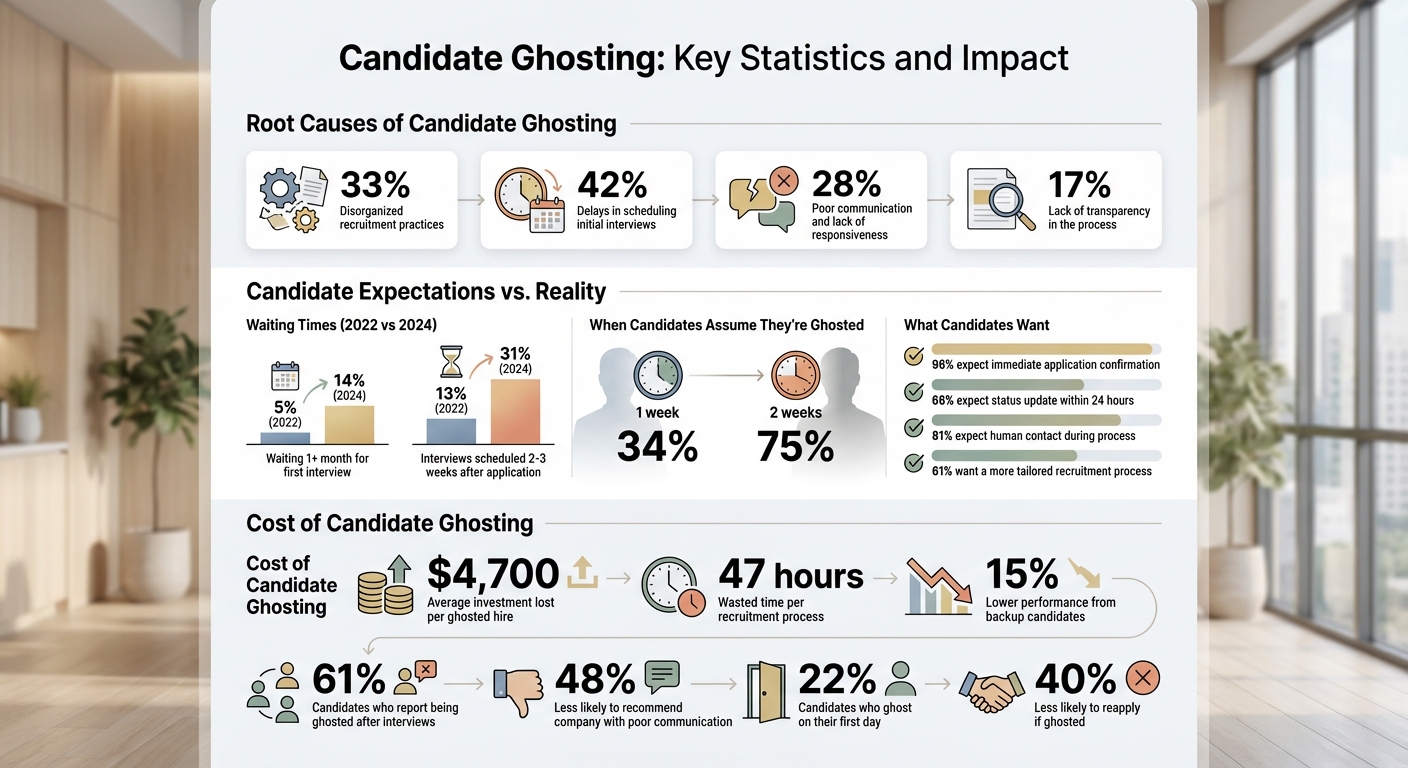 {Candidate Ghosting Statistics and Impact on Recruitment}
What Actually Causes Candidate Ghosting in Tech Recruitment
Candidate ghosting often highlights issues in communication, the way opportunities are presented, and how hiring processes are managed.
Slow Responses and Inconsistent Communication
Delays in communication can make developers feel like the opportunity has fallen through. For instance, in 2024, 14% of candidates reported waiting a month or more for their first interview - up from just 5% in 2022. Similarly, interviews scheduled two to three weeks after application jumped from 13% in 2022 to 31% in 2024 . The longer the wait, the worse it gets: 34% of candidates assume they've been ghosted if they don’t hear back within a week, and that number rises to 75% after two weeks .
When you consider that developers often juggle 10 or more applications at once , it’s no surprise that 28% of them cite "lack of responsiveness and poor communication" as their biggest frustration .
"Lack of responsiveness and poor communication was the top-cited reason for candidate frustration at 28%" - Akvile Peckyte, BambooHR
Delayed responses are only part of the issue. Generic communication makes things worse.
Copy-Paste Messages That Don't Connect
Mass-produced, impersonal outreach can send the message that recruiters aren’t truly interested. In fact, 61% of candidates say they want a more tailored recruitment process . When messages lack personalization, candidates feel undervalued, which discourages them from engaging. For 41% of job seekers, a hiring process that is efficient and respectful is a key indicator of how much a company values its applicants .
But even personalized communication can fall flat if the job details are unclear or inconsistent.
Unclear Job Details and Changing Requirements
When job descriptions lack clarity or requirements shift mid-process, candidates often see it as a sign of poor organization. This issue is responsible for one-third of ghosting incidents . Additionally, 17% of candidates list "lack of transparency" as one of the most frustrating parts of the interview process .
Late-stage drop-offs have surged by nearly 20% between 2019 and 2022, often because candidates discover deal-breakers - like outdated tech stacks or unexpected responsibilities - that should have been disclosed upfront .
"Transparency with job seekers begins with clarity and consensus among the hiring team." - Jess Hoffman, Datapeople
Without transparency, candidates quickly lose trust and disengage.
Hiring Processes That Take Too Long
Reducing time to hire is critical, as lengthy processes are another major culprit. For 42% of candidates, delays in scheduling the initial interview are enough to make them walk away . Automated scheduling tools can help, but drawn-out processes with multiple rounds or overly time-consuming tests are still common. When candidates face six or more interview rounds or take-home tests that exceed two hours, they often burn out and stop responding .
Speed matters - especially when 70% of candidates weigh the quality of the recruitment process as a deciding factor when choosing between job offers . A streamlined, efficient process isn't just nice to have; it's a competitive edge in a crowded market.
How Candidate Ghosting Damages Your Recruitment Results
Candidate ghosting doesn’t just highlight flaws in your hiring process - it creates real financial, operational, and reputational challenges.
When a candidate ghosts, you lose the $4,700 average investment per hire and often end up settling for a backup candidate who may perform 15% lower, costing your company thousands in lost productivity . The issue is widespread: 61% of candidates report being ghosted after interviews (a 9% increase since early 2024) , while 41% of organizations say they experience ghosting during the interview process .
Ghosting also means wasted time. On average, it consumes 47 hours per recruitment process , delaying time-to-fill metrics and dragging down the efficiency of your hiring efforts. Optimizing the candidate experience is essential to prevent these drop-offs. This wasted time compounds the financial losses tied to missing out on top talent.
"Ghosting incurs costs in three areas: The primary cost to a firm comes from losing the productivity and the value that would have been added if it had hired its top candidate... Next, when candidates ghost, your time-to-fill will be significantly extended... Finally, ghosting slows recruitment process improvement." - Dr. John Sullivan, Expert on Talent Management
And then there’s the damage to your employer brand. 48% of candidates are less likely to recommend or engage with a company that has poor communication , and 39% of jobseekers say being ghosted negatively affects their perception of the organization . In industries like tech, where professionals frequently share their hiring experiences, one bad process can shrink your talent pool for years to come. Even after an offer is accepted, ghosting remains a risk: 22% of candidates fail to show up on their first day . These situations don’t just hurt your external reputation - they also weaken trust internally, making hiring managers question the reliability of your recruitment pipeline.
Frequent ghosting frustrates hiring managers who’ve invested time and effort into interviews and candidate evaluations. It erodes trust in your process and makes it harder to secure their support for future candidates. With top talent often receiving competing offers in as little as 10 days , delays caused by restarting a search can leave you lagging in an already fiercely competitive market.
How to Reduce Candidate Ghosting
Tackling candidate ghosting starts with addressing its root causes. The key lies in three areas: making your outreach feel personal, maintaining consistent communication, and speeding up your hiring process to keep candidates engaged.
Make Your Outreach Personal
Personalized outreach makes a huge difference. Developers are more likely to stay engaged when they feel recognized as individuals, not just another name on a list. Show candidates you've done your homework - mention a specific GitHub project, a portfolio piece, or a unique skill that grabbed your attention . Always address them by name and reference their work directly .
"Developers don't ghost recruiters they respect - they ghost processes that feel like spam or waste their time." - Nimrod Kramer, daily.dev
The numbers back this up: candidates actively seeking roles are 50% less likely to ghost compared to those contacted through cold outreach . Even when using automation, keep the human touch alive by writing non-spammy recruiter emails - 81% of candidates expect some level of personalization in their interactions .
Personalized outreach sets the tone, but keeping the lines of communication open is just as critical.
Keep the Conversation Going
Once you've made contact, consistent updates are key to keeping candidates engaged. Silence is a fast track to ghosting, especially when 28% of candidates cite poor communication as their biggest frustration . Every day without an update increases the risk of losing top talent.
Touch base with candidates every 48 hours, even if it’s just a quick update like, “We’re still reviewing your application; expect feedback by Wednesday” . This helps maintain momentum and builds trust. In fact, 96% of candidates want immediate confirmation their application was received, and 66% expect a status update within 24 hours .
Go beyond email - use SMS or WhatsApp for quick reminders and updates. From the start, set clear expectations about the hiring process, including how many interview rounds there will be, estimated timelines, and decision deadlines. And don’t forget closure: 81% of candidates expect it, and 40% are less likely to reapply if they’re ghosted .
Move Quickly to Avoid Losing Candidates
Even with personalized outreach and regular updates, a slow hiring process can derail everything. Delays are costly - 42% of candidates have walked away from opportunities because interview scheduling took too long .
Keep your process efficient. Limit interviews to no more than three rounds , and ensure take-home assignments take less than two hours to complete, as longer tasks can lead to drop-offs . Self-scheduling tools can also help - over half of candidates prefer the flexibility to choose their interview times .
Set internal deadlines to provide feedback within 48 hours . If there’s a delay in issuing a formal contract due to HR or legal processes, consider making a verbal offer to keep the candidate engaged . Remember, 41% of candidates see an efficient hiring process as a sign of respect .
Finally, track key metrics like time-to-hire and drop-off rates to identify problem areas . If ghosting tends to happen at a specific stage - like an overly complex assessment - adjust accordingly. Disorganized recruitment processes account for one-third of candidate ghosting, so streamlining operations can have a big impact .
Hiring engineers?
Connect with developers where they actually hang out. No cold outreach, just real conversations.
How daily.dev Recruiter Helps Prevent Candidate Ghosting
daily.dev Recruiter tackles the issue of candidate ghosting by shifting away from impersonal outreach and prioritizing genuine, trust-based connections.
Rather than bombarding developers with generic messages, the platform facilitates warm, personalized introductions that feel more like authentic networking. Each introduction is double opt-in, meaning developers have already expressed interest before you even reach out. This approach addresses the issue of spam-like outreach, which often turns candidates off.
Additionally, the platform ensures your job postings are seen by developers whose skills and interests align with your opportunities. This targeted visibility enhances the connection between recruiters and candidates.
"When developers are given clarity, relevance, and control, they stick around. When they're fed vague pitches and endless loops, they vanish." - Nimrod Kramer, daily.dev
By focusing on relevance and clarity, daily.dev Recruiter achieves higher response rates and connects you with an engaged developer community, avoiding the pitfalls of mass outreach.
Moreover, the platform provides upfront details about compensation, timelines, and technical requirements. This transparency helps eliminate mismatched expectations and builds mutual respect throughout the hiring process.
Conclusion: Fix the Process, Not the Symptom
When candidates ghost employers, it’s often a sign of flawed recruitment practices rather than an issue with the candidates themselves. In fact, about 33% of ghosting incidents can be traced back to disorganized hiring processes . The real solution lies in improving these processes, not shifting blame onto candidates.
Consider this: 28% of candidates list poor communication and lack of responsiveness as their biggest frustrations, while 42% walk away from opportunities due to delays in scheduling . When hiring processes respect candidates’ time, offer clear communication, and remain transparent, candidates are far more likely to stay engaged. This highlights the importance of adopting a more candidate-focused approach.
To address ghosting effectively, companies need to focus on three key areas: creating personalized outreach that aligns with a candidate’s career aspirations, offering clear and upfront communication about compensation and timelines, and ensuring quick feedback loops to keep the process moving. These changes align with candidate expectations, with 81% wanting human contact and 66% expecting updates within 24 hours .
daily.dev Recruiter transforms cold outreach into warm, double opt-in introductions, fostering trust through clear, upfront communication. This approach treats developers as valued professionals, not just another lead in the pipeline, and ensures a hiring process that respects their time and expertise.
FAQs
What steps can companies take to reduce candidate ghosting during the hiring process?
Creating a hiring process that’s clear and well-organized is key to minimizing candidate ghosting. Start by focusing on open communication, prompt follow-ups, and consistent interview schedules. When candidates know what to expect and feel informed, they’re more likely to stay engaged. On the flip side, delays or vague expectations can quickly cause them to lose interest.
Another critical factor is building trust. Keep candidates in the loop with regular updates, be transparent about timelines, and show a genuine interest in what they’re looking for. Personalizing your outreach and maintaining steady communication throughout the process can make a big difference. When companies prioritize a respectful and seamless recruitment experience, they’re more likely to retain candidates and see better hiring outcomes.
Why do candidates sometimes stop responding during the hiring process?
Candidates sometimes stop responding, or "ghost", during the hiring process for a variety of reasons. One major culprit? Poor communication. If follow-ups are delayed or inconsistent, candidates might assume the company isn’t interested or well-organized, prompting them to disengage. Another common issue is a hiring process that’s too long or overly complicated. When candidates are juggling multiple opportunities, they’re likely to prioritize those that move faster.
Misaligned expectations or a lack of transparency can also drive candidates away. If they feel undervalued or unclear about the role, they may simply walk away without explanation. And let’s not forget external factors - things like a competitive job market or personal circumstances can also influence their decision to go silent.
To minimize ghosting, companies should focus on better communication, clear expectations, and a more engaging, transparent process. These steps can help build stronger connections and keep candidates invested throughout the hiring journey.
Why is communication important for keeping candidates engaged during the hiring process?
Clear and timely communication is crucial for keeping candidates interested throughout the hiring process. When candidates are regularly updated and know what to expect next, they’re more likely to remain engaged and committed. On the flip side, delays or vague messaging can leave them feeling overlooked or unsure, which often results in disengagement - or worse, ghosting.
Being upfront is equally important. Setting clear expectations about the process and addressing any questions or concerns helps build trust. This level of transparency not only reassures candidates but also reduces the chances of them dropping out. A well-organized communication strategy reflects professionalism and creates a positive experience, making it easier to maintain candidate interest and move toward successful outcomes.
.png)