

Hiring developers based on keyword matches alone doesn’t work. Resumes often fail to capture real skills, and keyword-based systems miss out on talented candidates who phrase their experience differently. Worse, these tools can perpetuate bias by favoring certain demographics and educational backgrounds. The solution? AI-powered contextual matching.
Key takeaways from the article:
- Keyword systems fall short: They overlook synonyms, ignore transferable skills, and fail to differentiate between basic exposure and deep expertise.
- AI-driven contextual matching excels: It evaluates career progression, skill relationships, and team compatibility, identifying candidates who truly fit the role.
- Reducing bias in technical hiring: AI removes personal identifiers like names and schools, focusing solely on skills and experience, improving diversity by 35%.
- Better results: AI boosts candidate response rates, reduces time-to-hire by 50%, and improves hiring accuracy by 16%.
- daily.dev Recruiter example: A platform that connects developers and recruiters through mutual interest, eliminating cold outreach and improving engagement.
Bottom line: Moving beyond keywords to focus on context ensures you find skilled developers while reducing bias and saving time.
Why Keyword-Based Matching Doesn't Work
::: @figure 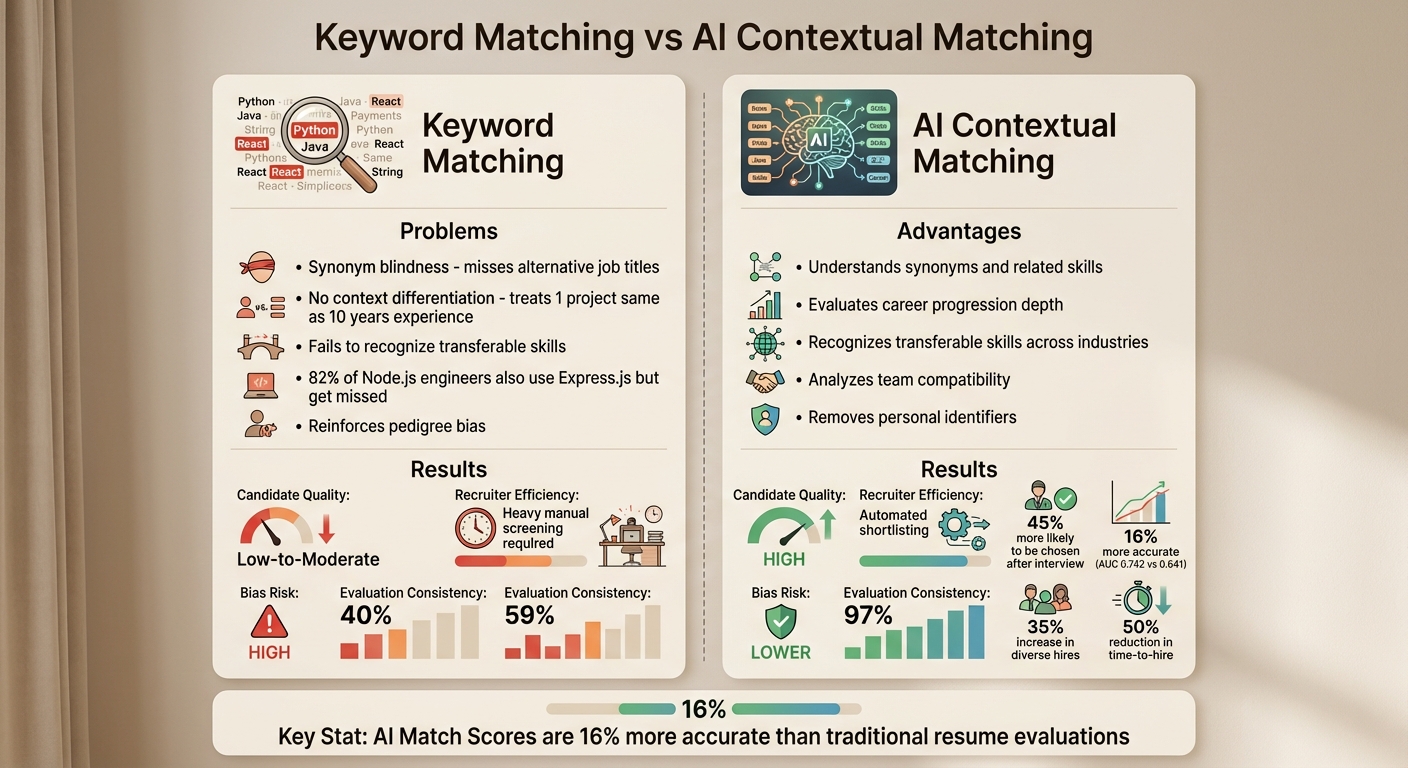 {Keyword Matching vs AI Contextual Matching in Developer Recruitment}
The Problems with Keyword Matching
Keyword-based systems rely on scanning resumes for exact text matches. This approach creates three major issues that disrupt the hiring process.
First, there's the issue of "synonym blindness." These systems overlook qualified candidates who use alternative terms for the same role. For example, a "Business Development Lead" and a "Sales Executive" might perform nearly identical tasks, but a keyword filter treats them as unrelated roles .
Second, keyword matching ignores context. It can't distinguish between someone with minimal exposure to a skill and someone with extensive experience. A developer who completed a single university project in Python is treated the same as one with a decade of hands-on experience leading Python development teams . Lastly, these systems fail to recognize transferable skills when described using industry-specific terminology from a different field.
The consequences? Recruiters waste time sorting through irrelevant candidates who pad their resumes with buzzwords, while truly qualified candidates are filtered out early. For instance, research shows that 82% of Node.js engineers also work with Express.js, yet keyword searches for "Node.js" alone would miss those who only mention Express.js on their resumes . This isn't just a small oversight - it reflects a fundamental misunderstanding of how professionals describe their expertise.
Specific Challenges for Developer Hiring
These problems are even more pronounced when hiring developers. In tech, core principles remain consistent even as tool names evolve, but keyword filters penalize candidates for not listing the latest buzzwords . A platform engineer with a strong background in distributed systems could easily adapt to cloud-native roles, but they might be excluded for not mentioning specific tools like "Kubernetes" or "AWS Lambda."
Context matters too. The same keyword can signify entirely different concepts depending on the field. For instance, "default detection" might refer to loan risk analysis in finance but could mean something entirely different in manufacturing, such as identifying defects in production . Keyword systems can't differentiate between these nuances, leading to mismatches that waste time for both recruiters and candidates. This friction often stems from a lack of insights into what developers want from the hiring process. These tools also fail to prioritize recent experience, treating skills used eight years ago the same as those used today - an issue in fast-paced technical fields where up-to-date expertise is critical .
The table below illustrates the differences between keyword matching and contextual matching:
| Feature | Keyword Matching | Contextual Matching |
|---|---|---|
| Candidate Quality | Low-to-Moderate (relies on exact phrasing) | High (evaluates role fit and proven experience) |
| Recruiter Efficiency | Requires heavy manual screening of false positives | Automates shortlisting of genuinely qualified candidates |
| Bias Risk | High (favors specific schools and prestigious employers) | Lower (focuses on skills and relevant context) |
This reliance on keywords also reinforces pedigree bias, favoring candidates with degrees from well-known schools or those employed by brand-name companies. Meanwhile, self-taught developers and bootcamp graduates - who often bring practical skills and fresh perspectives - are filtered out simply because their resumes don’t align with corporate jargon . Ultimately, this system rewards candidates who know how to "game" the algorithm, rather than those who are best equipped to excel in the role.
Hiring engineers?
Connect with developers where they actually hang out. No cold outreach, just real conversations.
How AI and Contextual Matching Improve Hiring
AI-Powered Contextual Analysis
AI-driven systems, powered by Natural Language Processing, go beyond simple keyword matching. They understand the deeper meaning in job descriptions and resumes, identifying transferable skills even when job titles or industries differ. For instance, they can connect a "platform engineer" with experience in distributed systems to a "cloud architect" role. This approach addresses the limitations of traditional keyword-based methods.
These systems evaluate candidates on three levels: their career progression, the specific job requirements, and the team dynamics they’d be joining . The results speak for themselves - candidates with high AI-calculated match scores are 45% more likely to be chosen after an interview . This shows that AI can recognize genuine compatibility, not just surface-level similarities.
Some platforms now use neuro-symbolic AI, which combines pattern recognition with symbolic reasoning to provide explainable results . Instead of just a match score, recruiters see detailed insights - like a candidate’s experience with certain frameworks, the complexity of their projects, or their ability to quickly learn related technologies. This level of transparency helps recruiters make smarter decisions while understanding the reasoning behind AI recommendations . By offering a layered and clear evaluation, these systems not only improve hiring accuracy but also promote fairer assessments.
Reducing Bias in Hiring
AI systems help reduce bias by removing personal identifiers - like age, gender, or educational background - from resumes. This ensures the focus remains on skills, improving evaluation consistency from 59% with manual reviews to 97% with AI . The result? A 35% increase in diverse hires.
"AI removes personal identifiers - age, gender, university - letting skills shine."
- Elena Bejan, People Culture and Development Director, Index.dev
Additionally, AI Match Scores are 16% more accurate than traditional resume evaluations (AUC 0.742 vs. 0.641) . To maintain fairness, companies conduct regular audits, testing the AI with resumes from diverse demographics to prevent it from perpetuating historical biases . These checks ensure the system remains fair and reliable, helping recruiters focus on a truly qualified and unbiased candidate pool.
Better Response Rates Through Contextual Matching
Contextual matching doesn’t just improve candidate evaluation - it also boosts response rates by connecting recruiters with developers who are genuinely interested in the role. AI analyzes engagement signals - like activity on professional platforms or technical contributions - to create personalized, two-way matches. This reduces time-to-hire by 50% and aligns outreach with candidates’ actual interests .
75% of job seekers favor AI-driven recruitment for its speed and clarity . Instead of generic messages, AI enables recruiters to reference a candidate’s GitHub projects, code contributions, or technical blogs . This makes the communication feel personal and thoughtful, rather than automated.
Double opt-in systems enhance this process by ensuring both parties are interested before moving forward. Candidates can evaluate whether a role aligns with their goals, while recruiters assess compatibility. This mutual approach respects everyone’s time. Automated updates throughout the process also keep candidates informed, increasing their willingness to stay engaged .
daily.dev Recruiter: Developer-First Candidate Matching
Key Features of daily.dev Recruiter
daily.dev Recruiter takes a fresh approach to connecting recruiters with developers, steering clear of scraped data and cold emails. Instead, it operates within a trusted professional network where over 1 million engineers already spend their time reading, learning, and growing . Job opportunities are seamlessly integrated into developers' daily.dev browser homepage and feed as native content - not as intrusive ads .
The platform employs real-time behavioral matching, analyzing developer activity such as reading habits, coding patterns, and community involvement to identify candidates with current intent . Through a "TinDev" double opt-in system, both parties must agree before any contact is initiated. This eliminates cold outreach and instead facilitates warm introductions, delivered directly to your inbox or ATS with a 100% trust score - far surpassing the <1% engagement rate of traditional cold emails .
"We built a place where engineers can turn off the noise. To enter this space, you don't need a hack. You need trust."
- Nimrod Kramer, CEO & Co-Founder, daily.dev
The platform also offers verified signals and fit scores based on developers' activity in specific technical areas, such as engagement with frameworks like React or Astro . Recruiters can set custom filters for timezone, location, tech stack, and seniority, ensuring roles are only shown to relevant candidates . With 90% of developers on the platform unwilling to engage with outreach on other platforms , this method achieves 3x higher engagement rates compared to traditional cold outreach .
These features directly tackle common recruitment challenges, ensuring only qualified and interested developers make it into your hiring pipeline.
How It Solves Developer Recruitment Problems
daily.dev Recruiter redefines how passive candidates are sourced and engaged, addressing one of the toughest challenges in tech recruitment. By tracking "pre-intent" talent - developers actively learning new skills but not yet updating their public profiles - the platform identifies these candidates in real time . This proactive approach strengthens the warm introduction process, making it easier to connect with hidden talent.
The mutual opt-in system saves recruiters an average of 37 hours per hire by automating sourcing and initial vetting. This eliminates the frustration of chasing unresponsive candidates or dealing with ghosting. With 40% of the talent pool consisting of senior individual contributors or engineering leaders , daily.dev Recruiter provides access to high-caliber candidates often unreachable through traditional methods.
The platform also improves team fit by considering not just technical skills but also a developer's learning journey and community reputation. With insights into GitHub contributions or technical blogs, recruiters can have more meaningful and personalized conversations. This developer-first approach respects candidates' time and builds trust from the first interaction.
Integration and Scalability
daily.dev Recruiter enhances efficiency with seamless integration and scalability, simplifying your hiring process. It offers native two-way sync with major ATS platforms like Greenhouse, Lever, Ashby, and Workable, automatically funneling warm introductions into your interview pipeline without manual data entry . Candidate profiles are created and updated in real time, ensuring your workflow runs smoothly.
The platform scales effortlessly to accommodate growing hiring needs. Automated discovery and behavioral screening handle increased volumes without adding manual work. Features like candidate deduplication prevent redundant outreach, maintaining a clean database . Additionally, the results-based pricing model - free from placement fees or monthly commitments - keeps costs manageable, whether you're hiring a single developer or building an entire team .
Full visibility tools allow you to track reply rates and other key metrics, creating a feedback loop to refine your hiring strategy and improve results over time .
How to Implement Contextual Matching
Using AI to enhance your hiring process can make a significant impact, but you need a clear strategy to implement contextual matching effectively. Here’s how to get started.
Setting Clear Hiring Criteria
Start by defining your hiring needs across three key areas: career trajectory and technical expertise, job-specific requirements (like seniority and core skills), and team dynamics . This layered approach ensures the algorithm understands not just the skills you need, but also the type of environment where a candidate will succeed.
Break your criteria into “must-have” and “nice-to-have” categories. For example, proficiency in React could be a must, while familiarity with TypeScript might be a bonus . This helps the algorithm focus on the essentials while still recognizing additional strengths.
To create detailed candidate profiles, use templates with 8–12 dimensions, such as technical skills, leadership potential, and communication style . The more context you provide, the better the AI can identify success factors. Companies that adopt AI-driven matching report hiring times that are 30–50% faster . These results are especially strong when hiring criteria are clear and regularly updated based on actual outcomes. By setting these parameters, you’re giving the system the precision it needs to find the right fit.
Using Developer Networks
Traditional recruiting platforms aren’t the only way to find talent. Developer networks are a goldmine for finding passive developer candidates where they naturally spend their time. This could include spaces where they read technical articles, participate in discussions, or work on improving their skills. By engaging with these communities, you can avoid the awkwardness of cold outreach and instead focus on meaningful, interest-driven connections.
A two-way matching approach is key. Developers often signal their career goals through their online behavior - whether it’s the topics they explore, the tools they use, or the skills they’re building . These signals provide far more insight into their interests than a static resume ever could.
Don’t overlook your internal network. Employees, advisors, and investors can help surface hidden talent through AI-powered introductions . This approach leverages personal connections, which are often more trusted and credible, while turning your organization into an active sourcing channel. Combining developer networks with well-defined hiring criteria further sharpens your ability to match the right candidates to the right roles.
Measuring Contextual Matching Results
To evaluate the success of contextual matching, start with efficiency metrics like time-to-hire, reduced manual sourcing hours, and improved screening accuracy. AI-powered systems can cut hiring times by up to 63% and lower recruitment costs by 30% . These numbers reflect a more streamlined process.
Next, focus on engagement. Compare response rates between warm introductions and cold outreach. Contextual matching often delivers reply rates of 85–90% through double opt-in systems, compared to under 5% for cold emails. Track offer acceptance rates and monitor how candidates move through your hiring pipeline to measure quality.
Long-term success is equally important. Retention rates and time-to-productivity are key indicators. For engineers, reaching full productivity can take 6–12 months, so tracking how quickly new hires become effective will show whether your matching criteria are working. Financially, consider the cost of your tools versus the expense of replacing a technical hire, which can be 1.5–2 times their annual salary, plus an estimated $17,000 for a bad hire.
Finally, ensure fairness by applying the "Four-Fifths Rule." This rule checks that selection rates for protected groups are at least 80% of those for the highest-performing group, helping you identify and address any biases in your process. By monitoring these metrics, you can confirm that contextual matching not only speeds up hiring but also builds a stronger, more engaged technical team.
Conclusion
Relying solely on keyword matching ignores the deeper technical capabilities of candidates. Job titles often differ, and resumes frequently highlight only surface-level skills, causing traditional hiring systems to overlook candidates who may be the perfect fit. AI-driven contextual matching changes this by recognizing that different labels can represent the same skill sets, bridging the gap that traditional methods leave behind.
The impact is hard to ignore. Companies using AI-powered recruitment tools have reduced their time-to-hire from 44 days to just 11. They've also slashed screening costs by 75%, cut gender bias in job postings by up to 40%, and improved workforce diversity by 35% . These tools not only save time and money but also help build stronger, more inclusive teams.
daily.dev Recruiter takes these benefits further by fostering trust with its double opt-in system. While cold emails and LinkedIn InMails achieve trust rates of less than 1% and around 5%, respectively, daily.dev guarantees 100% trust by ensuring mutual interest before any interaction . This approach eliminates spam and ghosting, replacing impersonal outreach with meaningful connections based on what developers are actively engaging with - what they’re reading, building, and learning. It’s a shift from outdated keyword searches to a system grounded in context and real behavioral insights.
Tech hiring teams must evolve beyond static resumes and keyword-based searches. Embracing behavioral, two-way matching ensures that both the company’s needs and the developer's career aspirations are respected. With tools designed specifically for developer recruitment, you can connect with passive talent who are genuinely interested - transforming the hiring process from a transactional search to a meaningful connection.
This shift from keywords to context redefines how technical hiring should work.
FAQs
How does AI-driven contextual matching help create a fairer hiring process?
AI-powered contextual matching transforms hiring by looking at candidates as more than just a collection of keywords. Rather than zeroing in on specific terms in resumes, it evaluates an applicant's skills, experience, and potential holistically. This approach helps prevent qualified candidates from being overlooked due to rigid keyword filters.
Using AI and machine learning, these tools uncover patterns and insights that help reduce unconscious bias, leading to a more balanced evaluation process. By doing so, recruiters can make smarter, data-informed decisions while fostering a hiring process that encourages diversity and fairness.
How does AI improve candidate matching compared to keyword-based systems?
AI takes candidate matching to the next level by analyzing more than just keywords. With tools like machine learning and natural language processing, it evaluates deeper aspects such as a candidate's skills, career growth, and even how well they might align with a company's values. This allows for a richer, more nuanced understanding of each candidate.
What makes this approach stand out is its ability to pull insights from various data points, like specific project contributions or resume details. This means it can identify talent that traditional keyword searches might overlook. On top of that, AI streamlines the hiring process by automating much of the sourcing work. It also helps reduce bias, making hiring not only faster but also more impartial and inclusive.
How can companies effectively use AI to match candidates beyond just keywords?
To make the most of AI in candidate matching, companies need to move beyond simple keyword searches. Advanced tools powered by machine learning and natural language processing (NLP) can evaluate much more than just a resume's buzzwords. They analyze a candidate's skills, career history, project achievements, and even how well they might align with the company's values and work environment. By focusing on context and deeper semantic understanding, AI offers a broader and more meaningful assessment of potential hires.
For these systems to work effectively, businesses must train AI models using diverse datasets. This approach helps reduce bias and supports fairer decision-making. Regular audits and features that explain the AI's reasoning are also crucial - they ensure transparency and help justify hiring choices. When AI-driven insights are paired with human judgment, companies can achieve better hiring accuracy, encourage diversity, and make decisions that reflect their core values.
.png)


