Reducing candidate drop-off is critical for successful hiring, especially in competitive fields like software engineering. High drop-off rates waste time, harm employer branding, and make future hiring harder. Here’s what you need to know:
- 80% of candidates abandon the hiring process, often due to long applications, poor communication, or unclear job details.
- Key fixes include simplifying forms, improving communication, and setting clear expectations about compensation and roles.
- Data is your best tool: Track drop-off rates at each stage, identify problem areas, and adjust accordingly.
- Shorten applications to under 5 minutes.
- Respond to candidates within 24–48 hours.
- Use automated tools to streamline scheduling and feedback.
::: @figure 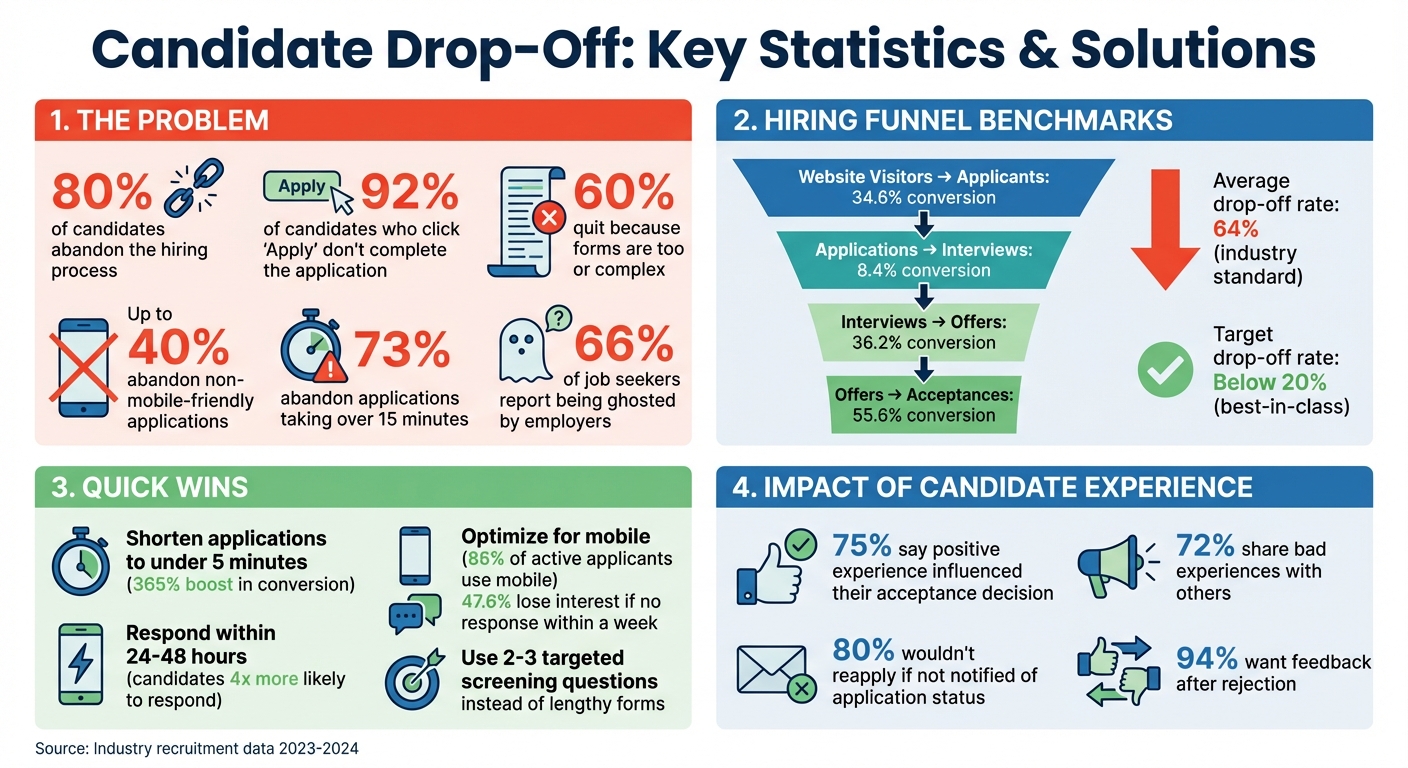 {Candidate Drop-Off Statistics and Hiring Funnel Conversion Rates}
Use Data to Find Drop-Off Causes
To reduce candidate drop-off, you first need to pinpoint exactly where and why candidates are leaving your hiring process. The best way to do this? Dive into the data. By measuring specific metrics at each stage of your recruitment funnel, you can uncover patterns and make informed adjustments.
Track Metrics at Each Funnel Stage
Start by calculating the drop-off rates at every step of your hiring process. Use this simple formula: (Entered − Completed) / Entered to measure conversion rates .
Focus on key metrics like:
- Application completion rate: How many candidates finish the application after clicking "Apply."
- Time-to-completion: How long it takes candidates to move through each stage.
- Response rates: How often candidates reply to your outreach efforts.
Your applicant tracking system (ATS) should provide these numbers, making it easier to identify problem areas. For reference, industry benchmarks reveal that only 34.6% of website visitors become applicants, 8.4% of applications lead to interviews, 36.2% of interviews result in offers, and 55.6% of offers are accepted .
Pay close attention to high drop-off rates during the application process. If forms are too long or complicated, candidates will leave. For instance, if filling out a page takes more than 5 minutes, you’re likely losing potential applicants . Tracking the time spent on each step can help you pinpoint exactly where the process becomes a hurdle.
Once you’ve gathered this data, it’s time to analyze it and figure out why candidates are leaving. Using a developer hiring checklist can help ensure you don't miss critical steps during this analysis.
Identify Common Drop-Off Reasons
Knowing where candidates drop off is only half the battle. You also need to understand why. Here’s what the data tells us:
- 92% of candidates who click "Apply" don’t complete the application . Why? 60% quit because the form is too long or complex .
- Up to 40% abandon non-mobile-friendly applications .
- Communication issues are another major factor. Candidates are 4x more likely to respond if contacted within 24 hours , but 47.6% lose interest if they don’t hear back within a week . This lack of engagement can also explain why 28% of candidates admit to ghosting recruiters .
To dig deeper, set up exit surveys for candidates who voluntarily withdraw. These surveys can provide direct insights into their frustrations . Additionally, ask hiring managers to log specific rejection reasons in your ATS. This will help you differentiate between candidates who didn’t meet qualifications and those lost due to process inefficiencies .
"What gets measured gets improved." - Jan Tegze, Fullstack Recruiter
Checklist to Reduce Candidate Drop-Off
Now that you know why candidates are leaving your hiring process, let’s focus on fixing those gaps. Below is a practical checklist to help keep candidates engaged at every stage of the process.
Simplify Application Forms
The application form is often a candidate’s first real interaction with your company. If it feels overly complicated, you risk losing them before they even begin. Consider this: 73% of job seekers abandon applications that take over 15 minutes, while 49% would apply immediately if the process appeared simple .
Start by testing your application process. Look for unnecessary steps, redundant fields, or technical issues. Streamlining the process to 5 minutes or less can boost conversion rates by up to 365% .
Here’s what you can do right away:
- Remove account creation requirements. Let candidates upload their resume directly from platforms like Dropbox or Google Drive, or use auto-fill options through LinkedIn .
- Optimize for mobile. Since 86% of active applicants use mobile devices , ensure the application works smoothly on smartphones.
- Simplify questions. Replace lengthy forms or cover letters with 2-3 targeted qualifying questions . If more information is needed later, include a "save progress" feature so candidates can return without starting over .
Tools like daily.dev Recruiter eliminate these pain points entirely by offering warm, double opt-in introductions, allowing developers to engage without lengthy forms or account creation. Once the application process is simplified, clear and timely communication, following technical hiring best practices, will help secure their interest.
Improve Communication and Transparency
Poor communication is one of the quickest ways to lose candidates. 66% of job seekers report being ghosted by employers, and 72% share bad experiences with others .
Here’s how to keep the lines of communication open:
- Acknowledge applications immediately. Set up automated responses through your ATS to confirm receipt, and follow up within 24 to 48 hours with next steps .
- Prepare candidates for interviews. Send detailed briefs with the interview time, location or video link, names and roles of interviewers, and any materials they should prepare .
- Be upfront about compensation. Discuss salary ranges during the initial screening call . For technical roles, share details about the tech stack, specific projects, and team structure to ensure alignment with the candidate’s goals .
With daily.dev Recruiter, candidates receive key role details upfront, eliminating the uncertainty that often plagues traditional hiring processes.
Optimize Job Descriptions and Screening
Vague job descriptions can confuse candidates and lead to drop-offs. In fact, 56% of job seekers feel unsure about how their application will be assessed or which skills to highlight .
Write job descriptions that answer the questions developers care about:
- What is the tech stack?
- What projects will they work on?
- What problems will they solve?
Be clear about responsibilities, team structure, and growth opportunities. Include details about perks like remote work options, learning budgets, and work-life balance.
For screening, focus on a few targeted questions that predict job success. Use 2-3 pre-screening questions and provide clear instructions on the qualifications that matter most . Also, update your ATS to avoid filtering out qualified candidates based on irrelevant keyword matching .
Streamline Interview Scheduling and Process
Delays in scheduling interviews can silently derail the hiring process. 42% of candidates drop out because of scheduling delays, and 45% of interviews are scheduled two or more weeks after applying .
To avoid this:
- Use self-scheduling tools to let candidates pick from flexible time slots.
- Schedule interviews mid-morning (9:00 AM – 11:00 AM) on Tuesdays through Thursdays when participants are most focused .
- Follow up within 48 hours if candidates haven’t responded to an invitation .
"Swift, efficient interview scheduling is critical in attracting top talent." - BambooHR
Limit the number of interview rounds to what’s absolutely necessary. If multiple interviews are unavoidable, include 10–15 minute breaks between sessions to allow interviewers to reset and give candidates their full attention .
Strengthen Offers and Candidate Experience
After all the effort you’ve put into the hiring process, losing candidates at the offer stage can be especially frustrating. 75% of employees say a positive candidate experience influenced their decision to accept a job .
Here’s how to close the deal effectively:
- Personalize offers. Avoid generic templates. Reference past conversations and explain how the role aligns with the candidate’s career goals.
- Be professional. Respond promptly, honor commitments, and treat all candidates with respect - even those you don’t select. Nearly 80% of job seekers wouldn’t reapply to a company that failed to notify them of their application status .
daily.dev Recruiter keeps candidates engaged throughout the process by connecting you with developers who are already part of the daily.dev community. This ensures trust and clarity, reducing the risk of last-minute drop-offs.
Monitor and Improve Over Time
Keeping your hiring process sharp requires constant monitoring and making adjustments based on data.
"You can't change what you can't measure." - Peter Drucker
The first step? Define measurable benchmarks to track progress and pinpoint areas for improvement.
Set and Track Benchmarks
Start by setting clear, measurable goals for every stage of your hiring funnel. For example, track the applicant drop-off rate - how many candidates start an application versus how many complete it . On average, industries see a 64% drop-off rate, but standout teams aim for below 20% .
Revisit earlier metrics to identify and fix issues like overly complicated assessments. Also, keep an eye on how long candidates spend in each stage of the process. If delays crop up, they can signal bottlenecks .
Define service-level agreements (SLAs) - like responding to candidates within 24–48 hours - and measure how well your team sticks to them . Use tools like Candidate Net Promoter Scores (cNPS) or short surveys at key stages to collect feedback on the candidate experience .
| Funnel Stage | Key Metric to Track | Red Flag Indicator |
|---|---|---|
| Application | Application Completion Rate | Completion rate below 20% |
| Screening | Assessment Completion Rate | High drop-off at login or test start |
| Offer | Offer Acceptance Rate | Declining rates (e.g., compensation concerns) |
Gather Developer Feedback
Numbers tell part of the story, but qualitative feedback from developers can reveal the "why" behind the data. Pair your metrics with direct input from candidates to refine your hiring process.
Send out quick surveys at key moments - like after the application, screen developers for tech expertise, or final interview . Even a small response rate (around 10%) can provide actionable insights .
It’s worth noting that 94% of candidates want feedback after being rejected . When you provide constructive feedback to rejected candidates, ask for their thoughts on your hiring process. This two-way communication not only builds goodwill but also gives you valuable data.
Don’t forget to monitor third-party platforms like Glassdoor or social media every quarter. Look for recurring complaints - like confusion over required versus preferred skills - and adjust job descriptions to be clearer . If candidates frequently mention feeling "ghosted", consider adding automated updates to keep them informed .
Using tools like daily.dev Recruiter can help maintain a feedback loop. By connecting with developers already engaged in a thriving community, you’ll gain honest insights that can help fine-tune your process continuously.
Conclusion
Reducing candidate drop-off starts with tackling the common roadblocks in the hiring process. Research shows that 60% of job seekers abandon applications that are too long , and 80–90% say their experience as a candidate heavily impacts their decision-making . By simplifying the application process, maintaining clear communication, and valuing developers' time, you’re not just speeding up hiring - you’re establishing a reputation that draws top talent.
Take Aliz, a Google Partner focused on Big Data and Machine Learning, as an example. By automating their technical screening to make it more relevant and less time-consuming, they reduced their candidate drop-off rate by 1.5 times . This demonstrates how targeted adjustments can lead to noticeable improvements.
First impressions matter, and tools like daily.dev Recruiter ensure every interaction feels meaningful and personalized. With its double opt-in system and high-context introductions, this platform connects you with developers who are genuinely interested in engaging. This trust-first approach eliminates many of the reasons candidates drop off - developers feel respected and valued from the start. By meeting candidates in spaces they frequent daily, you create a hiring process that feels seamless and considerate. Incorporating these strategies into your ongoing evaluations can help you continuously improve your recruitment efforts.
FAQs
How can I use data to identify where candidates drop out of the hiring process?
Data can show exactly where candidates drop out of your hiring process. By monitoring the number of applicants at each stage - whether it's viewing the job post, submitting an application, completing a screening questionnaire, or attending an interview - you can calculate conversion rates and identify where candidates are losing interest. For instance, dividing the number of applications started by the number completed gives you the abandonment rate, while examining each step's conversion rate pinpoints specific trouble spots.
Tools like daily.dev Recruiter make this easier by providing real-time insights, such as application flow and time spent at each stage. Visual aids like funnel charts can highlight issues like overly long forms or delays in feedback. Armed with this data, you can take focused actions - like streamlining forms, improving communication, or speeding up interview scheduling - and track the impact to minimize candidate drop-off.
How can I improve communication with candidates to reduce drop-off?
Improving communication with candidates can make a big difference in keeping them engaged and reducing drop-offs. Here are three practical ways to make this happen:
Acknowledge applications right away: As soon as someone applies, send out an automatic, branded confirmation email. Use this message to thank them, explain the next steps, and share a clear timeline. Setting expectations upfront helps candidates feel valued and informed.
Be clear and open throughout the process: After each stage - whether it's a screening or an interview - let candidates know what’s next. Share when they can expect to hear back and outline any actions they need to take. Consistent updates go a long way in building trust and reducing uncertainty.
Automate for consistency: Tools like daily.dev Recruiter can handle tasks like scheduling interviews, sending reminders, and providing status updates. Automation helps ensure timely communication while still keeping the tone personal and professional.
Making these small adjustments can create a smoother, more engaging hiring experience, keeping candidates interested and motivated to continue.
Why is it important to simplify the application process to reduce candidate drop-off?
Simplifying the application process is crucial because overly complex or lengthy forms often discourage candidates, causing many to quit before completing them. In fact, research indicates that as many as 92% of applicants abandon applications when faced with unclear or time-consuming steps.
To keep candidates engaged and boost completion rates, focus on making the process as straightforward as possible. This could mean reducing the number of required fields, designing an intuitive and user-friendly interface, and enabling quick submissions. A streamlined process not only respects candidates' time but also leaves them with a positive impression of your company right from the start.
.png)