Developers decide within 14 seconds if they’ll apply for a job. What makes them stay? Clear, detailed job briefs. Vague descriptions filled with buzzwords or missing key details - like salary, tech stack, or specific responsibilities - drive away top talent.
Here’s what developers want:
- Specific roles and tasks: What will they work on?
- Transparent salary ranges: 74% of candidates expect this upfront.
- Growth opportunities: Clear paths for skill and career development.
Companies that get this right see a 75% increase in job ad click-throughs and attract higher-quality candidates. Clear communication builds trust, saves time, and connects you with the right talent.
Want to stand out? Write developer job descriptions that focus on measurable outcomes, realistic qualifications, and transparency. Developers notice - and they’ll apply.
::: @figure 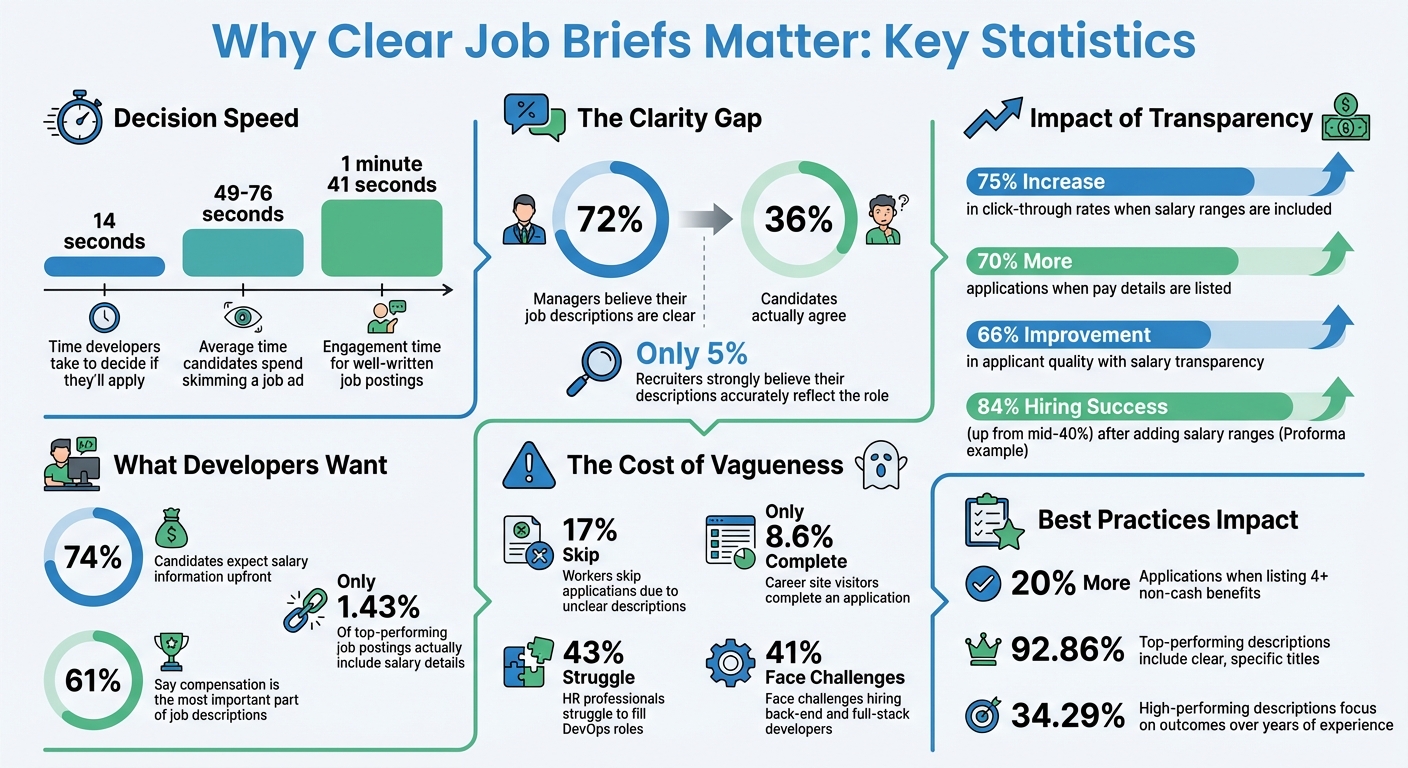 {Key Statistics on Job Brief Clarity and Developer Hiring Success}
How Vague Job Briefs Deter Developers
Vague job postings are a major turnoff for developers. There’s often a gap between what companies think they’re communicating and what candidates actually understand. For example, while 72% of managers believe their job descriptions are clear and effective, only 36% of candidates agree . This disconnect can cost companies top talent before the hiring process even begins.
The numbers don’t lie. Seventeen percent of workers admit to skipping job applications entirely because the descriptions were too "unclear" . Developers, in particular, make snap decisions - if they can’t find key details like the tech stack, job scope, or salary within the first 10 seconds, they move on . Let’s break down how vague job descriptions undermine trust and repel developers.
Unclear Job Requirements
When job postings lean on buzzwords instead of specifics, developers are left guessing about their actual responsibilities. Phrases like "team player" or "problem solver" don’t tell a backend engineer whether they’ll be scaling microservices for millions of requests or maintaining outdated code . Without clear expectations, it’s hard to imagine what the job really entails.
Technical inaccuracies make things worse. In July 2020, Sebastián Ramírez, the creator of the FastAPI web framework, pointed out a job posting that required four years of experience with his technology - even though FastAPI had only existed for 1.5 years . Unrealistic demands like this suggest the hiring team doesn’t fully understand the tools or roles they’re recruiting for.
"I have no idea why I'd want to work for you. You haven't announced a salary or described the tasks." - Maksym, developer
This lack of clarity doesn’t just confuse candidates - it damages the company’s reputation.
Poor Company Perception
A job description is often the first glimpse candidates get into a company’s culture. When postings are riddled with typos, overused buzzwords, or conflicting requirements, it sends a message of disorganization. Shockingly, 15.71% of job descriptions contain obvious typos that even basic spell-check software could catch .
"The effort that a company is putting into setting that environment, setting that stage for candidates right off the bat is going to tell you something." - Carol Cochran, VP of People and Culture at FlexJobs
Sloppy postings signal a lack of attention to detail, which is a major red flag for developers who work in environments where precision is critical.
The problem goes deeper. Only 5% of recruiters and hiring managers strongly believe their job descriptions accurately reflect the role’s actual demands . Candidates pick up on this misalignment, leading them to question whether the company truly understands its own needs.
Lower Candidate Engagement
Unclear job descriptions don’t just hurt trust - they also reduce engagement. While 74% of job seekers want salary details upfront, only 1.43% of top-performing job postings include them . Including salary ranges, however, can increase click-through rates by an impressive 75% .
Vague language creates a double-edged problem. On one side, terms like "knowledge of latest programming languages" bring in a flood of irrelevant applications. On the other, qualified candidates might hesitate to apply if they’re unsure about their fit for the role . This lack of clarity is one reason only 8.6% of visitors to career sites complete an application .
"If your process feels like hazing, great people will self-select out. Not because they can't do it. Because they won't." - Nimrod Kramer, CEO of daily.dev
When job postings are unclear, they often end up filtering out the very developers who could add the most value.
What Developers Look for in Job Briefs
Developers decide within just 14 seconds whether to apply for a job. What drives that decision? Clear answers to three critical questions: What will I do? What will I earn? How will I grow? With 43% of HR professionals struggling to fill DevOps roles and 41% facing challenges hiring back-end and full-stack developers , providing clarity in these areas can make all the difference. Addressing role clarity, compensation, and growth opportunities not only attracts attention but also helps draw in the right candidates. Let’s break these down, starting with the importance of role specificity in job descriptions.
Specific Roles and Responsibilities
Generic job descriptions won’t cut it. Developers want to know the impact they’ll have and the outcomes they’ll own. Vague phrases like "build amazing software" fail to resonate. Instead, focus on outcome-based descriptions that highlight specific contributions, like "optimize API response times" or "implement scalable front-end features" .
Take Calibre’s 2021 job ad for a Front-end Developer as an example. It clearly outlined the tech stack - React, Styled-System, Apollo/GraphQL, Rails - and collaboration tools like Slack and GitHub. This level of detail attracted over 300 applications in just two weeks.
Developers also want a clear picture of their day-to-day work. Whether it’s architecting new features or maintaining existing systems, specifics like sprint lengths, code review processes, and deployment frequency matter. Some companies go a step further by linking to their open-source projects on GitHub, letting candidates evaluate code quality before applying .
"Vague descriptions like 'build amazing software' tell them nothing about the actual work... When you're specific about what success looks like - 'optimize API response times' - you attract candidates who've actually done that work before." - Hayden Cohen, Writer, Near
Another key to effective job briefs? Separating required skills from nice-to-haves. This prevents qualified candidates from self-selecting out because they don’t meet every single criterion. For instance, specifying measurable targets, like maintaining 99.9% uptime or improving page load speeds, helps candidates quickly grasp the role’s impact .
Transparent Compensation and Benefits
For 61% of candidates, compensation is the most important part of a job description . Yet, many companies still avoid listing salary ranges, which can drive potential applicants away. Including salary details isn’t just a nice-to-have - it’s a game-changer. Job ads with salary ranges see a 75% boost in click-through rates, and companies that include pay details receive 70% more applications and a 66% improvement in applicant quality .
Proforma provides a great example. After adding salary ranges to its job postings, the company’s hiring success rate soared from the mid-40% range to 84% .
"Candidates prefer to know the salary up front, or they risk wasting their time applying for a position that cannot meet their needs." - Osman (Ozzie) Osman, The Holloway Guide to Technical Recruiting and Hiring
Beyond salary, developers value benefits like flexible hours, home office stipends, and time for side projects or open-source contributions. Job postings that mention at least four non-cash benefits see 20% more applications . For instance, Hubstaff’s 2025 ad for a Quality Assurance Engineer not only detailed the tech stack but also highlighted perks like a "Freedom Stipend" for equipment and a 2% monthly revenue growth KPI to signal company stability .
But job satisfaction doesn’t stop at clear roles and fair pay. Developers also care deeply about the tools they’ll use and the opportunities for growth.
Tech Stack and Growth Opportunities
A clear tech stack signals a company’s technical maturity. Developers want to know the core tools they’ll use daily, such as programming languages, frameworks, version control systems like Git, and CI/CD pipelines . They also appreciate transparency about technical specifics: Is there legacy code? What’s the code coverage? Are automated testing processes in place? .
Growth opportunities are just as important. Avoid vague phrases like "career development" and instead highlight concrete offerings, such as conference budgets, mentorship programs, or leadership tracks . Specific examples, like "rebuilding a core API to handle 10× traffic growth", give candidates a sense of the challenges and rewards they can expect.
High-quality job ads don’t just attract more candidates - they keep them engaged. While the average candidate spends just 49–76 seconds skimming a job ad, a well-written, descriptive posting can increase engagement time to 1 minute and 41 seconds . That extra time often means the difference between a quick glance and a serious application.
Key Components of Effective Job Briefs
While 72% of managers believe their job descriptions hit the mark, only 36% of candidates agree. That gap highlights a critical issue: many job briefs fail to connect with technical talent . To bridge this divide, you need to focus on three essential elements: clear titles, detailed responsibilities, and realistic qualifications. These components can turn a generic job post into one that resonates with developers.
Clear Job Titles and Descriptions
Job titles act as filters. Overly creative labels like "Code Ninja" or "Software Rockstar" may sound fun, but they often deter serious developers . Worse, these terms hurt your search engine rankings, making it harder for qualified candidates to even find your job post. Using coding-focused candidate sourcing tools can help ensure your posts reach the right technical audience.
Clarity always wins. Stick to standard, searchable titles that include seniority, role type, and key technologies. For example, instead of "Software Engineer", go with "Senior Frontend Developer (React)" or "Backend Engineer (Node.js/AWS)" . This approach not only helps developers quickly understand the role but also boosts your SEO. In fact, 92.86% of top-performing job descriptions include clear, specific titles .
After the title, the role summary should work like an elevator pitch. Focus on the technical challenges, the product's impact, and your team's culture . Be specific. Instead of vague phrases like "join our innovative team", say something like "rebuild our core API to handle 10× traffic growth while mentoring two junior developers."
"Clarity over cleverness is your best friend when it comes to job titles." - Lever
Once the title and summary are nailed down, detailed responsibilities give your job post more depth.
Detailed Responsibilities and Expectations
Replace generic bullet points with specific, measurable goals. For example, instead of "improve system performance", say "optimize API response times to maintain 99.9% uptime" or "develop scalable frontend features for 500K+ monthly active users" .
The best job descriptions list around eight distinct responsibilities . Highlight what success looks like in the first 30, 60, and 90 days. Developers also want insight into your workflow - mention sprint lengths, code review processes, deployment frequency, and team size . Questions like "Do you use Scrum?" or "What's the code coverage like?" are common , so answer them upfront.
Write directly to the candidate using "you" language. For instance, say "You will build..." instead of "The ideal candidate will..." . This small tweak makes the tone more approachable and engaging.
Realistic Qualifications and Requirements
This is where many companies lose great candidates. Research shows women typically apply only if they meet 100% of the listed requirements, while men apply if they meet just 60% . Overloading your requirements can unintentionally filter out talented individuals.
Focus on 3–4 truly essential skills needed for the first 90 days, and clearly separate "must-haves" from "nice-to-haves" . For example, instead of saying "5+ years of React experience", emphasize outcomes: "successfully build and scale frontend applications serving millions of users" . This approach, used in 34.29% of high-performing job descriptions , encourages more candidates to apply.
Avoid gatekeeping language. Skip degree requirements or mentions of "top-tier" universities unless absolutely necessary . Also, eliminate gender-coded terms like "ninja", "rockstar", or "competitive", which can discourage women and underrepresented groups from applying .
"Only use requirements if they are truly requirements; and when you do, it can be helpful to list which requirements are 'minimum requirements' and which are simply 'preferred.'" - Osman (Ozzie) Osman, Author
Finally, have a senior engineer review your qualifications to ensure they’re realistic and technically accurate . This step can help you avoid asking for impossible combinations - like 10 years of experience with a framework that’s only existed for five years. Clear, achievable requirements not only attract the right talent but also build trust and credibility with potential candidates.
Hiring engineers?
Connect with developers where they actually hang out. No cold outreach, just real conversations.
How daily.dev Recruiter Helps You Create Developer-Friendly Job Briefs

Now that we’ve outlined the key components of effective job briefs, let’s explore how daily.dev Recruiter takes things up a notch by connecting with developers in the spaces where they naturally spend their time.
Crafting a clear and concise job brief is only part of the equation - you also need to make sure it reaches developers in the right way. That’s where daily.dev Recruiter steps in. This platform moves beyond outdated practices like relying solely on CVs or cold outreach. Instead, it connects you with developers where they’re already active - reading, learning, and engaging with technical content.
The platform itself was designed with direct input from developers. In fact, 66 detailed pieces of feedback about the flaws in traditional hiring processes informed its creation. The result? A system built on trust, featuring double opt-in introductions that give developers full control over who can reach out to them.
"Developers don't live on job boards; they live where they learn. They don't update CVs in real time; their behavior is the real-time signal." - Nimrod Kramer, CEO, daily.dev
Developer-Focused Job Posting Features
daily.dev Recruiter doesn’t just help you write a clear job brief - it ensures your postings resonate with developers. According to CEO Nimrod Kramer, the platform promotes "telling the truth in the job post." This means including details like specific tech stacks, project scope, salary ranges, and any constraints. Transparency like this builds trust and encourages the right candidates to apply, rather than scaring them off.
The system evaluates candidates holistically, considering their past experience, current engagement, and future career goals. This allows you to tailor job briefs to what developers truly care about. Instead of focusing only on years of experience, you can zero in on candidates actively learning the exact technologies your team uses.
Before you even post a job, the platform encourages collaboration with your engineering team. This ensures alignment on the actual problems that need solving and the seniority level your budget can support. By doing this, you avoid the common pitfall of "unicorn hunting" and create realistic job briefs that reflect actual needs.
This thoughtful approach naturally leads to meaningful, high-context introductions with candidates.
Warm and High-Context Introductions
daily.dev Recruiter ensures every interaction feels intentional, reinforcing the transparency of your job brief. Unlike traditional recruitment methods that rely on mass outreach, this platform integrates job opportunities into developers’ daily routines. Because developers are already engaging with articles, discussions, and technical content on the platform, your job post appears as a natural part of their workflow - not as an interruption.
When developers see your opportunity, they can review all the relevant details - like salary ranges and the tech stack - and then decide whether they want to engage. This eliminates the noise of automated outreach and ensures only genuinely interested candidates make contact.
"We start with trust. No cold access. Developers are in control, and intros are double opt-in." - Nimrod Kramer, CEO, daily.dev
The platform also uses real-time behavioral signals instead of relying on static resumes. For example, if a developer is actively engaging with content about Kubernetes or React, that behavior provides a more up-to-date view of their skills than a resume that hasn’t been updated in months.
Efficient Screening and Targeting
daily.dev Recruiter takes the clarity of your job brief a step further by offering precise screening tools to identify qualified candidates quickly. You can filter candidates based on custom criteria before any introductions are made. This includes targeting developers who are actively learning specific technologies, engaging with relevant content, or pursuing career goals that align with your role.
With these advanced targeting options, your job brief reaches developers who are genuinely a good fit for your needs. Instead of casting a wide net and hoping for the best, you connect with pre-qualified candidates already showing interest in your tech stack through their daily interactions.
This targeted approach saves time and reduces the frustration of sifting through unqualified applicants. Considering that only 8.6% of career site visitors apply for roles, and most candidates spend just 14 seconds deciding whether to apply , daily.dev Recruiter’s high-context matching creates a hiring process built on intent and credibility - not cold outreach or endless screening calls.
Conclusion
Clear and detailed job briefs aren't just helpful - they give you a real edge in the hiring game. By including specific tech stacks, transparent salary details, and realistic expectations, your job postings stand out to experienced developers. And the stats prove it: 70% of companies that include pay ranges see more applications, and 66% report better-quality candidates . Plus, job postings with salary ranges see a 75% boost in click-through rates .
But it’s not just about attracting more applicants - it’s about speeding up the whole hiring process. When your job brief is clear, qualified developers are more likely to apply, and those who aren’t a fit can self-select out through pre-qualification. This saves time and avoids unnecessary interviews. For example, a Director of Career Advancement at Proforma saw their hiring success rate jump from the mid-40% range to an impressive 84% after adding transparent salary details to their postings .
Here’s the catch: candidates decide quickly - spending only 14 seconds on average to determine if they’ll apply . That’s why your job brief needs to grab attention and communicate value immediately. Platforms like daily.dev Recruiter make this easier by showcasing your opportunities directly to developers where they’re already active and engaged. With its double opt-in system, every conversation starts with mutual interest, eliminating the need for cold outreach.
Pairing a well-written job brief with a platform that prioritizes trust and developer engagement creates a hiring process that works for everyone. Developers get the transparency they’re looking for, while you connect with candidates who are genuinely interested and pre-qualified. This is how you build a strong, talented team - efficiently and with integrity.
FAQs
Why do developers prefer job descriptions with clear roles and responsibilities?
Developers are naturally attracted to job postings that spell out roles, responsibilities, and required skills in detail. Why? Because clarity helps set proper expectations. A well-crafted job description allows candidates to quickly determine if their expertise matches the position, cutting down on guesswork and saving time for everyone involved.
On the flip side, vague job listings can deter developers from applying. Uncertainty about expectations or priorities often raises red flags. By being upfront about the technologies, tasks, and objectives tied to the role, employers can not only draw in the right talent but also build trust right from the beginning.
Why does listing salary and benefits clearly attract more developers?
When you're open about salary and benefits, it sends a strong message of trust to developers. It shows that your company prioritizes transparency and respects potential candidates. This openness not only attracts applicants who are genuinely aligned with the role but also filters out those who might not be the right fit.
By eliminating guesswork, you create a smoother and more engaging hiring experience. Developers appreciate clear communication - it respects their time and priorities. Plus, in a crowded job market, straightforward job postings can make your company stand out and draw higher-quality applications.
How does unclear language in job descriptions impact hiring?
Using unclear or vague language in job descriptions can throw the entire hiring process off track. When the expectations, required skills, or responsibilities of a role aren’t spelled out clearly, it becomes harder for recruiters and hiring managers to stay on the same page about what they’re looking for. This often leads to interviews that lack consistency and decisions that rely more on gut feelings than solid, objective criteria.
On top of that, job postings with ambiguous descriptions tend to attract the wrong crowd. Skilled developers might pass over the listing, unsure if they’re the right fit, while less-qualified candidates may apply in droves. The result? Hours wasted sifting through irrelevant resumes, extended hiring timelines, and a greater chance of bringing in a hire who doesn’t align with the team’s needs - potentially affecting both performance and retention.
By crafting clear and detailed job descriptions, you can set the right expectations from the start and draw in the talent that truly fits the role.
.png)