Passive talent sourcing focuses on finding skilled professionals who aren’t actively job hunting. Data makes this process smarter and faster by analyzing developer activity (like GitHub contributions or profile updates) to identify candidates who might be open to new opportunities.
Key Takeaways:
- 70% of the workforce is passive talent, requiring proactive outreach.
- Data-driven methods reduce time-to-hire by 50% and save $10,000 per hire.
- Behavioral signals (e.g., GitHub activity) help recruiters time outreach effectively.
- AI tools improve targeting, match skills to roles, and reduce repetitive tasks by 80%.
- Platforms like GitHub and daily.dev provide real-time insights into developers’ skills and interests.
::: @figure 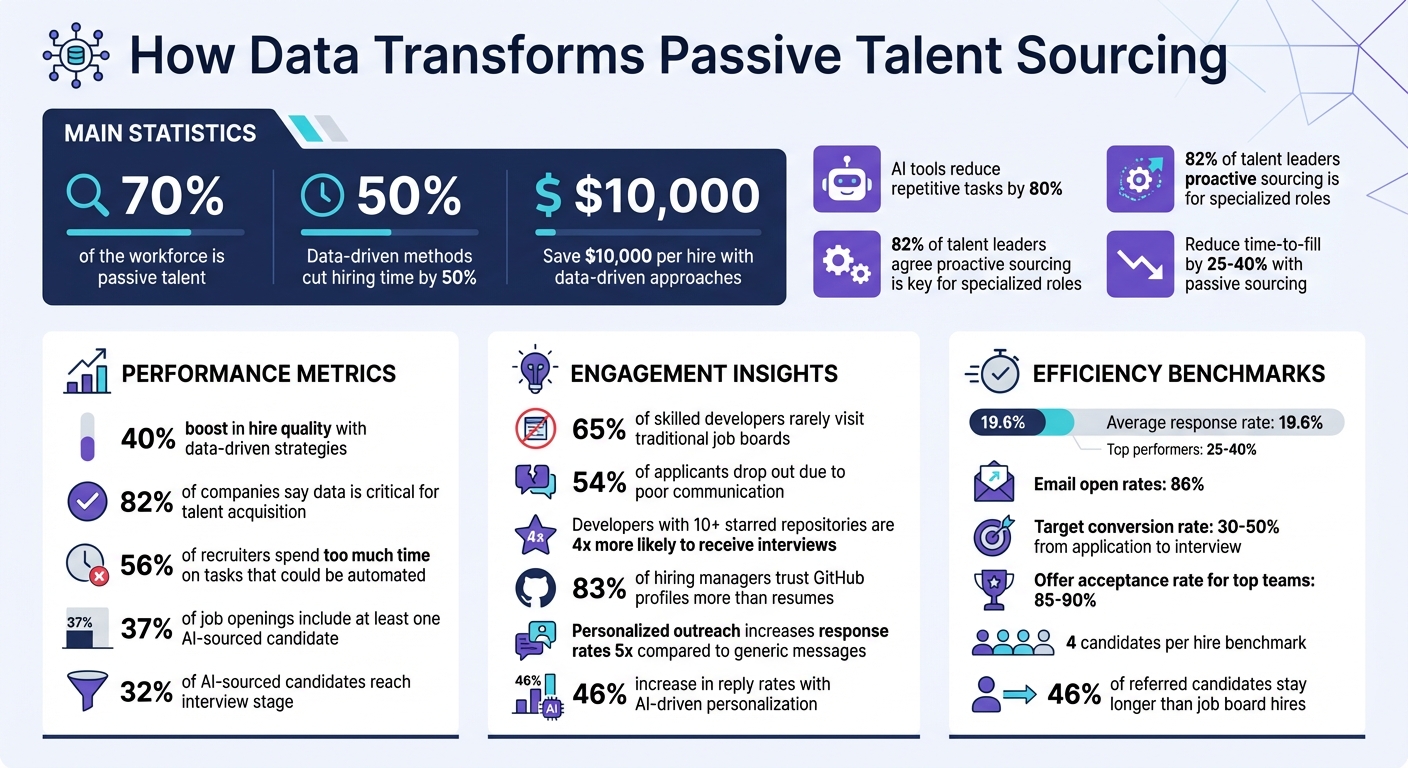 {Data-Driven Passive Talent Sourcing: Key Statistics and Impact}
What Is Passive Talent Sourcing?
Passive talent sourcing is all about proactively identifying professionals who are thriving in their current roles but aren’t actively looking for a new job . While these individuals aren’t scanning job boards, they might be open to exploring the right opportunity if it’s presented in the right way.
This approach stands in stark contrast to active recruitment, which typically relies on job postings and waiting for applications to roll in. Instead, passive sourcing requires thorough research, networking, and directly reaching out to potential candidates - often before they’ve even thought about switching roles . Think of it as building relationships and crafting detailed candidate profiles, rather than simply advertising open positions.
The stats back up its effectiveness. 82% of talent leaders agree that proactive sourcing is key to filling specialized or hard-to-fill roles . And when recruiters connect with candidates before a job is posted, they can reduce time-to-fill by 25–40% .
| Feature | Active Recruitment | Passive Talent Sourcing |
|---|---|---|
| Primary Method | Reactive (Job postings/ads) | Proactive (Research/Networking) |
| Candidate Status | Actively seeking a new role | Currently employed/Not looking |
| Competition | High (Candidates apply widely) | Lower (Targeted outreach) |
| Time-to-Fill | Slower (Dependent on flow) | Faster (25–40% reduction) |
| Tools Used | Job boards, ATS | AI, Boolean search, Social networks |
Common Challenges When Recruiting Passive Talent
Reaching passive developers is one thing; actually getting their attention is a whole other challenge. With so many messages flooding their inboxes, standing out is tough . Your outreach needs to grab their interest immediately or risk being ignored.
Adding to the complexity, 65% of skilled developers rarely visit traditional job boards. Instead, recruiters need to look for them on platforms like GitHub, Stack Overflow, and niche forums .
Trust is another hurdle. Developers are often skeptical of cold outreach, especially if it feels impersonal or spammy. Poor communication during the hiring process can also drive them away - 54% of applicants drop out due to infrequent or generic interactions . Without personalized messaging and meaningful context, your outreach might just blend into the noise.
Finally, understanding what drives passive candidates takes effort. These professionals aren’t actively seeking change, so they need a compelling reason to even consider leaving their current role. This means doing your homework - knowing their career aspirations, technical passions, and what they value in a workplace before reaching out.
These challenges highlight the importance of using precise data to craft effective engagement strategies.
Why Data Matters for Passive Sourcing
Data takes the guesswork out of passive sourcing. Instead of sending out hundreds of generic messages and hoping for a response, analytics can pinpoint the candidates most likely to engage - and the best time to reach them .
Behavioral signals are especially useful. For example, data can reveal when a developer might be open to new opportunities, such as nearing the two-year mark at their current job, updating their GitHub profile, or becoming more active on technical forums . These subtle cues can help recruiters time their outreach perfectly.
Data also improves targeting. Traditional keyword searches often miss great candidates because they’re too rigid. For instance, searching for "frontend developer" might overlook someone labeled as a "UI engineer." By using Natural Language Processing (NLP), recruiters can understand context and synonyms, broadening the talent pool while maintaining relevance .
The results speak for themselves. 82% of companies say data plays a key role in talent acquisition decisions , and recruiters using data-driven strategies report a 40% boost in hire quality . By leveraging data, recruiters can find better candidates faster and with greater precision.
Hiring engineers?
Connect with developers where they actually hang out. No cold outreach, just real conversations.
Data Sources for Finding Passive Developer Talent
To effectively identify and connect with passive developer talent, it’s crucial to focus on platforms where developers naturally engage and showcase their work. Unlike traditional job boards, these spaces provide insights into their actual skills and contributions, not just what’s listed on a resume.
Developer Networks and Communities
GitHub stands out as a key platform for evaluating technical skills. Home to over 100 million active developers , it offers a transparent view of what candidates build and how they collaborate. You can assess code quality, contribution patterns, and even the tone of pull request comments .
"Think about it: while LinkedIn shows you what developers claim they can do, GitHub reveals what they actually build." – Ricardo Batista, Fidforward
Another platform, daily.dev Recruiter, connects you with over 1,000,000 developers who are actively honing their skills. This community is particularly effective for finding senior-level talent, as 40% of its users are senior engineers or technical leads. The platform emphasizes professional growth, making it a goldmine for identifying motivated, experienced developers.
For managing outreach and pipeline processes, developer sourcing tools can save time and effort. These tools typically cost between $59 and $99 per month .
By tapping into these networks, you gain access to a pool of candidates whose technical abilities and professional engagement are on full display.
Technical Contributions and Online Activity
Digging deeper into developers’ online activity can reveal their expertise beyond a surface-level profile. Metrics like original code contributions, forks, and stars are reliable indicators of skill. Developers with 10+ starred repositories, for example, are four times more likely to receive interview invitations . Furthermore, 83% of technical hiring managers trust these profiles more than traditional resumes .
Consistent commit patterns and high-quality pull requests are also valuable signals. Regular activity often reflects dedication, while well-documented code and thoughtful comments highlight collaboration and communication skills. Teams hiring developers with three or more weekly commits have reported a 68% boost in retention rates .
To find potential candidates, Boolean search strings can be incredibly effective. For example, you can use: site:github.com (inurl:resume OR inurl:CV) software AND (engineer OR developer) . Some developers make their intentions clear by setting their profile status to "hireable" or including career-related keywords in their repositories . When outreach is personalized - referencing specific contributions - response rates can increase fivefold compared to generic messages .
A real-world example comes from Netflix’s talent team. In early 2025, they used a targeted GitHub search (org:netflix language:go followers:>100) to identify senior engineers. This approach led to 15 hires in just two months, with a 33% faster time-to-hire and a 27% higher offer acceptance rate .
Platforms like GitHub and daily.dev aren't just tools - they're windows into a developer’s true capabilities and potential. By focusing on these spaces, you can connect with talent that aligns with your team’s needs.
Matching Skills and Roles with Data
Finding the right developers for your open positions doesn’t have to involve sifting through endless profiles. With the help of data analytics tools, you can automatically align candidate skills with job requirements. In fact, 56% of recruiters say they spend too much time on repetitive sourcing tasks that could be automated . By leveraging AI-powered sourcing, you can cut the time spent identifying candidates by as much as 80% .
Modern systems go beyond basic keyword matching. They use advanced language processing to understand context and synonyms. For instance, if you’re searching for a "frontend developer", the system can recognize that someone labeled as a "UI engineer" or listing "React.js experience" might be a great fit - even if they don’t use your exact terminology. This semantic approach broadens your candidate pool without compromising quality.
Here’s a telling statistic: 37% of job openings now include at least one AI-sourced candidate, and 32% of those candidates make it to the interview stage . This shows how AI tools are reshaping the way we match skills to roles.
AI-Powered Matching
AI tools take data-driven insights to the next level by calculating precise match scores. These systems analyze profiles, engagement patterns, and activity data to generate a "match score" or "fit probability" for each candidate . By studying historical hiring data, predictive algorithms identify patterns in your past successful hires, helping you find similar candidates for new roles.
What’s more, these systems don’t wait for you to start a search. Proactive AI continuously scans databases, updates talent pipelines, and even suggests tweaks to your job descriptions based on real-time market trends .
One standout feature is reducing bias in technical hiring. AI tools can anonymize candidate data during the initial screening process, removing details like names, gender pronouns, and university names. This ensures the focus remains solely on technical skills and experience .
"AI can detect hidden talent not apparent in traditional recruitment processes, making the funnel of potential hires larger and thereby increasing the possibilities to get the right person for the job." – Lucas Botzen, CEO, Rivermate
Another game-changing capability? Revisiting past candidates. AI can scan your existing applicant tracking system to identify "silver medalists" - those strong candidates who weren’t hired previously - and flag them when their skills now align with current openings . This means you’re not starting from scratch every time you post a new job.
Custom Screening Criteria
AI matching is powerful, but sometimes you need to refine your candidate pool further. That’s where personalized filters come in. You can set specific criteria like seniority level, programming languages, industry experience, or even willingness to relocate.
Automated knockout questions help enforce non-negotiable requirements. For example, you can filter candidates based on certifications, legal work authorization, or availability to start within a specific timeframe. This ensures that only candidates meeting your baseline needs move forward .
For technical roles, you can take it a step further by filtering candidates based on verified contributions. This includes GitHub activity, Stack Overflow reputation, or involvement in open-source projects. These insights go beyond resumes, showcasing what candidates have actually built. Additionally, skills-based normalization ensures that experience is categorized accurately, regardless of how candidates format their profiles. For instance, a "Software Engineer II" with backend expertise will appear in searches for "Backend Developer" roles .
Every hiring situation is unique. A startup might value full-stack versatility, while an enterprise team may need someone with deep expertise in a specific framework. Custom screening criteria allow you to tailor your approach to the role, ensuring your outreach resonates with the right candidates at the right time.
Improving Sourcing Strategies with Analytics
Finding passive developer talent is just the starting point. The real edge comes from tracking what works and continuously improving your approach. However, there's a challenge: while 82% of companies acknowledge that data is critical for talent acquisition decisions, only about 50% actually measure their recruiting effectiveness . This gap presents a huge opportunity for teams ready to embrace analytics.
Advanced analytics, when paired with AI-powered matching, can take your engagement strategy to the next level. Data removes the guesswork from recruiting, turning it into a system you can refine and replicate. By tracking meaningful metrics, you can uncover where candidates drop off, which messages resonate, and which sourcing channels deliver the best hires. Without these insights, your process risks losing direction.
Key Metrics to Track
Start with outreach performance. The average response rate for sourcing campaigns is 19.6% , but top-performing teams often achieve 25–40% . Pay attention to open rates (typically around 86% ), reply rates, and interest rates to gauge whether your messaging is connecting. For instance, if your open rates are high but replies are low, the issue likely lies in your message content rather than your subject lines.
Next, focus on conversion rates at each stage of the funnel. High-performing teams aim for a 30–50% conversion rate from application to interview for sourced candidates . Calculate your sourced-to-screen ratio and screen-to-interview progression. A general benchmark is 4 candidates per hire - if you're consistently exceeding this, it could indicate poor candidate quality or ineffective targeting .
Track quality metrics using performance reviews and retention data. Top-tier recruiting teams maintain an offer acceptance rate of 85–90% , reflecting both strong candidate quality and effective communication of the opportunity. Additionally, gather candidate satisfaction scores through post-process surveys for both hired and non-hired candidates. These surveys can help identify pain points in your process .
Lastly, monitor efficiency indicators like time to fill and cost per hire. Compare these metrics across sourcing channels to determine which platforms provide the best return on investment. For example, referrals often lead to higher retention rates, with 46% of referred candidates staying longer than those sourced through job boards .
Once you've established these metrics, use detailed analysis to refine your sourcing strategy.
Using Data to Refine Your Approach
Experiment with A/B testing to evaluate different subject lines, message lengths, and sending times. Sonya Yeonas, Technical Recruiting Manager at Ramp, highlights their method:
When we send out our sequences, most sourcers here at Ramp have three or four stages with data showing we get the most response on the second or third outreach versus that first one .
Data also shows that reply rates peak slightly when emails are sent between 12 PM and 6 PM local time .
Evaluate sourcing channel performance carefully. Not all platforms yield the same results. By tracking "source of hire" and "quality of candidate" for each channel, you can identify which sources provide high volume versus those that deliver top-tier talent . This allows you to allocate resources more effectively.
Optimize your outreach sequences by leveraging data. Studies reveal that reply rates plateau after three emails, typically leveling off around 23% . Including at least one follow-up significantly boosts engagement, but sending more than three emails generally doesn’t improve response rates. Use this insight to strike the right balance - engage without overwhelming candidates.
One effective strategy is AI-driven personalization. Teams that use AI for tailored outreach see a 46% increase in reply rates compared to generic templates (35.3% vs. 24.1%) . Kiera Cox, Technical Recruiter at Liveflow, shares her experience:
Using Ashby's AI helps us source more quickly while still sending out way higher quality emails .
Balance automation with thoughtful, personalized messaging that demonstrates genuine interest in each candidate.
Christina Schmit from Renewal by Andersen emphasizes the importance of staying flexible:
It's not about perfection [when it comes to using talent acquisition insights]. It's about reviewing the data, adjusting accordingly, and keeping the train on the track .
Start with a few key metrics, establish benchmarks, and refine your process over time. The goal isn’t flawless data - it’s actionable insights that guide better decisions every week.
How daily.dev Recruiter Uses Data for Passive Sourcing

daily.dev Recruiter taps into an active developer network to ensure that every connection feels relevant and data-informed. By focusing on real-time behavioral insights, the platform creates a recruiting process that’s both engaging and highly personalized.
Warm Introductions and High-Intent Engagement
Forget cold outreach. With a double opt-in system, developers are presented with quick, focused briefs that highlight technical challenges and growth opportunities. They then decide whether to engage, ensuring that every conversation starts with someone genuinely interested in the role.
This setup guarantees that the developers you connect with not only meet your technical and logistical needs but are also motivated to explore the opportunity further. Recruiters can even add custom screening questions to refine candidate selection, making sure every interaction aligns with the role’s requirements.
Real-Time Data from an Engaged Developer Network
daily.dev Recruiter takes a dynamic approach by using real-time insights to overcome challenges in passive sourcing and update candidate profiles. The platform tracks how developers engage with professional content, such as technical articles, tools, and emerging technologies. This creates up-to-date skill profiles that reflect what developers are actively learning and where their interests are heading.
Conclusion
Data has revolutionized passive talent sourcing, turning it into a predictive and insight-driven process. By leveraging real-time behavioral data, recruiters can uncover developers' learning habits, interests, and openness to new opportunities. In fact, teams that rely on data-driven recruiting are 2.5 times more likely to hire efficiently compared to those that don’t. These insights are reshaping how every stage of passive talent sourcing is approached.
This shift allows recruiters to build talent pipelines well in advance of job openings, identifying candidates based on concrete evidence rather than guesswork. As Christina Schmit, Director of Talent & Culture at Renewal by Andersen, explains:
It's not about perfection [when it comes to using talent acquisition insights]. It's about reviewing the data, adjusting accordingly, and keeping the train on the track.
Taking this concept further, daily.dev Recruiter offers a platform designed to connect employers with passive developers in a way that prioritizes trust and meaningful engagement. Its double opt-in system ensures that conversations start with mutual interest, while real-time insights from an active developer community keep candidate profiles accurate and up-to-date.
FAQs
How can data-driven sourcing help recruiters save time and reduce hiring costs?
Data-driven sourcing leverages advanced analytics and AI to pinpoint and engage with pre-qualified, passive developer candidates. By targeting developers who closely match your hiring requirements, this method cuts out excessive outreach, saving valuable time typically spent on searching and initial screening.
This strategy doesn’t just speed up the hiring process - it also trims costs by reducing manual workload and streamlining efficiency. With a pool of top-tier, engaged candidates at their fingertips, recruiters can make quicker, smarter hiring decisions.
What are the best platforms for finding passive developer talent?
Finding skilled developers who aren't actively job hunting means tapping into the spaces where they naturally spend their time learning, collaborating, or showcasing their expertise. One standout option is daily.dev Recruiter, a hiring platform designed specifically with developers in mind. It connects recruiters with a network of pre-qualified engineers through a trusted professional community.
Beyond that, other valuable sources include curated talent pools, freelance platforms, and specialized job boards. By leveraging data from these platforms - like skill tags, engagement trends, and activity levels - recruiters can pinpoint developers who might not be actively seeking a new role but could be open to the right opportunity. This data-driven method helps create a more focused and effective recruitment strategy.
How does AI improve passive talent sourcing for recruiters?
AI makes passive talent sourcing much easier by taking over tedious tasks and offering insights backed by data. It scans public profiles, code repositories, and forums to spot developers whose skills and activities match a role - even if they’re not actively searching for a job. On top of that, AI enriches these profiles with details like intent signals, skill trends, and recent activity, helping recruiters zero in on the most promising candidates.
It doesn’t stop there. AI improves outreach efforts by crafting personalized, context-aware messages and automating follow-ups, which can lead to better response rates. When used with a developer-focused platform like daily.dev Recruiter, AI becomes even more effective. By tapping into real-time activity signals and trust-based introductions, it connects recruiters with engaged and qualified developers. This not only saves time but also expands the talent pool and fosters meaningful connections with potential candidates.
.png)