

Developers often feel hiring processes waste their time. Poor communication, irrelevant assessments, and vague job descriptions are common issues. Here's how to fix that:
- Be transparent upfront: Share salary ranges, role details, work models, and company info in job postings.
- Streamline the process: Limit interviews to 3-4 rounds and avoid lengthy delays or ghosting candidates.
- Redesign assessments: Focus on practical tasks aligned with the job, not abstract coding puzzles. Keep take-home assignments under 4 hours.
- Respect candidates' time: Provide clear timelines, detailed interview prep, and a dedicated contact person.
Treating developers with respect improves trust, boosts acceptance rates, and enhances your reputation, even among rejected candidates. Start by refining job listings, simplifying interviews, and ensuring assessments reflect real tasks.
What Developers Expect and Where Recruiting Fails Them
::: @figure 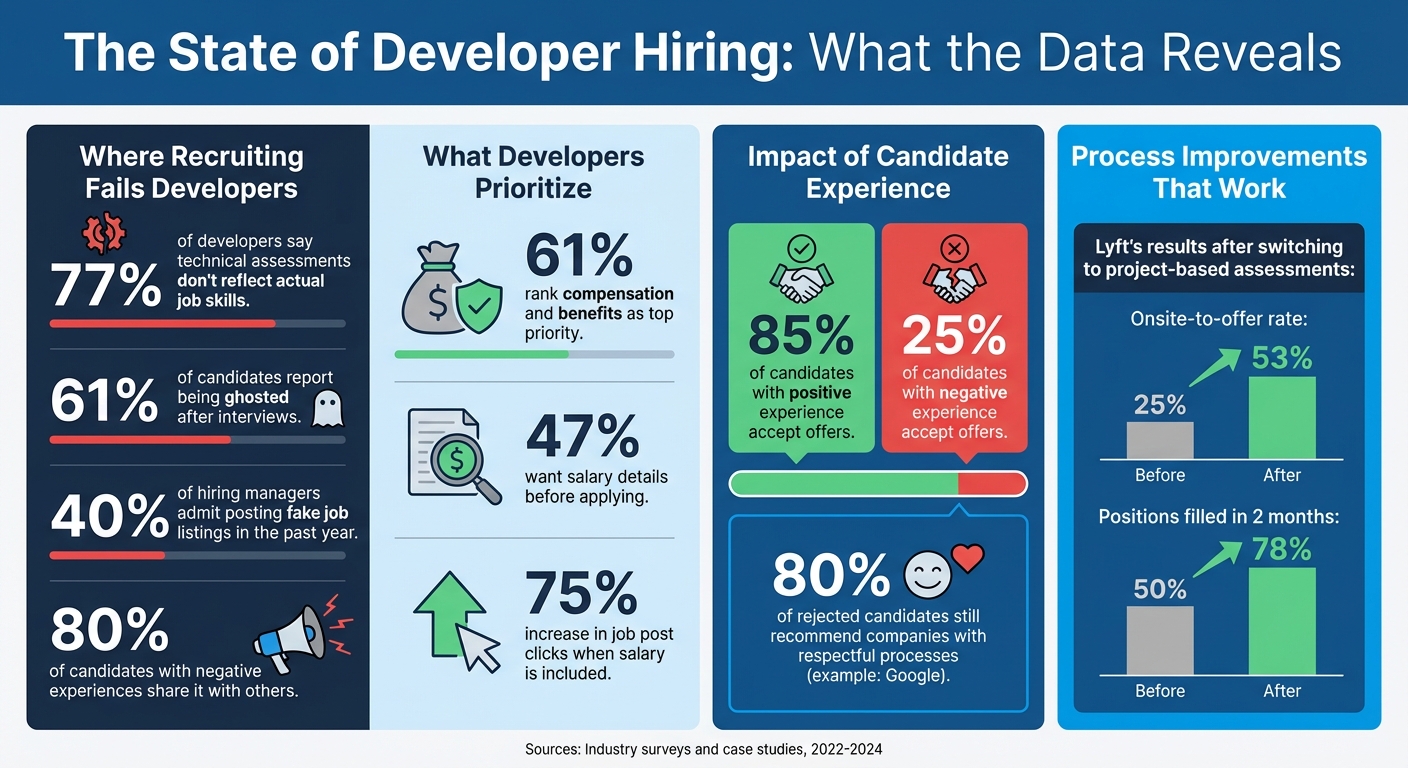 {Developer Hiring Experience Statistics: Key Metrics That Impact Recruitment Success}
Why Developers Think You're Wasting Their Time
Developers often feel stuck in a flawed hiring system, and the stats back it up. 77% of developers say technical assessments don’t reflect the actual skills needed for the job . Imagine spending hours preparing for a test only to realize it has zero connection to the real work you’d be doing. It’s frustrating, and it’s not the only problem. 61% of candidates report being ghosted after interviews . That kind of radio silence erodes trust and leaves candidates feeling disrespected.
Then there’s the issue of job descriptions. Many combine unrelated roles - like DBA, full-stack, network, and DevOps - into one position. This screams disorganization. Pablo Portillo, a Google Cloud Specialist at Telus, explains:
"I've seen these 'all-in-one' roles that combine skills for DBA, full-stack, network, DevOps… all in one single profile, and that for me is a red flag. It means that there is no clear expectation for the candidate and the role."
Vague job descriptions don’t just confuse candidates - they show a lack of respect for their time and expertise.
The interview process can be just as discouraging. Endless rounds of interviews drain candidates, and every additional step increases the chance they’ll walk away. Long delays between stages - or worse, complete silence - don’t just cost companies great talent. They also hurt their reputation. 80% of candidates who have a negative experience will share it with others .
Adding to the distrust is the rise of fake job listings. 40% of hiring managers admit their company has posted a fake job listing in the past year . These listings are often used to project growth or collect resumes, not to fill actual roles. For developers, this creates skepticism about every job post they see. To rebuild trust, companies need to start with clear, honest communication.
4 Things Developers Need to See Immediately
Given these issues, companies must provide four critical details upfront: salary range in USD, role scope, work model, and company information. These aren’t just nice extras - they’re deal-breakers. 61% of candidates rank compensation and benefits as their top priority , and 47% want to know salary details before applying .
- Salary range: Be specific. Don’t say “competitive” or “based on experience.” Give an actual range, like "$120,000–$150,000."
- Role scope: Explain what the developer will work on and the impact they’ll have. Avoid simply listing technologies.
- Work model: Clearly state whether the role is remote, hybrid, or on-site. This directly affects work-life balance.
- Company information: Go beyond vague phrases like “fast-growing startup.” Share details about the tech stack, team size, and what makes this role stand out among the dozens of others in their inbox.
Hiding this information or saving it for later signals to developers that their time isn’t valued. As Portillo puts it:
"People are investing their lives, their time in your process, so keep communication two-way."
Transparency isn’t about losing negotiating power - it’s about respect. These details set the tone for the entire hiring process and determine whether developers even want to engage with your company.
Mapping a Developer Candidate Journey That Shows Respect
Hiring a developer is a two-way street. While you're evaluating their skills, they're sizing up your professionalism, company culture, and whether they see themselves thriving in your environment . The stats back this up: candidates who report a positive experience are 85% more likely to accept an offer, compared to just 25% for those with a negative experience . Even more telling, 80% of candidates who were rejected by companies with respectful processes still recommend others apply . Building trust and setting clear expectations from the start can make all the difference.
Think of the hiring process as a series of trust-building opportunities, not hurdles. Start small with brief initial screenings, then gradually increase the time commitment as mutual confidence grows . Developers are busy and often juggling multiple interviews, so respecting their time is crucial. Assign a dedicated point of contact for each candidate to ensure no one feels forgotten or ghosted. This simple step can make them feel valued rather than just another name in the pile.
Transparency is the foundation of respect, and it should run through every stage of the hiring process. Start by being upfront about key details like salary, job role, and work model. Then, keep that openness going. Before interviews, send a clear, detailed email outlining everything they need to know: the interview schedule, names of interviewers, logistics (like a remote link or office location), preparation tips, the number of rounds, the type of questions they’ll face, and realistic timelines . This kind of clarity not only reduces stress but also shows you respect their time and effort.
Limit the interview process to three or four rounds - any more, and you risk losing candidates to fatigue or frustration. Use structured evaluation rubrics to assess skills objectively, steering clear of vague "culture fit" assessments that can introduce bias. Focus on skills-based evaluations by reviewing GitHub portfolios, work samples, or practical tasks. Avoid relying on generic algorithm puzzles that often have little to do with the actual job.
When it’s time to extend an offer, make it personal. Call the candidate before sending the formal email, and have the hiring manager reach out to congratulate them . Stick to the timelines you’ve promised - if you said two weeks, don’t let it drag to four. Developers often have competing offers, and delays can suggest disorganization or a lack of genuine interest. Be clear about the salary (in USD), whether there’s room for negotiation, and what the next steps are. This consistent communication reinforces the respect you’ve shown throughout the process and helps cement their trust in your company.
How to Redesign Technical Assessments Developers Won't Hate
Technical assessments are often where hiring processes fall apart for developers. Too many of these tests focus on skills that don’t align with the actual work, like asking candidates to reverse linked lists on a whiteboard when the job involves debugging microservices or reviewing pull requests. To regain developer trust, assessments need a serious overhaul.
Core Principles for Better Developer Assessments
To create assessments that developers respect, focus on real work scenarios. Test candidates on tasks they’ll actually encounter on the job - like database migrations, REST API development, troubleshooting CI/CD pipelines, or reviewing code. Provide pre-configured repositories so candidates can dive right into problem-solving instead of wasting time setting up boilerplate .
Let candidates use real-world tools. Developers should be allowed to work with their preferred IDEs, operating systems, and even use the internet for documentation - just like they would in a real job setting. Use a structured 1-5 rubric to evaluate key aspects like code correctness, quality, efficiency, and testing. This approach minimizes bias and ensures fairness across all candidates .
Time limits are a must. Technical screens should last no longer than 60-90 minutes, and take-home assignments should be capped at 2-4 hours . Before rolling out any assessment, have your own engineers test it to ensure the instructions are clear and the time limit is reasonable . For example, in June 2024, Lyft partnered with Byteboard to replace traditional algorithm-based tests with project-based assessments. The results? Their onsite-to-offer rate jumped from 25% to 53%, and they filled 78% of open positions within two months - compared to just 50% with their old methods .
Take-home assignments, in particular, should reflect real challenges that align with the role.
Fixing Take-Home Assignments
Take-home projects should closely mirror the kind of work candidates will do if hired. Instead of asking them to build something from scratch, give them a small, focused task within an existing codebase. For example, you could ask them to add a feature to a microservice or fix a bug in a production-like environment.
Set clear time limits and stick to them. Provide detailed instructions on what you’re evaluating, how submissions will be graded, and what a strong submission looks like. To accommodate different preferences and circumstances, consider offering candidates options: a take-home task, a live pair-programming session, or even a review of their past open-source contributions . This flexibility shows respect for their time and working styles.
In 2022, GitHub introduced "Interview-bot", a custom GitHub App, to streamline their take-home technical interviews. Candidates work in their own environments and submit Pull Requests to a private repository. The bot anonymizes submissions before assigning them to engineers for review using a standardized rubric . This not only reduces bias but also ensures a fair and consistent evaluation process.
Updating technical screens is another way to align assessments with real-world job demands.
Replacing Outdated Technical Screens
Whiteboard coding tests often measure anxiety more than actual skills. It’s time to replace them with formats that reveal how candidates think and collaborate.
Pair programming sessions (60-90 minutes) are a great way to evaluate real-time problem-solving and communication skills. Work on a realistic task together or review code the candidate has already written. For senior roles, system design discussions are crucial. These should focus on architectural thinking, trade-offs, and how candidates handle ambiguity, rather than relying on memorized patterns .
For initial screens, keep things straightforward. The goal here is to filter out clear mismatches, not to find the perfect candidate - that comes later .
Adjust the difficulty based on the role. For junior positions, focus on code correctness, basic quality, and following conventions. Senior roles, on the other hand, should emphasize architectural thinking, testing strategies, and handling complex, ambiguous problems . There’s no need to make a senior engineer prove they can write a for-loop. Instead, use a short pre-screen (about 60 minutes) to confirm basic proficiency, then move on to deeper discussions about architecture . These updates not only provide a better measure of technical skills but also demonstrate that you value candidates’ time and expertise.
| Assessment Type | Recommended Time Limit | Best For Assessing |
|---|---|---|
| Technical Screen | 60-90 Minutes | Basic API implementation, debugging, and setup |
| Take-Home Project | 2-4 Hours | System design, business logic, and code quality |
| Pair Programming | 60-90 Minutes | Collaboration, communication, and real-time problem-solving |
Hiring engineers?
Connect with developers where they actually hang out. No cold outreach, just real conversations.
Using daily.dev Recruiter to Build a Better Developer Experience
daily.dev Recruiter takes the developer hiring process to the next level by focusing on respect and transparency. It connects with developers directly in their professional feed, offering the context they need before they even think about applying.
Providing Context Before Candidates Hit Your ATS
Developers value their time, and they want clarity before committing to any interview process. Instead of bombarding them with vague, buzzword-filled job descriptions, daily.dev Recruiter lets you showcase detailed technical profiles. These profiles include specifics like frameworks, team dynamics, and salary information, helping to filter out mismatches early on.
The platform operates on a consent-based introduction model. Developers review opportunities and actively choose to engage - no unsolicited emails, no spam. In fact, job postings that include salary details see a 75% increase in clicks . By prioritizing transparency, daily.dev Recruiter ensures candidates have all the information they need upfront, reducing drop-off rates and attracting motivated, pre-qualified applicants.
Adding Respectful Practices to Your Current Hiring Process
You can easily integrate daily.dev Recruiter with your existing Applicant Tracking System (ATS) to enhance your hiring approach with respectful and efficient practices.
For instance, you can use three targeted screening questions to assess candidates' qualifications before they move forward. This step saves time for everyone involved and ensures you're only interviewing developers who meet your technical criteria. Additionally, the platform provides insights into developers' interests, allowing for personalized outreach that feels genuine, not automated.
Consider this: 80% of candidates rejected by Google would still recommend the company to a friend because of the positive experience they had . daily.dev Recruiter helps you create a similar atmosphere by replacing impersonal cold outreach with thoughtful, high-context communication.
| Practice | Traditional Recruitment | daily.dev Recruiter Approach |
|---|---|---|
| Outreach | Cold emails/Spam | Consent-based (Double opt-in) |
| Job Details | Vague/Buzzword-heavy | High-context/Technical depth |
| Initial Screening | Manual resume review | Pre-qualified via 3 targeted questions |
These strategies pave the way for quick, measurable improvements, which you can start implementing through a 30-day action plan.
30-Day Action Plan: Changes You Can Make This Month
Here’s how you can transform your hiring process in just one month:
Week 1: Refine job details and assessments
- Include salary ranges (in USD) in all job postings.
- Add specific technical details, like frameworks and team structure, to your job descriptions.
- Test your current take-home assignments with your engineering team and limit them to 2–4 hours.
Week 2: Launch daily.dev Recruiter and streamline your workflow
- Create an account on daily.dev Recruiter and post your first high-context job listing.
- Use the platform’s screening tools to filter candidates based on essential skills.
- Review your interview process and cut any redundant steps - aim for no more than four touchpoints from initial contact to final offer.
Week 3: Upgrade assessments and start sourcing candidates
- Replace at least one whiteboard coding test with a pair programming session or a system design discussion.
- Train interviewers to use a structured 1–5 scoring rubric for fair evaluations.
- Source your first group of candidates through daily.dev Recruiter and compare response rates with your usual methods.
Week 4: Collect feedback and improve decision-making
- Email candidates from the past 60 days, including those you didn’t hire, to gather feedback.
- Use their input to fine-tune your process.
- Commit to making final hiring decisions within 48 hours of the last interview.
These adjustments don’t require a complete overhaul of your hiring process. They simply emphasize treating developers as skilled professionals while making the experience more efficient and respectful for everyone involved.
Conclusion
Hiring developers with respect boils down to three key principles: clarity, efficiency, and relevance. Developers want transparency upfront - details like salary ranges, preferred tech stacks, and work models should be clear from the start. They also value a streamlined hiring process, ideally limited to three or four interview rounds, with assessments that reflect real-world tasks instead of abstract challenges.
The numbers back this up. When candidates have a positive experience, 85% are likely to accept an offer. On the flip side, only 25% with a negative experience would do the same . The difference? It’s about treating developers as skilled professionals and understanding that every interaction shapes their view of your company’s culture and professionalism.
Using daily.dev Recruiter’s transparent approach can help you align with these principles and elevate the candidate experience. This platform connects with developers where they naturally spend time - reading, learning, and engaging with their peers. It ensures opportunities are presented with the technical depth and openness developers need to feel engaged.
"Identifying great developer talent requires a deep understanding of how developers work and live, which leads to a mutual respect between companies and developers." - Qualified Manifesto
Take action with a simple 30-day plan: include salary ranges in job postings, cut unnecessary interview steps, and collaborate with your engineering team to validate take-home tasks. These small but meaningful changes show developers the respect their expertise truly deserves.
FAQs
How can companies create technical assessments that reflect real job responsibilities?
When crafting technical assessments, it’s crucial to focus on tasks that reflect the actual responsibilities of the role. Start by working closely with the hiring team - especially the engineers who will collaborate with the new hire. Together, define the role’s day-to-day tasks, key goals, and frequently used tools. Use this information to create a concise take-home project or live-coding exercise that mirrors a practical challenge, such as debugging a problem or enhancing an existing codebase. This not only lets candidates demonstrate their skills but also gives them a sense of how their work would integrate into the team’s workflow.
Clear communication is key to making assessments both fair and effective. Be upfront about what’s expected: explain the evaluation criteria, provide a realistic estimate of the time required, and share any starter materials they’ll need. Before rolling out the test, have your in-house engineers review and trial it to ensure it’s appropriate for the role’s level and accurately represents the job’s demands. Pair this with a skills-focused approach to minimize unnecessary interview steps and build trust with candidates.
Lastly, don’t forget to gather feedback from both candidates and hiring managers after each hiring cycle. Use their insights to fine-tune the process - adjusting the difficulty, simplifying steps, and keeping timelines reasonable. This ensures your assessment stays a reliable indicator of how well a candidate will perform on the job.
Why is it important to include salary ranges in job postings?
Including salary ranges in job postings shows honesty and consideration for candidates' time. It allows developers to immediately assess whether the role meets their financial expectations, cutting down on unnecessary discussions and delays during the hiring process.
This approach also fosters confidence among candidates, signaling that your company prioritizes openness and is clear about its offerings. By drawing in applicants who are already comfortable with the compensation, you simplify the hiring process and enhance the overall experience for everyone involved.
Why is transparency crucial in hiring developers?
Transparency plays a crucial role in hiring developers because it fosters trust and removes unnecessary guesswork. When candidates are provided with clear, upfront details - like salary ranges, role responsibilities, work arrangements, and insights into the company’s identity - they can quickly assess whether the opportunity aligns with their career goals. This not only saves time for both the candidate and the hiring team but also demonstrates respect for the developer’s time and effort.
It’s not just about saving time; transparency directly impacts results. Clear communication throughout the process minimizes frustration, keeps candidates engaged, and increases the likelihood that they’ll accept an offer. Developers appreciate hiring processes that are efficient, respectful, and free from unnecessary hurdles. By making transparency a priority, hiring teams create a streamlined experience that stands out in today’s competitive job market.
.png)