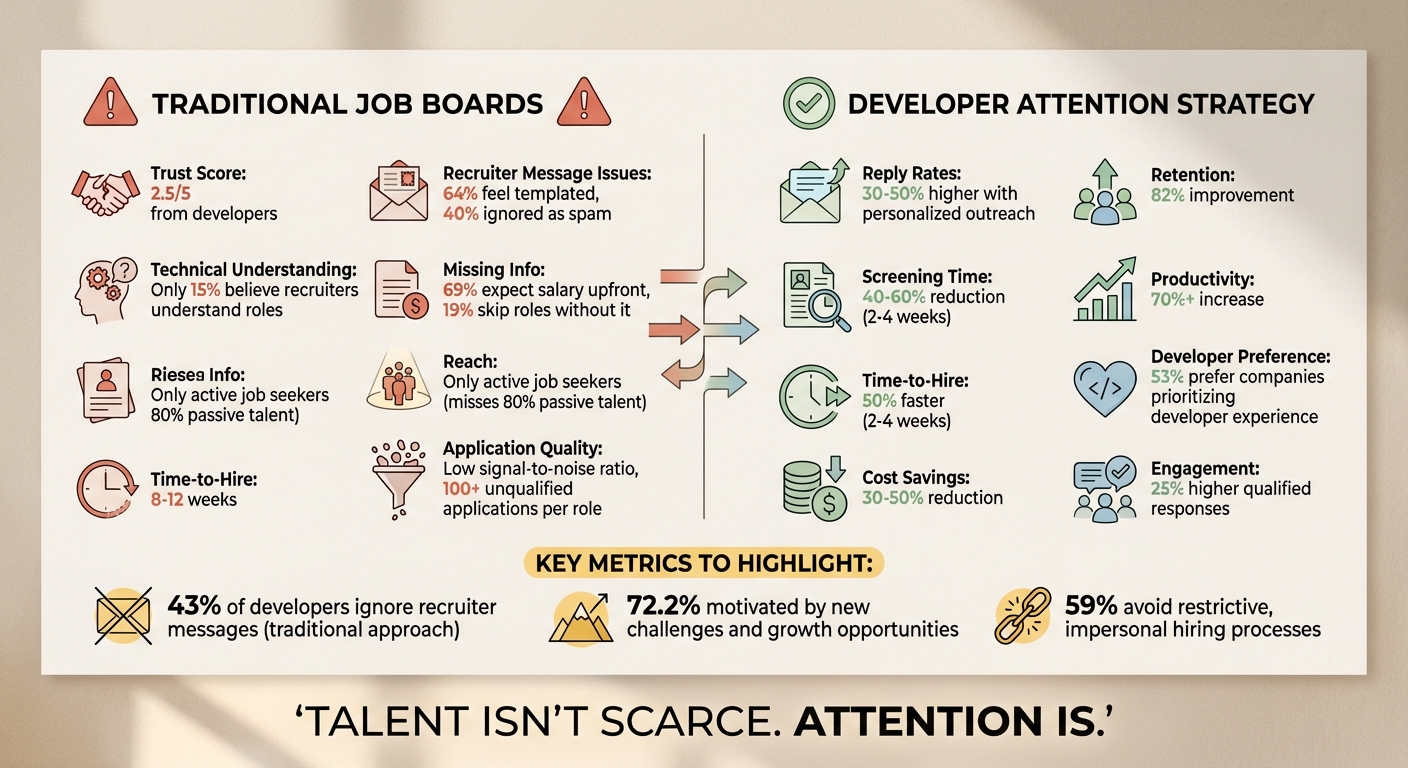
Hiring developers isn’t about finding talent; it’s about earning their attention. Traditional job boards fail to engage the right candidates, delivering irrelevant applications and missing out on skilled passive talent. Developers often ignore generic outreach, with 43% ignoring recruiter messages and 64% labeling them as templated. Instead, attention-based strategies focus on personalized, trust-driven engagement on platforms developers already use, like GitHub or Stack Overflow.
Key Insights:
- Job boards struggle: Overwhelming low-quality applications, lack of transparency (e.g., missing salary info), and failure to reach active vs passive candidates.
- Developers value trust: Only 2.5/5 trust recruiters, and 69% want salary details upfront.
- Effective strategies: Personalized outreach, tailored job briefs, and engaging developers on relevant platforms boost reply rates by 30-50%.
- Better outcomes: Attention-based methods cut time-to-hire by 50%, reduce costs, and improve retention by 82%.
Bottom line: Rethink your hiring approach. Focus on meaningful, personalized connections to attract and retain top developer talent.
The Problem with Job Board Traffic
Job boards promise wide exposure, but they often fall short by delivering a flood of irrelevant applications. Generalist platforms cast a broad net, but this approach comes with a major downside: a low signal-to-noise ratio. Qualified candidates get buried beneath stacks of resumes that don’t fit the role at all .
Too Many Unqualified Applicants
One of the biggest issues with job boards is the sheer volume of unqualified applications. These platforms allow anyone to apply, regardless of whether they meet even the basic qualifications. This results in wasted time and resources as hiring teams sift through irrelevant resumes, driving up costs and delaying the hiring process .
The problem gets worse when job postings are incomplete. For example, 69% of developers expect salary information upfront, and 19% will skip over a role entirely if that detail is missing . Without critical details like this, you attract candidates who might not have bothered applying if they had the full picture.
Missing Passive Talent
Here’s the real missed opportunity: job boards only cater to active job seekers. But what about the 80% of developers who are open to new roles but aren’t actively searching? These passive candidates are often the most skilled and stable professionals, excelling in their current positions. They’re not browsing job boards, and they’re certainly not applying to generic postings .
Job boards simply aren’t designed to reach this segment. Passive talent requires a completely different approach - one that involves personalized outreach, building trust, and providing a compelling reason to engage. A static job listing can’t accomplish that. Job boards are transactional by nature, but recruitment today demands a more relationship-driven strategy .
Generic and Transactional
Another major drawback of job boards is their impersonal, cookie-cutter approach to hiring. 64% of developers say recruiter messages feel templated, and 40% ignore outreach because it looks like spam . When your job posting blends into a sea of identical listings, it’s no wonder it fails to stand out.
This transactional system has also eroded trust. On average, recruiters score just 2.5 out of 5 on trustworthiness among developers . As Nimrod Kramer, CEO of daily.dev, explains: "The 'spray and pray' method didn't just fail. It poisoned the well." . Developers have grown skeptical of job boards, burned too many times by vague job descriptions, missing salary ranges, and recruiters who don’t know the difference between Java and JavaScript .
"Java is not like JavaScript, and the senior and lead is not the same thing." - Senior Backend Engineer
When only 15% of developers believe recruiters understand the technical requirements of the roles they’re hiring for, it’s clear why job boards struggle to deliver meaningful connections . To succeed, recruitment strategies need to move beyond volume and focus on direct, thoughtful engagement with developers.
What Is Developer Attention and Why It Matters
Developer attention is all about connecting with developers in meaningful ways on platforms they already use - like GitHub, tech forums, or professional networks. Instead of blasting out generic job postings, it focuses on thoughtful interactions that build genuine relationships with both active job seekers and passive candidates.
This targeted approach naturally leads to the strategies outlined below.
Focused and Contextual Engagement
Engaging developers effectively means meeting them where they are and tailoring your outreach to their current projects and interests. Rather than sending out a generic "We're hiring!" message, it’s about creating personalized touchpoints - like commenting on their open-source work, sharing challenges that match their expertise, or presenting roles that align with their career goals.
This approach resonates because 72.2% of software developers are motivated by opportunities to tackle new challenges and grow their skills . When you align a role with their interests and aspirations, you’re not just offering a job - you’re offering a chance to grow. This kind of engagement builds the foundation for trust, which is crucial in developer recruitment.
Building Trust and Relevance
Trust is non-negotiable. Developers value transparency, so sharing details about your company’s culture, growth opportunities, tech stack, and salary upfront is essential - especially since 69% of developers expect this information in the very first message .
Relevance is equally important. Highlighting specific project challenges, opportunities for skill development, and how the role contributes to meaningful work shows you understand their priorities. 53% of developers evaluate employers based on "developer experience" - they want to know you grasp the realities of their workflows, tools, and day-to-day challenges .
By addressing these factors, you create a connection that feels genuine and worthwhile.
Impact on Recruitment Outcomes
Focusing on developer attention leads to better recruitment results. By targeting candidates who’ve already shown interest - whether through their contributions to projects, engagement with certain technologies, or pursuit of new skills - you’re starting conversations with people more likely to respond and move forward in the hiring process.
But the benefits don’t stop at hiring. When developers are onboarded thoughtfully and engaged properly, retention rates improve by 82%, and productivity increases by over 70% . This ensures they come into the role with clear expectations and genuine enthusiasm, setting both them and your team up for long-term success.
Why Developer Attention Beats Job Board Traffic
When it comes to recruitment, focusing on developer attention offers a smarter, more effective way to connect with the right candidates. Instead of wading through a flood of unqualified applications, this method puts you in touch with skilled professionals who are genuinely interested in your opportunities. It’s a win-win that saves time and ensures quality hires.
Higher Engagement from Qualified Candidates
Attention-based recruitment targets developers based on their actual skills and interests. The result? Reply rates jump by 30-50% thanks to personalized outreach . Instead of sorting through over 100 low-quality applications per role, you’re starting meaningful conversations with candidates who fit your needs. Agencies report that screening time drops by 40-60% when using this method .
Even better, this approach aligns with what developers value. 53% of developers prefer companies that prioritize their experience, and by showing that you care about their time and expertise, you’re making a strong first impression .
Faster and More Cost-Effective Hiring
This strategy doesn’t just improve engagement - it speeds up the entire hiring process. By leveraging recruiter networks and directly targeting passive candidates, companies often cut time-to-hire by 50% or more . Compare that to traditional job boards, where the process can drag on for 8-12 weeks between posting, sourcing, and screening. Agencies using attention-based methods report delivering polished candidate lists in just days, enabling hires in as little as 2-4 weeks .
The cost savings are just as compelling. Businesses save 30-50% by avoiding expenses like dedicated HR salaries ($50,000-$80,000 annually), job board fees ($5,000-$20,000 per posting), and the steep costs of bad hires (over $100,000 per turnover) . For example, one tech company hired a senior engineer for a $150,000 role in just three weeks using a developer recruiting agency - far quicker and cheaper than their previous 10-week timeline and $15,000 in job board expenses. This efficiency allowed the team to focus on a critical product launch .
Better Developer Experience
A standout feature of attention-based recruitment is how it enhances the overall experience for developers. By replacing high-volume, impersonal spam with targeted, respectful outreach, this method values developers’ time and expertise . When candidates feel respected and informed throughout the hiring process, retention rates improve by 82%, as they start their roles with clear expectations and genuine enthusiasm .
In contrast, job boards often create a transactional, impersonal experience that leaves developers feeling burned out. 59% of developers avoid restrictive, impersonal hiring processes, preferring trust-based approaches that treat them as professionals rather than just another application . By prioritizing a better experience, you’re not just making hires - you’re laying the groundwork for long-term success and loyalty.
How to Capture and Maintain Developer Attention
Getting a developer's attention isn't about flashy gimmicks - it's about delivering the right message at the right time and in the right place. To do this effectively, focus on three main strategies: crafting job briefs that respect their expertise, engaging with them on platforms they already frequent, and personalizing your outreach to show genuine interest. Here's how to put these ideas into action.
Writing Job Briefs Developers Want to Read
Developers can spot a generic job post from a mile away, and most won't give it a second look, often because developers misunderstand job descriptions that lack clarity. In fact, 69% of developers want to see the salary range in the very first message . If you're hiding that information or burying it in irrelevant corporate jargon, you're likely losing their interest before they even start reading.
Start with the essentials: clearly state the tech stack and highlight how the role makes a real impact. Avoid buzzwords and long-winded skill lists. Instead, focus on 3–5 key technical requirements and specific responsibilities, like "Optimize database queries for over 1 million users." Transparency is crucial - include salary ranges upfront (e.g., $120,000–$160,000 for U.S. markets) to attract serious candidates and save everyone's time . Remember, only 15% of developers feel recruiters truly understand the roles they're hiring for . A well-written job brief shows you're not just another recruiter sending out cookie-cutter posts.
Connecting with Developers Where They Are
Even the best job briefs won't matter if you're not reaching developers where they spend their time. Spoiler alert: it's not job boards. Developers are more likely to be found learning, collaborating, or problem-solving on platforms like GitHub, Stack Overflow, Reddit (r/programming, r/cscareerquestions), Hacker News, and Slack or Discord communities tailored to their tech stacks .
To engage meaningfully, focus on adding value rather than pitching right away. For instance, contribute to a GitHub repository with a pull request, share a case study like "How we scaled our app 10x with Rust" in a relevant subreddit, or host an Ask Me Anything (AMA) session on the tech challenges your team is tackling. These actions build trust and interest before you even mention a job opening.
When you do reach out, make it personal. On GitHub, reference a developer's specific commit. On Reddit, end a helpful comment with a simple "DM me if you're curious" rather than leading with a sales pitch. This approach feels less intrusive and more like a natural part of the conversation.
Making Outreach Personal
Nobody likes generic messages, and developers are no exception. 64% of developers say recruiter messages feel copy-pasted, and recruiters score an average trust rating of just 2.5 out of 5 among developers . Personalization can change that.
Take the time to reference specific accomplishments - like a notable GitHub contribution or a well-received Stack Overflow answer. Tailor your message to what they value, whether that's work flexibility, opportunities for growth, or a chance to work with cutting-edge technology. Keep your outreach short and to the point - under 100 words is ideal - and include clear next steps.
For better open rates, use subject lines like "Quick chat about scaling Go services?" Personalized messages that mention specific contributions or achievements have been shown to generate 25% higher qualified responses and better retention rates, thanks to clear and thoughtful onboarding . A little research goes a long way in earning a response - and building a connection that lasts.
Measuring Success in Attention-Based Recruitment
When shifting from traditional job boards to an attention-based recruitment strategy, tracking the right metrics can make all the difference. Instead of focusing solely on the number of applications, prioritize metrics like engagement quality, candidate progression, and long-term outcomes. These indicators help you determine whether you're genuinely connecting with developers or just contributing to the noise. By focusing on these areas, you not only validate your efforts to engage developers but also solidify your move away from relying on outdated job board approaches.
Engagement and Reply Rates
Metrics like open rates, click-through rates, and reply rates are essential for gauging the relevance and timing of your outreach. If developers are opening your messages at rates above 40%, clicking through at 10–15%, and replying at 20–30%, you're on the right path . By comparison, traditional job boards often see reply rates fall below 10%. For instance, one tech company that transitioned to developer-focused outreach on Stack Overflow saw reply rates jump from 8% to 28%, cutting their time-to-hire in half . These early engagement metrics lay the groundwork for assessing candidate quality throughout the hiring process.
Candidate Quality and Progression
To measure the quality of candidates, track metrics like offer acceptance rates (aim for over 70%), interview-to-offer ratios (around 3:1), and pipeline progression rates (~50%). Developer-centered strategies that highlight growth opportunities and maintain transparency have shown to improve progression rates by 82% . After hiring, monitor metrics such as time to first contribution (ideally under two weeks) and technical fit scores to validate your recruitment efforts. Agencies leveraging pre-vetted networks report a 20% lower risk of bad hires compared to traditional methods . These metrics not only reflect the quality of your hires but also tie directly into evaluating long-term success and retention.
Long-Term Retention and Satisfaction
For long-term success, aim for retention rates above 85% after one year and track satisfaction through tools like Net Promoter Scores (targeting scores over 50) and quarterly pulse surveys . Pay attention to factors like autonomy, access to tools, and mental health support, which can lead to a 54% boost in retention and help reduce turnover by 20–30% . Agencies that personalize onboarding and offer ongoing market insights see 25% higher retention rates and productivity gains exceeding 70% . Regularly conducting exit interviews and gathering feedback ensures that the trust established during recruitment translates into long-term success for both the developer and your organization.
Conclusion: Why Developer Attention Is the Future of Hiring
The move from relying on job board traffic to focusing on developer attention marks a key shift in how tech recruiting is evolving. Traditional job boards often overwhelm recruiters with unqualified applicants, fail to tap into passive talent, and rely on a generic, transactional approach - something 64% of developers criticize for lacking relevance . On the other hand, prioritizing developer attention means meeting developers where they already spend their time, building trust through tailored engagement, and fostering genuine connections. This approach lays the groundwork for a more efficient and trust-centered hiring process.
Focusing on attention-based strategies allows for deeper, more meaningful interactions that lead to better hires and stronger job matches. When companies prioritize the developer experience, they see results: retention rates improve by 82%, and productivity jumps by over 70% .
The harsh truth is this: "Talent isn't scarce. Attention is" . While many developers are open to new opportunities, they're becoming more selective than ever . The old method of posting jobs and hoping for the best is outdated. Consider this - developers rate their trust in recruiters at an average of just 2.5 out of 5.0 . That’s a clear signal that the system needs to change.
So, what’s next? Start by reassessing your reliance on job boards. Shift toward personalized outreach that includes essential details like the tech stack, salary range, and work model right from the start. Focus on tracking engagement rather than simply counting applications. Work with developer communities where developers are already active, and involve your current development teams in the hiring process to ensure the candidates align with your needs and values . The future of hiring isn’t about casting the widest net - it’s about earning the attention of the developers who truly fit.
FAQs
How does personalized outreach improve developer hiring?
Personalized outreach can make a huge difference in developer hiring by building trust and encouraging meaningful engagement. When recruiters take the time to craft messages that reflect a developer's unique skills, past projects, or specific interests, it communicates genuine respect for their expertise. This thoughtful approach not only boosts response rates but also leaves a lasting positive impression, increasing the chances of a productive conversation.
On the flip side, developers frequently receive generic, impersonal messages that often come across as spammy or dismissive. By investing effort into creating tailored outreach, recruiters can stand out, demonstrate honesty, and build credibility. This kind of connection helps close the trust gap and leads to stronger relationships and better hires in today’s competitive hiring landscape.
Why is it hard to reach skilled developers through job boards?
Skilled developers tend to steer clear of job boards. Why? Many postings don’t match their expertise, are outdated, or fail to come across as trustworthy. Similarly, cold outreach or generic job listings often miss the mark, as they rarely resonate with what developers are actually looking for in their careers.
To genuinely engage with developers, you need to meet them where they are - on platforms they trust and actively use. By doing so, recruiters can effectively connect with passive talent and build relationships that feel authentic and worthwhile.
What are the best platforms to connect with developers effectively?
The most effective way to connect with developers is to meet them where they naturally spend their time - on professional networks, in online communities, and on platforms designed specifically for developers. For example, daily.dev Recruiter stands out by facilitating genuine, trust-driven interactions within developer communities.
Platforms like GitHub and Stack Overflow offer additional opportunities to identify passive talent. These platforms let recruiters assess technical skills by reviewing developers' contributions and activity within the community. Beyond online spaces, engaging in open-source projects, participating in forums, or attending local meetups can help establish authentic relationships. Developers tend to value transparency and personalized communication, making trust-building essential.
By prioritizing platforms that align with developers' interests and communication styles, recruiters can build deeper connections and achieve better hiring results than with traditional job boards.
.png)