

Developers are selective, and outdated hiring methods aren’t cutting it. With programmer unemployment at just 1.6%, only 15% of developers feel recruiters understand their roles, and 40% ignore recruitment messages due to spam-like outreach. Developer-first recruiting flips the script by focusing on trust, transparency, and respect.
Here’s what works:
- Trust: Build credibility through peer referrals, developer communities, and permission-based outreach.
- Transparency: Share key details upfront - tech stack, salary, and work model. Avoid vague communication.
- Respect: Personalize outreach, avoid mass messaging, and honor developers' time with concise, relevant assessments.
This approach improves candidate quality, reduces hiring time, and creates lasting connections. Developers value clear opportunities that align with their skills and interests. Employers benefit from engaged, skilled candidates who are genuinely interested in the role.
Want better results? Focus on meaningful communication, personalized outreach, and fair assessments.
::: @figure 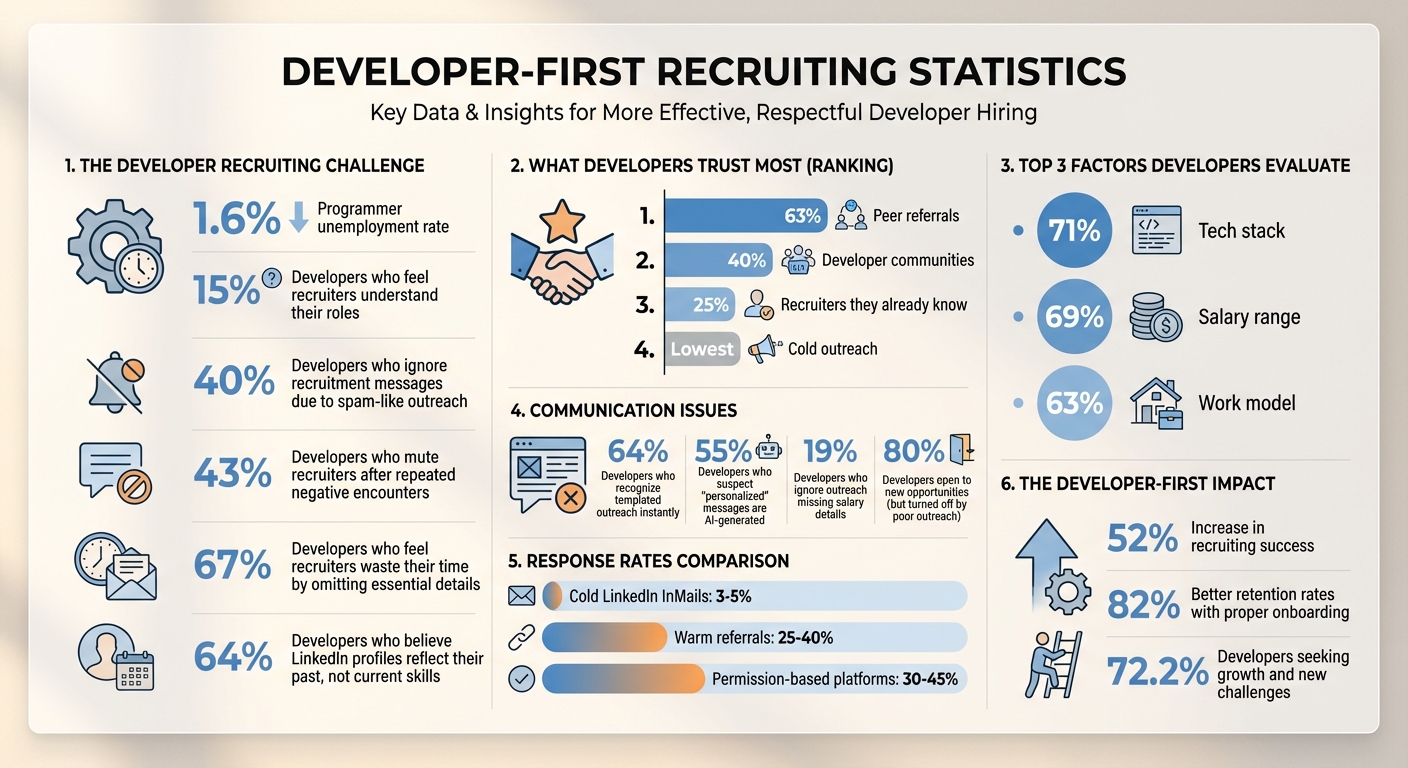 {Developer-First Recruiting: Key Statistics and Trust Factors}
Core Principles of Developer-First Recruiting
Why Standard Recruiting Fails with Developers
The traditional approach to recruiting often falls short when it comes to developers. Generic mass messaging is a key culprit - prioritizing quantity over quality. This strategy floods inboxes with irrelevant outreach, leading 40% of developers to dismiss messages that feel like spam and 43% to mute recruiters after repeated negative encounters .
The issues go beyond sheer volume. Imagine reaching out to a Java developer for a .NET role - it’s a glaring mismatch that shows a lack of understanding. Additionally, platforms like LinkedIn are often seen as outdated by developers, with 64% believing these profiles reflect their past rather than their evolving skills or future potential. Yet, recruiters frequently rely on these static profiles instead of exploring active portfolios or recent projects . On top of that, 67% of developers feel recruiters waste their time by omitting essential details - like the tech stack, salary, or work model - in generic outreach .
These shortcomings make it clear: a new approach is needed, one that prioritizes trust, openness, and genuine respect.
The 3 Pillars: Trust, Transparency, and Respect
Developer-first recruiting is built on three essential principles.
Trust is about earning attention rather than demanding it. Nimrod Kramer, CEO & Co-Founder of daily.dev, captures it well:
"This isn't a sourcing problem. It's a trust problem" .
Developers place the most trust in peer referrals (63%), followed by developer communities (40%), and recruiters they already know (25%). Unsurprisingly, cold outreach ranks as the least trusted method .
Transparency means putting critical information front and center. Developers evaluate opportunities based on three main factors: the tech stack (71%), salary range (69%), and work model (63%) . Skipping salary details? That’s a dealbreaker for 19% of developers, who will ignore outreach that leaves out this key info . Transparency also involves moving beyond static resumes to dynamic platforms like GitHub, where developers showcase their active work .
Respect is about treating developers as individuals, not just names on a list. While 80% of developers are open to new opportunities, they’re often bombarded by irrelevant or poorly crafted messages . Developers can spot templated outreach a mile away - 64% recognize it instantly, and 55% suspect even so-called “personalized” messages may be AI-generated . Respectful recruiting means adopting permission-based outreach, where developers choose to engage rather than feeling like they’re being spammed or commoditized.
Preparing Your Developer-First Hiring Process
Building a hiring process rooted in trust, transparency, and respect starts with solid internal planning. Before reaching out to candidates, ensure you have a clear understanding of your needs and can communicate what you’re offering and why it matters. This preparation phase is what separates recruiters who get responses from those who don’t.
Define Your Hiring Requirements
Collaborate with technical teams and hiring managers to pinpoint the exact skills you need. Think about the technical challenges this role will address and the gaps it will fill . With nearly 50% of tech employers prioritizing skills over degrees, it’s crucial to focus on what candidates can do rather than just their credentials .
Organize your requirements into two categories: essential and nice-to-have. This approach helps avoid creating unrealistic job descriptions, often referred to as the "purple squirrel" trap . For example, essential skills might include production experience with Python and PostgreSQL, while bonus skills could be familiarity with Kubernetes . Highlight opportunities for growth to make the role more appealing.
Once you’ve outlined your requirements, craft job descriptions that resonate with developers and reflect their experiences.
Write Job Descriptions That Developers Actually Read
Developers can spot unnecessary jargon from a mile away. Stick to highlighting the 3–4 core technologies they’ll be working with daily. Google’s approach to job descriptions is a great example:
"As a software engineer, you will work on a specific project critical to Google's needs with opportunities to switch teams and projects as you and our fast-paced business grow and evolve" .
Use a "day in the life" format to help candidates understand their role’s real-world impact. Be specific about the kinds of problems they’ll solve and the projects they’ll build. This clarity shows respect for their time and aligns with the transparency you’re aiming for.
Make sure to include a clear salary range in USD - hiding compensation often discourages candidates from applying. Additionally, outline potential career paths, whether that’s advancing from an individual contributor to a technical lead or moving into specialized fields like AI or blockchain . Keep in mind that passive candidates, who make up 70% of the developer workforce, typically expect a 10–20% pay increase to consider a new role .
Personalize Your Outreach
When it comes to reaching out to developers, personalization isn’t just a nice touch - it’s essential. Developers can easily spot a mass message, and they’re quick to ignore it. With 61.5% of developers feeling recruiters aren't doing a great job and 55% suspecting "personalized" messages are actually AI-generated, the need for genuine, tailored communication has never been more critical .
Stop Using Generic Messages
Let’s face it: cold LinkedIn InMails have a dismal response rate of just 3–5% . Why? Because they often miss the mark. They lack context and fail to address what developers care about most. Here’s what developers actually want:
- 71% expect details about the tech stack and role scope in the very first message.
- 69% want salary information upfront.
- For 19%, leaving out salary details is a dealbreaker .
If your outreach doesn’t include this information, you’re already losing their interest. Get straight to the point: include the tech stack, the challenges the role involves, and the compensation. And skip vague or generic openers - if you can’t find something specific to mention about the candidate’s work, you need to dig deeper.
Research Developer Profiles and Contributions
Personalized messaging starts with research. Spend 10–15 minutes exploring a candidate’s professional footprint before reaching out. Check their GitHub repositories, open-source contributions, technical blogs, or Stack Overflow activity. Look for connections between their work and the requirements of your role. For example, if they’ve contributed to a Python library relevant to your team or written about microservices architecture, call it out in your message.
This effort goes a long way. Developers want their skills and contributions to be recognized. In fact:
- 37% prefer showcasing their abilities through GitHub.
- 17% lean on personal portfolios.
- Only 14% think LinkedIn accurately reflects their professional direction .
To make a genuine connection, focus on platforms where their real work shines.
Honor Developer Communication Preferences
Even the most personalized message can fall flat if it’s delivered at the wrong time or through the wrong channel. Timing and communication preferences matter. Here’s what developers trust and respond to:
- 63% trust job opportunities shared via personal referrals, while cold outreach vs. warm introductions shows that cold outreach is the least trusted method .
- Warm introductions through referrals boast response rates of 25–40%, compared to just 3–5% for cold InMails .
When reaching out directly, use the developer’s preferred channel - whether that’s email, a platform they’re active on, or a double opt-in system like daily.dev Recruiter. Platforms like these see response rates of 30–45% because developers have already expressed interest in hearing from recruiters .
Also, be mindful of timing. Avoid contacting developers on weekends or during late evenings unless they’ve explicitly indicated availability. Respecting these preferences shows you value their time and increases the likelihood of a positive response.
Create Better Screening and Assessment Processes
After connecting with developers, the next step is evaluating their skills in a way that’s efficient and meaningful. Traditional screening methods often fall short - they’re either too generic, consume too much time, or don’t relate to the actual work. A developer-focused approach prioritizes fairness, relevance, and respect for candidates' time. This phase builds on the principles of transparency and respect by ensuring assessments are as thoughtful as your initial outreach.
Design Assessments That Reflect Real Work
Effective technical assessments should simulate real-world tasks. Developers want to showcase their abilities through challenges that align with the actual work they’ll do - not abstract algorithm puzzles or lengthy projects that feel like unpaid labor.
To start, use structured interviews with standardized questions and a clear scoring rubric. Research shows these interviews are twice as predictive of job performance compared to unstructured ones, with a predictive validity coefficient of 0.51 versus 0.20–0.38 for unstructured formats . As the Karat Team explains:
"If a competency is on the interview rubric it's signal. If it's not, then it's noise" .
Keep technical screens concise - 60–90 minutes is enough to evaluate technical and soft skills like API implementation and debugging. For take-home projects, limit the time commitment to 2–4 hours to assess system design and code quality. Pair programming sessions should also be capped at 60–90 minutes to evaluate collaboration and real-time problem-solving .
To minimize bias, ensure interviewers provide independent feedback using a 4-point scale before group discussions. This prevents "anchoring", where one person’s opinion sways the group, or the "HIPPO" problem, where the highest-paid person’s opinion dominates . A 4-point scale - ranging from 1 (Strong No Hire) to 4 (Strong Hire) - eliminates the ambiguity that comes with middle scores .
Provide Feedback to Every Candidate
One area where many companies fall short is post-assessment communication. Ghosting candidates or sending generic rejection emails not only damages your reputation but also disrespects the time candidates invested. Offering meaningful feedback isn’t just polite - it strengthens your employer brand and demonstrates that you value the candidate’s effort.
Share specific feedback that highlights both strengths and areas for improvement, based on your technical rubrics. For smaller teams, you might even pair rejected candidates with a senior developer for a brief feedback session to discuss their approach .
Deliver structured feedback within 24 hours whenever possible. AI tools can help streamline this process, ensuring candidates receive actionable insights promptly . Even sharing assessment results or behavioral profiles can provide candidates with professional growth opportunities, regardless of the hiring outcome .
This approach creates a two-way communication channel that contrasts sharply with traditional recruitment, where feedback often flows in one direction - or not at all. Treat every candidate interaction as a chance to add value. By doing so, you’re not just filling roles; you’re building relationships that could prove beneficial in the future. With clear and respectful assessments in place, the next steps can further refine this developer-first approach.
Structure Interviews and Offers for Developers
When it comes to structured interviews and clear offers, these elements play a critical role in developers' decisions to join your team. Companies often lose strong candidates - not because of technical mismatches, but due to a lack of focus on what developers value most: meaningful work, transparent compensation, and respectful treatment. Structured interviews, which are shown to be twice as predictive as unstructured ones , help align role details with developers' priorities and career values. This sets the stage for crafting interviews and offers that truly resonate.
Show Growth and Impact Potential
Developers want to know how their work will make a difference. During interviews, clearly outline how the role contributes to the product roadmap and team goals. Highlight specific technical challenges and growth opportunities - something that 72.2% of developers actively seek . Use the STAR method (Situation, Task, Action, Result) to frame behavioral questions. This approach not only provides insight into how candidates handle real-world challenges but also creates a two-way dialogue. Developers can evaluate whether the role aligns with their career aspirations, rather than just feeling like they're being tested.
Be Clear About Compensation and Benefits
Transparency around compensation is a must. When salary ranges are missing from job postings, 19% of developers skip over them entirely . Include clear salary ranges in USD (e.g., $130,000–$160,000) and provide details about base pay, equity (with vesting schedules), bonuses, and benefits like health insurance or remote work options. Developers prefer straightforward numbers over vague promises. Tailor your offer to emphasize how the package supports their goals - whether that’s equity growth, skill development, or achieving a better work-life balance.
Maintain a Positive Candidate Experience
From the first contact to the final offer, consistent and respectful communication is key. This builds trust and sets you apart from companies that leave candidates in the dark. Effective onboarding can even increase retention by 82% . Ensure interviewers provide independent feedback to minimize bias, and share decisions promptly with context. Every interaction is an opportunity to leave a positive impression - developers talk, and your reputation will quickly spread within their networks. Treat each candidate as a potential long-term connection, whether or not they join your team.
Source Developers Where They Actually Are
If you're serious about connecting with top-tier developers, you need to meet them where they already spend their time. Most skilled engineers aren’t hanging out on traditional job boards or obsessively updating their LinkedIn profiles. Instead, they’re immersed in technical communities, reading articles, contributing code, and solving complex problems. To stand out, recruiters need to shift their focus from chasing resumes to building a presence in the spaces developers truly value.
Use Platforms Built for Developers
Developers rely on platforms that fit seamlessly into their workflows. Tools like daily.dev Recruiter allow you to connect with active vs passive developer talent through a double opt-in system embedded in a developer's content feed. This approach ensures you’re reaching engineers based on their current interests and activities, signaling genuine relevance. With 40% of users being senior contributors or leaders and 90% unlikely to respond to recruiters on other platforms , this method cuts through the noise, creating meaningful connections. Plus, its pay-for-results model - free of placement fees or subscriptions - means you only pay when you successfully engage qualified candidates .
Platforms like GitHub and Stack Overflow are also invaluable for assessing skills and collaboration. By examining repositories, pull requests, and technical contributions, you get an authentic view of a developer's abilities. Use advanced search qualifiers (e.g., language:python location:"san francisco" followers:10..30) to pinpoint mid-to-senior-level talent with proven expertise. These tailored strategies naturally lead to deeper engagement with developer communities.
Participate in Developer Communities
Beyond specialized platforms, actively engaging in developer communities can make all the difference. In fact, participating in developer-focused spaces can boost your success rates by 52% . The key? Focus on contributing value. Host webinars, give talks at conferences, or join discussions in a meaningful way. Even a concise 60-second pitch, tailored to a developer’s recent work, can leave a lasting impression .
Platforms like Reddit (e.g., r/rust, r/reactjs, r/MachineLearning), Dev.to, Hashnode, and Hacker News are ideal for connecting with developers who publish technical content. Follow the 90/10 rule: spend 90% of your time adding value to discussions and only 10% on recruitment. Mention specific repositories, recent commits, or technical articles to show you’ve done your homework. Weekly tracking of source conversions can help you prioritize high-yield channels, such as active Discord groups .
Build Your Employer Brand
A strong employer brand, built on trust and transparency, can attract developers before you even reach out. Highlight real project work, showcase growth opportunities, and involve your tech teams in hiring decisions . Developers care about meaningful work and a transparent culture, and addressing these priorities can make your company stand out. Proper onboarding tailored to developers’ needs can increase retention by 82% , turning your current team into powerful advocates for your brand.
Encourage your team to contribute to open-source projects, write technical blogs, or speak at meetups. These activities not only demonstrate your company’s technical expertise but also create passive sourcing opportunities. Developers often share their experiences within their networks, amplifying your company’s reputation. Make sure it’s a reputation that draws in the talent you’re looking for.
Conclusion
Developer-first recruiting is changing the way tech hiring works. By prioritizing trust, transparency, and respect, you create an environment where developers feel valued and motivated to engage. This means crafting job descriptions that focus on meaningful challenges and growth, tailoring outreach with thoughtful research, and designing technical assessments that are fair and mindful of candidates' time.
The benefits are clear: developers gain access to detailed, relevant opportunities, while employers see a 52% increase in recruiting success, 82% better retention rates, and faster hiring processes . Implementing these practices can significantly shorten hiring timelines and help new hires hit the ground running .
To succeed, you need to meet developers where they are - whether that’s on platforms they already use, in technical communities they contribute to, or through employer branding that highlights real projects and team culture. Considering that 72.2% of software developers are driven by opportunities to tackle new challenges and expand their skills , your approach should showcase those exact possibilities.
This shift builds on the principles discussed earlier. Take a closer look at your process: Are you clearly outlining the tech stack, salary range, and work model in every message? Are your assessments respectful of candidates' time and provide timely feedback? Is your outreach personalized instead of generic? Even small tweaks can lead to noticeable improvements in the quality of candidates and the speed of hiring. The companies thriving in today’s competitive talent market aren’t necessarily the ones with the largest budgets - they’re the ones that respect developers' time, preferences, and professional goals at every stage. By aligning your recruitment process with developers' priorities, you can stand out where it matters most.
FAQs
What does developer-first recruiting change first?
Developer-first recruiting reshapes hiring by prioritizing clarity, trust, and efficiency. Instead of relying on outdated, impersonal tactics, it focuses on creating genuine connections and understanding what developers truly value. This method delivers a recruitment process that resonates with developers' expectations and professional priorities.
What should I include in the first outreach message?
When reaching out to developers for the first time, aim for a message that's personalized, clear, and to the point - keeping it under 125 words. Highlight something specific about their work or projects to show genuine interest. Mention the tech stack involved, provide a clear salary range, and outline the role's key expectations. To make it easy for them, suggest a no-pressure next step, like a quick call or chat. This approach helps establish trust and boosts the chances of getting a response.
How do I keep technical assessments fair and short?
When conducting technical assessments, it's essential to focus on evaluating practical skills that align with the position. Here are some ways to keep the process efficient and fair:
- Use portfolio reviews, short take-home projects, or live pair programming to gauge candidates' abilities in real-world scenarios.
- Keep assessments within 2-3 hours to respect candidates' time and prevent unnecessary stress.
- Design tasks that reflect the core responsibilities of the role, ensuring they are directly relevant.
- Avoid abstract puzzles or overly theoretical challenges that don't relate to the job.
By emphasizing practical, role-specific challenges, you create a process that is both effective and considerate.
.png)


