Hiring developers through community-based platforms beats job boards - here’s why:
- Job boards attract too many unqualified applicants, wasting time and effort.
- 73% of top developers aren’t actively job hunting but are open to new opportunities if approached in the right way.
- Community platforms like daily.dev Recruiter focus on engaging with developers where they already spend time, such as GitHub or professional forums.
- These platforms use real-time activity data, not outdated resumes, to identify skilled candidates and ensure mutual interest before outreach.
Key Insights:
- Higher Quality Hires: Community platforms boast a 90% retention rate over 18 months vs. 70% for job boards.
- Faster Hiring: They reduce time-to-hire by up to 40%, saving recruiters hundreds of hours annually.
- Better Engagement: Reply rates are 3x higher due to warm, opt-in connections.
If you’re hiring for senior or specialized roles, community platforms are more effective, while job boards work better for entry-level, high-volume needs.
Why Do Community-Based Hiring Platforms Outperform Job Boards?
Community-based platforms focus on developers' current activity rather than relying on outdated resumes. Traditional job boards often depend on CVs that haven’t been updated in months (or even years). In contrast, platforms like daily.dev Recruiter build a Developer Identity based on real-time engagement. This means they don’t just rely on static profiles - they tap into live signals that reflect a developer’s present interests and skills.
By analyzing indicators like increased activity on GitHub or participation in discussions, these platforms achieve about 3x higher reply rates compared to traditional cold outreach. That’s because they’re reaching out to developers who are actively engaged and interested.
Additionally, their double opt-in process ensures that developers express interest before recruiters make contact. This eliminates the need to wade through unqualified applicants, saving employers time and effort. With over 13,000 companies already relying on daily.dev Recruiter, this approach offers a more efficient and community-focused way to connect with top developer talent.
Key Metrics: Community Platforms vs Job Boards
::: @figure 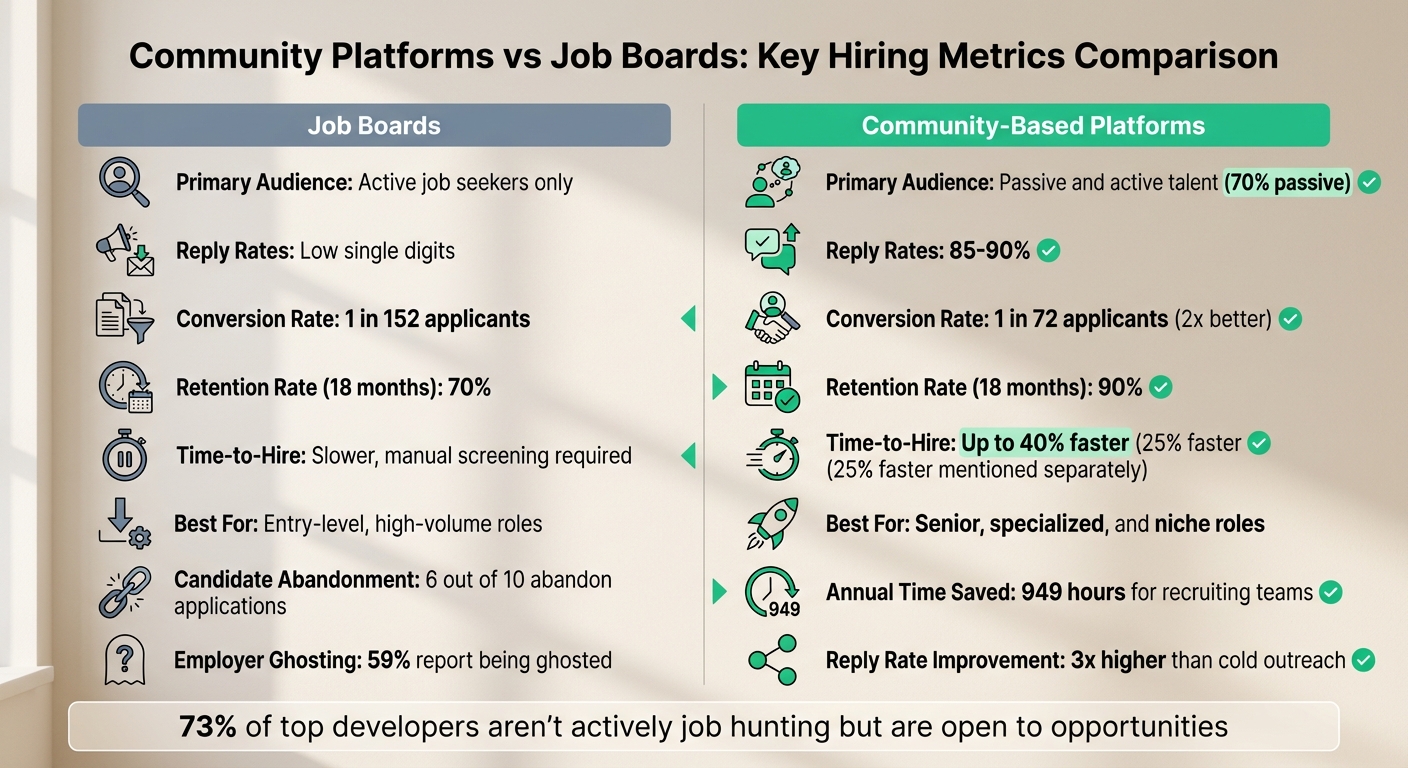 {Community Platforms vs Job Boards: Key Hiring Metrics Comparison}
Metrics highlight how community-based hiring platforms consistently outperform traditional job boards in several critical areas.
Talent Quality
The most striking difference lies in talent quality. Candidates sourced through community platforms show a 90% retention rate over 18 months, compared to just 70% for job board hires . Melissa Hoegener from SCOPE Recruiting explains the challenge with job boards:
"We have a lot of promising candidates on paper, but when interviewed, they often clearly inflate their qualifications."
Community platforms tackle this issue head-on by prioritizing real engagement and proven skills over self-reported credentials. By analyzing live behavioral signals - like GitHub activity or participation in discussions - these platforms identify candidates who truly excel. This approach not only boosts the quality of hires but also speeds up the recruitment process.
Time Efficiency
When it comes to time efficiency, community platforms make a significant impact. They connect recruiters with pre-qualified developers who have already expressed interest, cutting vacancy times by up to 40% . On average, recruiting teams save 949 hours annually using these methods . Faster hiring processes naturally lead to reduced overall recruitment costs, making these platforms a win-win for employers.
Cost Per Hire
Cost per hire also sees a meaningful reduction. Job boards often generate a flood of applications, but many lack relevance or quality . George Fironov, Co-Founder & CEO of Talmatic, captures this frustration:
"Job boards will continue to exist but are less effective today since they have too many unqualified or irrelevant applications."
This inefficiency is further compounded by candidate disengagement. On traditional job boards, 6 out of 10 candidates abandon applications due to frustration, and 59% report being ghosted by employers . Community platforms address these issues by fostering mutual interest before the hiring process even begins before the hiring process even begins. This ensures that conversations are meaningful and rooted in genuine engagement, reducing drop-offs and wasted effort.
Pros and Cons
Both methods have their upsides and challenges.
Community-based platforms excel at connecting with the 70% of developers who aren’t actively job hunting but are open to the right opportunity. Based on the metrics provided, these platforms convert sourced candidates to hires at a rate of 1 in 72 - nearly twice as efficient as job boards, which average 1 in 152. Their double opt-in model ensures that every interaction starts with mutual interest, cutting down on unqualified applications. These platforms shine when hiring for senior, specialized, or niche roles where quality is key. However, they often come with higher upfront subscription costs and may not be the best choice for high-volume, entry-level hiring.
Job boards, on the other hand, cast a wider net and have lower initial costs, making them ideal for entry-level or high-volume roles where speed and quantity matter. With keyword-based matching and access to a large pool of active job seekers, they can quickly fill pipelines. However, their "pull" strategy primarily targets active job seekers, leading to lower engagement rates and a more time-intensive screening process.
Here's a side-by-side comparison of key metrics:
| Metric | Job Boards | Community-Based Platforms |
|---|---|---|
| Primary Audience | Active job seekers | Passive and active talent (70%) |
| Reply Rates | Typically low single digits | 85–90% |
| Conversion Rate | 1 in 152 applicants | 1 in 72 applicants |
| Time-to-Hire | Slower, manual screening | Up to 25% faster |
| Best For | Entry-level, high-volume roles | Senior, specialized, and niche roles |
Ultimately, the right choice depends on your hiring goals. If you're looking for standout talent in specialized fields, community-based platforms offer better efficiency and higher-quality candidates. But if you need to rapidly fill multiple entry-level positions, job boards can meet that demand - though they require more effort in screening and follow-up. As the data suggests, when quality takes precedence, tapping into community-driven platforms and live behavioral signals provides a clear edge.
Conclusion
Switching from traditional job boards to community-focused platforms is a game-changer in developer recruitment. As The Betts Team aptly describes:
"Comparing hiring platforms versus job boards is like choosing between a supercomputer and a smartphone – you might be able to use both for the same purpose, but one is going to handle that purpose a lot better than the other."
Community-based platforms like daily.dev Recruiter tap into an engaged developer network, achieving impressive 85–90% response rates by connecting with the 70% of developers who are passive but open to opportunities. This approach emphasizes double opt-in introductions, cutting out the inefficiencies of cold outreach and unnecessary screening calls.
For companies seeking senior, specialized, or niche talent, these platforms deliver higher-quality candidates, faster hiring timelines, and retention rates exceeding 90% at 18 months. The data speaks for itself: community-driven hiring not only improves candidate quality but also simplifies the recruitment process.
If you're looking to secure top-tier talent that hits the ground running, community-based platforms are the way forward.
FAQs
What are behavioral signals in developer hiring?
Behavioral signals in developer hiring offer a window into a developer's active participation within their communities. These signals include contributions, activity levels, and interactions, all of which highlight their genuine passion and how well their skills align with the role you're hiring for.
How does double opt-in hiring work?
Double opt-in hiring establishes a mutual and voluntary connection between employers and developers. With this approach, developers actively agree to be contacted or considered for roles, creating pre-approved introductions. This method removes the need for cold outreach or mass job postings, leading to a more focused and engaged hiring process.
When should I use job boards instead?
Job boards work well when you need to cast a wide net to attract active job seekers or quickly fill general positions. But if you're aiming to connect with passive, highly skilled professionals and build meaningful engagement, community-driven developer platforms are a better choice. These platforms emphasize active involvement and provide valuable behavioral insights, making them a powerful tool for finding top-tier talent.
.png)