Looking for better developer hires? Community-driven platforms outperform job boards by focusing on real-time engagement and verified skills instead of outdated resumes. Here’s why:
- Job boards rely on keyword matching, often missing skilled developers who aren't actively job hunting.
- 70% of developers are passive candidates, meaning they don’t browse job boards but engage in professional communities.
- Community platforms, like daily.dev Recruiter, connect employers with developers where they’re already active - learning, networking, and contributing.
- Behavioral signals replace static resumes, offering insights into a developer's skills, interests, and activity.
- Higher response rates (up to 85–90%) and faster hiring timelines (as short as 14 days) make these platforms more effective.
Quick Comparison:
| Feature | Job Boards | Community Platforms |
|---|---|---|
| Candidate Pool | Active job seekers only | Passive and engaged talent |
| Matching Method | Keyword-based filtering | Behavior-based analysis |
| Response Rates | Single digits | 85–90% (opt-in connections) |
| Hiring Timeline | 58–62 days | 14 days or less |
| Data Quality | Self-reported resumes | Verified engagement metrics |
The takeaway: Community platforms provide access to better candidates, faster hires, and more accurate matches. If you’re tired of sifting through irrelevant resumes, it’s time to explore smarter hiring solutions.
::: @figure 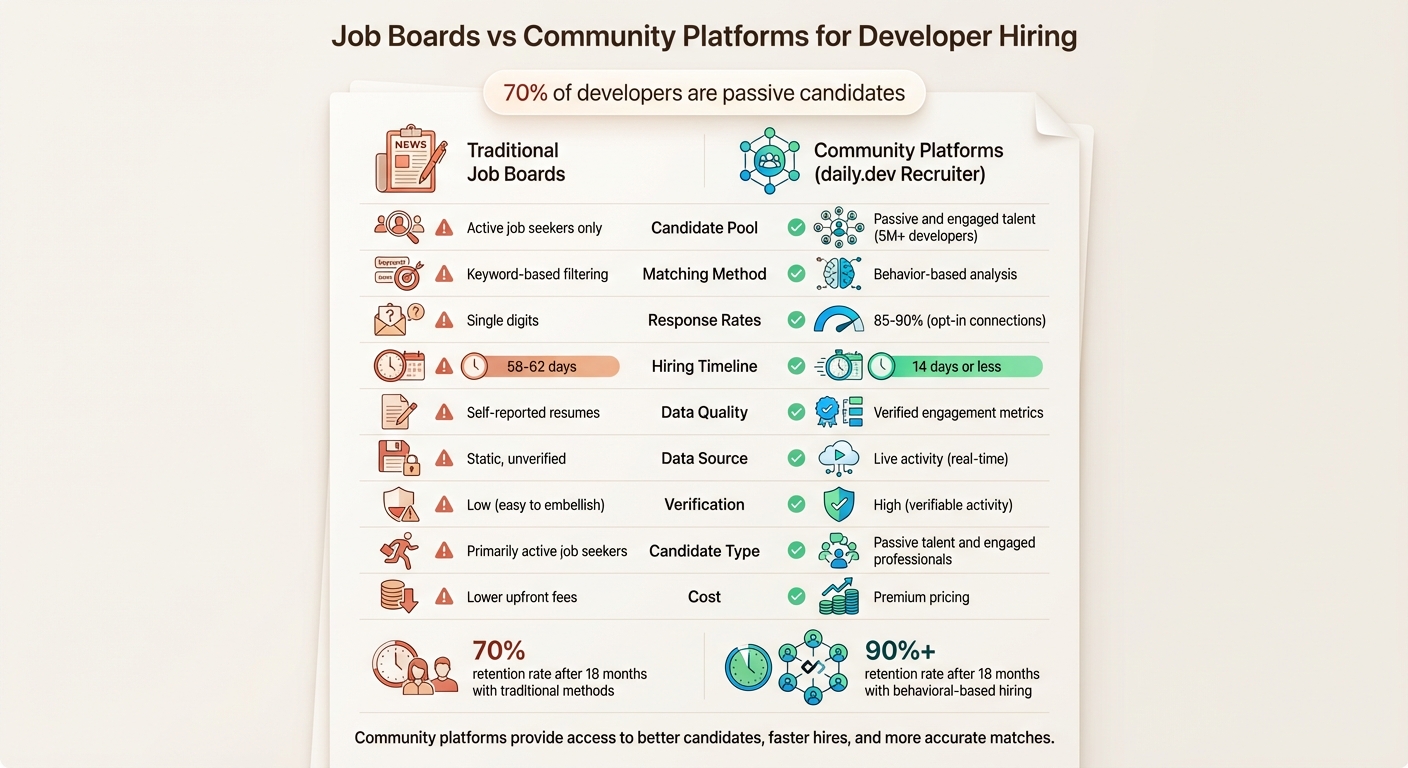 {Job Boards vs Community Platforms: Developer Hiring Comparison}
The Problems with Job Boards for Developer Hiring
Job boards often rely on keyword-matching algorithms that prioritize candidates skilled in search optimization rather than those with real-world, production-level expertise. As a result, hiring managers end up spending hours sifting through resumes that may look impressive but fail to meet technical expectations during evaluations. This inefficiency is only made worse by the intense competition on these platforms.
When you post a senior engineering position, you're up against numerous companies vying for the same limited pool of talent. This level of competition pushes recruiters to adopt mass outreach tactics, which rarely yield more than a handful of meaningful conversations.
Another major issue is the lack of deeper insights into a candidate's technical abilities. Resumes might list a broad range of skills, but they don’t tell you how a candidate approaches complex problems, what challenges excite them, or how actively they engage with their field. These static documents, often outdated, can lead to mismatched candidates, wasted interview time, and frustration for both parties.
The return on investment for traditional job boards is frequently disappointing. Hiring managers report long review processes that often result in finding candidates who are either unresponsive or already committed elsewhere. These challenges underscore the need for a more community-focused approach to finding top-tier developers.
How Community-Based Platforms Solve Developer Hiring Problems
Community-based platforms are changing the way companies hire developers by replacing outdated resumes with real-time engagement data. Instead of relying on static documents, these platforms use live interaction metrics to show a developer's skills, interests, and activity. This approach turns hiring into a more informed and precise process, making it easier to evaluate candidates and understand their true potential.
Take daily.dev Recruiter as an example. Built around a community of over 5 million developers, it offers a unique advantage: warm, double opt-in connections that traditional job boards simply can't match. Developers on these platforms are actively engaging with technical content, exploring new frameworks, and staying ahead of industry trends. When they express interest in a position, it’s because the role genuinely matches their career goals - not because they’re applying en masse. The result? Better response rates, a stronger pool of candidates, and less time spent on initial screenings.
Unlike traditional job boards vs. community platforms, which rely on static profiles, community platforms provide behavioral data that reflects a developer’s actual expertise and interests. You can see the technologies they follow, the content they engage with, and their level of participation in professional discussions. This kind of information not only highlights technical qualifications but also reveals whether a candidate aligns with your team’s values and work culture. The result is higher-quality interactions and better hiring outcomes.
These platforms also dramatically cut down hiring timelines. While conventional methods might take 58 to 62 days to secure a qualified remote developer, niche community platforms can reduce that to just 14 days for permanent roles - or under 72 hours for contractors . This speed is possible because the candidates are already pre-qualified and actively engaged.
Another key factor is trust. Developers are far more responsive when approached through platforms they already know and value, rather than receiving unsolicited emails from generic lists. This developer-first mindset shifts the focus from simply filling open positions to building authentic, meaningful connections. Community-based platforms carry this philosophy throughout the hiring process, fostering trust and engagement every step of the way.
Behavioral Signals vs Resume Keywords
The move from static evaluations to behavior-based assessments highlights a key idea: insights drawn from real actions lead to better hiring decisions.
Resumes rely on static, self-reported claims, often centered around keyword matching. For instance, a developer might list "React" on their resume, but that doesn’t clarify whether they’ve built full-scale applications or just completed a tutorial. Developer hiring platforms vs ATS differ significantly; traditional systems scan for specific terms, which means talented candidates can slip through the cracks. A highly skilled developer who writes "building web applications" instead of naming specific frameworks might be filtered out unfairly.
Behavioral signals address these gaps by offering a clearer picture of technical expertise. Community platforms track what developers actually do instead of relying on what they claim. On daily.dev Recruiter, for example, you can see which technologies a developer follows, the articles they engage with, and their participation in technical discussions. This real-time activity provides tangible proof of their skills and interests.
The difference in matching accuracy is striking. Unlike keyword-based systems, semantic analysis identifies related skills. For example, if someone is proficient in Python, they likely have experience with Django or Flask, even if those frameworks aren’t explicitly listed. This approach uncovers candidates who might otherwise be overlooked by rigid filters.
| Feature | Keyword-Based (Job Boards) | Behavioral-Based (Community Platforms) |
|---|---|---|
| Data Source | Self-reported resumes/ATS | Live activity (GitHub, Stack Overflow, daily.dev) |
| Verification | Low (easy to embellish with AI) | High (verifiable code and commit history) |
| Matching Method | Exact string matching | Context-aware and semantic analysis |
| Candidate Type | Primarily active job seekers | Passive talent and engaged professionals |
| Depth of Signals | Shallow (titles and dates) | Deep (code quality, logic, and collaboration) |
| Reply Rates | Low (single digits for cold outreach) | High (85–90% for double opt-in) |
Behavioral data goes beyond technical skills. It reveals communication styles through pull request comments and issue discussions, showing how well developers explain technical concepts and work within teams. Job boards don’t provide insights into whether a candidate writes clean, maintainable code or collaborates effectively. These behavioral signals improve hiring outcomes by speeding up the process and ensuring better matches. The result? Higher retention rates - over 90% after 18 months compared to just 70% with traditional methods. This approach sets the stage for a more efficient and trust-driven hiring process, which will be explored further in the pros and cons discussion.
Pros and Cons
When it comes to hiring, community-based platforms and traditional job boards each come with their own set of strengths and challenges. With daily.dev Recruiter, you gain access to a community of over 5 million engaged developers through verified, opt-in connections. This results in high reply rates, a stark contrast to the single-digit response rates often seen with job boards' cold outreach. Additionally, behavioral signals from real-time developer activity provide a reliable way to verify expertise - something static resumes can't offer.
This advantage in quality naturally leads to a closer look at trade-offs like cost, complexity, and maintenance.
Community-based platforms, while offering deeper insights and better targeting, also come with higher costs and steeper learning curves. Advanced tools and ATS (Applicant Tracking System) integration require more training and operational effort compared to the straightforward "post and wait" approach of job boards. For teams on tight budgets, job boards remain the simpler, more affordable option.
| Aspect | Traditional Job Boards | daily.dev Recruiter |
|---|---|---|
| Cost | Lower upfront fees | Premium pricing |
| Reply Rates | Single digits for cold outreach | High |
| Candidate Pool | Active job seekers only | Passive talent and engaged professionals |
| Learning Curve | Minimal - post and wait | Advanced targeting tools |
| Data Quality | Self-reported, unverified | Behavioral signals with verifiable activity |
| Maintenance | Low - manual posting works | High - requires ATS integration |
Ultimately, teams need to balance cost and simplicity with the desire for quality, speed, and retention. For those struggling with low-performing job boards and prioritizing verified, high-quality matches, a community-based platform like daily.dev Recruiter offers a distinct edge.
Conclusion
When it comes to making effective hiring decisions, the focus should always be on the quality of outcomes. For managers tired of the constant headaches caused by job boards - like low response rates, outdated resumes, and endless screening processes - daily.dev Recruiter offers a smarter, more efficient solution. By tapping into a thriving network of over 5 million active developers, this platform connects you with active vs passive developer recruitment validated by real-time activity, rather than relying on stale keyword searches.
The benefits go beyond just better candidate quality - they also make financial sense. Traditional recruitment agencies typically charge 15% to 25% of a hire's first-year salary , while job board postings can cost anywhere from $299 to $498 per listing . With daily.dev Recruiter, you're paying for results, not just exposure. That means higher response rates, precise matches, and connections with developers who genuinely want to hear from you.
The efficiency and performance metrics highlighted throughout this article show how community-driven platforms can tackle the biggest challenges in developer hiring. These tools help reduce time-to-fill, improve retention rates, and cut down on wasted effort spent on unqualified candidates.
For teams that value better hires, faster placements, and stronger retention, the investment is well worth it.
If you're ready to leave behind the outdated methods of traditional job boards and engage with developers in the spaces they already trust, daily.dev Recruiter is your gateway to smarter, more effective hiring.
FAQs
What are behavioral signals in developer hiring?
Behavioral signals in developer hiring refer to actions like participation on platforms such as GitHub or Stack Overflow, code contributions, and engagement habits. These behaviors can highlight a developer's expertise, areas of interest, and willingness to explore new opportunities. Unlike traditional resume keywords, these signals provide a richer, more nuanced understanding of a candidate's capabilities and professional mindset.
How does double opt-in outreach improve reply rates?
Double opt-in outreach improves reply rates by focusing on building connections that both parties agree to. Developers are far more likely to respond when the outreach feels tailored and respectful, rather than coming across as impersonal cold emails or generic mass messages. This method helps establish trust and ensures the communication is both welcomed and meaningful, which naturally leads to better engagement.
How do I measure ROI versus job boards?
To gauge ROI against job boards, prioritize candidate quality and hiring efficiency over sheer volume. Job boards typically use keyword matching, which can result in a flood of irrelevant applicants. In contrast, community-based platforms leverage deeper insights, such as user engagement and participation, to refine metrics like matching accuracy, time-to-hire, and retention rates. This approach leads to more effective hires, boosting long-term ROI through enhanced productivity, improved team alignment, and lower turnover rates.
.png)