If you're trying to hire developers, should you use an ATS (Applicant Tracking System) or a developer hiring platform? Here's the short answer:
- ATS: Best for managing large volumes of applications, tracking compliance, and organizing the post-application process. It's ideal for companies handling hundreds of resumes and needing standardized workflows.
- Developer Hiring Platforms: Focused on sourcing and engaging passive developer talent. These platforms identify skilled candidates based on real-time activity (e.g., GitHub contributions) and use warm introductions to improve response rates.
Key Takeaways:
- ATS Strengths: Automates resume parsing, interview scheduling, and compliance tracking. Works well for high-volume hiring but struggles with engaging technical talent.
- Developer Hiring Platforms Strengths: Targets passive candidates, uses real-time data for skill matching, and delivers higher response rates (85–90%) through double opt-in methods.
- When to Use Which: Use an ATS for bulk recruitment and compliance-heavy processes. Use developer hiring platforms for sourcing hard-to-reach, highly skilled technical talent.
Quick Comparison:
| Feature | ATS | Developer Hiring Platform |
|---|---|---|
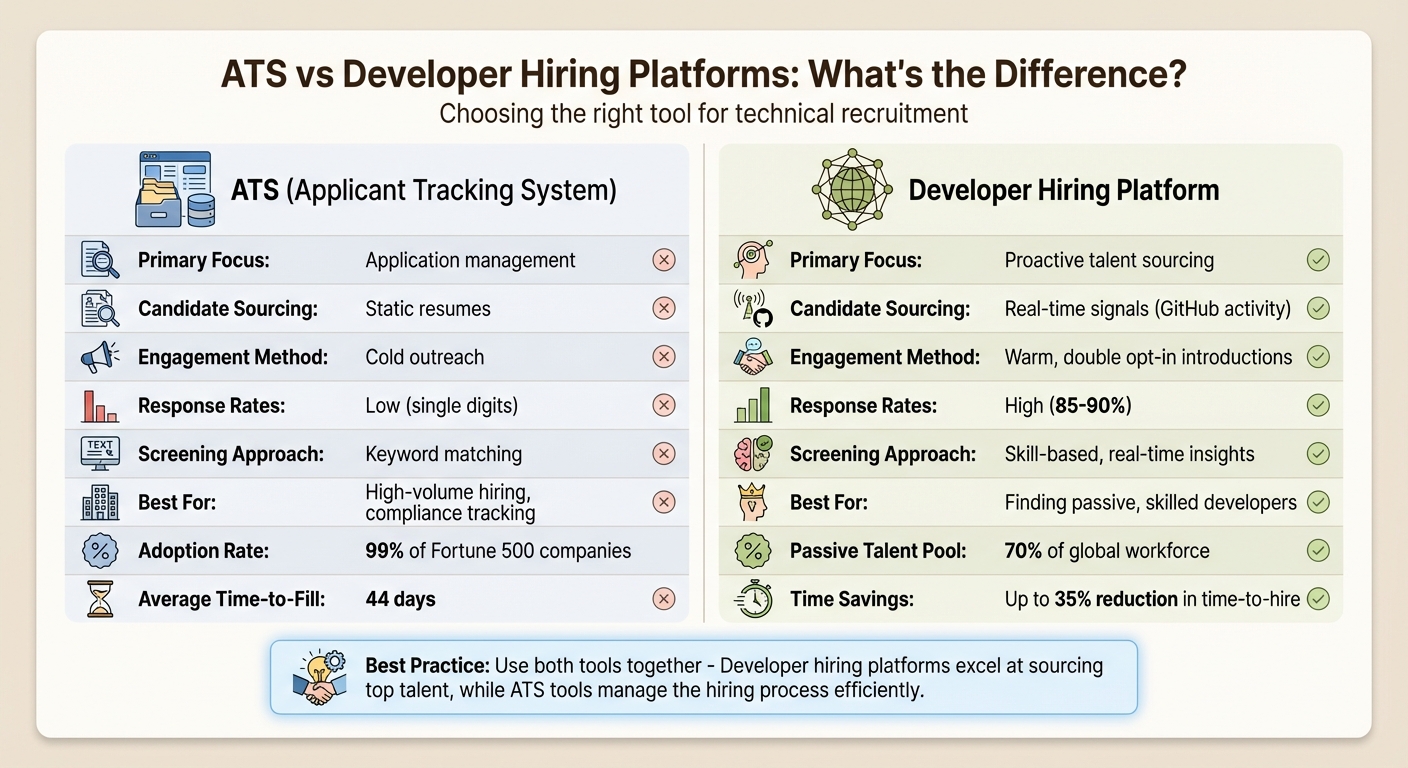
| Primary Focus | Application management | Proactive talent sourcing |
| Candidate Sourcing | Static resumes | Real-time signals (e.g., GitHub activity) |
| Engagement | Cold outreach | Warm, double opt-in introductions |
| Response Rates | Low (single digits) | High (85–90%) |
| Screening | Keyword matching | Skill-based, real-time insights |
| Best For | High-volume hiring, compliance | Finding passive, skilled developers |
Bottom Line: Use both tools together for a balanced hiring strategy. Developer hiring platforms excel at sourcing top developer talent, while ATS tools help manage the hiring process efficiently.
What is an Applicant Tracking System (ATS)?
An Applicant Tracking System (ATS) is software designed to streamline the recruitment process by digitally managing job applications. Think of it as a candidate database that helps companies gather and organize applicant information from various sources like job boards, company websites, and internal referrals .
The main purpose of an ATS is to handle applications after they’ve been submitted. Mile Živković, a B2B Content Marketer, explains it like this:
"An applicant tracking system (ATS) is software that helps businesses streamline and organize recruitment processes and identify top talent at a fraction of the time and cost compared to manual effort."
ATS adoption is nearly universal among large companies. In fact, 99% of Fortune 500 companies use these systems to manage their hiring needs . With positions taking an average of 44 days to fill, ATS tools are essential for managing the heavy administrative workload that comes with processing hundreds - or sometimes thousands - of applications .
Core Features of ATS
ATS platforms are built to simplify recruitment by automating time-consuming tasks. Here’s how they do it:
- Resume parsing: Automatically extracts key details like skills, experience, and contact information from resumes, cutting down on manual data entry.
- Keyword filtering: Scans resumes for specific qualifications such as job titles or required skills, ranking candidates based on relevance .
- Interview scheduling: Syncs calendars and sends invites, eliminating endless back-and-forth emails.
- Compliance tracking: Keeps records of hiring decisions and interactions to ensure adherence to regulations like EEOC or GDPR.
- Offer management: Handles everything from drafting offer letters to tracking acceptance rates and storing compensation details.
These tools are particularly useful for managing large volumes of applications. They consolidate feedback from interviewers, standardize candidate evaluations using scorecards, and provide insights into metrics like time-to-hire. While ATS platforms are excellent for processing applications efficiently, they often fall short when it comes to engaging specialized talent, like developers.
Strengths and Limitations of ATS
ATS platforms are great for organizing the hiring process and ensuring compliance. They’re designed to handle high volumes of applications quickly and maintain detailed records, which makes them indispensable for large-scale recruitment. The centralized database allows hiring teams to access everything from resumes to interview notes in one place.
However, these systems have clear limitations, especially when it comes to sourcing and engaging technical talent. For example:
- They rely heavily on static resumes, which means they struggle to identify passive candidates who might not be actively applying but are highly qualified.
- Keyword matching can be rigid, and older systems can lose up to 50% of resume data due to formatting issues like tables or multi-column layouts .
- Candidates often find the process impersonal. Only 58% of applicants receive a basic acknowledgment email after applying, and 34% of job seekers report no follow-up even two months later .
While ATS platforms excel at managing applications, they’re not built for proactively sourcing talent or fostering relationships with developers before they apply. This makes them less effective for roles that require deeper engagement and a more personalized approach.
What is a Developer Hiring Platform?
A developer hiring platform bridges the gap between recruiters and pre-qualified, passive developer talent - those who aren’t actively seeking jobs but are open to the right opportunity. Unlike an ATS (Applicant Tracking System) that handles incoming applications, these platforms actively engage developers by leveraging real-time signals from their work environments. It’s worth noting that 70% of the global workforce consists of passive talent - individuals who aren’t actively job hunting but might consider a compelling offer . This proactive strategy is what makes these platforms stand out.
Key Features of Developer Hiring Platforms
Developer hiring platforms take a fresh approach compared to traditional recruitment tools. Instead of relying on cold outreach, they focus on warm introductions, ensuring that connections start with mutual interest rather than unsolicited messages.
- Double Opt-In Introductions: Developers can indicate interest before recruiters reach out, resulting in reply rates of 85-90%, far exceeding those of cold outreach.
- Workflow Integration: These platforms often sync with tools like GitHub, allowing them to pull real-time data from developers' projects and activities. This reduces unnecessary friction for candidates.
- Custom Screening Criteria: Recruiters can filter candidates based on actual technical skills, preferred tech stacks, and work preferences, moving beyond generic job titles or arbitrary years of experience.
Rather than relying on static resumes or keyword searches, these platforms use real-time insights like coding projects and community engagement to identify developers who meet specific technical needs. By doing so, they streamline the process and respect developers’ time, making the interaction feel more like a professional collaboration than a formal application.
Developer-Centric Approach
The philosophy behind these platforms is simple: build trust through relevance. Developers are often inundated with recruiter messages, many of which are irrelevant or poorly targeted. Developer hiring platforms flip this script by ensuring recruiters only engage with developers who have shown genuine interest in new opportunities.
This approach puts the developer’s experience first. Developers are presented with opportunities tailored to their skills and career aspirations, often within environments they already trust - like professional communities or platforms they use regularly. For recruiters, this means every conversation starts with credibility rather than skepticism. Instead of interrupting a developer’s day with a cold pitch, you’re reaching out to someone who’s already expressed interest.
The result? A recruitment process that benefits both sides. Recruiters connect with high-quality candidates who are genuinely interested, while developers avoid the frustration of irrelevant outreach and instead engage with roles that align with their career goals. This mutual opt-in model shifts recruiting from a numbers-driven game to a process built on respect, quality, and relevance.
Feature Comparison: ATS vs Developer Hiring Platforms
An ATS (Applicant Tracking System) and a developer hiring platform serve different purposes in the hiring process. ATS tools focus on managing candidates who have already applied, offering features like interview tracking, document storage, and compliance management. On the other hand, developer hiring platforms target pre-application engagement, connecting with developers who aren’t actively job hunting but might consider the right opportunity. This core difference shapes how each tool sources, engages, and screens candidates.
When it comes to candidate sourcing, the contrast is clear. ATS platforms rely on static resumes, which often become outdated. Developer hiring platforms, however, use dynamic, real-time signals - like GitHub activity, coding contributions, and even technical reading habits. This allows them to identify developers based on demonstrated skills, making them particularly effective for technical roles.
The engagement approach also sets these tools apart. ATS systems typically rely on cold outreach methods, such as emails or LinkedIn InMails, which often yield response rates in the single digits. In comparison, developer hiring platforms prioritize double opt-in introductions, driving response rates as high as 85–90%.
Screening candidates is another area where these tools diverge. ATS systems often depend on keyword matching, which can struggle with technical terms and symbols. For example, programming symbols like <> or variations like "React.js" versus "ReactJS" can lead to qualified candidates being overlooked. Developer hiring platforms, however, evaluate candidates based on real-world behavior - such as open-source contributions, technical skills demonstrated in live projects, and custom technical assessments.
Feature Comparison Table
Here’s a breakdown of how ATS and developer hiring platforms differ:
| Feature | Applicant Tracking System (ATS) | Developer Hiring Platform |
|---|---|---|
| Primary Strength | Compliance and process management | Access to passive, hard-to-reach talent |
| Candidate Sourcing | Static resumes and job boards | Real-time behavioral signals (e.g., GitHub activity) |
| Engagement | Cold outreach (InMails/Email) | Double opt-in / Warm introductions |
| Screening | Keyword matching (parsing) | Activity-based / Custom technical questions |
| Response Rates | Low (single digits) | High (85–90%) |
| Data Source | Self-reported, often outdated profiles | Live coding, reading, and learning activity |
When to Use an ATS
An ATS proves especially useful in several key scenarios, making it an essential tool for modern recruitment.
One of the primary use cases is handling high volumes of applications for a single role. For instance, tech positions in competitive fields like AI, machine learning, and cybersecurity often draw more than 1,000 resumes per job posting . It's no surprise that nearly 99% of Fortune 500 companies rely on an ATS as part of their hiring process . Additionally, 86% of recruiters report that using an ATS has significantly reduced their time-to-hire .
Companies operating in strictly regulated environments also gain a lot from an ATS. If your business spans multiple states or needs to comply with EEOC, OFCCP, or GDPR standards, an ATS can simplify compliance. Features like centralized audit logs, role-based access controls, and automated regulatory reporting ensure sensitive candidate data is managed securely and consistently across jurisdictions .
For large enterprises, an ATS becomes indispensable when integrated with broader HR tools like HCM systems, payroll solutions, and performance tracking platforms. Systems such as Workday or Oracle provide a unified view of the entire employee lifecycle, making an ATS an essential part of a larger HR technology ecosystem .
Another advantage of an ATS is its ability to help you tap into internal talent pools. By searching your database for "silver medalist" candidates - those who were qualified for past roles but not hired - you can quickly identify strong matches for new openings. This approach can significantly lower hiring costs, a benefit frequently realized by Fortune 500 companies .
For companies hiring across multiple locations or departments, an ATS ensures consistency. It enforces standardized workflows while still allowing local managers some flexibility. This way, every candidate is evaluated using the same criteria, no matter where the role is based or which team is hiring .
However, if these scenarios don’t align with your needs, a developer hiring platform might be a better fit for your recruitment strategy.
When to Use Developer Hiring Platforms like daily.dev Recruiter
Applicant Tracking Systems (ATS) are great for managing bulk applications, but developer hiring platforms shine when it comes to engaging passive talent. Platforms like daily.dev Recruiter are designed to connect you with the 70-90% of developers who aren’t actively job hunting but might be open to the right opportunity. This is a game-changer because the best developers rarely search for jobs; they need a compelling reason to consider new opportunities. This proactive strategy is key for sourcing specialized talent.
For roles requiring niche expertise, daily.dev Recruiter significantly reduces hiring time. Traditional ATS workflows can take over 50 days to fill such positions, but daily.dev Recruiter streamlines the process while also cutting costs by minimizing reliance on pricey recruiting agencies . The primary difference lies in the approach: rather than waiting for the right candidates to apply, you’re actively reaching out to developers based on their skills and interests.
Another standout feature is its ability to foster trust through warm, double opt-in introductions. Both the recruiter and the developer agree to connect before any conversation begins, which avoids the impersonal feel of cold outreach. Developers often find ATS-driven cold emails impersonal and spammy, but daily.dev Recruiter creates genuine engagement right from the start.
If improving the candidate experience and boosting reply rates are priorities, daily.dev Recruiter is a strong choice. Unlike ATS workflows that rely on mass emails and generic job postings, this platform speaks in developers’ language, respects their time, and connects based on real-time activity and interests - not outdated resume keywords. This approach leads to higher response rates by cutting out the noise of spammy outreach.
For recruiting strategies focused on engaging passive candidates, quickly filling specialized roles, or building meaningful connections with developers, daily.dev Recruiter offers a far more effective solution than relying solely on an ATS.
How Developer Hiring Platforms Differ from ATS
While traditional ATS (Applicant Tracking Systems) focus on managing existing candidate pipelines, developer hiring platforms take it a step further by actively sourcing and engaging passive talent using real-time behavioral signals. As the TuraHire Team explains:
"An ATS is like a digital filing cabinet... an AI hiring platform goes a step further by actively analyzing data, understanding context, and making predictions" .
This distinction is crucial because many top developers aren't actively job hunting. They're not uploading resumes or browsing job boards. Instead, they’re busy coding, reading, or contributing to open-source projects. Developer hiring platforms tap into this by tracking real-time activity, whereas ATS rely on static resumes that often fail to capture a candidate's current skills or interests.
Another key difference lies in cost. ATS typically range from $60 to $120 per user/month and often require additional tools for sourcing talent. Developer hiring platforms, on the other hand, integrate sourcing intelligence directly into the system, with costs ranging from $100 to $400 per user/month . These differences in functionality and pricing pave the way for greater efficiency and deeper engagement in the recruitment process.
Efficiency and Engagement
Developer hiring platforms cut through the noise by focusing on pre-qualified candidates. Unlike traditional methods that rely on cold outreach, these platforms use a double opt-in model, where both the recruiter and the developer agree to connect before any conversation begins. This approach results in response rates of 85-90%, a stark contrast to the single-digit response rates typical of bulk messaging. By shifting from high-volume outreach to trust-based matchmaking, recruiters can focus on meaningful conversations with candidates who are genuinely interested.
Better Candidate Experience
Traditional ATS often rely on keyword-heavy bulk emails, which can feel impersonal and irrelevant. In contrast, developer hiring platforms meet engineers where they already spend their time - whether they’re exploring new frameworks, contributing to open-source projects, or diving into technical content. By leveraging insights into a developer’s current interests, such as learning Rust, experimenting with GenAI, or working on specific frameworks, these platforms enable precise matches that resonate with candidates.
This developer-centric approach fosters trust. For instance, when a recruiter uses daily.dev Recruiter to present a role that aligns with a developer's skills and interests, it feels like a tailored opportunity rather than generic outreach. This trust-driven interaction is a major reason why warm, double opt-in introductions lead to significantly higher engagement rates compared to traditional methods.
Moving from ATS to Developer Hiring Platforms
This section explores how to seamlessly combine an ATS with a developer hiring platform to optimize your recruitment process. Think of the developer hiring platform as your sourcing powerhouse, while your ATS remains the go-to tool for managing interviews, compliance, and offers.
First, pinpoint the gaps in your ATS. Are engineering roles taking over 50 days to fill? Are response rates dropping below 10%? Are hiring managers raising concerns about candidate quality? If any of these sound familiar, it’s time to integrate a specialized sourcing tool. Some companies have reported cutting time-to-hire by as much as 35% after adding this layer .
To make the integration work smoothly, ensure secure API connections and real-time data syncing between systems. Map essential data fields - like name, email, LinkedIn profile, and technical skills - so information flows seamlessly. Activate features like "In-ATS Indicators" to alert recruiters when a candidate is already in your system, avoiding redundant outreach.
However, the real game-changer isn’t just technical integration - it’s rethinking your process. Shift from cold outreach to a double opt-in model, where developers can express interest before being added to your ATS. This approach not only respects candidates’ preferences but also significantly boosts engagement.
Finally, train your team to navigate this hybrid system effectively. Recruiters should understand that the developer hiring platform focuses on initial discovery and warm introductions, while the ATS takes over once candidates opt in. By leveraging the strengths of both tools, you can create a more streamlined and engaging recruitment experience.
Conclusion: Choosing the Right Tool for Your Needs
Deciding between an ATS and a developer hiring platform comes down to understanding what each tool does best. An ATS shines when it comes to managing active applicants, ensuring compliance, and organizing the post-application process. On the other hand, a developer hiring platform is tailored for sourcing passive talent and establishing meaningful, opt-in connections.
If your technical hiring process is dragging - taking 60–120 days to fill roles - or your cold outreach response rates are stuck below 10%, relying solely on an ATS might not cut it. This is especially relevant when 70% of IT leaders report talent shortages, with most developers being passive candidates .
A smarter approach combines both tools. For example, you can use daily.dev Recruiter to discover developers based on their real-time coding activity and technical interests. From there, warm, double opt-in introductions can help secure genuine engagement. Once candidates are interested, you can seamlessly switch to your ATS for interviews, compliance checks, and making offers.
To make this strategy work, start by analyzing your current recruitment metrics. Look at your time-to-fill rates, recruiter response rates, and feedback from hiring managers about candidate quality. If these areas need improvement, adding a specialized sourcing tool could be the missing piece. The idea isn't to replace your ATS but to complement it, using each tool for what it does best. This integrated approach tackles the challenges head-on and helps streamline your hiring process.
FAQs
Can I use an ATS and a developer hiring platform together?
Yes, you can absolutely use both systems together. By integrating an ATS with a developer hiring platform, you can streamline candidate syncing, boost engagement, and maintain more precise data. This combination leverages the strengths of both tools, making your hiring process smoother and more efficient.
How do double opt-in intros improve reply rates?
Double opt-in introductions can significantly boost reply rates by ensuring that both parties actively agree to connect. This method helps establish trust, cuts down on irrelevant outreach, and promotes respectful communication. When both sides give clear consent, the interaction feels more authentic and meaningful, increasing the likelihood of a response. By reducing spam and prioritizing quality over quantity, this approach creates a more positive experience, leading to stronger engagement and better results in networking or recruiting efforts.
What data should sync from a hiring platform to my ATS?
To keep your hiring process running smoothly, it's essential to sync key data points like candidate profiles, activity signals, engagement status, screening responses, and communication history. This ensures up-to-date information, minimizes errors, and keeps workflows efficient.
.png)