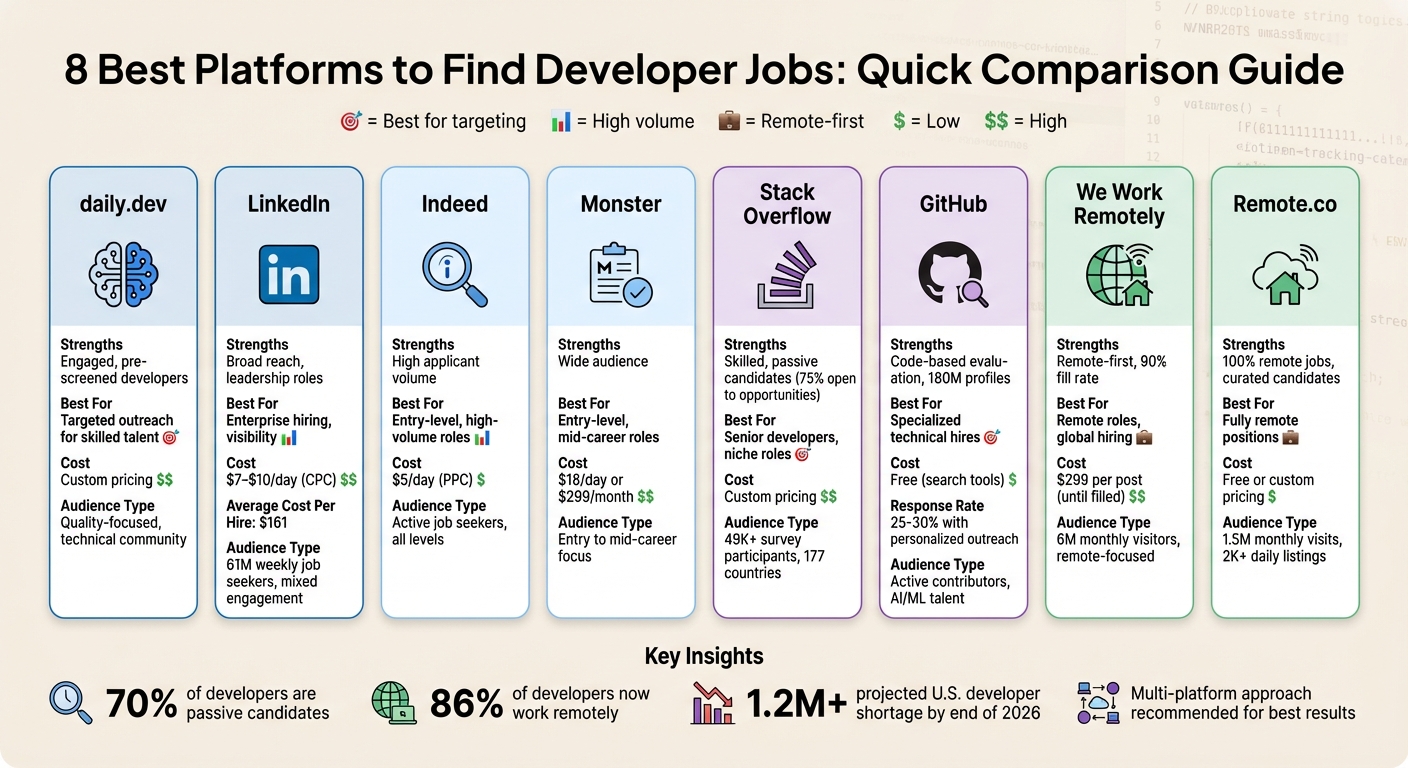
When hiring developers, using generic job boards like LinkedIn or Indeed might not cut it. Developers often prefer platforms tailored to their industry, where they engage with technical content, contribute to projects, and interact with peers. This guide covers eight platforms that connect recruiters with developers where they are most active:
- daily.dev: Focuses on engaged developers consuming technical content. Double opt-in connections ensure higher response rates.
- LinkedIn: Offers massive reach but mixed developer engagement. Better for broad visibility and leadership roles.
- Indeed: High volume of applications, ideal for entry-level or multiple roles, but less targeted for technical hires.
- Monster: Wide reach, but not specialized for tech roles. Best for entry-level or mid-career positions.
- Stack Overflow: Targets skilled developers with proven expertise. Great for passive candidates open to new roles.
- GitHub: Allows recruiters to evaluate candidates through code contributions. Excellent for specialized technical hires.
- We Work Remotely: A remote-first job board with a high success rate for filling remote positions.
- Remote.co: Dedicated to fully remote jobs with a curated list of serious candidates.
Each platform has its strengths, from broad visibility to niche targeting. Combining multiple platforms ensures better results for different hiring needs.
Quick Comparison
| Platform | Strengths | Best For | Cost (Starting From) |
|---|---|---|---|
| daily.dev | Engaged, pre-screened developers | Targeted outreach for skilled talent | Custom pricing |
| Broad reach, leadership roles | Enterprise hiring, visibility | $7–$10/day (CPC) | |
| Indeed | High applicant volume | Entry-level, high-volume roles | $5/day (PPC) |
| Monster | Wide audience | Entry-level, mid-career roles | $18/day or $299/month |
| Stack Overflow | Skilled, passive candidates | Senior developers, niche roles | Custom pricing |
| GitHub | Code-based candidate evaluation | Specialized technical hires | Free (search tools) |
| We Work Remotely | Remote-first, high success rate | Remote roles, global hiring | $299 per post |
| Remote.co | Fully remote jobs, curated candidates | 100% remote positions | Free or custom pricing |
This multi-platform approach ensures you connect with developers where they are most active while balancing cost and effort.
1. daily.dev
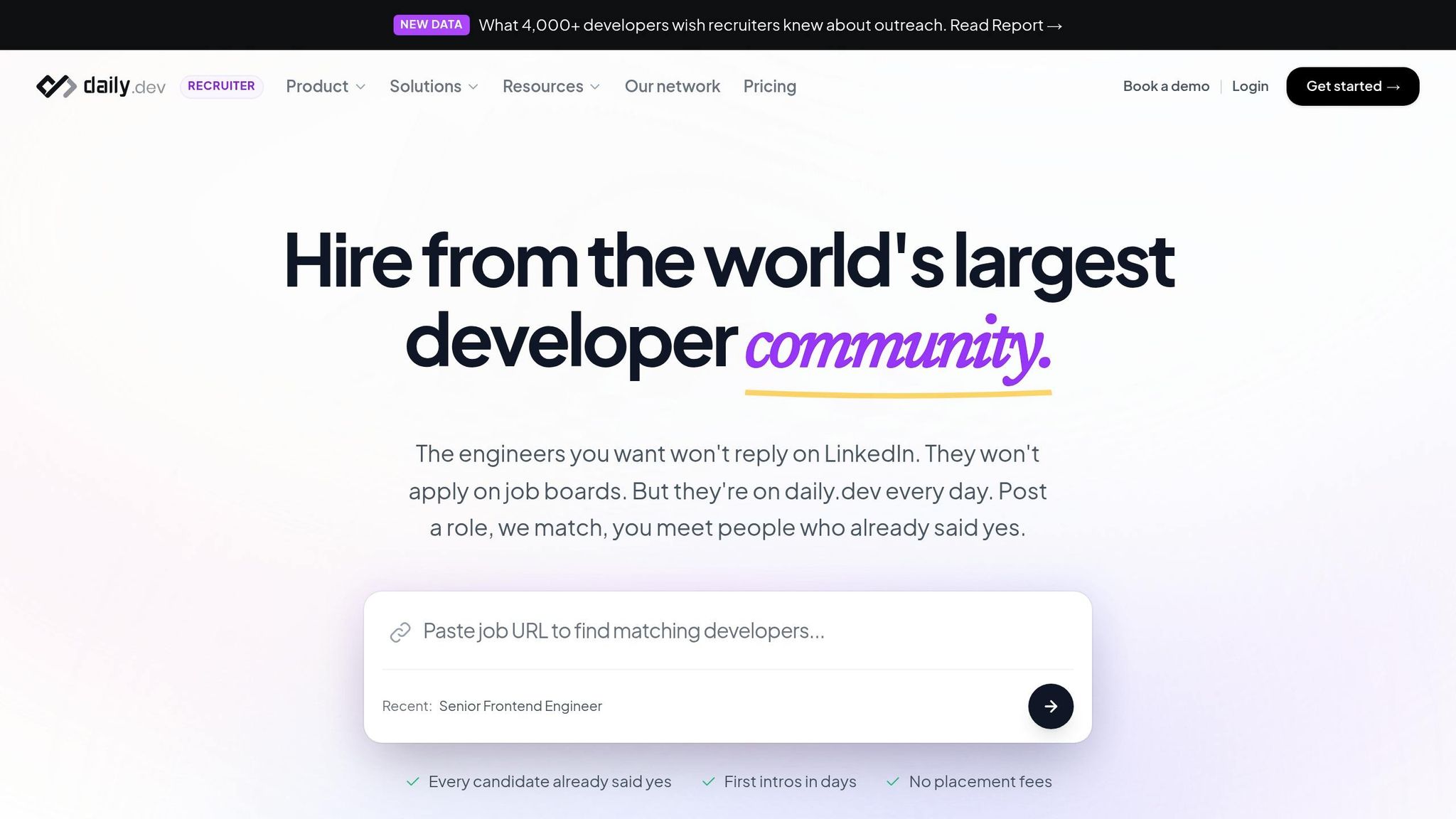
daily.dev Recruiter connects you directly with developers who are actively engaged with technical content and staying on top of industry trends. The platform thrives within a dynamic developer community where professionals spend their time daily, making it an ideal space for meaningful recruiting interactions.
Developer Engagement
On daily.dev, developers aren’t just passively scrolling through job listings. Instead, they’re diving into articles about frameworks, participating in discussions, and keeping up with the latest in software development. Every connection is double opt-in, meaning developers have already expressed interest before you reach out. This eliminates the hassle of cold outreach and boosts response rates.
Audience Size
The platform focuses on quality over quantity, connecting you to software engineers who meet your technical requirements. With access to a global pool of developers, spanning various experience levels and technical expertise, you can find candidates that align with your specific needs.
Posting Costs
daily.dev Recruiter uses a straightforward pricing model, allowing you to focus on hiring pre-screened talent rather than paying for visibility. This approach helps avoid unpredictable tech recruiting costs often associated with traditional job boards, keeping your recruiting budget under control while delivering access to top-tier candidates.
Candidate Quality
The platform ensures you’re connecting with skilled professionals who are committed to advancing their technical expertise. Developers interested in technologies like React or Node.js can be targeted through your job descriptions . Advanced filtering options let you screen candidates based on custom criteria before introductions, saving you time. Plus, since candidates opt in, you’re only engaging with those genuinely curious about your opportunity.
2. LinkedIn
LinkedIn is the go-to professional network, with an impressive 61 million people searching for jobs on the platform every week . For recruiters, it offers unparalleled access to a vast pool of talent across various experience levels and technical specialties.
Developer Engagement
Developer activity on LinkedIn is a mixed bag. While 48% of active job seekers log in daily, only 29% of passive candidates who are "casually open" to opportunities visit the platform daily . Trust is a significant hurdle - 61.5% of developers feel recruiters aren't doing a good job , and 46% rate their trust in cold outreach vs. warm intros at 0-2 out of 5 . Additionally, only 31% of developers believe their listed skills accurately reflect their abilities .
"64.5% say LinkedIn doesn't show where they're headed as a developer." - daily.dev State of Developer Trust 2025 Survey
When it comes to showcasing their expertise, developers prefer GitHub (37%) and personal portfolios (17%), with LinkedIn coming in at just 14%. This suggests LinkedIn is better suited for initial introductions rather than in-depth technical evaluations .
Audience Size
LinkedIn’s biggest strength is its massive reach. The platform connects millions of tech professionals across the U.S., from entry-level developers to senior engineering leaders. This makes it especially useful for enterprise hiring teams managing multiple roles or targeting niche technical positions that benefit from broad visibility.
Posting Costs
LinkedIn offers a free job posting option visible to your network and through basic searches . For greater reach, you can promote posts using a CPC model, with a daily minimum spend of $7–$10 . Sponsored job posts can generate up to 30x more applicants than free listings .
For a Software Engineer in the U.S., the average cost per applicant is $2.71 . Considering it takes about 57 applicants to make one hire, recruiters can expect an average ad spend of $161 per hire . For higher-volume hiring, LinkedIn offers "Job Slots" on a contract basis, costing anywhere from $1,500 to $3,000 per active post .
To maximize results, post jobs between Tuesday and Thursday and keep them live for at least five days to attract enough applicants . Adding mandatory screening questions helps filter out unqualified candidates, saving you from unnecessary clicks and costs .
Candidate Quality
LinkedIn shines when it comes to professional and leadership roles. However, finding the right developers often requires using advanced filters to narrow down the broad applicant pool . The platform’s extensive reach means recruiters need to spend additional time sorting through applications to find top-tier talent.
3. Indeed
Indeed is known for its massive reach and ability to generate a high volume of applications quickly. If you're hiring for multiple developer roles or looking to fill entry-level positions, Indeed can deliver hundreds of applications in a short time - sometimes overnight . Unlike niche platforms, its focus is on delivering volume rather than targeting specific candidates.
Developer Engagement
Indeed's strength lies in attracting active job seekers, but this comes with some trade-offs. Developers often feel disconnected from the hiring process on the platform. Once they submit their resume, there's little clarity about where it goes or who reviews it . This lack of transparency can make it less appealing to senior engineers, who tend to favor platforms that offer a more personalized or community-driven experience.
"Indeed is designed for active job seekers. It's an inbound firehose - great for visibility, less great for signal." – daily.dev
Audience Size
One of Indeed's standout features is its enormous audience, spanning all experience levels and technical specialties. It excels when you need broad exposure and fast results. This makes it an excellent choice for companies running large-scale hiring campaigns or recruiting for positions that don't require highly specialized skills. Its strategy aligns with reaching developers on platforms they already frequent.
Posting Costs
Indeed operates on a results-based pricing model, meaning you pay per click (PPC) or per started application (PPSA) rather than a flat fee . Employers in the U.S. can post up to three free jobs per month, with each job staying live for 30 days . However, many recruiters opt for Sponsored Jobs to ensure their listings remain visible, as free posts tend to lose prominence over time.
Sponsored Job budgets start at $5 per day or $150 per month . Premium options include features like "Matched Candidates", which lets recruiters directly invite top matches to apply . Billing occurs monthly or when your account reaches a $500 spending threshold .
Candidate Quality
While Indeed provides a large pool of applicants, sorting through them can be time-consuming. Many candidates may not meet your technical requirements or might just be casually exploring opportunities . This makes it better suited for roles where a high volume of applications is beneficial, even if it means more manual effort to identify the right fit.
"If you're hiring at scale - multiple roles, entry-level positions, or non-technical roles - Indeed remains the easiest way to drive high application volume." – daily.dev
4. Monster
Monster is one of the most recognized job boards out there, offering a broad range of listings. However, its mixed approach means recruiters often have to wade through a sea of unqualified applicants to find the right fit.
Developer Engagement
One of Monster's challenges is its lack of focus on developer-specific roles. By combining tech and non-tech listings, the platform struggles to cater to senior engineering candidates who are often looking for niche, specialized communities.
Audience Size
Monster does attract a large audience, but its user base leans heavily toward entry-level and mid-career professionals. While its wide reach, boosted by Google Jobs indexing, gives postings more visibility, the platform still struggles to connect with highly specialized technical talent. This makes it less appealing for recruiters targeting experienced developers or engineers.
Posting Costs
Monster offers two main pricing models:
- Monster+ Standard: A pay-as-you-go option where employers set a daily budget of $18, $27, or $35. Costs are only incurred when candidates view or apply to the job.
- Monster+ Pro: A subscription-based plan priced at $299 per month. This includes unlimited job promotions and access to Monster's resume database, allowing employers to proactively source candidates.
Candidate Quality
When it comes to senior engineering roles, Monster's candidate quality often falls short. Recruiters frequently report a low signal-to-noise ratio, making it harder to find top-tier talent. The platform is better suited for high-volume hiring and entry-level positions rather than specialized technical roles. This limitation highlights the difference between Monster and platforms designed specifically for remote or technical hiring.
5. Stack Overflow
Stack Overflow connects recruiters with a global network of skilled developers. In its 2025 Developer Survey, over 49,000 developers from 177 countries participated, showcasing the platform's reach and the active engagement of its technical community. Impressively, 65% of professional developers on the platform contribute to open-source projects, reflecting their dedication and expertise.
Developer Engagement
One of Stack Overflow's standout features is its ability to engage passive talent. While only 15.2% of developers are actively job hunting, a remarkable 75% remain open to new opportunities. This makes it a goldmine for recruiters looking to connect with highly skilled professionals not typically found on traditional job boards.
When developers on Stack Overflow consider new roles, they focus on a few key factors: the programming environment, salary, and the technologies they'll work with. Recruiters who tailor job postings to address these priorities - highlighting tech stacks, workplace culture, and compensation - are far more likely to attract interest than those using generic descriptions.
This targeted approach ensures better engagement and access to top-tier talent.
Candidate Quality
Stack Overflow is particularly effective for sourcing candidates with proven technical skills. The platform naturally attracts experienced developers who are constantly learning and solving complex problems. Its technical focus acts as a filter, drawing in specialists and senior engineers who actively showcase their expertise through community contributions and problem-solving.
Unlike general job boards, Stack Overflow allows recruiters to identify candidates who have already demonstrated their abilities publicly. This transparency offers a unique advantage, giving you a clear sense of a developer's skills and experience before initiating contact.
6. GitHub
GitHub is home to over 180 million developer profiles, making it the largest platform for hosting code globally. In 2025 alone, 36.2 million new developers joined the platform - about one every second. India contributed 5.2 million of these new developers, and projections suggest India will surpass the United States in developer population by 2028 .
Developer Engagement
GitHub stands out from traditional job boards by showcasing actual code contributions and project involvement instead of just resumes. Recruiters can evaluate talent through contribution graphs that display commit patterns, pinned repositories highlighting a developer's top work, and README files that reflect communication skills . It's particularly useful for finding AI and machine learning talent, as AI-related projects saw a 178% year-over-year growth in 2025, adding 693,867 new projects .
Keep in mind, though, that 82% of contributions happen in private repositories, so a sparse public profile doesn’t necessarily mean low activity. GitHub offers a unique lens into a developer’s skills, making it an excellent tool for specialized recruiting. This transparency helps recruiters discover quality candidates efficiently.
Posting Costs
GitHub’s advanced search and filtering tools are free to use and incredibly effective for recruiters. Features like Google X-ray search allow you to filter candidates by location, programming language, follower count, and repository activity - all without any cost .
Candidate Quality
Personalized outreach on GitHub can yield impressive results. Referencing specific repositories in your messages can lead to 25–30% response rates . For example, Codility’s recruiting team achieved a 30% response rate by tailoring messages to individual projects instead of using generic templates .
When assessing candidates, look for meaningful projects where developers have tackled real-world challenges, rather than relying on tutorial-based code. Indicators of professional-quality work include test harnesses, clear documentation, and detailed commit messages . Developers with over 50 followers often have strong work histories, repositories with 100+ stars suggest solid projects, and those with 1,000+ stars indicate high recognition .
However, avoid reaching out through GitHub Issues or Pull Request comments, as developers generally find this approach disruptive .
7. We Work Remotely
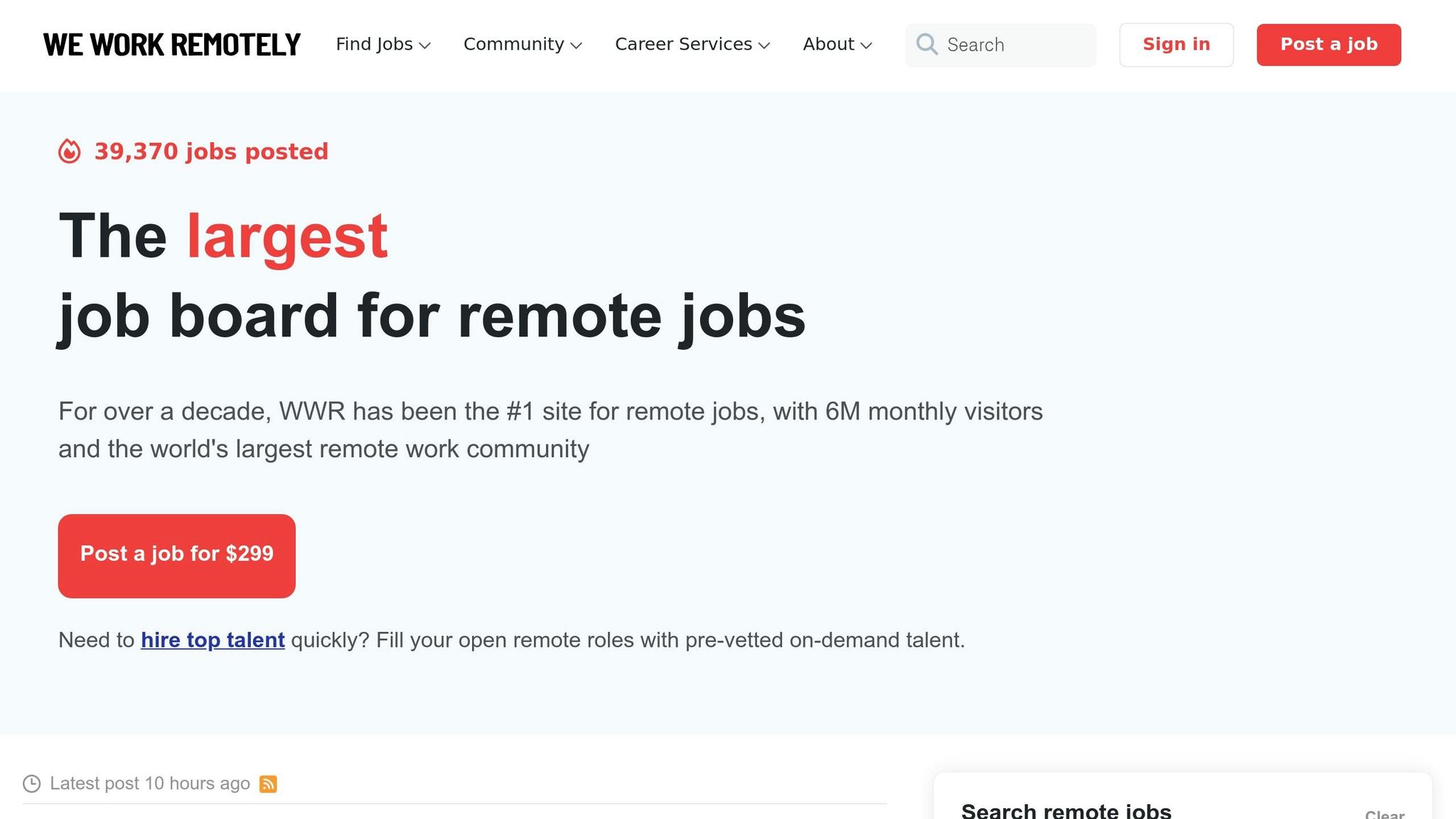
We Work Remotely (WWR) stands out as the largest remote-first job board, attracting an impressive 6 million visitors every month . Since its launch in 2011, WWR has focused solely on remote job opportunities, ensuring that listings remain highly visible .
Audience Size
Thanks to its dedication to remote work, WWR has built a strong and active community. The platform boasts a 90% success rate in filling positions posted on the site and has a global Slack community with nearly 9,000 members . By November 2021, it had hosted over 22,000 remote job listings . With 86% of developers now working remotely , WWR has become a go-to hub for remote job seekers and employers alike.
Developer Engagement
WWR’s features cater specifically to remote professionals, especially developers. Users can refine their job searches by technical roles - such as Back-End, Front-End, Full-Stack, and DevOps - or by geographic region and time zone, making it easier to find roles that align with their preferences . The platform also offers additional resources like a Slack community, learning forums, resume templates, and career coaching .
One of WWR’s standout policies is that it only accepts direct postings from verified employers. This approach eliminates scraped listings and minimizes the risk of scams or outdated postings .
"We don't scrape listings from other platforms, we have the strongest remote community in the world, and we fill 90% of the positions posted -- quickly." - We Work Remotely
Posting Costs
WWR charges a flat rate of $299 per job listing . Unlike many job boards where posts expire after 30 days, WWR keeps listings active until the position is filled . For frequent posters, bundle packages are available, offering discounts of up to 40% . These pricing options make it easier for recruiters to find top-notch remote candidates.
Candidate Quality
Remote job postings on WWR often draw a large pool of applicants from around the world. To streamline the hiring process, Thomas De Moor, Content and SEO Marketer at X-Team, suggests using screening questions or specific instructions - such as asking candidates to include a keyword like "Red Panda" in their subject line - to quickly identify those who follow directions .
Hunter McKinley, Founder & CEO of Yac, highlights the advantages of time zone diversity:
"Many people seek development teams that are within the same time zone. We've always loved our team in India because they can start working when we finish up stateside" .
For better visibility, use standard job titles that match common search terms. Clearly stating time zone requirements can also help set expectations for communication and collaboration .
8. Remote.co
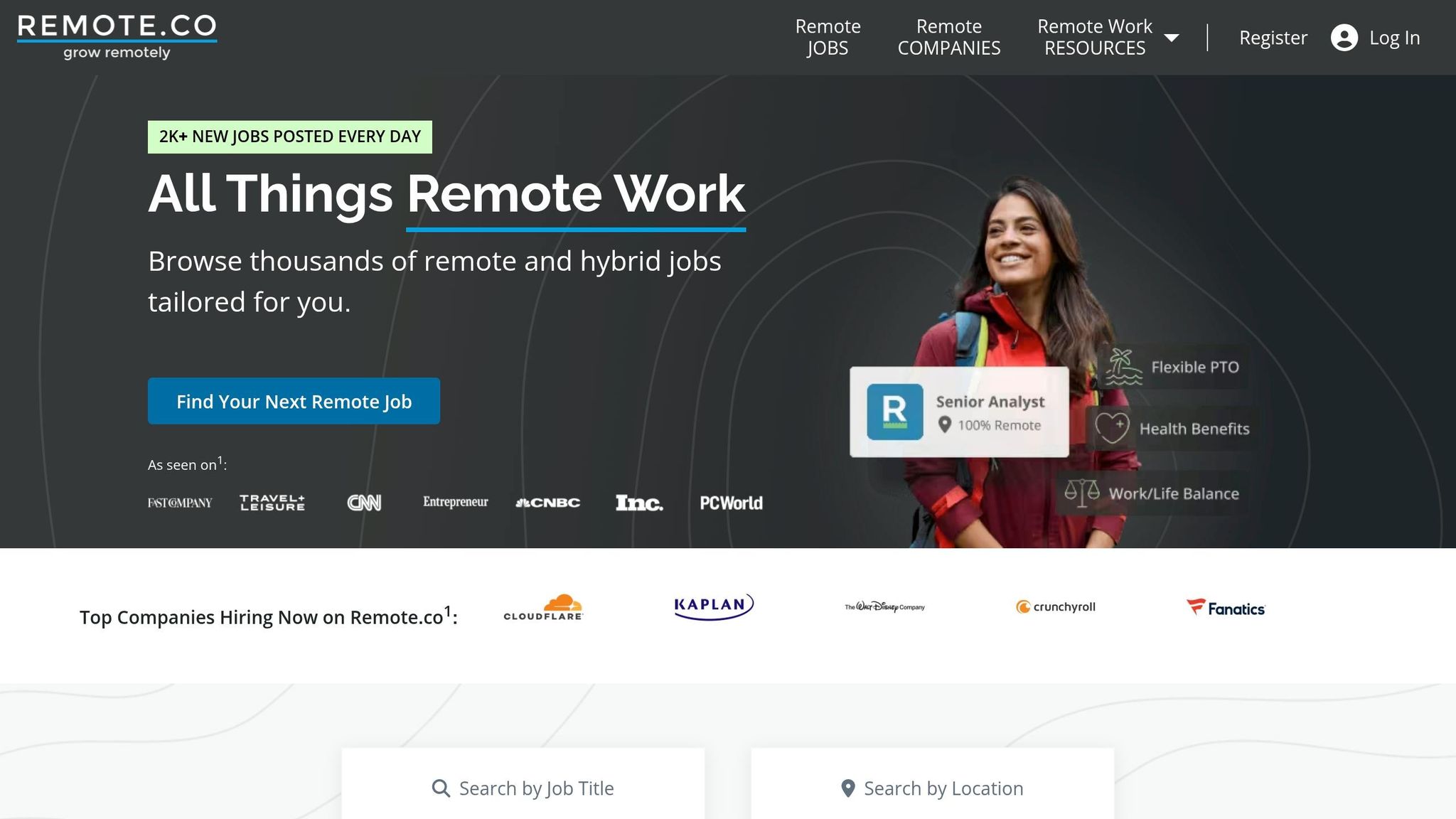
Remote.co stands out as a dedicated, free-to-use job board exclusively for 100% remote positions, drawing over 1.5 million visits each month . Unlike broader job boards that mix remote, hybrid, and office-based roles, Remote.co filters out unclear or non-remote postings, making it a go-to platform for developers seeking fully remote opportunities . The platform adds more than 2,000 new job listings daily across 100+ categories, ensuring a constant stream of opportunities for those pursuing distributed work . Below, we explore its audience, engagement, costs, and candidate quality.
Audience Size
Remote.co appeals to mid-career professionals who prioritize authentic remote work opportunities. Its careful curation process has earned it a 4.1/5 rating on Trustpilot from 235 reviews as of February 2026 . By focusing on quality over quantity, the platform cultivates a smaller but highly dedicated pool of candidates compared to larger, high-volume job boards.
Developer Engagement
In addition to job postings, Remote.co offers resources like educational content, Q&A forums, and a "Why Remote" section that features insights from over 140 companies about their remote work practices . These features allow developers to learn about potential employers and gain tips on thriving in remote roles. However, the platform lacks advanced tools like social media sharing, email blasts, or automated applicant filtering . This straightforward approach aligns with its focus on simplicity and transparency.
Posting Costs
Remote.co allows qualifying companies to post jobs for free . For those that don’t meet the criteria, paid options are available through custom pricing provided by the sales team . This tiered system offers flexibility for businesses with varying budgets.
Candidate Quality
Remote.co’s emphasis on manually vetting every job listing ensures that candidates are serious about remote work. Ronald O'Connor from Remote100K highlights this distinction:
"Remote.co is a real platform with genuine remote job listings... but it operates differently than most job boards" .
Recruiters are encouraged to contact the sales team to confirm eligibility for free postings. Additionally, creating a detailed company profile and leveraging the "Why Remote" feature can help showcase a company’s remote work culture, appealing to job seekers who value transparency and professionalism in distributed work environments . This focus on quality and community engagement makes Remote.co a trusted platform for both recruiters and candidates.
Platform Comparison: Strengths and Weaknesses
Choosing the right platform depends on your hiring goals, budget, and the type of developer you're looking to attract. Broad job boards like Indeed and LinkedIn are great for reaching a wide audience. However, since about 70% of software engineers are passive candidates , these platforms often attract more junior talent or active job seekers, which might not align with your need for experienced professionals in specialized roles.
If you're targeting highly skilled developers, developer-specific platforms like Stack Overflow, GitHub, and daily.dev are worth considering. These platforms connect you to technically engaged candidates but typically come with higher posting costs due to their specialized focus.
For remote hiring, platforms such as We Work Remotely and Remote.co cater specifically to remote-first roles, offering a targeted approach for distributed teams. Beyond audience type, the pricing models of these platforms also vary significantly. For instance:
- Indeed: Sponsored posts start at $5 per day or range from $15–$50 per application.
- Dice: Charges between $399 and $495 for a 30-day job posting.
- Arc.dev: Uses a placement fee model, charging 15%–21% of the annual salary.
- Noxx: Offers a 3% pay-on-hire model, shifting financial risk to the employer.
The ongoing challenge for 91% of tech leaders - finding skilled workers for specialized fields like AI, cybersecurity, and cloud architecture - highlights the importance of using multiple platforms. Developer-focused platforms like daily.dev often deliver pre-qualified candidates, reducing the time spent on screening. On the other hand, general job boards may require more effort to sift through large volumes of applicants to find the right match.
When considering cost efficiency, it’s critical to look beyond just posting fees. Factors like reply rates, screening time, and the quality of hires all play a role. Placement fee models can minimize financial risk, but your strategy should align with the platforms where your target candidates are most active. For instance, Wellfound (formerly AngelList Talent) is particularly suited for startups, offering transparency around equity but with a narrower focus that may not suit enterprise-level hiring needs .
A well-rounded, multi-platform approach ensures that your recruitment efforts are tailored to your specific hiring challenges, balancing cost, effort, and candidate quality.
Conclusion
Hiring developers requires tailoring your approach to where your ideal candidates spend their time. Broad job boards like Indeed and LinkedIn are great for generating a high volume of applications, especially if you have the resources to filter through large pools of candidates. However, with 70% of developers identified as passive candidates , these platforms might miss experienced professionals who aren’t actively job hunting. This highlights a key difference between volume-based strategies and more focused approaches that prioritize quality.
Developer-specific platforms like Stack Overflow, GitHub, and daily.dev attract skilled talent who actively engage in technical communities. These platforms emphasize quality over quantity, saving recruiters from sorting through unqualified applications.
If flexibility is a key aspect of the role, remote hiring platforms are worth considering. With over 50% of software engineers working remotely , these platforms connect you with candidates who value remote work, offering a more targeted pool of applicants.
To refine your recruitment strategy, adopt a data-driven, multi-platform approach. Run a 30-day test across several platforms using identical job descriptions. Track metrics like application volume, response rates, screening time, and the quality of hires . With a projected U.S. developer shortage of over 1.2 million by the end of 2026 , staying targeted and analytical in your recruitment efforts is more important than ever.
Finally, be transparent in your job postings. Clearly outline salary ranges, tech stacks, and real-world technical challenges. Developers tend to prefer warm introductions over generic cold outreach, especially when approached on community platforms they already use in their daily routines.
FAQs
How do I choose the right job sites for the type of developer I need?
Choosing the right job sites depends on where developers are most active and your specific hiring needs. For niche roles, platforms like daily.dev and Stack Overflow are excellent choices since they attract highly engaged developers. If you're hiring for remote positions, focus on remote-first platforms tailored to that audience.
Adjust your strategy based on whether you're seeking active candidates - who frequent job boards - or passive talent, which you can find in developer communities like GitHub. Make it a habit to regularly evaluate the performance of these platforms to fine-tune your approach and maximize results.
What metrics should I track in a 30-day multi-platform hiring test?
Track important metrics such as vetting quality, time-to-hire, cost per hire, and how well you can connect with passive candidates. Monitoring these will give you a clearer picture of the platform's performance and help you fine-tune your hiring strategy throughout the 30-day period.
How can I improve developer response rates without cold outreach?
To connect effectively with developers, it’s crucial to meet them where they are - platforms like daily.dev Recruiter, GitHub, and Stack Overflow. These are spaces where developers actively engage, share their work, and collaborate.
Here’s how to create meaningful connections:
- Genuine Contributions: Participate in discussions, offer helpful insights, or share resources that align with their interests or challenges. This shows you’re invested in their world, not just selling something.
- Personalized Messages: Tailor your communication to reflect their specific skills, projects, or contributions. A message that acknowledges their work is far more likely to resonate than a generic pitch.
- Community Involvement: Be an active part of developer communities. Whether it’s answering questions, providing feedback, or simply being present, this builds credibility over time.
- Clear Value: When reaching out, make it obvious how you can help or add value. Developers are more likely to engage when they see a tangible benefit.
By focusing on respectful, tailored interactions instead of cold outreach, you’ll significantly improve response rates and establish trust in these highly skilled communities.
.png)