When developers leave, the costs are immense - up to $1 million for senior roles when you factor in hiring, onboarding, and lost productivity. Beyond dollars, turnover disrupts teams, delays projects, and drains morale. With 23% annual turnover in tech and a 9-13% chance of triggering more exits when one person leaves, retention is a critical challenge.
Here’s what works to keep developers engaged and onboard:
- Career Growth: Clear career paths, mentorship, and opportunities for skill development keep 68% of developers from leaving.
- Better Management: Developers value leaders who provide technical guidance, set priorities, and support their growth.
- Addressing Technical Debt: Reducing time spent on legacy systems and tedious tasks boosts motivation.
- Pay and Benefits: Competitive compensation matters, but recognition and fairness are just as important.
- Work-Life Balance: Flexible schedules, reduced workloads, and mental health support lower burnout and attrition.
Retention starts with proactive efforts - stay interviews, regular 1:1s, and smarter hiring practices that align candidates with your team’s needs. Fixing these issues early saves time, money, and talent.
What Developer Turnover Actually Costs
::: @figure 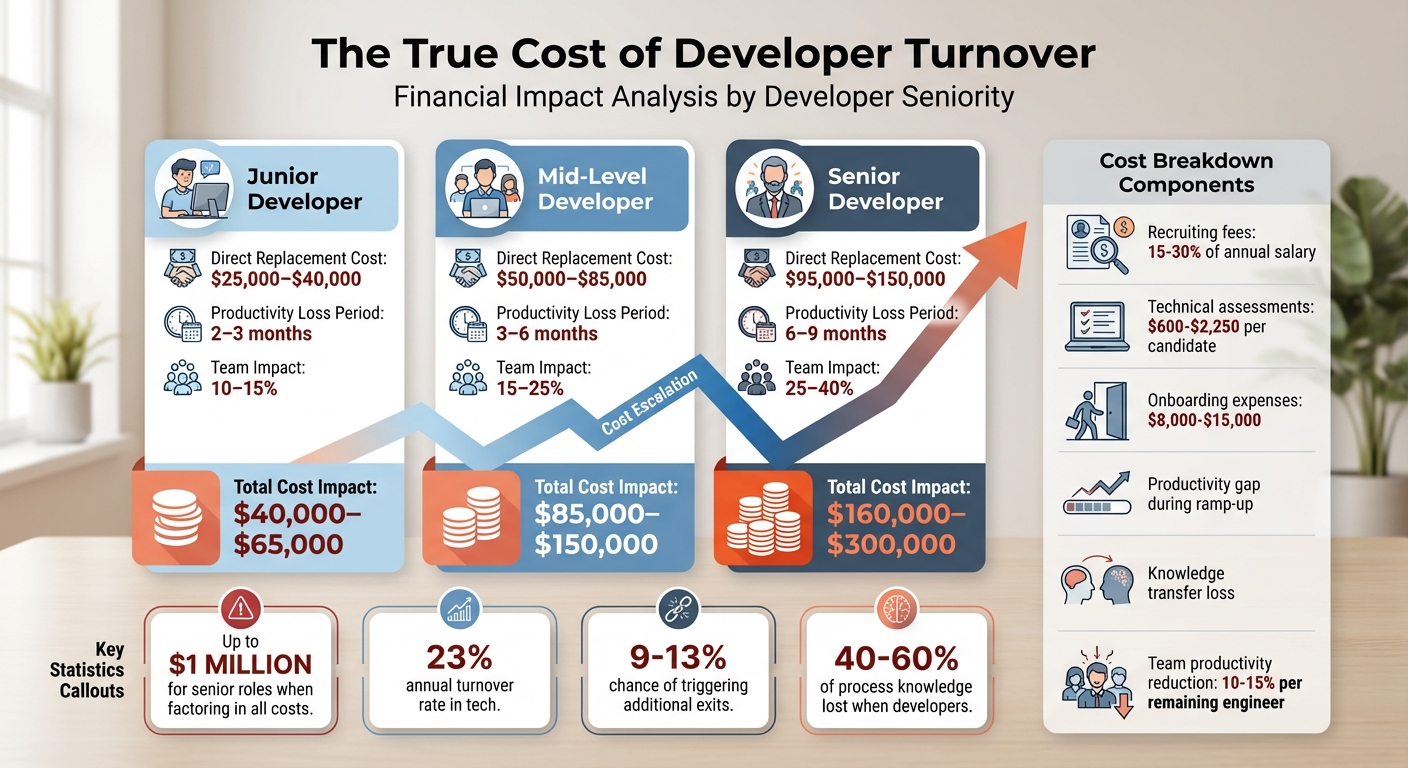 {The True Cost of Developer Turnover: Financial Impact by Seniority Level}
Direct Financial Expenses
The financial hit of replacing a developer starts as soon as they submit their resignation. Just the recruiting fees alone typically account for 15% to 30% of the new hire's annual salary . For example, if you're replacing a mid-level developer earning $140,000, you're looking at $21,000 to $42,000 in recruiting costs.
But recruiting is just the beginning. Technical assessments and interviews, which can take 8 to 15 hours per candidate and cost $75–$150 per hour, add another $600–$2,250 per candidate . Then there’s the productivity gap. A senior developer earning $200,000 might only reach 25% productivity in their first month . Over the first three months, this gap could cost a company around $37,500. Onboarding expenses, such as HR orientation, training materials, and structured knowledge transfer, tack on another $8,000 to $15,000 .
When all these direct costs are combined, the financial burden becomes significant. And that’s before factoring in the hidden costs, which can be even more impactful.
| Developer Level | Direct Replacement Cost | Productivity Loss | Knowledge Transfer Loss | Overall Cost Impact |
|---|---|---|---|---|
| Junior | $25,000–$40,000 | 2–3 months | 10–15% team impact | $40,000–$65,000 |
| Mid-level | $50,000–$85,000 | 3–6 months | 15–25% team impact | $85,000–$150,000 |
| Senior | $95,000–$150,000 | 6–9 months | 25–40% team impact | $160,000–$300,000 |
Hidden Operational Costs
Direct expenses only scratch the surface. When a developer leaves, the workload shifts to the remaining team, reducing their productivity by 10% to 15% per engineer . About 40% of the work left behind - like addressing technical debt, updating documentation, or improving architecture - often gets abandoned entirely.
Even more concerning is the loss of process knowledge. Between 40% and 60% of the reasoning behind critical code decisions disappears when developers leave . This can leave teams digging through old Slack threads and pull requests just to understand why certain decisions were made, wasting valuable time.
Turnover also destabilizes morale. When one developer leaves, the likelihood of others following jumps by 9% to 13% . Take the example of a mid-sized payments processor: after losing a senior engineer, three more team members resigned shortly after. This chain reaction cost the company over $700,000 in replacement expenses and triggered system failures that led to millions in losses .
"The fundamental misalignment: executive compensation optimizes for quarterly results; engineer retention requires long-term investment." - CodeGood
During transition periods, overall team productivity can drop by as much as 40% . Deadlines slip, features are delayed, and quality suffers as teams scramble to keep up. For senior roles, when you factor in project delays and missed opportunities, the total cost of turnover can climb to $500,000–$1,000,000 .
Why Developers Leave: Survey Data and Patterns
Job satisfaction among developers is low, with only 24% to 25% reporting being satisfied, while turnover rates hover around 23% . The average tenure for engineers has dropped from 59% in 2015 to 52% in 2024, highlighting a workforce increasingly ready to leave when their needs aren't met .
The reasons for this trend are clear. A lack of growth opportunities is the leading cause, driving 68% of developers to leave their roles . Poor management comes next, with 47% citing ineffective communication as a key factor . Additionally, technical debt significantly impacts developers' ability to work effectively, with 66% frequently encountering related issues .
Interestingly, while only 15% of senior engineers leave primarily due to salary concerns, 68% later indicate that pay reflects a deeper issue - feeling undervalued . This suggests that addressing underlying frustrations may be more impactful than merely increasing compensation. Below, we explore the top drivers of developer turnover: limited growth, poor management, and technical debt.
Limited Career Growth
Developers need clear career paths. Without them, 33% cite limited learning and development opportunities as a major negative experience . Companies without formal career ladders make matters worse, especially when engineers lack a defined path to senior roles or are pushed into management positions they don't want. Over the past nine years, the engineer-to-manager ratio has increased by 30%, from 5.87 to 7.65, leaving teams with fewer mentors .
"Retention is a lagging indicator of trust and impact. Engineers stay where they can grow, ship, and influence direction." - Jarod Reyes, Head of Developer Community, SignalFire
One example of addressing this issue comes from a mid-size FinTech company. In 2024, they reduced their annual turnover from 35% to 14% in just six months by introducing a 7-level career growth framework and allocating 15% of time to innovation projects. These changes led to an 86% increase in career growth satisfaction and a 121% boost in projected average tenure . Clearly, solving growth challenges can have a major impact on retention.
Bad Management
Poor management is another major reason developers leave, with 47% pointing to inadequate technical insight and weak feedback as key issues . It’s not just about incompetence - leaders who lack technical expertise or fail to provide meaningful guidance often push engineers to look elsewhere. High-performing organizations ensure managers stay engaged in technical work, such as design documentation and mentoring, to maintain credibility and build trust .
When managers fail to set clear priorities, developers may waste time on tasks that are later discarded. This lack of direction contributes to frustration, with 72% of engineers saying excessive demands make it hard to innovate . Additionally, rising engineer-to-manager ratios stretch leadership capacity, leaving teams without the support they need. Without targeted retention strategies, these issues can drive top talent away.
Technical Debt and Outdated Tools
Developers often feel demotivated when most of their time is spent maintaining legacy systems instead of building new features. On average, only 16% of developer time is spent on new initiatives, while 79% report that code maintenance is a major drain . This imbalance, known as the "maintenance trap", pushes engineers to seek roles where their work feels more impactful.
Technical debt compounds the problem, making codebases harder to work with and forcing developers to spend more time debugging than innovating. In fact, 38% of engineers identify frequent code maintenance as a top factor in a negative work experience, tied with the burden of too many tedious tasks .
Tool overload adds another layer of frustration. A staggering 88% of developers say juggling too many tools hurts productivity, with 44% experiencing major focus loss due to constant context switching . On the other hand, 94% of developers who have automated at least half of their tasks report spending more time on energizing work, compared to just 67% for those with little automation .
| Top Reasons for Negative Developer Experience | % of Engineers Citing |
|---|---|
| Frequent code maintenance (upgrades, patching) | 38% |
| Too many tedious tasks | 38% |
| Excessive workload or burnout | 35% |
| Limited learning and development opportunities | 33% |
| Frequent context switching | 32% |
| Lack of recognition and appreciation | 28% |
| Lack of effective tools | 28% |
Retention Strategies Ranked by Impact
Retention strategies have varying levels of effectiveness, and the numbers show just how critical career progression is. A striking 82% of People Leaders identify career growth as their top retention challenge, compared to 61% who prioritize compensation . For developers, 68% leave due to limited growth opportunities, while factors like technical challenges (53%), management quality (47%), and compensation (42%) also play significant roles . While these factors interact, investing in career advancement delivers the greatest impact on retention.
By prioritizing career growth, competitive pay, and work-life balance, you can craft a retention strategy that truly resonates. Below, we explore each approach, breaking down how to make them work for your team.
Career Growth Opportunities
Career growth is the cornerstone of retention. Developers are far more likely to stay when they see a clear path forward. Dual career tracks are essential here - not everyone wants to step into management. Forcing technical experts into leadership roles can waste their potential. Instead, provide separate paths for those who want to remain technical contributors and those interested in leadership . Use competency matrices to define what each level entails, connecting day-to-day tasks with career milestones .
Mentorship programs are another powerful tool. Pair junior engineers with experienced mentors who can offer guidance on everything from code reviews to career advice . Keep manager-to-engineer ratios manageable - ideally 1:6–9 - to ensure managers have the bandwidth to provide meaningful mentorship. Studies show that when managers oversee more than 10 direct reports, engineers tend to leave four months earlier on average .
"Retention is a lagging indicator of trust and impact. Engineers stay where they can grow, ship, and influence direction." - Jarod Reyes, Head of Developer Community, SignalFire
Innovation time is another way to keep developers engaged without requiring promotions. Take inspiration from Google's "20% time" policy, which has led to projects like Gmail and AdSense . Even if you don’t have Google’s resources, allocating 10–20% of working hours for creative exploration or tackling technical debt can make a big difference .
Internal mobility also helps prevent stagnation. Encourage developers to move between roles, projects, or teams to keep their skills sharp and relevant . Regularly updating your tech stack can also help - developers often leave when they feel stuck using outdated technology . Succession planning is another way to show clear advancement opportunities by identifying and nurturing future leaders within your team .
Once career growth opportunities are in place, the next step is to align compensation and benefits with these efforts.
Competitive Pay and Benefits
While career growth is the most important factor, compensation is still a basic necessity. You can’t retain top developers if your pay doesn’t meet market standards. Compensation priorities shift with seniority. For early-career developers (P1/P2 levels), a strong base salary is critical. For senior developers (P3+), equity and career progression often outweigh base salary increases .
"The days of paying everyone at median are over - that's a recipe for losing your key talent. Invest in the roles that drive your success." - Evert Kraav, Senior Compensation Manager, Bolt
Rather than applying blanket raises, focus on roles that are critical to your business. Pay these positions at the 60th or 75th percentile instead of the median . For senior developers, equity refresh grants and performance bonuses are often more effective than standard salary increases . Conduct market rate reviews twice a year to ensure your pay stays competitive .
Help engineering managers explain compensation decisions during one-on-one meetings. When developers understand how their pay compares to market rates and how it reflects their contributions, they’re less likely to feel undervalued. While only 15% of senior engineers leave primarily because of salary, 68% later say that pay reflected a deeper issue - feeling undervalued .
Interestingly, early-stage companies show that compensation isn’t everything. Despite offering smaller pay raises (3.0% on average), these companies have the lowest attrition rate at 14.5%, likely due to high equity stakes and clear impact. Late-stage companies, despite offering better cash compensation, see higher attrition at 17.6% .
Beyond pay, work-life balance plays a critical role in keeping developers engaged and satisfied.
Work-Life Balance and Flexibility
Work-life balance ranks as the third most impactful retention strategy, but it’s quickly becoming a must-have. 62% of tech employees report chronic stress, often due to unrealistic workloads or poor boundaries. Teams with clear work-life boundaries see 32% higher productivity and 21% lower attrition rates . Flexibility, especially with remote work, removes "office inertia", ensuring developers stay for the role, not just convenience .
"Flexible schedules, remote work, and mental health programs are no longer perks - they're essential retention tools for sustainable teams." - Devsu
Establishing sustainable work practices is key. Flexibility isn’t just about allowing remote work - it’s about fostering connection in distributed teams to prevent isolation .
Cut down on "toil" - tasks like excessive meetings or administrative work that take developers away from coding . While 93% of developers find coding fulfilling, only 16% of their time is spent on it each week . Protect "maker time" by minimizing context switching and reducing non-core tasks .
Encourage the use of mental health days and PTO policies. It’s not enough to offer them; you need to actively promote their use . Set realistic expectations and avoid normalizing overtime . With technology’s voluntary turnover rate at 18.9%, 71% of this is tied to poor management, often due to unmanageable workloads .
Next, we’ll explore tools and techniques engineering managers can use to implement these strategies effectively.
Practical Tools for Engineering Managers
Engineering managers need actionable strategies to keep their teams engaged and reduce turnover. Three key approaches - regular one-on-one meetings, clear career ladders, and meaningful project ownership - can help create an environment of trust, growth, and autonomy. These elements are essential for long-term retention.
Regular 1:1 Meetings
One-on-one meetings are a powerful way to catch issues early and keep team members engaged. Employees who regularly meet with their managers are nearly three times as likely to feel engaged at work . These meetings shouldn’t just rehash updates that could be handled via tools like Jira, standups, or Slack - they should focus on real concerns .
"The single most impactful thing you can do to improve performance and retention across your team is to hold routine 1:1 meetings." - Peter Inge, Co-founder, DevClarity
A simple structure like the 10/10/10 Rule can make these meetings more effective: spend 10 minutes on the employee’s agenda, 10 minutes on your topics, and 10 minutes on career growth . Letting the developer set the initial agenda ensures their priorities are addressed first . While 30-minute sessions work for regular check-ins, longer 60-minute meetings can reveal deeper issues .
Consistency matters. Canceling one-on-ones can send the wrong message about priorities. If you need to reschedule, make sure to follow through . Preparing for these meetings by reviewing past notes or recurring issues can help identify patterns . Taking notes during the meeting also helps track progress over time .
"The cost of winging 1:1s isn't that they go badly. It's that they go okay. They're pleasant... But you miss things: You miss patterns... You miss sentiment shifts." - Amy Wightman, Co-founder, Vereda AI
Ask open-ended questions like, “What’s been frustrating you lately?” or “Is there anything slowing you down that I can help with?” . Active listening techniques, such as paraphrasing (e.g., “So what you’re saying is…”), show that you’re fully engaged . When giving feedback, use the SBI Model - Situation, Behavior, Impact - to keep the conversation clear and constructive .
Clear Career Ladders
A well-documented career ladder gives employees a clear path for growth and removes ambiguity around promotions. Expanding from three levels to seven can highlight incremental progress and provide more frequent milestones . These levels should be based on transparent criteria, such as years of experience or specific contributions, to avoid bias .
The "Three Circles of Impact" framework evaluates engineers across three areas: Individual Contributions, Collaboration, and Enabling Others (e.g., mentoring or creating tools) . This approach goes beyond technical skills and provides a more rounded assessment. Standardizing pay at each level also promotes fairness and reduces stress during salary discussions .
"Your manager isn't a mind reader. You can't expect guidance if you don't come with a direction. Your growth is a shared effort, but it starts with you." - Dalia Abuadas, Software Engineer, GitHub
To make this system effective, map your team members to the appropriate levels and set clear timelines for progression . Use quarterly career reviews to focus on long-term goals, separate from day-to-day updates . For those approaching the next level, assign stretch projects that broaden their skills or increase their visibility .
While career ladders provide structure, giving developers ownership of meaningful projects enhances their sense of purpose and accountability.
Project Ownership
Empowering developers with control over meaningful projects not only boosts engagement but also strengthens retention. Define success clearly, but allow team members the freedom to decide how to achieve it . Assigning responsibilities like leading internal tools or prototyping experimental features gives them a sense of influence over the company’s technical direction .
It’s also important to balance workloads. Developers who are stuck maintaining legacy code exclusively may lose motivation . Offering opportunities to switch teams or projects can keep things fresh and prevent burnout . Reducing non-essential tasks allows developers to focus on creative work like coding and design . Stay interviews can also help uncover early signs of disengagement - if a previously vocal team member becomes quiet, it’s worth exploring why .
Hiring engineers?
Connect with developers where they actually hang out. No cold outreach, just real conversations.
Stay Interviews: Catching Flight Risk Early
Stay interviews are a proactive way to uncover potential turnover risks before they become resignation letters. Too often, managers wait until an employee decides to leave to ask what went wrong - by then, the damage is done. Stay interviews take a different approach: they’re structured conversations aimed at understanding what motivates team members to stay and what might push them to leave while they’re still engaged and open to dialogue. These interviews are especially critical in tech, where around 75% of developers are either actively job hunting or open to new opportunities.
"Stay interviews... provide a great opportunity to build a strong and open enough relationship to the point where your direct reports trust that they can share their feelings." - Former Google Executive
How to Run a Stay Interview
A successful stay interview starts with a thoughtful structure. Use a 10–15 question framework that begins with positive topics to build trust. Once rapport is established, shift to discussing challenges like productivity barriers, frustrations with processes, or dissatisfaction with tools. Midway through, touch on compensation to address concrete concerns, then wrap up with forward-looking questions about career goals and aspirations within the company.
Document responses carefully by organizing them into categories such as workload, compensation, growth opportunities, and team dynamics. This helps identify recurring issues that may indicate broader problems. For example, if multiple developers express frustration with outdated tools, it’s likely a systemic issue worth addressing. After the interviews, share the outcomes with your team. Communicate what changes will be implemented based on their feedback, and if certain requests can’t be fulfilled, explain why. This transparency builds trust and shows employees that their input matters.
These conversations not only provide valuable insights but also lay the groundwork for targeted solutions, which we’ll explore further in the next section.
What to Ask in Stay Interviews
The right questions can reveal critical insights about an employee’s engagement and retention risks. Like 1:1 meetings, stay interview questions should be open-ended, neutral, and actionable. Here are some areas to focus on:
| Category | Specific Questions |
|---|---|
| Role & Workload | What parts of your role give you the most energy, and which drain you? What gets in the way of doing your best work? |
| Growth & Learning | What skills would you like to develop that you haven't had the chance to yet? What would "progress" look like for you in the next year? |
| Manager & Team | What does your manager do that helps you succeed, and what could be different? When was the last time you felt genuinely valued for a contribution? |
| Compensation | On a scale of 1–10, how fairly do you feel you are rewarded for the work you do? Do you understand how your salary range is determined? |
| Retention Risk | What keeps you here? Is there anything that could push you to consider leaving? |
Pay close attention to subtle cues during these discussions. For instance, if a developer who usually contributes ideas becomes unusually quiet, it could signal disengagement. Comments about wanting to work on “cooler” projects or newer technologies might also hint at dissatisfaction.
"If someone who's been coming to you with their ideas suddenly stops, it's a huge sign they're on the way out the door." - Jason Cole, Tech Consultant
To dig deeper, use follow-up prompts like, "Can you tell me more about that?" or "What would 'better' look like?" The goal is not just to collect information but to truly understand what matters to each team member - and address concerns before it’s too late.
When to Let Go: Healthy vs. Toxic Retention
After putting strategies in place to retain top talent, it's just as important to recognize when it's time to part ways with team members who might be holding the group back. Not every departure is a setback - letting go of someone who isn't aligned with the team's goals can actually improve performance and morale. The real challenge lies in identifying healthy attrition - when someone who doesn't fit the team leaves - versus toxic retention, where you hold onto someone who's disengaged or negatively impacting the team.
Recognizing When to Part Ways
Healthy attrition happens when developers who contribute to technical debt or disrupt workflows decide to leave. These are individuals who might disregard existing codebases, push for complete rewrites instead of incremental improvements, or skip crucial steps like code reviews to meet deadlines. They may also avoid documentation and prioritize quick fixes over sustainable solutions.
Look out for warning signs. Developers who frequently use "I" instead of "we", work in isolation, or react defensively to feedback may be signaling disengagement. Technically, you might notice reduced participation in code reviews, minimal input during team discussions, or dismissive phrases like "Just ship it." A lack of curiosity - like no longer sharing tools or articles - can also suggest they've lost connection with the team's goals.
Keeping the wrong person isn't just frustrating - it’s costly. Technical debt can snowball, increasing by 40% during transitions. Worse, failing to address a poor fit can lead to "attrition contagion", where one departure raises the likelihood of others leaving by 9–13%. Before making a decision, consider offering mentorship or growth opportunities. But if the disconnect remains, parting ways can benefit everyone involved.
Once you've identified the problem, it's essential to understand why counter-offers are rarely the solution.
Why Counter-Offers Usually Fail
While counter-offers might seem like a quick fix, they rarely address the deeper issues behind turnover. These offers often focus on financial concerns, ignoring underlying problems like poor management, lack of career growth, or technical stagnation. Even though 68% of engineers mention compensation as a factor, only 15% say it’s the main reason for leaving. A pay raise might address a feeling of being undervalued, but it doesn’t resolve the root cause.
"Counteroffers also send a message to your team: the way to get a raise here is to threaten to leave. That's not a culture. That's a hostage negotiation." - Clive Hays, Co-Founder, Clover ERA
Counter-offers can also create mistrust. A sudden pay increase may cause resentment among teammates who see resignation as a way to negotiate better terms. Worse, relying on counter-offers signals a flawed hiring or management process.
Instead of reacting to resignations, focus on proactive strategies. Conduct stay interviews to understand what keeps employees engaged, and adjust salaries twice a year to remain competitive in the market. When someone leaves for valid reasons - like pursuing a new career, relocating, or seeking opportunities your company can’t provide - handle their exit professionally. Recognizing these situations allows you to refocus on team members who contribute to growth, strengthening your long-term retention strategy.
How Better Hiring Reduces Turnover with daily.dev Recruiter
Reducing turnover begins with smarter hiring practices. By focusing on finding developers who align with your team's culture and technical needs, you can set the stage for better retention. With 75% of developers either actively seeking or open to new opportunities , the real challenge isn't locating candidates - it’s identifying the right ones who will stay beyond the costly ramp-up period.
Matching Developers by Behavior and Fit
daily.dev Recruiter leverages real-time behavioral data to understand what developers are reading and learning. This insight helps pinpoint their true technical interests and growth potential.
Why does this matter? Developers often leave roles where they feel stuck working with outdated technology . By identifying candidates whose learning habits and curiosity align with your tech stack, you can attract engineers who are genuinely excited about what you’re building. The platform also connects you with 40% senior individual contributors and leaders, a group that rarely browses job boards but remains open to the right opportunity. These experienced professionals bring stability and help reduce turnover risks.
This precise matching process paves the way for more meaningful interactions, enhanced further by warm introductions.
Why Warm Introductions Work Better
Tailored matching is just the first step - warm introductions take it to the next level. In today’s hiring landscape, cold outreach often feels impersonal and is easy to ignore. daily.dev Recruiter addresses this by using a double opt-in model, ensuring that conversations only happen when both parties show genuine interest. Developers discover your opportunity within a trusted professional community and choose to engage on their terms.
This approach eliminates the early misalignment that often leads to poor retention. By the time developers opt in, they’ve already explored your team’s technical challenges and culture. Instead of trying to “sell” them during interviews, you’re having authentic conversations with people who are genuinely interested. Considering that hiring a single software engineer costs $28,000 to $36,000 and the average developer turnover rate is 57.3% , starting with mutual interest significantly increases the likelihood of retaining talent long-term.
Conclusion
Developer retention is more than just a nice-to-have - it’s a critical part of any engineering strategy. Every developer who stays saves your organization from an 8-month replacement cycle. And when replacing a senior developer can run up to $1 million , the financial argument for retention couldn’t be clearer.
But beyond the costs, the reasons behind turnover deserve close attention. A staggering 71% of voluntary turnover stems from poor management . Addressing this means getting back to basics: offering meaningful work, creating transparent career paths, and reducing unnecessary administrative tasks. This is especially vital when engineers spend just 16% of their week coding, even though 93% say coding is the most rewarding part of their job .
Practical tools like stay interviews, regular 1:1s, and clear career ladders can help identify potential issues early. For example, if a previously engaged developer suddenly stops contributing ideas, it’s often a red flag that they may be thinking about leaving . While counter-offers might temporarily solve pay concerns, they rarely fix deeper problems like career stagnation or mounting technical debt.
To build a stable engineering team, retention needs to be treated with the same urgency as delivering features. As discussed in the retention toolkit and stay interviews sections, track the true cost of every departure, tackle technical debt before it drives away top talent, and start retention efforts during hiring. Focus on bringing in developers whose learning styles and interests align with your team’s mission. The companies that thrive aren’t the ones scrambling to fill vacancies - they’re the ones that prioritize a developer-first culture from day one.
FAQs
What are the fastest ways to spot flight risk before someone quits?
The fastest way to spot potential flight risks is by keeping an eye on behavioral changes. Look for signs like a drop in productivity, less engagement, or noticeable communication struggles. Regular one-on-one check-ins - like stay interviews - can be a game-changer. These conversations give team members a safe space to voice concerns or frustrations before they consider walking away. It's also essential to watch for signs of burnout, as addressing these early can help prevent bigger problems down the road.
How can I build a clear career ladder without adding bureaucracy?
To support engineers in their growth, it’s essential to set clear role expectations and outline milestones that align with their career progression. Start by documenting success criteria for each level. This should cover key areas like required skills, responsibilities, and measurable performance metrics. Having this framework in place gives engineers a clear understanding of what’s expected at every stage of their journey.
Equally important is maintaining transparency and regular communication. Use one-on-one meetings and career-focused discussions to provide consistent feedback. These conversations offer opportunities to address progress, clarify goals, and ensure alignment with both individual aspirations and team objectives.
By combining structure with flexibility, this approach creates a roadmap for growth that’s easy to follow. It also avoids unnecessary bureaucracy, allowing engineers to focus on meaningful work while still having a clear path to advancement.
How does daily.dev Recruiter help reduce developer turnover?
daily.dev Recruiter helps lower developer turnover by focusing on personalized outreach, encouraging community involvement, and ensuring open communication. These approaches cater to what developers value most, making recruitment efforts more effective and aiding in keeping skilled professionals on board.
.png)