Losing developers is expensive and disrupts your team. Replacing a single software engineer can cost 1.5x to 2.5x their annual salary - up to $300,000 for mid-level roles. Beyond financial loss, turnover delays projects by 4–8 weeks, increases technical debt by 37%, and lowers team morale. The good news? 42% of developer turnover is preventable by focusing on the right strategies.
Here’s what works:
- Career Growth: Developers leave when they lack clear paths to advance. Structured career ladders and opportunities for learning are key.
- Fair Compensation: While not the top reason for leaving, compensation often becomes a tipping point if other frustrations exist.
- Better Management: Poor communication, micromanagement, and unclear requirements drive developers away.
- Work-Life Balance: Remote flexibility and async workflows are now baseline expectations for most developers.
- Ownership: Giving developers autonomy over their projects boosts engagement and loyalty.
Effective retention starts with aligning job offers with developer goals, clear career progression, and regular feedback. Stay interviews help catch problems early, while tools like daily.dev Recruiter ensure you hire developers who align with your team’s goals.
Bottom line: Keeping developers isn’t just about pay - it’s about creating an environment where they can grow, thrive, and feel valued.
The Real Cost of Losing Developers
::: @figure 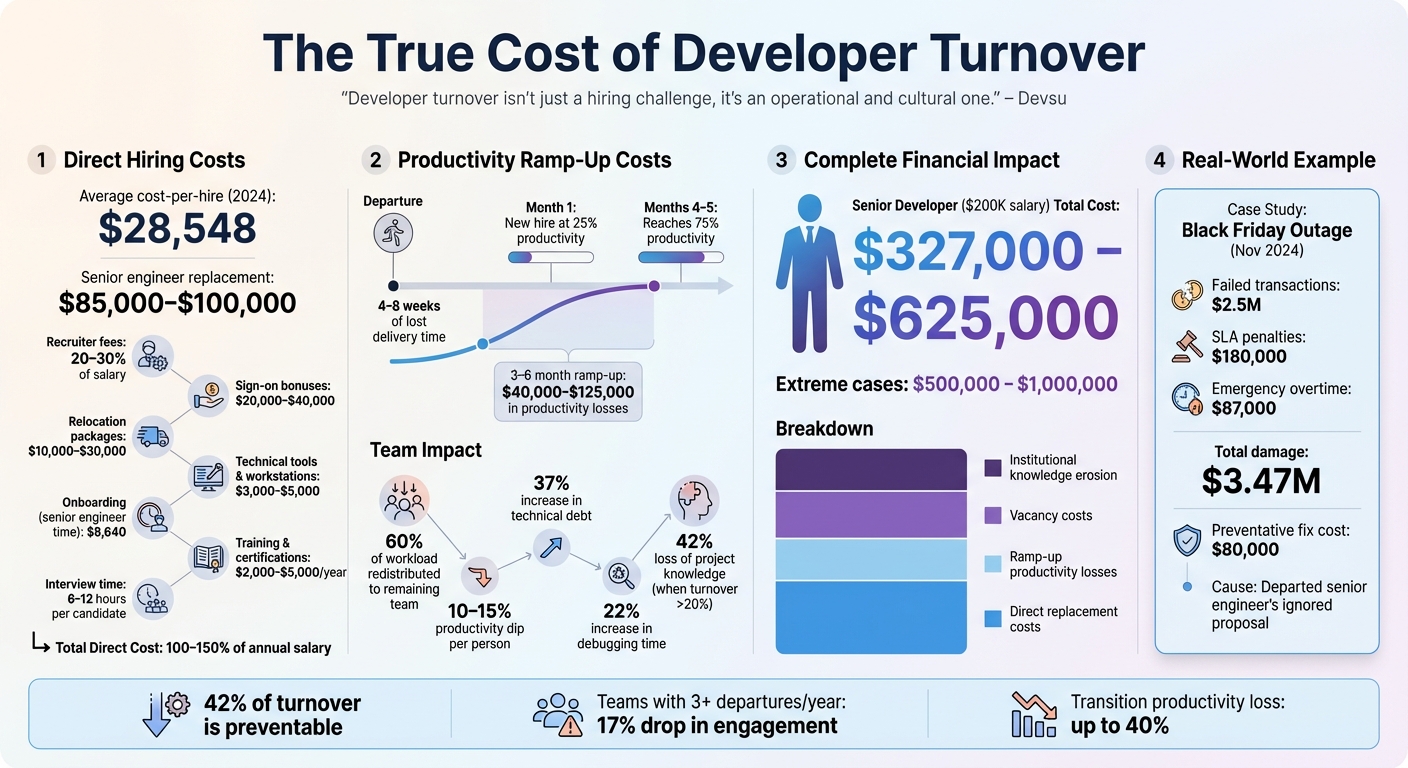 {The True Cost of Developer Turnover: Financial Impact and Hidden Expenses}
When a developer leaves, the financial impact is far greater than just the cost of posting a new job. Recognizing these expenses is crucial for making the case for retention strategies.
Direct Costs: Hiring, Onboarding, and Training
Replacing a developer is expensive. In 2024, the average cost-per-hire for developers reached $28,548 . For senior engineers earning $200,000 annually, direct replacement costs can soar to $85,000–$100,000 . These costs include recruiter fees (20–30% of the salary), sign-on bonuses ($20,000–$40,000), relocation packages ($10,000–$30,000), and technical tools such as assessment platforms and workstations ($3,000–$5,000 per developer) .
The expenses don’t stop there. Onboarding and knowledge transfer require about $8,640 of senior engineer time in the first three months. Add to that the $2,000–$5,000 spent annually on training and certifications per developer . Even the interview process demands significant internal resources, with senior engineers dedicating 6–12 hours per candidate . Altogether, replacing a specialized developer can cost 100% to 150% of their annual salary .
Lost Productivity: Ramp-Up Time and Knowledge Gaps
Losing a developer disrupts productivity in major ways. Teams often lose 4 to 8 weeks of delivery time after a departure . A new senior engineer typically operates at just 25% productivity in their first month, gradually improving to 75% by months 4–5 . During the 3- to 6-month ramp-up period, the resulting productivity losses can cost anywhere from $40,000 to $125,000, depending on the role .
The ripple effects don’t end there. About 60% of the departing developer’s workload is redistributed among the remaining team, causing a 10–15% productivity dip per person due to context-switching and burnout . High turnover also increases technical debt by 37% and debugging time by 22% compared to stable teams . Worse, when annual turnover exceeds 20%, companies may lose as much as 42% of project-specific knowledge . These setbacks make retaining developers even more pressing.
Damage to Employer Brand and Team Morale
The financial toll is only part of the story. High turnover can harm your company’s reputation as an employer and lower team morale. A stark example comes from November 2024, when a mid-sized payments processor faced a disastrous Black Friday outage. The issue stemmed from a deprioritized database sharding proposal by a senior platform engineer who had resigned four months earlier. The outage resulted in $2.5 million in failed transactions, $180,000 in merchant SLA penalties, and $87,000 in emergency overtime costs - totaling $3.47 million. The preventative fix? Just $80,000 .
Turnover can also create a downward spiral. Teams with more than three departures in a year see employee engagement drop by 17% . Remaining team members face heavier workloads and uncertainty, which can slash overall productivity by up to 40% during transitions .
"Developer turnover isn't just a hiring challenge, it's an operational and cultural one." – Devsu
When you add up direct replacement costs, vacancy costs, ramp-up productivity losses, and the erosion of institutional knowledge, losing a senior developer earning $200,000 can cost anywhere from $327,000 to $625,000. In some extreme cases, the total price tag can climb to $500,000–$1,000,000 per departure . These numbers underscore the importance of prioritizing developer retention.
This context lays the groundwork for understanding the reasons developers choose to leave.
Hiring engineers?
Connect with developers where they actually hang out. No cold outreach, just real conversations.
Why Developers Leave: Survey Data and Patterns
Survey data sheds light on why developers decide to move on, and it’s not just about money. Process failures and poor management often play a larger role. In 2025, only 25% of developers reported being happy in their current role , a slight improvement from 19% in 2024 . Meanwhile, nearly half (48%) described themselves as "complacent" , signaling they’re open to exploring better opportunities.
The reasons developers leave tend to follow familiar patterns across surveys. One study found that 62% of developers pointed to scope creep and unclear requirements as a top reason for leaving. Other major factors include late or unreliable payment (51%), micromanagement and lack of autonomy (48%), and limited opportunities for growth or learning (43%). Poor communication from leadership (39%) and excessive meetings (36%) also contribute significantly to turnover.
Interestingly, while only 15% of senior engineers cited salary as their main reason for leaving, 68% viewed it as an area needing improvement . This suggests that complaints about pay often surface when other frustrations - like feeling undervalued - have already taken root.
"Compensation isn't the primary driver of attrition, but it becomes a symbol of undervaluation when other factors are already problematic." – Toyez, Full-stack Engineer
Workflow inefficiencies add to the problem. About 53% of developers say waiting for answers to technical questions disrupts their productivity , while 30% report that knowledge silos slow them down at least 10 times per week . Over time, these frustrations push developers to seek roles where they can work more effectively.
Lack of Career Growth and Learning Opportunities
A lack of growth opportunities is one of the biggest reasons developers leave. According to survey data, 43% of developers cited the absence of a clear path for growth or learning as a top factor . Developers want to work on modern tech stacks, solve challenging problems, and grow their skills. When they’re stuck maintaining outdated systems without time to learn new technologies, many start looking for a change. In fact, 27% said that working with outdated or frustrating tech stacks was among their top reasons for leaving .
"Developers will accept a modest rate discount for genuinely stimulating technical problems - but they will not accept boredom at any price." – Yaseen Deen, Co-Founder, OctogleHire
The lack of defined career paths only makes things worse. When developers can’t see a clear progression from mid-level roles to senior or leadership positions, they often conclude that growth isn’t possible at their current company. This perception of stagnation aligns with broader survey trends showing widespread dissatisfaction.
Bad Management and Poor Communication
Management plays a huge role in whether developers stay or go. Almost half (48%) of developers cited micromanagement and lack of autonomy as key reasons for leaving , while 39% pointed to poor communication from leadership . Micromanagement can take many forms - constant monitoring, frequent overrides of technical decisions, or requiring developers to justify every minute of their time - and it often erodes trust.
Communication issues also lead to major problems. For example, unclear project requirements often result in scope creep, which 62% of developers identified as a top reason for leaving . When timelines or compensation don’t adjust to account for expanding workloads, developers can face a 40–60% increase in their responsibilities, leading to burnout.
The rise of asynchronous work has further exposed communication gaps. In 2026, 67% of developers preferred async-first workflows , but many companies still insist on daily synchronous meetings. In fact, 43% of developers said they would decline a job offer if it required daily standups outside their preferred hours . This mismatch, combined with excessive meetings, creates unnecessary friction and drives developers to seek more flexible environments.
Burnout from Tech Debt and Overwork
Technical debt and overwork are a recipe for burnout. Developers often find themselves stuck maintaining legacy systems or dealing with unresolved architectural issues instead of building new features. When companies fail to allocate time to address tech debt, the problem compounds, forcing developers to work longer hours to keep things running.
This creates a vicious cycle: technical debt leads to inefficiencies, which cause scope creep and overwork. Over time, developers become exhausted and less able to push back against unrealistic demands. Many eventually decide that finding a healthier technical environment is their only option.
Retention Levers Ranked by Impact
When it comes to keeping developers on board, not all strategies are created equal. Survey data reveals that 68% of developers leave due to limited growth opportunities, while only 42% cite compensation as a primary concern . This means engineering leaders need to focus on what truly matters instead of spreading their efforts too thin.
Here’s the ranking: career growth opportunities top the list, followed by technical challenges, management quality, compensation, and finally, work-life balance. Interestingly, only 15% of senior engineers leave primarily because of pay, but a significant 68% believe compensation could have been improved .
| Retention Lever | Impact Rank | Primary Driver |
|---|---|---|
| Career Growth | 1 | Mentorship, clear ladders, internal mobility |
| Technical Challenge | 2 | Autonomy, project rotation, innovation time |
| Management Quality | 3 | 1:1 feedback, technical leadership, trust |
| Compensation | 4 | Market alignment, transparency, bonuses |
| Work-Life Balance | 5 | Remote flexibility, mental health support |
These insights provide a roadmap for designing effective retention strategies, which are explored further below.
Career Growth Opportunities
Career growth is the single most important factor in retaining developers. They want a clear path forward - whether that means advancing to senior roles, mastering new technologies, or tackling bigger challenges. Without these opportunities, they’ll likely move on.
Take this example: between June and December 2024, a mid-size FinTech company with 65 developers introduced a structured retention plan. They implemented a seven-level engineering career ladder, allocated 15% of work hours for innovation, and adjusted salaries to match market rates twice a year. The results? Their annual turnover rate dropped from 35% to 14%, and career growth satisfaction soared by 86% .
The takeaway is clear: developers need structured career paths that allow them to grow without being forced into management roles. This includes dual career ladders, mentorship programs, time for skill-building, and opportunities to work on challenging projects.
"I don't worry if they stay with us. If they're growing, that's good enough. But if they're growing with us, they'll likely stay with us." – Savio Lobo, CIO at Ensono
Competitive Compensation Structures
Pay alone won’t keep developers, but underpaying them is a quick way to lose their trust. Compensation ranks fourth in impact but functions as a "hygiene factor" - its absence creates dissatisfaction, but its presence isn’t enough to build loyalty by itself.
Transparency is critical. 73% of developers say salary transparency is the most important factor when considering a new role . Open salary ranges build trust, while regular benchmarking - ideally twice a year - prevents pay from falling behind the market. Without this, developers might discover they could earn 20-30% more elsewhere. In fact, 82% of employees would leave their current job for better pay or benefits .
Compensation issues often become a tipping point when they’re paired with other frustrations, like a lack of growth or poor management. At that stage, pay becomes a symbol of deeper organizational problems.
Perks and Work-Life Balance
Work-life balance has shifted from being a bonus to a baseline expectation for developers. Today, 89% of developers prefer fully remote work, and only 4% are interested in returning to an office full-time . Beyond remote setups, developers value asynchronous communication and respect for their time zones.
67% of developers favor async-first workflows, and 43% would turn down a role requiring daily standups outside their preferred hours . This approach not only protects focus time but also helps prevent burnout. Studies show that 62% of tech employees experience chronic stress from excessive workloads or unclear boundaries . Teams that enforce work-life boundaries report 21% lower attrition rates and 32% higher productivity .
Perks like mental health programs and flexible schedules are most effective when paired with strong career growth opportunities and fair pay. By 2026, 85% of employees will value their well-being as much as their salary , making it clear that organizations need to prioritize both areas to keep their teams happy and engaged.
Engineering Manager's Retention Toolkit
Turning retention strategies into actionable steps is where engineering managers can make a real difference. Three key practices stand out: consistent 1:1 meetings, clear career progression paths, and giving developers real ownership of their work.
Regular 1:1 Meetings for Feedback and Support
Regular 1:1 meetings are one of the most effective ways to keep developers engaged. In fact, employees who have routine 1:1s with their managers are nearly three times more likely to feel engaged at work . But the value of these meetings depends on how they're conducted.
The biggest pitfall? Turning 1:1s into status updates. Those updates are already covered in stand-ups and trackers, so use this time to tackle challenges, address frustrations, and streamline workflows . Let the developer set the agenda. A helpful structure, like the 10/10/10 framework, divides a 30-minute session into three parts: 10 minutes for the developer’s topics, 10 minutes for the manager’s, and 10 minutes for career-focused discussions .
Active listening is non-negotiable. Techniques like paraphrasing can help ensure clarity and build trust. For longer 60-minute sessions, remember that deeper issues often surface only after 20–30 minutes . Rushing through these conversations can mean missing critical insights. Create a safe space where developers feel comfortable admitting mistakes without fear of judgment.
"The single most impactful thing you can do to improve performance and retention across your team is to hold routine 1:1 (one-on-one) meetings." – Peter Inge, Engineering Leadership Expert
Consistency is more important than perfection. Skipping a bi-weekly meeting can push it to a monthly cadence, which is too infrequent in fast-paced environments . To maximize value, review recent stand-up notes and active tickets beforehand to identify recurring issues . During the meeting, take notes and follow up on agreed action items. Neglecting these meetings risks missing early signs of dissatisfaction or burnout .
Clear Career Ladders
Developers need to know where their careers are headed. A lack of clarity can lead to frustration - 52% of employees who leave voluntarily believe their departure could have been prevented by their manager or company . Career ladders provide transparency and prevent developers from feeling forced into management roles to advance.
The key is to distinguish between individual contributor (IC) and management tracks. Engineering management should be seen as a parallel career path, not a promotion . This approach allows ICs to grow without feeling pressured into leadership roles just to gain recognition or higher pay. Both tracks should offer comparable compensation and clearly defined titles that reflect experience and tenure .
For smaller organizations with limited vertical growth, consider a "growth lattice" approach. This allows lateral moves to build new skills - like a backend developer spending a quarter with the infrastructure team . Even in startups with lean structures, outline specific milestones that demonstrate how staying with the company leads to increased expertise and influence.
Stay interviews can help gauge how well career paths are communicated. Questions like, "Do you feel you have a clear growth path?" or "What skill would you like to develop in the next six months?" can provide valuable insights . Managers should transition from oversight to sponsorship, actively seeking out projects that challenge and expand a developer’s abilities .
"Not view engineering management as a promotion, but as a career path that runs in parallel with individual contributors." – Matthew Bill, Technology Leader
Project Ownership and Autonomy
Career clarity is crucial, but giving developers real ownership of their projects takes engagement to another level. This approach ties into broader strategies of autonomy and professional growth. Start by defining the "what" - the desired outcome. Then, let developers figure out the "how."
For example, in March 2025, Dalia Abuadas, a Software Engineer at GitHub, used a 1:1 to express her interest in leadership and mentorship. Her manager assigned her to co-lead a project with an intern, focusing on building an internal tool for enterprise configuration details. This assignment gave Abuadas both technical ownership and the chance to mentor a peer, aligning her personal goals with the company’s needs .
Managers should act as facilitators rather than decision-makers. When engineers face trade-offs - like whether to refactor now or later - prompt them to explain how each option aligns with business goals. The "Three Circles of Impact" framework can help frame discussions by showing how individual work contributes to three areas: Individual Contributions, Collaboration, and Enabling Others .
Resist the urge to second-guess decisions that fall within acceptable boundaries, even if you would have approached things differently. Trust is built when developers see their decisions respected. Periodically review how project assignments align with engineers’ growth objectives.
"Your manager can't debug what they don't see." – Dalia Abuadas, Software Engineer, GitHub
The Stay Interview: Catching Flight Risk Before the Resignation
Stay interviews are a proactive way to address potential retention issues before they escalate into resignations. Many engineering leaders don’t realize they have a problem until resignation letters start landing on their desks. By then, the decision to leave was likely made months earlier . Stay interviews flip the script by opening a dialogue with team members while they’re still engaged, aiming to identify and resolve concerns early.
Unlike exit interviews, which focus on feedback after an employee has already quit, stay interviews are forward-looking, one-on-one conversations. These sessions explore why an employee chooses to stay and what factors might push them to leave . Timing is key - conducting these interviews twice a year, separate from performance reviews, encourages open and honest feedback.
The stakes are high. Research shows that 52% of employees who voluntarily leave believe their departure could have been prevented if their manager or company had taken action sooner . For senior developers, whose replacement costs can climb to $300,000, addressing potential flight risks early isn’t just good leadership - it’s a smart financial move . Below are practical tips and questions to help you make stay interviews effective.
Questions to Ask in a Stay Interview
The goal of a stay interview is to uncover what keeps your team members engaged and what might cause them to reconsider their role. Structure the conversation to start on a positive note, explore areas of concern, and end with a focus on the future.
Role and Energy:
Ask questions like, "What do you look forward to most when starting your work week?" and "Which parts of your role energize you, and which feel draining?"Growth and Learning:
Explore their aspirations by asking, "What skills or knowledge areas would you like to develop that you haven’t had the chance to yet?" and "How do you stay current with technology?"Retention Risk:
Prompt future-focused thinking with, "If you imagine yourself here in two years, what would make that exciting rather than just tolerable?" and "What might cause you to start looking for other opportunities?"Manager and Culture:
Get insights into their experience by asking, "What does your manager do that helps you succeed, and what could be improved?" and "Do you feel your expertise is valued when technical decisions are made?"Compensation:
Address sensitive topics later in the conversation with questions like, "On a scale of 1–10, how fairly do you feel rewarded for your work?" and "Have you received external offers that made you question your compensation?"
Keep the session focused with 5–10 well-chosen questions to avoid overwhelming the employee. Pay attention to subtle shifts in language - if they start saying "you" instead of "we", it could signal a growing disconnection from the team.
"Stay interviews are low-hanging fruit that can be used to mitigate dissatisfaction, disengagement, and ultimately, departure." – Lisa Brown Alexander, President and CEO, Nonprofit HR
Turning Feedback into Action
Listening is only the first step; acting on the feedback is where the real work begins. Ignoring what employees share can quickly erode trust and make the process feel like an empty gesture . Developers are quick to spot when promises don’t lead to action.
Within a week of the interview, create and share a formal action plan, outlining specific steps, resources, and a timeline to address the feedback . Follow up within three to six months to check on progress. A simple question like, "We agreed to work on X - how’s that going?" shows that you’re serious about making improvements. These follow-ups help ensure the interview isn’t a one-off event but part of an ongoing effort to enhance engagement.
Wrap up each stay interview by summarizing the employee’s reasons for staying and setting a clear follow-up date .
"The simple act of conducting a stay discussion can boost a team member's engagement because of the time and attention their leader is investing in them." – Christine Render, CEO, ScaleUp Coaching & Consulting
When to Let Go: Healthy Attrition vs. Toxic Retention
While efforts to retain top talent are essential, knowing when to let someone go is just as important. Not all turnover is bad. In fact, the software engineering industry typically sees annual turnover rates of 23% to 25%, but those numbers don’t tell the whole story . For instance, a company shedding underperformers and replacing them with stronger hires could be thriving with a 25% turnover rate. However, if that same percentage reflects the departure of top performers, it signals a serious problem .
It’s critical to distinguish between functional turnover - departures that benefit the team - and dysfunctional turnover, which involves losing key talent. For example, if a developer consistently undermines existing codebases or advocates for unnecessary rewrites instead of incremental improvements, their departure may actually improve long-term team stability . Similarly, developers who resist feedback, harbor negativity about past teams, or avoid collaboration can hold everyone back .
On the flip side, problems arise when companies hold onto disengaged employees. Toxic retention - keeping developers who have mentally checked out - can harm a team more than letting them go. These employees may meet minimum expectations but lack enthusiasm, often creating a "death spiral" where others have to pick up the slack, leading to burnout . Relying on counter-offers to retain employees is another pitfall. Such offers fail to address underlying issues and are only effective 30% of the time for retaining employees beyond 12 months .
Recognizing Healthy Turnover
Sometimes, departures can strengthen a team. For instance, consulting or contracting firms often expect turnover rates of 20% to 40%, which are factored into their business models . In companies undergoing rapid shifts - such as changing direction every six months - low retention may actually reflect necessary realignment rather than dysfunction .
Certain warning signs can indicate that a departure might be beneficial. Within the first 90 days, watch for behaviors like avoiding documentation, skipping meaningful participation in code reviews, or rushing solutions without proper analysis . Developers who focus solely on salary and benefits during interviews, without asking about architecture or growth opportunities, may also not be a good fit . While replacing a senior developer can cost around $300,000 , keeping the wrong person can lead to even greater expenses in technical debt and damaged team morale.
Healthy turnover creates opportunities for fresh ideas, new skills, and career growth for remaining team members . It’s a natural part of career progression and can help prevent stagnation when managed well.
Signs of Toxic Retention Practices
Toxic retention occurs when employees who should leave are kept on board. One clear indicator is disengagement - developers who stop discussing career growth, remain silent in meetings, or shift from saying "we" to "you" when referring to the team .
Another warning sign is when a senior engineer suddenly produces a burst of comprehensive documentation after previously doing it gradually. This often signals they’re preparing for a handover before leaving . Additionally, developers requesting salary increases of more than 25% are 156% more likely to leave soon after, suggesting that further retention efforts might be a lost cause .
"The real issue isn't that developers leave - it's that leaders miss the signals until it's too late. By then, your developer has already mentally checked out." – Mike Tempest, Engineering Leadership Consultant
These situations often highlight deeper retention problems. In fact, 52% of employees who left voluntarily said their departure could have been prevented by better management or organizational practices . However, addressing these issues requires tackling root causes, not just offering higher salaries.
Knowing when to let go is a key step in building better hiring strategies and improving overall retention.
How Better Hiring Reduces Turnover with daily.dev Recruiter
Getting hiring right from the start is just as important as having solid retention strategies. In fact, many retention issues take root before a candidate even accepts the job. When developers step into roles that don't align with their passions, technical expertise, or career goals, they're more likely to leave early. The numbers back this up - nearly 70% of developers leave their jobs before hitting the two-year mark . To tackle this, it's essential to rethink how candidates are sourced and engaged from day one.
Warm, Double Opt-In Introductions
Cold outreach often does more harm than good. Generic, automated messages sourced from outdated profiles tend to alienate developers, leaving them uninterested - or worse, with a negative impression - before any real conversation begins. daily.dev Recruiter eliminates this issue with its double opt-in introductions. This approach ensures that both the developer and the employer express mutual interest before any interaction takes place.
This method weeds out poor fits early on. Instead of wasting time on screening calls with candidates who aren’t genuinely interested, you’re connecting with developers who have already shown intent. These introductions happen within the daily.dev community, a space where over 1 million developers already engage, learn, and collaborate. Reaching developers in this trusted environment - rather than disrupting them with a cold email - lays the groundwork for trust right from the start.
This model is particularly effective for engaging passive candidates, such as senior engineers who aren’t actively job hunting but remain open to the right opportunity. When you approach them with relevant roles on a platform they trust, you're far more likely to find hires who are aligned with your team’s needs and willing to stick around for the long haul.
Behavioral Matching for Better Fit
Resumes alone don’t tell the whole story. A developer’s actions - what they read, the projects they work on, and the technologies they explore - offer far better insights into whether they’ll thrive in a particular role. daily.dev Recruiter uses data from developers’ platform activities to match them with roles that align with their technical interests and career goals.
This behavioral matching goes beyond the surface-level filtering of job titles or years of experience. Instead, it focuses on what developers are actively learning and building. For instance, a backend engineer who frequently reads about distributed systems and contributes to open-source infrastructure projects is likely a stronger candidate for a microservices role than someone whose resume simply lists "5 years backend experience."
Aligning candidates with roles they’re truly excited about leads to longer tenure. Developers who are passionate about the technologies they work with are far less likely to leave early. This alignment also saves money - replacing an employee typically costs the equivalent of 6 to 9 months of their salary . Beyond the financial impact, each departure can delay projects by 4 to 8 weeks .
Developer-Friendly Hiring Practices Build Trust
A transparent hiring process lays the foundation for loyalty after the hire. Sharing clear details about your tech stack, team culture, and challenges upfront allows developers to assess their fit before they accept an offer. This openness helps avoid the all-too-common "bait and switch" scenarios that drive early resignations.
daily.dev Recruiter encourages this transparency with developer-focused job briefs. These briefs emphasize technical details and growth opportunities, steering clear of vague corporate jargon. When developers know exactly what they’re signing up for, the risk of mismatched expectations drops significantly.
Respecting developers' time is equally important. Avoiding mass-messaging and generic outreach shows that you value their expertise. This approach not only improves the candidate experience but also strengthens your employer brand. High turnover rates can lead to 37% more technical debt , a costly burden that grows over time. Starting with the right hire helps prevent this downward spiral. By aligning candidates with roles that suit them from the beginning, you set the stage for better retention and stronger teams.
Conclusion
Keeping developers on your team requires a combination of technical hiring best practices, effective management, and clear paths for career growth. When these pieces come together, turnover drops. But if even one is overlooked, you could find yourself stuck in a costly cycle of constant replacements.
Replacing a mid-level developer can cost anywhere from $85,000 to $150,000, while senior-level roles may climb as high as $300,000. Each departure not only sets projects back by 4 to 8 weeks but also increases turnover risk by 9% to 13% and adds 37% more technical debt to your plate .
To counter these challenges, focus on proactive measures: conduct stay interviews, create clear career progression paths, and regularly evaluate compensation. Dedicate 10% to 20% of engineering time to innovation or reducing technical debt - a small investment compared to recruitment costs. For perspective, a $3,500 laptop is a drop in the bucket compared to the $28,000 to $36,000 it takes to replace a single developer .
Retention isn’t just about keeping your current team happy; it starts long before the offer letter. Hiring developers who align with your tech stack and are genuinely excited about your mission reduces early exits. Tools like daily.dev Recruiter help connect you with candidates who are the right fit from the start. When developers step into roles that resonate with them, they’re far more likely to stick around.
The best companies treat retention as an ongoing strategy. They measure turnover, address team pain points, and adapt as their teams grow. When you combine smart hiring, thoughtful management, and focused retention efforts, your team won’t just stay - they’ll thrive and deliver consistently.
FAQs
What should I measure to predict developer turnover?
To anticipate developer turnover, keep an eye on behavioral cues such as decreased participation in projects, a noticeable drop in enthusiasm, or disengagement during one-on-one discussions. Additionally, exit interviews can shed light on recurring reasons for departures, including ineffective management, lack of advancement opportunities, or burnout. Spotting these trends early allows companies to take proactive steps to retain their most skilled team members.
How do I build a career ladder for a small engineering team?
When structuring a career path for a small engineering team, simplicity is key. Focus on creating a framework with clear roles and progression paths that align with your team’s size and needs.
A straightforward approach might include just a few levels, such as:
- Intern
- Junior Engineer
- Tech Lead
This keeps things manageable and avoids unnecessary complexity. For each role, document the responsibilities, skills, and criteria for advancement so team members understand what’s expected at each stage.
Additionally, consider offering dual career tracks - one for those interested in management and another for those who want to focus on deepening their technical expertise. This approach promotes transparency, supports individual growth, and ensures that career development aligns with your team’s overall goals.
How often should managers run stay interviews?
Managers should aim to hold stay interviews every 6 to 12 months. Many experts recommend conducting them either annually or twice a year to consistently gather insights about employee satisfaction and retention. Sticking to a regular schedule allows managers to address potential issues early and encourages open, ongoing communication.
.png)