Hiring developers doesn’t have to be a scramble. A well-built talent pipeline ensures you’re always ready to fill roles with skilled candidates. The key? Focus on building relationships with developers before you need to hire.
Key Takeaways:
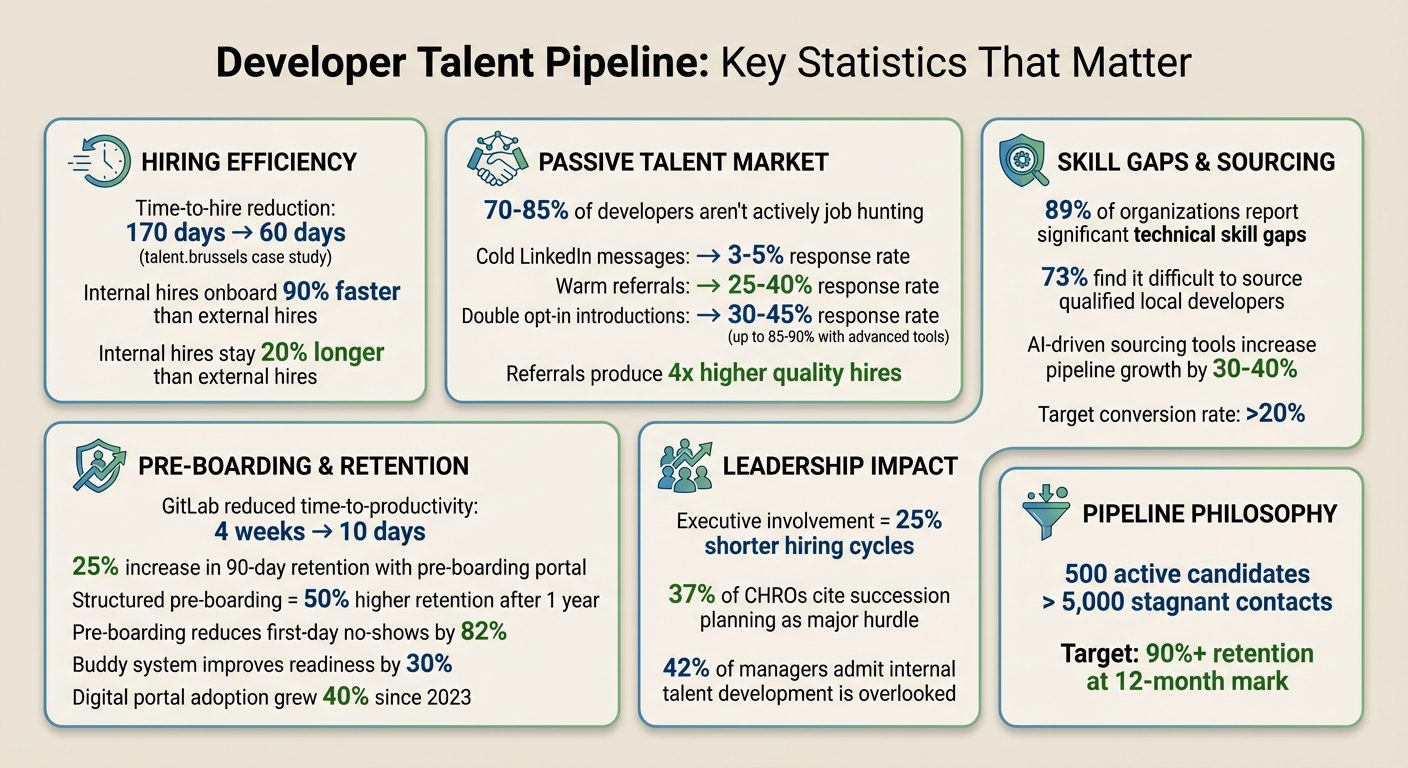
- Time-to-Hire Improvements: Companies like talent.brussels cut hiring time from 170 to 60 days by simplifying processes.
- Passive Talent is Gold: 70-85% of developers aren’t actively job hunting but could be open to the right opportunity.
- Smaller, Engaged Pipelines Work Better: A focused pool of 500 active candidates outperforms a stagnant list of 5,000.
- Retention Matters: Every retained engineer saves you the cost of hiring and training someone new.
This guide covers strategies for planning, sourcing, nurturing, evaluating, and retaining top developer talent. By prioritizing meaningful engagement and streamlined processes, you can reduce hiring stress and build a stronger team.
1. Pipeline Planning
Map Your Talent Needs to Business Goals
To build an effective hiring strategy, start by aligning your talent needs with your business goals. For example, if you’re planning to launch a mobile app in Q4 2026, don’t wait until the project begins to look for iOS and Android developers. Begin building your pipeline now. This forward-thinking approach ensures smoother sourcing and stronger candidate relationships later in the process.
Start with a skills gap analysis. Compare your team’s current capabilities to the requirements of upcoming projects. Go beyond formal job descriptions - talk to your top performers to learn which tools and frameworks they rely on daily. These insights often reveal gaps that aren’t immediately obvious. According to research, 89% of organizations report significant technical skill gaps, and 73% find it difficult to source qualified local developers .
"Talent leadership belongs to those who look ahead and plan for the future." - Paul White, Executive Consultant
Once you’ve identified your needs, prioritize roles based on urgency. Break them into three categories: "Ready-Now" for immediate hires, "Warm" for roles needed in 3–6 months, and "Nurture" for longer-term prospects. This structure helps you allocate resources effectively - use direct outreach for urgent roles, maintain personalized communication with warm candidates, and share educational content to nurture long-term prospects. Make it a habit to update developer personas quarterly with input from your engineering teams.
Recruitment is increasingly shifting toward "Talent Architecture" - a long-term, strategic approach rather than reactionary hiring . Build and maintain standardized talent pools for key technical areas like DevOps, Machine Learning, or Backend Systems. These pre-vetted pools ensure you’re ready to fill critical roles when the need arises.
2. Sourcing Strategies
Build Dual-Track Sourcing: Internal Mobility Plus External Passive Talent
The best developer pipelines come from two main sources: your current team and passive external candidates. Internal sourcing involves spotting top talent already on your payroll. Tools like succession planning and talent management systems can help identify developers with high potential. According to Gartner, internal hires onboard 90% faster and stay 20% longer compared to external hires . If your company is moving into areas like AI or cloud computing, look for team members who’ve shown interest in these fields. Offer them tailored development plans, complete with mentorship opportunities. But don’t stop there - external talent is equally crucial.
For external sourcing, focus on passive candidates - those who aren’t actively job hunting but might be intrigued by the right opportunity. Start with market mapping: create a database of 50-100 technical profiles from competitors by analyzing LinkedIn and org charts . Attend industry events like AWS re:Invent to meet potential candidates face-to-face. AI-driven tools can also help match specific skills, like React or DevOps, to your needs, potentially increasing your pipeline growth by 30-40% .
When reaching out, the approach matters. Cold LinkedIn messages typically get a 3-5% response rate, but warm referrals see 25-40% . Rather than jumping straight to a call, send a short document outlining the role or the technical challenges involved . Tools like daily.dev Recruiter use double opt-in introductions, ensuring candidates engage only when genuinely interested. This method boosts response rates to 30-45% .
"Proactively build relationships - engage early, network continuously, and use data to anticipate needs; treat candidates as people, and they'll reach back." - Erika Torres, Cornerstone
To refine your strategy, track metrics like conversion rates (the percentage of candidates hired, aiming for over 20%), pipeline velocity (how quickly candidates move through stages), and source effectiveness . Referrals are especially effective, producing hires of 4x higher quality compared to other channels . Review these metrics every quarter to focus on what’s working and eliminate underperforming sources.
3. Candidate Nurturing
Shift From Generic Updates to Personalized Technical Value
When it comes to nurturing developers, the focus should be on delivering role-specific technical content that resonates with their expertise. For instance, a backend engineer might find value in discussions about scaling distributed systems, while a frontend developer could benefit from insights on optimizing React 18 performance. Using the dual-track sourcing method, candidates can be segmented into three groups: Ready-Now, Warm, and Nurture.
Each group requires a tailored approach. Warm candidates should receive personalized updates, such as check-ins or invitations to relevant events. Ready-Now candidates are best suited for immediate outreach and interview scheduling. Meanwhile, Nurture contacts should be engaged with quarterly technical insights, product news, or occasional event invites. Striking a balance is key - updates every two to four weeks keep you on their radar without overwhelming them. These tailored efforts ensure candidates stay engaged and prepared to move forward in the hiring process.
While automation can streamline communication, personalization remains critical. Use dynamic tokens like a candidate's GitHub handle or recent project achievements to make your outreach feel genuine. Tools like daily.dev Recruiter leverage a double opt-in system that significantly boosts response rates - up to 85–90%, compared to the usual 10–15% .
Every message should include the "Big Three":
- Tech stack (e.g., React 18, Go, Kubernetes)
- Salary range (e.g., $140,000–$170,000)
- Work model (remote or hybrid)
This transparency builds trust and credibility with candidates. For those with high seniority or niche skills, complement automated outreach with quarterly manual check-ins to maintain a personal connection. Additionally, keep top-tier candidates who weren’t immediately selected engaged through updates about new projects or technical challenges. This approach transforms recruitment from a one-off interaction into a trust-driven, long-term relationship, ensuring candidates are primed for evaluation when the right opportunity arises.
4. Evaluation Methods
Replace One-Time Interviews With Continuous Assessment
Building a strong developer talent pipeline means shifting from one-off interviews to ongoing, lighter assessments throughout the candidate journey. This approach allows you to gauge candidates at multiple stages. For example, you can evaluate past project achievements, gather input from team leaders, and conduct early skills tests. From there, candidates can be categorized into tiers like "ready now" for immediate roles, "ready in 6–12 months" for those who need minor development, "high potential" for leadership roles down the line, or "not ready" . These continuous assessments naturally set the stage for more structured evaluation strategies.
Just as personalized candidate nurturing keeps pipelines fresh, structured evaluations ensure relevance. Start with success profiles that go beyond generic job descriptions. Pinpoint key competencies like coding expertise or problem-solving, factor in applicable experience such as delivering scalable projects, and consider candidate motivations that align with long-term success. For internal candidates, set up regular check-ins with questions like, "Does this talent pool still align with your goals?" or "Is this the best career path for you?" Research from Gartner shows that internal hires tend to ramp up faster and stay longer compared to external hires .
Once you've established these criteria, track progress through measurable performance metrics. Keep an eye on indicators like pipeline velocity, conversion rates, and quality of hire, which includes performance and retention outcomes. Review these metrics monthly and adjust your criteria quarterly to ensure they remain effective . By following these methods, you can maintain a high-performing, high-conversion developer talent pipeline.
5. Leadership Involvement
Make Talent Pipeline Strategy an Executive Mandate
Getting leadership involved in developer recruitment turns it into more than just a hiring process - it becomes a strategic advantage. When executives take ownership of talent planning, companies see faster hiring and better candidates. For example, businesses that involve leadership in their talent strategies report hiring cycles that are 25% shorter and improvements in candidate quality.
One effective approach is making talent a standing item on leadership agendas. This means executives regularly review topics like team strength, progress in employee development, and potential risks to their talent pool - right alongside revenue goals and product strategies. Quarterly reviews can keep everyone accountable. However, a disconnect often exists: 37% of Chief Human Resource Officers (CHROs) say succession planning is a major hurdle, while 42% of managers admit internal talent development is overlooked . This problem usually stems from isolating talent discussions from broader strategic plans.
Leaders should also take an active role in recruitment. T-Mobile offers a great example, training its leaders to act as "gatekeepers of their succession plans." They focus on identifying high-potential female and minority candidates, even if those individuals aren’t within the typical three-to-five-year readiness range . Senior leaders can further engage by participating in technical discussions with "Ready-Now" candidates or appearing in company vlogs. These actions not only personalize the employer brand but also show a strong commitment to building a thriving developer pipeline.
When executives champion talent development, it sends a clear message: nurturing talent is critical to business success. Leaders who advocate for high-potential employees by giving them stretch assignments and big opportunities help create a culture where building the talent pipeline is everyone’s responsibility. By involving leadership at every stage, the pipeline transforms into a well-aligned, strategic resource.
6. Pre-boarding Practices
Use a "Developer Welcome Portal" for Pre-Boarding
The time between offer acceptance and the first day can often lead to a loss of enthusiasm and momentum. However, in Q2 2024, GitLab tackled this issue with a pre-boarding portal, cutting developer time-to-productivity from four weeks to just 10 days. This initiative, led by Head of Talent Acquisition Elena Martinez, also resulted in a 25% increase in 90-day retention among 150 new engineers . Pre-boarding practices like these bridge the gap, keeping new hires engaged and prepared for a strong start.
A solid pre-boarding strategy kicks off with a welcome packet sent within 24 hours of offer acceptance. This packet should include an employee handbook, a team org chart, a developer reading list, and a detailed Day 1 agenda . Additionally, providing read-only access to relevant repositories and setup checklists - such as Docker installations, IDE configurations, and internal tool documentation - can help developers get a head start on their technical environment.
Pairing new hires with a "buddy" for weekly check-ins is another effective step. This buddy system, which covers tools, projects, and company culture, has been shown to improve readiness by 30% while fostering a sense of connection before day one . Virtual coffee chats with teammates and the hiring manager also go a long way in introducing current projects and answering technical questions. These efforts not only keep new hires engaged but also lay the groundwork for better long-term retention.
According to Gartner, companies with structured pre-boarding programs experience 50% higher retention rates after one year . Additionally, proactive engagement through pre-boarding reduces first-day no-shows by a staggering 82% . For remote developers, digital portals featuring personalized learning paths and tech stack familiarization have become increasingly important, with adoption of such tools growing by 40% since 2023 .
When done right, pre-boarding turns potential hires into fully engaged team members, ready to contribute from day one.
7. Retention Frameworks
Build a Proactive Retention System That Prevents Turnover Before It Starts
Most companies act only after an employee resigns, but by then, the decision to leave was likely made months earlier. A strong retention framework focuses on prevention, not reaction, by addressing five critical areas: competitive pay, clear career growth opportunities, effective management, engaging work, and a positive workplace environment .
One effective strategy is conducting quarterly or semi-annual stay interviews. These conversations explore what motivates developers to stay and what changes could enhance their experience. The key is acting on their feedback - when employees feel ignored, the risk of losing them increases .
Career growth is another area that requires careful planning. Providing dual career paths allows engineers to grow as individual contributors without feeling pressured to move into management roles. Regular compensation reviews are also essential to avoid salary compression - when new hires earn more than long-time employees in similar roles. Beyond pay and promotions, allocating time to reduce technical debt and improve tools can ease daily frustrations, helping developers feel more connected to their work and proud of their contributions .
These actions integrate retention efforts into a broader talent pipeline strategy, ensuring smoother transitions and long-term success.
"Every engineer retained is a hire you didn't need to make - and a knowledge repository you didn't lose." - daily.dev Engineering Retention Guide
Conclusion
Building a developer talent pipeline is all about prioritizing quality relationships over sheer numbers. By maintaining a network of pre-qualified engineers who have had at least two recent, meaningful interactions, you can sidestep the stress that comes with last-minute hiring demands .
"Developing a strong talent pipeline means proactively building relationships - engage with potential candidates early, continuously network within the industry, and leverage data-driven insights to anticipate future hiring needs before they arise." – Erika Torres, Cornerstone
The secret isn't in the size of your database but in how quickly you can turn engaged candidates into hires. A well-maintained pool of 500 active prospects will always outperform a stagnant list of 5,000 outdated contacts . By focusing on a smaller, engaged group, you not only reduce hiring risks but also speed up the hiring process - especially when those efforts lead to retention rates exceeding 90% at the 12-month mark .
FAQs
What makes a developer talent pipeline actually work?
A thriving developer talent pipeline hinges on thoughtful, tailored outreach that prioritizes building trust. To make this work, start by engaging developers on platforms they already frequent. Skip the generic, spam-like messages - nobody likes those - and always get their consent before reaching out.
Keep the connection alive by staying involved through regular communication, participating in developer communities, and sourcing talent from spaces where developers are actively engaged. Combining proactive sourcing with genuine trust-building is the key to attracting and keeping top-tier talent.
How do I keep passive developers engaged without spamming them?
To connect with passive developers without coming across as intrusive, focus on personalized and respectful communication. Craft messages that specifically reference their skills, projects, or interests - steering clear of generic mass outreach.
Earn their trust by sharing relevant technical insights and actively participating in developer communities. Use opt-in channels that align with their preferences, ensuring they feel in control of the interaction. Platforms like GitHub or LinkedIn are excellent for initiating connections, as they provide a professional and trusted environment. This approach not only minimizes the risk of overwhelming them but also lays the foundation for meaningful, long-term relationships.
Which metrics best show if my recruiting pipeline is improving?
To gauge how well your recruiting pipeline is working, focus on these key metrics:
- Time-to-fill: Measures how long it takes to fill a position from the moment it opens. A shorter time often indicates a more efficient process.
- Candidate quality: Tracks the suitability of candidates for the roles you're hiring for, often measured by post-hire performance or retention rates.
- Offer acceptance rates: Shows the percentage of candidates who accept job offers, reflecting the competitiveness of your offers and the appeal of your company.
- Conversion rates: Examines how candidates move through each stage of the recruiting funnel, helping you identify bottlenecks or areas for improvement.
By keeping an eye on these metrics, you can better understand your pipeline's efficiency and make adjustments to improve results.
.png)