

Developers are prioritizing AI, cloud computing, and security skills in 2026. Here's why it matters:
- AI Proficiency: 95% of companies now factor AI skills into hiring decisions. Tools like LangChain and Anthropic's Claude are in high demand, with AI assistants contributing up to 48% of code for heavy users.
- Cloud Skills: Platforms like Microsoft Azure (+131% interest) and AWS (+89%) remain critical as 64% of developers rely on cloud-based environments.
- Security and Data Engineering: Security management interest grew 164%, and secure coding practices increased 102%. Data preparation and validation are also key as AI adoption expands.
- Learning Trends: 69% of developers learned a new language or skill last year, and 40% plan to change jobs within a year for better skill development opportunities.
For hiring, focus on specific skills, practical coding challenges, and career growth opportunities to attract top talent. Developers value learning, flexibility, and roles that align with their growth goals.
Key takeaway: Developers are evolving fast - your hiring process should too.
::: @figure 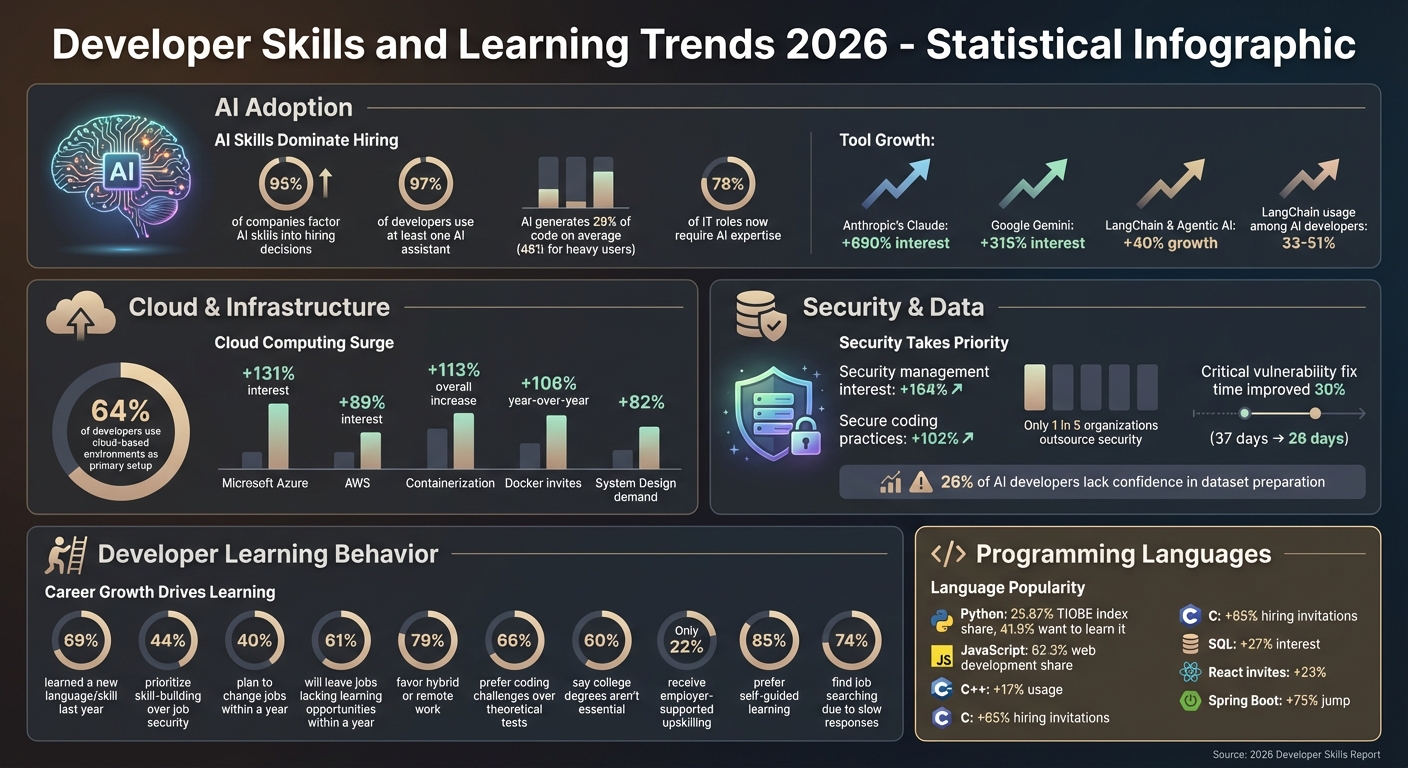 {2026 Developer Skills Trends: AI, Cloud, and Security Statistics}
What Developers Are Learning in 2026
Python now commands a 25.87% share on the TIOBE Index, with 41.9% of developers eager to learn or work with it . Its versatility is fueling advancements in fields like natural language processing (NLP), computer vision, and recommendation systems. As Evgenia Verbina from JetBrains explains:
"Python drives innovation in areas like natural language processing, computer vision, and recommendation systems... it offers support at every stage of the process, from prototyping to production."
While Python takes center stage, developers are also focusing on infrastructure skills. 64% of developers now rely on cloud-based environments as their primary setup . This shift to remote development is no longer just a passing trend - it's become the norm. Python's role in AI and cloud computing highlights the growing demand for expertise in these areas.
AI and Machine Learning Skills
AI tools are transforming how developers work. 97% of developers now use at least one AI assistant, with AI generating an average of 29% of their code - and up to 48% for heavy users . This has sparked interest in AI orchestration tools, with Agentic AI and LangChain seeing a 40% growth in popularity as developers focus on building applications powered by large language models (LLMs) . Usage rates for LangChain and Ollama among AI developers range from 33% to 51% .
The focus isn't just on frameworks; developers are also diving into the languages that underpin AI infrastructure. C++ usage increased by 17%, and C saw a 65% rise in hiring invitations , driven by their importance in GPU programming with CUDA and optimized inference runtimes. Additionally, SQL interest surged by 27% , as its role in managing AI data infrastructure and training models becomes more apparent.
As AI reshapes coding, the need for solid cloud infrastructures to support these innovations has become more pressing.
Cloud Computing and DevOps Expertise
Cloud-native tools are seeing rapid adoption. Interest in containerization has doubled, with a 113% overall increase . Docker, in particular, experienced a 106% growth in invites year-over-year , reflecting the shift toward microservices and AI-driven workloads that require scalable solutions.
Terraform remains the leader in Infrastructure as Code, but OpenTofu - a Linux Foundation-backed fork - is gaining traction in enterprises following changes to HashiCorp's licensing . Meanwhile, demand for System Design skills has jumped by 82% , as companies recognize that architectural thinking and high-context reasoning are areas where human expertise still outshines AI.
Full-Stack Development Frameworks
Despite the rise of AI, traditional full-stack skills remain indispensable. React invites increased by 23%, and Spring Boot saw a 75% jump . These frameworks are essential for building comprehensive applications, from user-facing interfaces to backend systems.
JavaScript continues to lead web development with a 62.3% share, although Python has surpassed it on GitHub and the TIOBE rankings, thanks to its role in AI development . While JavaScript powers the web interfaces users interact with daily, Python handles the AI and data processing behind the scenes.
Cybersecurity and Data Engineering Skills
Security is no longer a niche concern - it’s now a shared responsibility across teams. Interest in security management has surged by 164%, and secure coding practices grew by 102% . According to the Docker 2025 State of App Dev Report:
"Security is no longer a siloed specialty - especially when vulnerabilities strike. Just 1 in 5 organizations outsource security, and it's top of mind at most others."
Data engineering has also become a critical focus. 26% of AI developers report lacking confidence in preparing datasets or distrust the quality of their data . This gap creates opportunities for developers skilled in data preparation and validation. On a positive note, the average time to fix critical vulnerabilities dropped by 30% in 2025, from 37 to 26 days . These trends highlight the growing demand for developers who can address these challenges with precision and expertise.
How Learning Trends Affect Hiring Strategies
Tailoring hiring strategies to align with developers' learning habits is crucial for engaging top-tier talent.
Understanding Why Developers Learn Specific Skills
Developers often choose skills with a clear career purpose in mind. For instance, 44% of developers prioritize skill-building opportunities over job security, showing a preference for roles that let them apply and expand their expertise. Nearly half are even considering switching jobs to fuel their growth.
A major driver here is the fear of becoming outdated, also known as FOBO (fear of obsolescence). This pushes developers to stay ahead by mastering tools and frameworks, particularly in AI. With 97% of developers already using AI assistants, many are on the lookout for positions that let them deepen their knowledge of tools like Anthropic's Claude, Google Gemini, or LangChain. These insights can guide you in crafting job descriptions that align with what developers value most right now.
Writing Job Descriptions That Match In-Demand Skills
When writing job descriptions, specificity matters. Instead of using vague terms like "cloud skills", mention platforms such as Microsoft Azure (up 131% in interest) or AWS (up 89%) directly. Similarly, highlight technologies like LangChain, Anthropic's Claude (which saw 690% growth in interest), or Google Gemini (up 315%).
Educational credentials are becoming less of a priority. 60% of developers - and nearly half of recruiters - no longer see a college degree as essential for technical roles. Instead, focus on practical skills. Since 66% of developers prefer coding challenges over theoretical tests, incorporating real-world tasks into your hiring process can boost engagement. Additionally, with 61% of developers planning to leave jobs that lack learning opportunities within a year and 79% favoring hybrid or remote work, job descriptions should emphasize growth opportunities, internal mobility, and flexible work arrangements. These adjustments can help attract highly skilled candidates who are actively investing in their development.
Reaching Passive Candidates Who Are Upskilling
Many top developers are more focused on learning than actively job hunting. Only 22% of developers receive employer-supported upskilling, so offering dedicated learning time can set your company apart. You can also build your presence in learning-focused spaces by contributing to open-source projects or hosting hackathons, signaling your commitment to the tools and technologies developers are mastering.
Personalizing your outreach is another effective strategy. For example, if a developer has been contributing to containerization projects on GitHub - especially as interest in containerization has grown by 113% - mentioning those efforts can make a strong impression. As Jonas David puts it:
"The industry now rewards what you can do today more than the credentials you earned yesterday".
Hiring engineers?
Connect with developers where they actually hang out. No cold outreach, just real conversations.
How to Use daily.dev Recruiter to Hire Developers
daily.dev Recruiter connects hiring teams with developers who are actively enhancing their skills in areas like AI, cloud computing, and cybersecurity. With 85% of developers preferring self-guided learning , this platform helps you engage with candidates who are genuinely committed to growth. Here's how daily.dev Recruiter's features simplify connecting, targeting, and screening the right talent.
Using Double Opt-In Introductions to Connect with Developers
The double opt-in feature tackles a common pain point in hiring. Did you know that 74% of developers find job searching frustrating due to slow responses and ghosting ? Instead of relying on cold outreach, this method ensures you're connecting only with developers who have shown interest, making the process smoother for both sides.
Targeting Ads Based on What Developers Are Learning
With daily.dev Recruiter, you can customize your outreach by focusing on what developers are currently learning. For example, if you're targeting AI professionals, highlight tools like Anthropic's Claude, which has seen a 690% growth, or Google Gemini, with a 315% increase in interest . For cloud-focused candidates, mentioning platforms like Microsoft Azure (up 131%) or AWS (up 89%) can make your ads more relevant. This approach ensures you're reaching developers who are actively building their expertise.
Screening Candidates by Specific Skills
The platform also allows you to pre-screen candidates based on their learning habits and skill development. With 97% of developers already using AI assistants and AI contributing to 29% of their code, you can identify those who are deeply engaged with emerging technologies. Look for in-demand skills like System Design, which has seen an 82% increase in hiring demand, or Docker, with a 106% growth in invites . These skills remain challenging for AI to fully automate, making them strong indicators of a candidate's hands-on expertise.
Conclusion
Hiring developers in 2026 requires a clear understanding of how their skills and tools are evolving. Today, most developers rely on AI assistants and online courses to stay ahead . This means recruiters need to align their strategies with how developers truly learn and grow. The data is clear: developers are doubling down on AI tools, cloud platforms like Azure and AWS, and in-demand skills such as System Design and Docker, which have seen massive growth in hiring invites - 82% and 106%, respectively .
The stakes couldn’t be higher. Many developers are considering leaving their roles due to a lack of career development and learning opportunities. To attract and retain top talent, hiring managers need to focus on what developers value most.
Key Takeaways for Hiring Managers
Adapt to developers' learning trends. With 78% of IT roles now requiring AI expertise , your developer hiring checklist should highlight the specific tools your team uses, emphasize learning opportunities, and include practical coding challenges instead of outdated algorithmic puzzles . Instead of banning AI tools during interviews, assess how candidates use them to tackle real-world problems.
Streamline your hiring process. Seventy-four percent of developers struggle to land roles due to slow feedback and irrelevant assessments . Tools like daily.dev Recruiter simplify the process by connecting you with engaged candidates through warm, double opt-in introductions. Avoiding common mistakes when hiring technical talent—such as lacking practical evaluations or clear career paths—is essential to avoid turning away top talent.
"If companies don't invest in their developers - whether through pay, career growth, or meaningful work - developers will invest in themselves. And that may well mean leaving." – HackerRank 2025 Developer Skills Report
The message is clear: developers are constantly updating their skills, and your hiring strategy needs to keep up. By aligning with these trends, you’re not just filling positions - you’re building a team ready for the future.
FAQs
Why are AI skills essential for developers and hiring managers today?
AI skills are becoming increasingly important as artificial intelligence reshapes the way software is created and implemented. Many companies are focusing on Generative AI (GenAI) and similar technologies, making expertise in areas like machine learning, natural language processing, and AI tools highly sought after. Developers with these skills can design cutting-edge solutions, optimize workflows, and navigate the demands of AI-powered systems.
For hiring managers, staying informed about these trends is essential to finding candidates who can excel in this shifting landscape. Developers with AI knowledge not only speed up development processes but also help businesses maintain a competitive edge. As AI continues to influence the future of software, both developers and recruiters need to prioritize AI proficiency to stay ahead.
How can companies attract developers who prioritize learning and growth?
To appeal to developers who prioritize learning and personal growth, companies need to create an environment that actively supports ongoing education and skill enhancement. Developers are naturally drawn to organizations that demonstrate a commitment to their development by offering access to quality learning resources, structured mentorship programs, and opportunities to engage with modern tools and technologies.
Emphasizing opportunities to gain expertise in trending fields like AI, data science, or widely-used programming languages such as Python and JavaScript can significantly boost your company's appeal. By providing advanced tools, targeted training, and dedicated time for professional growth, you signal a genuine investment in their career progression - something that resonates deeply with ambitious developers eager to evolve.
What cloud platforms and tools should developers focus on learning to stay competitive?
Developers aiming to stay competitive in the ever-changing cloud space should focus on mastering Kubernetes. This platform has become a cornerstone for container orchestration, helping organizations achieve better scalability and efficiency. With its widespread adoption, Kubernetes expertise is more important than ever.
Another area to prioritize is understanding hybrid and multi-cloud strategies. These approaches are gaining traction as companies look for greater flexibility and resilience in their cloud operations. Being well-versed in these strategies can give developers an edge in meeting business needs.
Don't overlook tools like Docker, either. It remains a vital component of modern software development workflows. And for those diving into AI or data science, Python continues to dominate as the go-to programming language, offering robust libraries and frameworks for these fields.
By focusing on these platforms and tools, developers can align with industry demands and stay relevant in a tech landscape that's constantly evolving.
.png)


