Hiring DevOps engineers often looks straightforward but fails due to common mistakes in job descriptions, candidate evaluations, and team alignment. Companies frequently rely on certifications and vague roles while overlooking practical skills and collaboration. This leads to mismatched hires, productivity issues, and infrastructure failures.
Key takeaways:
- Job descriptions are often unclear: Many conflate DevOps with other roles or demand unrealistic qualifications.
- Certifications ≠ practical skills: Hands-on problem-solving and real-world experience matter more.
- Collaboration is critical: DevOps success depends on teamwork and communication, not just technical ability.
To improve, focus on clear job roles, practical skill assessments, and evaluating team fit. Use developer-focused platforms and personalized outreach to attract top talent.
::: @figure 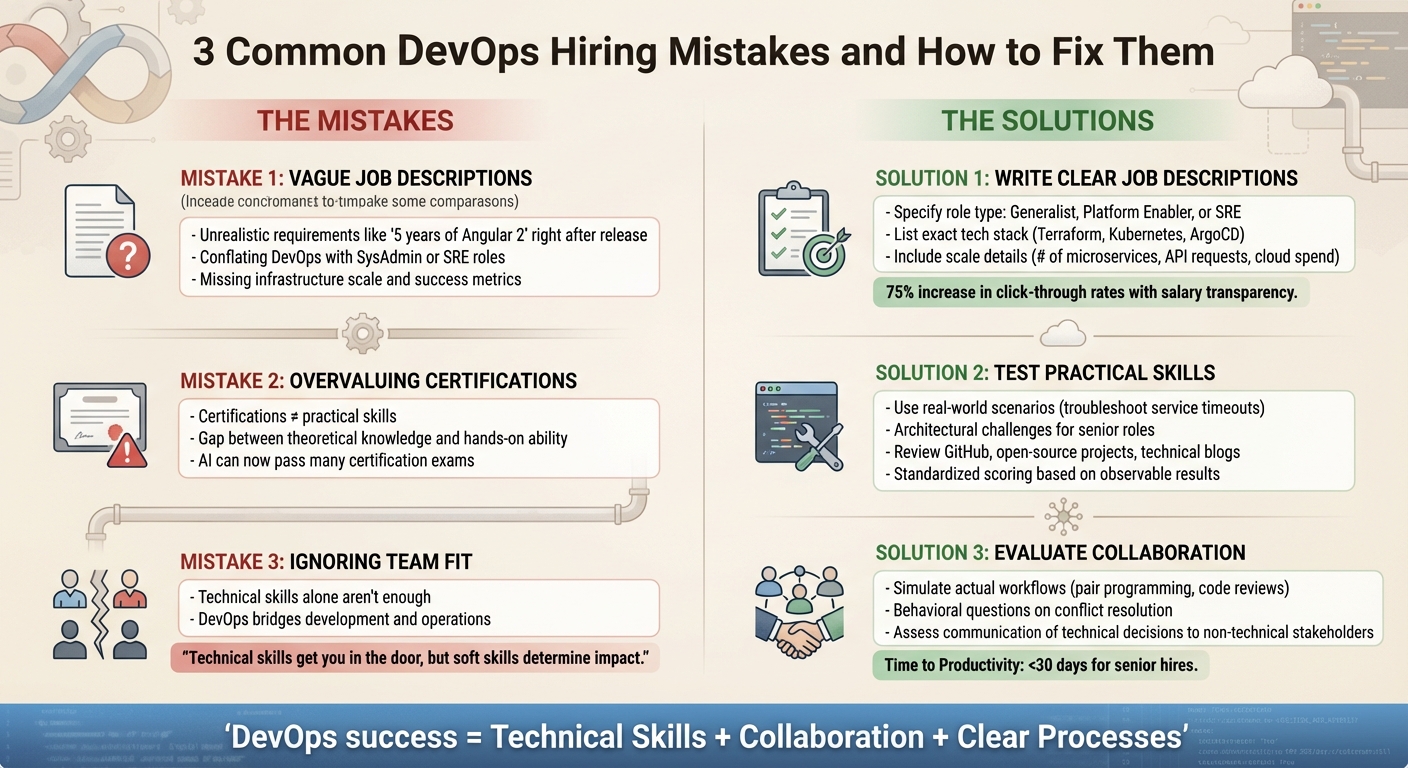 {3 Common DevOps Hiring Mistakes and How to Fix Them}
Common Mistakes in DevOps Hiring
Mistake 1: Vague Job Descriptions and Unrealistic Requirements
Job descriptions for DevOps roles often miss the mark by being either too vague or wildly unrealistic. The term "DevOps" is frequently misused, slapped onto roles that are closer to sysadmin positions with a sprinkle of scripting or platform architecture tasks. This muddling of roles creates unnecessary overlap with positions like Site Reliability Engineers (SREs) and Platform Engineers . Nir Cohen, Ops Architect at GigaSpaces, sums it up perfectly:
"The term 'DevOps Engineers' is an irony and a paradox... it contributes to the delusion that such people exist" .
The problem gets worse when job postings demand impossible qualifications - like requiring "5 years of Angular 2" right after its release or asking for "30 years of Rust" . These unrealistic expectations not only misrepresent the role but also scare off talented professionals. Expecting one person to juggle infrastructure, security, CI/CD, and development is a recipe for failure . Additionally, many job descriptions fail to include critical details like infrastructure scale or clear success metrics, leaving candidates guessing .
Mistake 2: Focusing on Certifications Instead of Practical Skills
Overemphasizing certifications is another common pitfall. While certifications like AWS Solutions Architect or Kubernetes Expert might look impressive on paper, they don't guarantee practical expertise. Passing an exam doesn't necessarily translate to real-world problem-solving skills. In fact, there’s often a noticeable gap between theoretical knowledge and hands-on ability . Some candidates even rack up certifications but struggle to explain the reasoning behind their architectural choices .
With AI now capable of passing many certification exams, relying solely on these credentials has become even riskier . Instead of just reviewing certifications, dig deeper. Look at a candidate’s GitHub contributions, open-source projects, or technical blogs to get a clearer picture of their problem-solving abilities .
Mistake 3: Ignoring Team Fit and Collaboration Skills
Technical skills are important, but they’re only part of the equation. A DevOps engineer who can’t work well with others is unlikely to succeed. Since this role bridges development and operations, collaboration is just as critical as technical expertise. Greg T., a technical interviewer, puts it well:
"Technical skills get you in the door, but soft skills determine how far you'll go and how much impact you'll have on the team" .
Great DevOps engineers should also be able to explain complex technical decisions and trade-offs in a way that non-technical stakeholders can understand. Ignoring collaboration skills can lead to hiring technically brilliant individuals who struggle to integrate with the team. To avoid this, look for candidates with diverse experiences that naturally counteract organizational silos . Go beyond traditional technical tests - assess team fit through activities like code reviews, architectural discussions, or documentation exercises. These methods provide a more complete picture of a candidate’s ability to contribute effectively.
How to Improve Your DevOps Hiring Process
Strategy 1: Write Clear and Specific Job Descriptions
A common pitfall in hiring is relying on vague job descriptions or focusing too much on certifications. Instead, write descriptions that emphasize the role's outcomes and potential impact. Osman (Ozzie) Osman, author of Technical Recruiting and Hiring, explains:
"If your job description is built around checklists of requirements, it will be a lot less compelling to candidates than if it is built around the challenges and impact of the work - the outcomes" .
Rather than listing generic qualifications, highlight specific goals like "developing microservices that handle 10 million requests per day" .
Be clear about the type of DevOps role you're hiring for. Is it a generalist who will build infrastructure from scratch for a startup? A platform enabler tasked with creating internal tools for a growing company? Or a specialized SRE managing enterprise-level complexities? Clearly outline the tech stack - name tools like Terraform, Kubernetes, GitHub Actions, or ArgoCD instead of using broad terms like "cloud experience" .
Add a section detailing the scale of your technical environment. Include information like the number of microservices, daily API requests, cloud spend, or infrastructure challenges . Transparency about on-call expectations - such as rotation schedules, compensation (e.g., $500/week), and incident volume - also helps set realistic expectations . Job postings that include salary ranges see an average 75% increase in click-through rates , so being upfront about pay is a smart move.
Strategy 2: Test Practical Skills with Hands-On Scenarios
Once you've nailed the job description, focus on testing candidates' practical skills. Avoid abstract coding puzzles that don't reflect real work. Instead, present scenarios that mirror the challenges they’ll face on the job. For instance, ask candidates to troubleshoot a service with intermittent timeouts, explaining their debugging process and proposed solution . Jacob Kaplan-Moss, co-creator of Django, highlights the importance of this approach:
"Interviewing fundamentally measures a candidate's skill at interviewing! ... Only by asking them to actually use those skills can you weed out the bullshit artists" .
For senior positions, introduce architectural challenges. For example, ask candidates how they would migrate a monolithic application to microservices while maintaining 99.9% uptime . Provide clear details, such as the problem's scope, required deliverables, and specific criteria like "must include at least one test" . Use a standardized scoring system to grade candidates fairly based on observable results .
Strategy 3: Evaluate Team Fit and Collaboration Abilities
Technical expertise is important, but it’s only part of the equation. Assessing how well a candidate fits with your team and collaborates is just as crucial. As Brokee.io points out:
"DevOps is as much about people as it is about technology" .
Simulate your team's actual workflows during interviews. If your team uses pair programming or asynchronous code reviews, include these processes to see how the candidate adapts .
Have a team member review the candidate's take-home project and discuss it with them. This conversation can reveal how they think, how they handle feedback, and how well they explain their decisions and trade-offs . Behavioral questions should explore scenarios like resolving team conflicts, adapting to new workflows, and handling high-pressure situations . Aiming for a "Time to Productivity" of under 30 days for senior hires - where they complete their first production deployment within a month - can also serve as a good benchmark .
How to Find and Attract Top DevOps Engineers
Once you've fine-tuned your hiring process, the next step is actively seeking candidates who stand out in their technical communities. Leveraging developer-focused platforms can complement your improved evaluation methods by connecting you with engineers who have already demonstrated their expertise.
Use Developer-Focused Platforms
Traditional job boards often miss the mark when it comes to attracting top-tier DevOps engineers. Many of these professionals are already employed and actively participating in technical communities like CNCF Slack channels or subreddits such as r/devops and r/kubernetes . To find exceptional candidates, look for contributions to GitHub projects, technical blogs, or other visible displays of real-world problem-solving .
A standout option is daily.dev Recruiter, which takes a more targeted approach. Instead of relying on cold outreach or scraped databases, it connects you with passive, pre-qualified developers who are already engaged on the platform. These users are reading technical content, learning, and interacting with the community. The process is warm and double opt-in, meaning candidates have already expressed interest before any contact is made. Nimrod Kramer, CEO of daily.dev, emphasizes the importance of this approach:
"Trust is the only edge that lasts."
Once you've identified potential candidates, your next focus should be building trust through thoughtful, personalized outreach.
Build Trust Through Warm Introductions
Generic, cold emails are rarely effective with DevOps engineers, who often face an overwhelming volume of impersonal recruiting messages. Warm introductions, on the other hand, establish credibility from the start. Be upfront about the role's challenges - whether it’s the on-call rotation, incident volume, or compensation (typically $500–$1,000 per week) . Highlight a culture of learning and accountability, such as a blameless approach to post-mortems, rather than glossing over the realities of production environments.
When reaching out, focus on what makes your opportunity stand out. For example, mention exciting aspects like embracing Infrastructure as Code, implementing GitOps, building internal platforms, or managing AI/ML GPU orchestration. It’s critical to make it clear that this is a genuine software engineering position, not just a configuration management role. As Matt Lievertz puts it:
"This really is a position writing software (not scripts, not configuration, not templates - software)"
Conclusion: Building a Better DevOps Hiring Strategy
When it comes to DevOps hiring, certifications aren't the ultimate measure of success. What truly matters is aligning your hiring process with the real-world needs of your team. As Hirecruiting puts it:
"DevOps success relies on the combination of team collaboration, automated processes, transparent practices, and responsible accountability. It's not just about technical skills."
Your hiring strategy should adapt to your company's stage of growth. Startups often need generalists who can make practical, cross-functional decisions. Scale-ups benefit from specialists who can focus on building internal platforms. Meanwhile, enterprises typically require specific roles like Site Reliability Engineers (SREs) or Platform Engineers . This approach builds on the earlier discussion of tailoring hiring to fit your team's unique needs.
Transparency is key to building trust with candidates. Be upfront about critical details like on-call rotations, incident frequency, and compensation. For example, you might offer $500–$1,000 per week for primary on-call duties, plus additional pay for handling incidents . Highlighting a culture of blameless postmortems and psychological safety can also make a big difference, as these are often priorities for senior engineers evaluating opportunities.
The growing emphasis on Platform Engineering signals a shift in expectations for DevOps professionals. Many now prefer roles where they can focus on creating internal developer tools rather than just maintaining infrastructure . To reflect this evolution, your job descriptions, technical assessments, and interview processes should address these changing priorities. Design assessments that mimic real-world scenarios and evaluate how well candidates collaborate within a team setting.
Finally, finding the right DevOps talent means meeting candidates where they already engage - whether that's contributing to open source projects or participating in technical communities. Platforms like daily.dev Recruiter, which use warm, double opt-in introductions, can be a great alternative to impersonal cold outreach. When your hiring process respects both the technical demands and the collaborative nature of DevOps work, you'll attract engineers who not only fit your team but also help it thrive.
FAQs
What should a DevOps job description include?
A strong DevOps job description should center around practical skills instead of merely listing certifications or tools. Core responsibilities often include automating workflows, managing CI/CD pipelines, and overseeing cloud infrastructure. Look for candidates with proven abilities in problem-solving, automation, and hands-on experience with infrastructure as code (IaC), monitoring systems, and scaling solutions.
Equally important is a candidate's ability to collaborate effectively - they should excel at bridging the gap between development and operations teams. Prioritize individuals with real-world experience in areas like troubleshooting and system optimization, as these skills often outweigh theoretical expertise.
How do you test real DevOps skills in interviews?
To genuinely assess DevOps skills, prioritize practical tasks that mirror actual job duties. This could include activities like creating CI/CD pipelines, managing infrastructure, or automating workflows in scenarios that feel realistic. Hands-on evaluations, such as pair programming sessions or live troubleshooting exercises, are excellent tools for gauging a candidate's abilities in real time.
Additionally, reviewing a candidate's portfolio, GitHub repositories, or previous work can provide valuable insights into their expertise. Avoid relying heavily on lengthy take-home assignments, as these can deter candidates and may not accurately showcase their skills in a practical context.
How can you assess DevOps collaboration and team fit?
To evaluate how well candidates align with DevOps collaboration and team dynamics, focus on practical tasks and behavioral interviews. Use hands-on exercises that mirror real-world scenarios, such as managing infrastructure as code or debugging CI/CD pipelines. Dive deeper into their communication style, problem-solving abilities, and teamwork by discussing prior experiences - ask about moments where they resolved conflicts or worked together on deployments. The goal is to see how they demonstrate collaboration and flexibility, ensuring they align with DevOps values like shared responsibility and continuous improvement.
.png)