Employee referral programs are the most effective way to hire engineering talent. Why? They deliver faster hires, better retention, and lower costs compared to traditional hiring methods. Referrals account for 40% of tech hires but only represent 6-7% of applications, making them a high-impact channel.
Key benefits include:
- Faster hiring: Referrals take an average of 29 days to hire vs. 39-55 days for job boards.
- Higher retention: 45% of referral hires stay over four years, compared to 25% from job boards.
- Cost savings: Referral bonuses (e.g., $5,000) are far cheaper than recruiter fees (up to $30,000 for a $150,000 role).
However, poorly designed programs fail. Engineers won’t participate if processes are time-consuming, unclear, or lack transparency. This guide explains how to create a program engineers trust, with tips on:
- Simplifying the referral process (e.g., Slack commands, mobile-friendly forms)
- Offering meaningful bonuses (cash, perks, or experiences)
- Avoiding mistakes like bias and referral fatigue
- Tracking metrics like participation rates and referral-to-hire ratios
The takeaway: A well-run referral program saves time, money, and effort while attracting top engineering talent. Let’s explore how to build one that works.
::: @figure 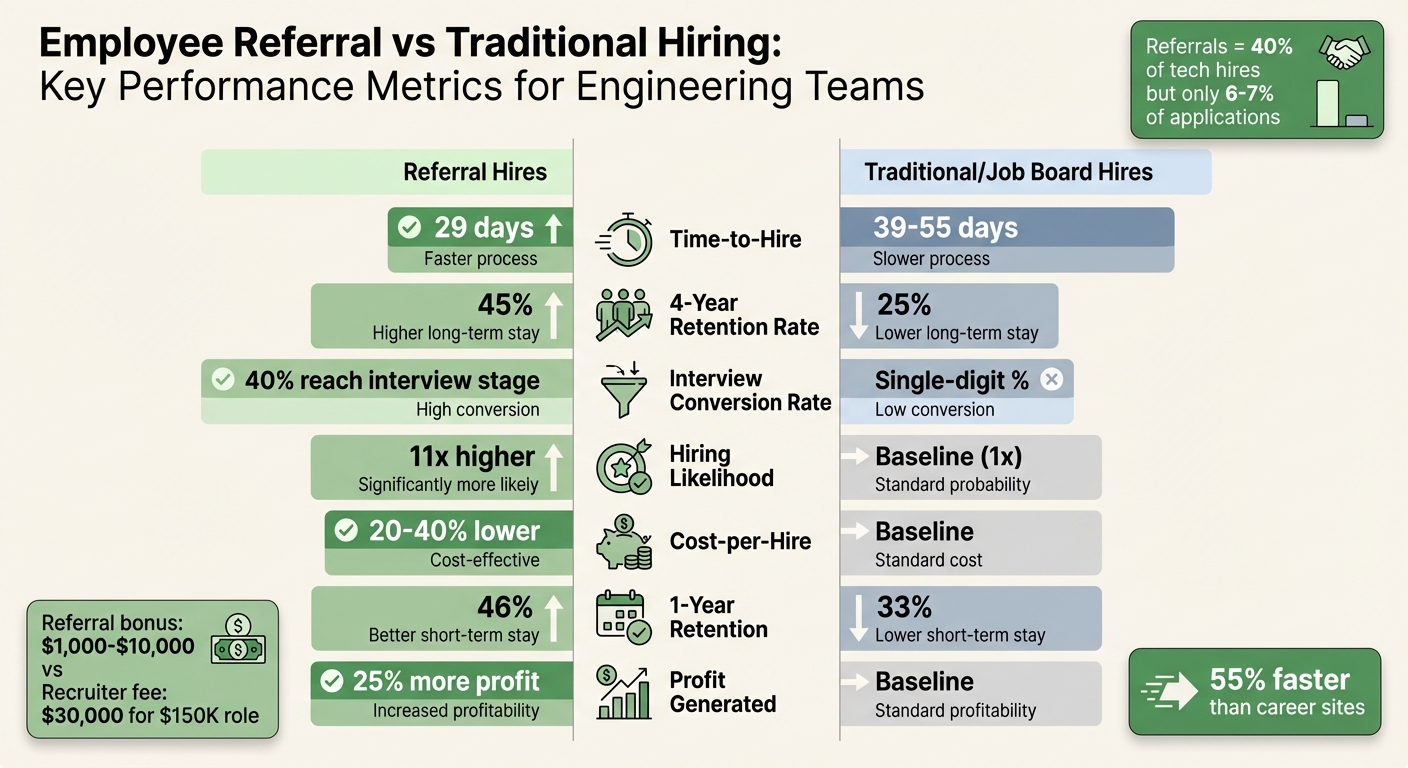 {Employee Referral vs Traditional Hiring: Key Metrics Comparison}
Why Referrals Are the Top Source for Quality Engineering Hires
Referrals thrive on trust - engineers only recommend someone when their own reputation is on the line. This built-in trust gives referrals an edge over other hiring channels. Unlike job boards or LinkedIn searches, referrals come with a personal endorsement that acts as a natural filter.
Better Quality Candidates
When engineers make referrals, they’re not just forwarding resumes - they’ve already assessed technical skills and team compatibility. Your existing team knows what success looks like in your environment, from the codebase to team dynamics to those unwritten rules that define the workplace.
And the stats prove it: referrals increase the likelihood of hiring by 11 times, with 40% of referred candidates reaching the interview stage . Compare that to the single-digit conversion rates typical of cold applications. Referrals also open the door to passive senior engineers who might not be actively job hunting but are open to the right opportunity .
"The bottleneck is not keywords. Not resume formatting. Not your GitHub. It is trust. And trust has a shortcut: someone who already works there." - Ahmad Alharbi, AI Engineer
This pre-screening process ensures not only higher-quality candidates but also better long-term results.
Better Retention Rates
Referred hires tend to stick around longer. 45% of engineers hired through referrals stay for more than four years, compared to just 25% of hires from job boards . Even over a shorter term, 46% of referrals remain after one year, compared to 33% of traditional hires .
Why the better retention? Referred candidates come in with clear, realistic expectations. They’ve already heard the unvarnished truth about the company, the team, and the tech stack from someone they trust. This transparency eliminates surprises, creates alignment from the start, and reduces early turnover.
"Retention isn't just an HR metric; it's a strategic moat. Every resignation drains context and momentum." - SignalFire
This combination of quality and longevity makes referrals a cornerstone of effective hiring strategies.
Lower Cost and Faster Hiring
Speed is critical in engineering recruitment, and referrals deliver. The average time-to-hire for a referral is 29 days, compared to 39-55 days for traditional methods . That’s 55% faster than hiring through career sites . For critical roles, shaving weeks off the process can make all the difference.
Referrals also save money. Referral bonuses typically range from $1,000 to $5,000 for most tech roles, and up to $10,000 for senior or hard-to-fill positions . Compare that to external recruiter fees, which can take 20-30% of a first-year salary - that’s $30,000 for a $150,000 engineering role. Overall, referral programs can cut cost-per-hire by 20-40% compared to other channels . Plus, referred hires generate 25% more profit for employers than those hired through other sources .
These time and cost savings further highlight why referrals are such a powerful tool for engineering teams.
| Metric | Referral Hires | Traditional/Job Board Hires |
|---|---|---|
| Time-to-Hire | 29 days | 39-55 days |
| 4-Year Retention Rate | 45% | 25% |
| Hiring Likelihood | 11x higher | Baseline |
| Cost-per-Hire | 20-40% lower | Baseline |
How to Design a Referral Program Engineers Will Actually Use
The most effective referral programs are those that respect engineers' time and seamlessly integrate into their workflows. If the process takes more than a couple of minutes or disrupts their focus, participation rates drop. The key is to create a frictionless, straightforward system that naturally fits into their daily routines.
Make the Process Simple and Clear
Engineers tend to avoid anything that feels overly complicated or time-consuming. Keep the referral process as streamlined as possible - allow submissions with just a name and email. Recruiters can gather additional details later, aligning with engineers' preference for quick, task-oriented actions .
Transparency is just as important. A real-time dashboard where engineers can track their referral's progress (e.g., "Interviewing", "Offer Made", or "Not Moving Forward") ensures they feel acknowledged and engaged . This visibility reinforces their efforts and encourages ongoing participation.
Integrate with Tools Engineers Already Use
To make referrals effortless, embed the process directly into tools engineers already rely on, such as Slack or Microsoft Teams. For example, let them use simple commands like /referral [Name] [Email] [Role] to submit candidates without leaving their primary workspace . This approach eliminates the hassle of navigating to a separate portal and makes referrals feel like a natural part of their workflow.
Since referrals often happen during informal conversations, ensure the process works smoothly on mobile devices as well. This flexibility ensures engineers can submit referrals anytime, anywhere, without interrupting their flow .
Never Ghost Referred Candidates
"A poorly run program does more than just fail to bring in candidates; it can actively disengage your best people. When an employee submits a referral and it disappears into a black hole with no feedback, it sends a clear message: their effort isn't valued. Nothing kills motivation faster." - Underdog.io Team
One of the worst mistakes you can make is ignoring referred candidates. Establish a 48-hour service level agreement (SLA) to ensure every referred candidate is contacted promptly . This not only shows respect for the candidate but also reassures the employee that their effort is appreciated.
Even when a candidate isn’t the right fit, provide feedback. For example, explaining that a candidate lacked specific skills like Kubernetes experience helps employees refine their future referrals. Automated status updates can keep referrers informed as candidates move through the hiring process, reinforcing their involvement and commitment .
Referral Bonus Structures That Work
Tiered cash bonuses tied to the difficulty of the hire tend to generate more engagement. For instance, junior roles often come with bonuses ranging from $1,000 to $5,000, while senior or hard-to-fill engineering positions may warrant $10,000 or more . The reward should match the effort required to tap into personal networks.
Cash Bonuses: Amounts and Payment Timing
Splitting the bonus payout - half upfront and half later - balances immediate gratification with long-term retention. A common approach is to pay 50% when the new hire starts and the remaining 50% after a 90-day probationary period . This ensures employees focus on referring candidates who are likely to stay.
"A split payout... encourages your team to refer people who will be a great long-term fit, not just a quick hire." – Underdog.io Team
Take PureCars as an example. In 2022, they offered a $2,500 bonus, divided into two payments of $1,250 at six and 12 weeks. By automating the process through their HRIS, they avoided any missed payments . On the other hand, HubSpot offers a flat $10,000 bonus for successful developer referrals, paid after the new hire completes four months .
While cash is a strong motivator, alternative rewards can appeal to other priorities, especially for engineers.
Non-Cash Rewards
Non-cash rewards can tap into different motivations. Engineers often value perks that support their professional growth, such as home office budgets, conference tickets, or certification courses . For those prioritizing work-life balance, time-based incentives like extra PTO or long weekends can be highly appealing . Experience-driven rewards - such as all-expenses-paid trips or event tickets - are also effective for those who value memorable experiences .
DigitalOcean took an innovative approach by combining a $3,500 cash bonus with a $1,500 charitable donation made in the referrer’s name. This strategy avoided the perception of a "bribe" while still offering meaningful financial value, resulting in a 43% participation rate, four times the industry average . Tech gadgets like iPhones, Apple Watches, or high-end headphones also generate excitement and work well as supplementary rewards during referral campaigns .
Rewarding Both the Referrer and New Hire
Programs that reward both the referrer and the new hire tend to outperform one-sided systems. By providing benefits to both parties, the process feels less transactional and more collaborative. These two-sided programs can increase sharing rates by 30–50% and click-to-signup conversions by 20–40% .
For example, you could offer matching bonuses - such as $2,500 for both the referrer and the new hire - or combine a cash bonus for the referrer with a signing bonus for the new hire. This approach frames the referral as a win-win opportunity rather than a favor, encouraging employees to connect with their best contacts. It’s a structure that builds trust and reinforces the value of the referral process.
Common Referral Program Mistakes to Avoid
Referral programs can go awry when they’re treated as just another hiring tool instead of a trust-based system that relies on your employees’ reputations and a fair, transparent process.
Referral Fatigue
Bombarding your team with constant hiring updates is a surefire way to make them disengage. Weekly Slack pings or daily email reminders can quickly lead to employees tuning out. Instead, keep updates to a manageable frequency, like quarterly announcements or monthly digests .
A smarter strategy? Run targeted referral sprints - short, focused campaigns like "Double bonus for Data Engineers this month." These create a sense of urgency while avoiding the burnout that comes with constant messaging . This way, employees are encouraged to act quickly without feeling overwhelmed by endless recruitment pushes.
Amplifying Hiring Bias
Another major pitfall is the risk of reinforcing hiring biases. Referrals often lead to homogeneous networks because people tend to recommend others who are similar to them. A Federal Reserve Bank of New York study revealed that most referrals occur between individuals with similar racial, gender, age, and educational backgrounds . If left unchecked, this can result in a team that lacks diverse perspectives.
"A well-run referral program should broaden your talent pool, not make it an echo chamber. Keep a close eye on the diversity metrics of your referred candidates to make sure your program is helping, not hurting, your DEI goals." – The Underdog.io Team
Pinterest tackled this issue directly in 2015-2016 by encouraging their engineering team to refer twice as many female candidates over a six-week period. The initiative led to a 24% increase in female referrals . To counter bias, consider diverse interview panels, track referral demographics, and ensure referred candidates go through the same thorough evaluation as external applicants .
Limiting Eligibility to Certain Groups
Finally, restricting your referral program to specific groups - like only senior engineers or certain departments - can hinder its effectiveness. This approach limits your network, as employees at all levels, from junior developers to product managers, have valuable connections . Opening the program to all full-time employees, and even offering scaled bonuses for interns or contractors, can significantly broaden your reach. The aim is to tap into as many networks as possible, not just rely on your most senior employees’ contacts.
Hiring engineers?
Connect with developers where they actually hang out. No cold outreach, just real conversations.
How to Measure Referral Program Performance
You can't improve what you don't measure. Tracking the right metrics is the backbone of a successful referral program. It's what separates a program that fades into obscurity from one that becomes a major hiring channel. By focusing on measurable data, you can ensure trust in the process and make informed adjustments.
Key Metrics to Track
Start by looking at your participation rate - the percentage of your engineering team that has submitted at least one referral in the last year. A rate below 25% often signals either a lack of awareness or a process that's too cumbersome . For example, in January 2025, DigitalOcean achieved a 43% participation rate - well above the industry average - by offering a $1,500 charitable donation in addition to a $3,500 cash bonus for successful referrals .
Next, evaluate your referral-to-hire ratio, which measures candidate quality. If you're receiving a flood of referrals but hiring very few, your team might not fully understand the type of candidates you're seeking. A ratio of 10:1 or better is considered strong for tech roles . Additionally, referrals should ideally be hired in about 29 days - faster than the 39-55 days typical for job boards .
Retention rate is another critical area where referrals tend to excel. Compare your numbers to the tech industry benchmark of a 45% one-year retention rate for referral hires . If referred engineers are leaving at the same rate as other hires, it might indicate a mismatch in expectations or cultural alignment.
Lastly, include diversity impact metrics. This involves tracking the demographic makeup of referred candidates compared to other sources. As referrals often reflect existing networks, it's crucial to ensure your program isn't unintentionally narrowing your talent pool .
| Metric | Tech Industry Benchmark | Why It Matters |
|---|---|---|
| Participation Rate | 25-40% | Reflects program awareness and employee trust |
| Referral-to-Hire Ratio | 10:1 (or lower) | Indicates the quality and fit of referred candidates |
| Time-to-Hire | ~29 Days | Demonstrates efficiency compared to job boards |
| Retention Rate (1 Year) | ~45% | Shows long-term success and cultural alignment |
| Cost-per-Hire | 20-40% Lower | Highlights cost savings and program ROI |
To fully leverage these metrics, you'll need an applicant tracking system (ATS) that simplifies and automates referral tracking.
Using Your ATS for Referral Tracking
Manually tracking referrals can quickly become a bottleneck. Instead, configure your ATS to flag referred candidates as soon as they enter the pipeline. This ensures they receive priority review . Automate status updates so that employees who submit referrals are kept in the loop with real-time notifications, such as when their candidate moves to "Interviewing" or "Hired." Transparency like this keeps employees engaged and prevents the frustration of feeling ignored .
"A poorly run program does more than just fail to bring in candidates; it can actively disengage your best people." - The Underdog.io Team
Your ATS should also handle bonus tracking. For example, set it up to split payments (50% at hire, 50% after 90 days) and automatically release them once milestones are reached . Use the system's dashboard to monitor progress and identify bottlenecks. For instance, if candidates linger too long in the "Submitted" status, it’s a sign to investigate delays. Establish clear timelines for hiring managers, such as requiring feedback on referred candidates within 48 hours .
When Jobber transitioned from manual tracking to an automated system, they reported a 4.86% higher lifetime value for referred customers compared to those from other sources . This demonstrates the tangible benefits of automating and streamlining your referral process.
Combining Referrals with Passive Sourcing
Employee referrals are a great way to tap into trusted personal networks, but they can only go so far. To create a well-rounded talent pipeline, it’s essential to pair referrals with passive sourcing. This approach helps you reach skilled developers outside your employees' immediate circles while maintaining the high quality and engagement that make referrals so effective.
Strengthen your pipeline by revisiting past referrals stored in your ATS and expanding your search externally. Platforms like GitHub, Reddit, and Slack can be valuable for finding qualified candidates beyond your direct network. Attending industry events is another way to connect with professionals in person. A smart move? Ask engaged passive candidates for referrals. For instance, Intel doubled its referral bonus to $4,000 in 2024 for successful diversity hires, including women and veterans, demonstrating the power of combining these strategies . These efforts align perfectly with the advanced tools provided by daily.dev Recruiter.
How daily.dev Recruiter Supports Passive Sourcing
daily.dev Recruiter takes your referral strategy to the next level by ensuring warm, double opt-in connections. This means every developer you connect with has already shown interest, creating a more engaged talent pool. The platform’s advanced filters allow you to search for candidates based on specific skills, experience, or location, helping you fill roles that referrals might not cover. For example, if your team lacks expertise in areas like Rust development or machine learning, daily.dev Recruiter can help you connect directly with professionals in those fields. By leveraging these targeted connections, you can extend your reach and fill niche roles more effectively.
Reaching Developers Outside Your Network
While referrals build trust, passive sourcing introduces fresh perspectives and helps you connect with talent beyond your immediate circles. This approach is especially critical for filling challenging positions, where unfilled roles can result in revenue loss. It also supports diversity efforts, as referrals often mirror existing networks. When reaching out to passive candidates, be transparent that there might not be an immediate opening, but emphasize how their skills align with long-term opportunities. Techniques like Boolean searches and reviewing GitHub portfolios can help you verify technical expertise, while sponsoring events aimed at specific skills or industries can broaden your network even further.
Referral Program Templates and Email Scripts
Templates make the referral process smoother and ensure consistent communication. Below are three key templates tailored for engineering teams. These are designed to follow best practices, making every referral straightforward and impactful.
Program Launch Email Template
A launch email should grab attention right away and clearly highlight the rewards. Use a specific and reward-driven subject line, like "Refer a Senior Dev & Earn $3,000", instead of something vague or generic . Start with a hook that recognizes your team’s contributions, followed by a simple breakdown of the program. For instance, offer tiered rewards such as $3,000 for Senior Software Engineers or Data Scientists, $2,000 for DevOps Engineers, and $1,000 for Junior Developers . Conclude with a direct link to your referral portal and step-by-step instructions. Keep in mind that 60% of employees who don’t participate in referral programs say they never received a referral link , so make it impossible to miss.
"We believe that our employees are our best recruiters." - Adaface Team
Next, streamline the submission process with a well-thought-out form.
Referral Submission Form Template
Your form should only ask for the essentials: the candidate’s name, contact details, LinkedIn profile or resume, the referrer’s relationship to the candidate (e.g., former colleague), and a short explanation of why the candidate is a good match for the role . Including a "role fit" field gives employees a sense of involvement and helps recruiters prioritize submissions. Make sure the form is mobile-friendly, as many employees will be sharing links on their phones . To save time, integrate LinkedIn functionality so candidate details can be auto-filled from a profile URL .
Once referrals are submitted, maintaining communication is crucial. That’s where follow-up email scripts come into play.
Thank You and Reminder Email Scripts
Send a thank-you email right after a referral is submitted to acknowledge the effort and outline the next steps . Follow up with a reminder email 48–72 hours after the program launch to capture interest while it’s fresh - this email tends to generate the highest ROI since employees may have intended to refer but got sidetracked . Keep the reminder short and include a single, clear link that takes no more than 10 seconds to complete.
Throughout the process, send automated updates when candidates move through stages like "Interview Scheduled" or "Offer Extended" to avoid the dreaded "black hole" that discourages future participation . When a referral results in a hire, confirm the reward immediately. This not only builds trust but also encourages employees to make another referral while they’re feeling appreciated .
Conclusion
Creating a smooth and transparent referral process is crucial. When employees are left in the dark with no feedback, their trust erodes, and they're less likely to participate in the future . The most effective programs take the guesswork out of the equation by using specialized platforms that provide real-time updates and consistent bonus structures. Take DigitalOcean, for example: their strategy of combining a $3,500 referral bonus with a $1,500 charitable donation shows how aligning incentives can significantly increase engagement .
Employee referrals account for 40% of tech hires and often lead to candidates who stick around longer . Still, there’s a natural cap to the reach of your team’s network, which means plenty of skilled developers remain outside your immediate circle.
That’s where daily.dev Recruiter steps in. It connects you to passive, pre-qualified developers who are already engaged in a vibrant professional community. When paired with the referral best practices and passive sourcing strategies mentioned earlier, this creates a well-rounded hiring strategy. Every introduction is warm and double opt-in, ensuring developers feel respected and never spammed.
FAQs
Which roles should receive the largest referral bonuses?
Hard-to-fill roles, like software engineers and senior technical positions, often come with the highest referral bonuses. These bonuses can range between $15,000 and $25,000 for in-demand positions. Focusing on these roles helps tackle the challenges of filling specialized positions more effectively.
How do you prevent referral programs from hurting diversity?
To make sure referral programs support diversity rather than hinder it, focus on promoting inclusive practices. Encourage employees to refer candidates from a range of backgrounds and experiences. Regularly track how the program affects diversity metrics and take steps to address any biases that may emerge. Additionally, educating employees about why diversity matters and fostering a sense of accountability can go a long way in ensuring the hiring process remains fair and balanced.
What’s the best way to combine referrals with passive sourcing?
To get the most out of your hiring efforts, consider combining structured referral programs with active sourcing. Referral programs encourage employees to recommend talented individuals from their own networks, including those who may not be actively seeking jobs. Meanwhile, actively tapping into professional networks and social platforms allows you to connect with a wider pool of potential candidates. This two-pronged approach helps you reach both passive and active talent, ensuring better coverage and stronger hires by utilizing both internal and external networks.
.png)