In 2026, attracting top engineering talent starts long before the first interview. Developers prioritize real insights over corporate polish, focusing on your team's technical reputation, challenges, and peer reviews. Here’s what matters most:
- Transparency: Be upfront about your interview process, challenges, and expectations.
- Technical Credibility: Showcase your team’s skills through GitHub, engineering blogs, and open-source contributions.
- Team Quality: Developers research potential teammates via technical content and activity.
- Career Growth: Clear paths for advancement and skill-building opportunities are key.
- Peer Validation: Honest employee reviews and testimonials carry more weight than marketing.
Developers also evaluate companies through platforms like Glassdoor, GitHub, and technical blogs. A strong employer brand can cut hiring costs by up to 50% and reduce turnover by 28%. Focus on sharing your team's real stories, challenges, and achievements to stand out in a competitive hiring landscape.
What Employer Branding Means to Developers
When HR professionals talk about employer branding, they often rely on structured frameworks like the "4 P's" . But developers? They view things differently. For them, it’s not about glossy marketing campaigns or benefits packages. Instead, they want to know about the tech stack, the real challenges they’ll face, and, most importantly, the people they’ll be working with.
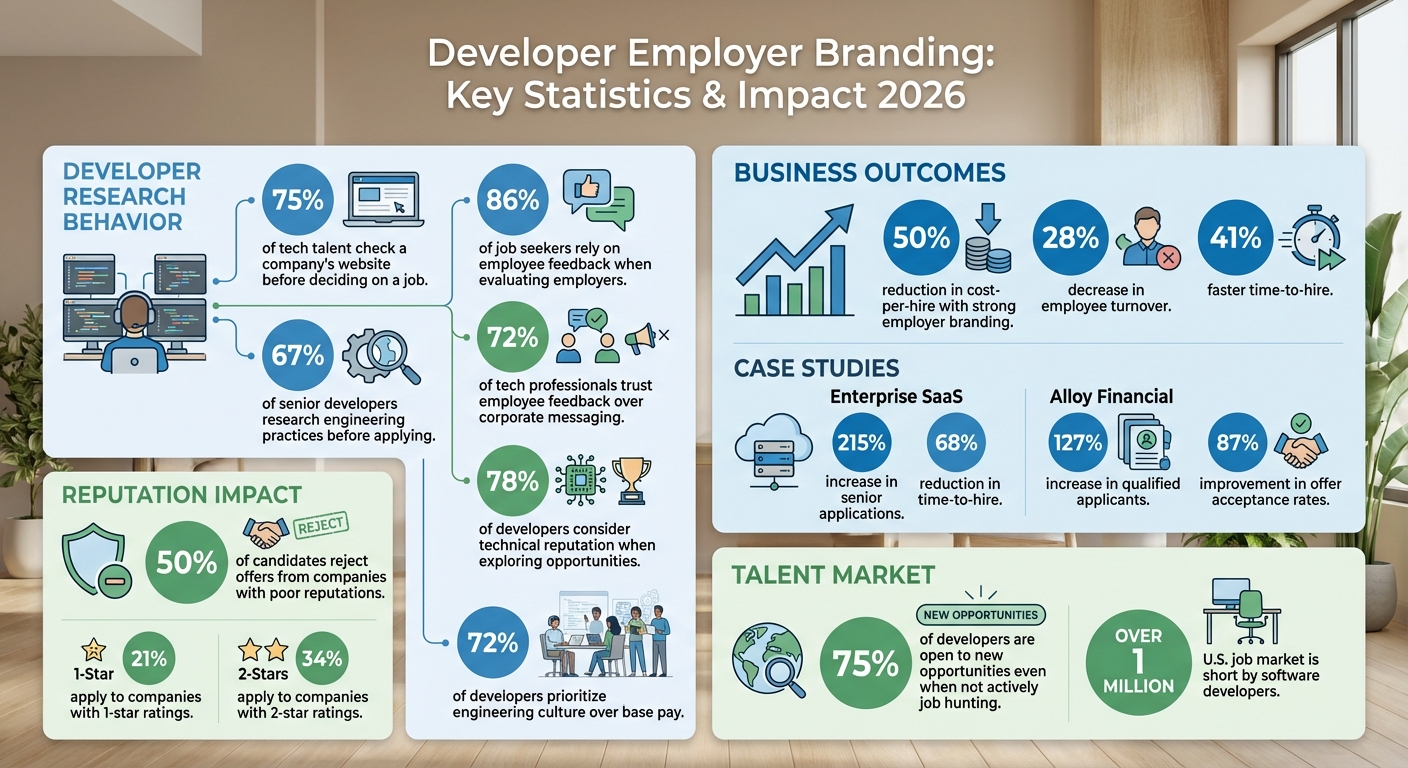
While HR might focus on polished videos or well-crafted employee value propositions, developers are doing their own research. In fact, 75% of tech talent check a company’s website before deciding on a job . They’re not looking for flashy production; they’re searching for technical credibility and validation from their peers. It’s worth noting that 86% of job seekers and 72% of tech professionals rely on employee feedback when evaluating a potential employer .
Below, we’ll break down how genuine insights shape how developers perceive employer branding.
Developers Trust Peer Experiences Over Corporate Marketing
Developers prefer hearing the real story from those who’ve lived it. They’re not swayed by corporate messaging or glossy presentations. What matters to them are honest, unfiltered accounts from fellow engineers. This preference explains why 50% of candidates reject offers from companies with poor reputations . Developers want to hear about the nitty-gritty details - technical debt, leadership quality, work-life balance - and these are insights that only come from peer-to-peer interactions .
Nathalie Figuière from CoderPad highlights the value of this approach:
"Strong employer branding is a valuable asset. By building an attractive employer brand, you spend less time and energy reaching out to talent and more time talking to engaged tech candidates."
A great example of this is Twilio, which has built its employer brand around a "builder" identity. New hires at Twilio are encouraged to create an app using the Twilio API during onboarding. Their "Twilio Magic" page reflects this identity with four pillars - "We are builders, we are owners, we are curious, and we are positrons" - that resonate deeply with developers .
This focus on authenticity and peer validation forms the foundation of what developers want in an employer brand.
Core Elements of a Developer-Focused Employer Brand
To connect with developers, companies need to focus on four key areas: transparency, technical challenges, team quality, and career growth. These aren’t just buzzwords - they’re the specific things developers care about when evaluating a potential employer. Let’s break them down:
Transparency: Developers value honesty. Share details about every interview round, who will be involved, and what skills will be tested. Be upfront about the challenges they’ll face. For example, if you promise work-life balance but expect late-night deployments, that disconnect will harm your credibility .
Technical Challenges: Highlight the real technical problems your team is solving. For instance, Clover Network’s employee value proposition (EVP) initiative not only showcased their challenges but also helped them cut hiring costs .
Team Quality: Developers often evaluate potential teammates through signals like GitHub activity, engineering blogs, or other technical content. They want to work with peers who share an "engineering-first" mindset. VMware’s "Future of Work" initiative is a strong example of this, as it combines flexible work models with authentic employee testimonials to emphasize growth and collaboration .
Career Growth: Clear paths for advancement and opportunities for autonomy are crucial. When developers see a company that supports their technical growth, the results speak for themselves: strong employer branding can reduce hiring costs by up to 50% and decrease employee turnover by as much as 28% .
The 5 Signals Developers Check Before Applying
Developers rely heavily on peer insights to decide whether to apply for a job. Instead of trusting careers pages, they focus on platforms that showcase a company’s technical credibility. 67% of senior developers research a company’s engineering practices before applying . Here’s how they evaluate potential employers.
Glassdoor Reviews: Company Reputation and Culture
Glassdoor provides developers with a reality check. They don’t just glance at the star rating - they dig into recurring themes in reviews. Developers want to know about leadership, work planning, and whether the company provides the right tools for the job .
For example, only 21% of candidates apply to companies with a one-star rating, and that number rises to just 34% for two-star ratings . More importantly, 72% of developers prioritize engineering culture and practices over base pay . They’re reading reviews to understand management style, autonomy, and transparency.
| Review Aspect | What Developers Look For |
|---|---|
| Leadership | Empathy and direction vs. lack of guidance |
| Technical Tools | Modern tools vs. outdated or inadequate ones |
| Work Planning | Project management, deadlines, and technical debt |
| Culture | Values like inclusion, autonomy, and diversity |
| Growth | Clear career paths and skill development opportunities |
Take Salesforce as an example - by actively managing its Glassdoor presence, responding to reviews, and addressing recurring concerns, it has built a reputation as a top employer in tech .
GitHub and Open Source Activity
Developers turn to GitHub to verify technical claims. They want to see actual code, contributions, and how your team engages with the open-source community. This is where “show, don’t tell” comes into play .
GitHub activity offers a window into team quality and the complexity of the work. Developers look at employee profiles, project contributions, and open-source involvement. 78% of developers consider a company’s technical reputation when exploring job opportunities .
One Enterprise SaaS platform saw a 215% increase in senior applications and a 68% reduction in time-to-hire by publicly sharing Architecture Decision Records (ADRs) and open-sourcing internal tools . Transparency in technical decisions clearly pays off.
Technical Blogs and Engineering Content
Engineering blogs give developers a deeper look at how your team solves problems. Posts about architecture decisions, performance tuning, or lessons learned from incidents show that your team values learning and sharing knowledge. A single, detailed post often carries more weight than multiple shallow ones.
These blogs also reflect your engineering culture. When developers see thoughtful, technical content, it signals that your team is engaged in meaningful challenges rather than just going through the motions. This kind of authenticity builds trust far better than polished corporate messaging ever could.
Interview Process and Team Interaction
The interview process is another critical signal for developers. They assess whether your process is transparent, respectful, and technically sound. Developers want to know upfront about the number of interview rounds, who they’ll meet, and what skills will be tested. Any mismatch between expectations and reality during the interview can harm your credibility.
The quality of interview questions and the expertise of interviewers are equally important. Developers are evaluating potential teammates and looking for signs of an “engineering-first” mindset. A poorly structured interview - filled with trick questions or inefficiencies - sends a clear message about how the company values its engineering team.
Tech Stack and Development Tools
Your choice of technology speaks volumes about your engineering priorities. Developers want to work with tools and stacks that not only help them grow but also look impressive on their resumes.
For instance, Alloy Financial, a fintech company, shared its journey from a monolith to a microservices architecture. By being open about their challenges and solutions, they saw a 127% increase in qualified applicants and an 87% improvement in offer acceptance rates .
| Category | Current Stack | Selection Rationale | Evolution Strategy |
|---|---|---|---|
| Backend | Go microservices | Performance, simplicity, concurrency | Expanding service mesh capabilities |
| Infrastructure | Kubernetes on AWS | Deployment consistency, scaling | Enhancing GitOps workflows |
| Data Storage | PostgreSQL, Redis | Relational integrity, performance | Exploring time-series extensions |
Modern tooling - like CI/CD pipelines, debugging tools, and efficient local development environments - also matters. These tools demonstrate respect for developers’ time and reduce unnecessary friction. Companies with well-developed engineering brands see 41% faster time-to-hire , with the tech stack being a key factor in that advantage.
Building an Engineering Blog That Attracts Candidates
An engineering blog can be a powerful tool for showcasing your team's technical expertise and workplace culture. It strengthens your employer brand by highlighting real achievements and offering a glimpse into your team's environment. In fact, 72% of tech professionals trust insights from current employees more than official corporate messaging .
Take Airbnb’s engineering blog, for example - it has amassed 94,000 followers. Similarly, Instagram’s blog, which focuses on Python and performance, has drawn 18,000 followers . These numbers show how consistent, credible content can make a big impact.
"The purpose of the blog is not just to 'show the cool stuff you've built' but rather to showcase your employer brand, highlight your engineering team's culture, and introduce the talented engineers on your team."
The key is to focus on topics that matter to developers and reflect genuine technical challenges your team has tackled.
Choosing Topics Developers Care About
Developers are drawn to content that dives into real-world problem-solving. Instead of writing surface-level posts like “What is Kubernetes?”, focus on topics that dig into your team’s decision-making process, internal tools, or technical hurdles you’ve overcome .
For example, Slack’s engineering blog includes posts such as "Refactoring Backend Engineering Hiring at Slack", offering a transparent look into their internal processes. Similarly, sharing challenges like database sharding or migrating from a monolith to microservices not only highlights your team’s expertise but can also spark meaningful discussions with prospective hires.
A good mix of content types can keep your blog engaging. Blend in-depth tutorials, behind-the-scenes looks at your team’s daily work, and quick problem-solving posts. Companies like Buffer and Thoughtworks excel at this balance, with formats like Buffer’s “Snackchat” posts and Thoughtworks’ Technology Radar, which showcase their engineering culture while keeping content fresh and varied.
Publishing Consistently with a Technical Voice
Consistency is just as important as the topics you choose. A strong, technical voice builds trust with your audience. To achieve this, consider appointing a skilled developer to manage the blog. This ensures posts maintain a high level of quality and authenticity. Encourage team members to contribute - having each engineer write one detailed post a year spreads the workload and keeps the content genuine.
"The fastest way to lose a developer's trust is to provide them with a tutorial that doesn't actually work or ignores the real-world complexities of their stack."
- Carl Hughes, Founder, Draft.dev
Set up a peer review process to validate all technical content, including code snippets, so readers know they can rely on your blog. Include clear calls-to-action, such as “Join Our Team,” especially in posts that highlight parts of your codebase new hires might work on. Finally, share your blog posts actively in developer communities, forums, and through your team’s social media. This not only amplifies your reach but reinforces your blog as a recruiting asset.
Open Source Contributions as Employer Branding
Open source contributions are a powerful way to showcase your company's technical strengths, especially when aiming to build a developer-focused employer brand. By participating in open source, your company demonstrates its technical expertise, code quality, and architectural decisions. According to research, 72% of tech professionals trust employee voices more than official company messaging . This makes employee-driven contributions a credible way to highlight your organization's capabilities.
Additionally, nearly 75% of developers are open to new opportunities, even when not actively job hunting . A strong presence on platforms like GitHub can help you connect with this passive talent pool, especially those who value technical excellence. With the U.S. job market currently short by over one million software developers , open source becomes a key avenue for engaging engineers who prioritize innovation and community involvement. This is where your GitHub activity can play a pivotal role in showcasing your technical leadership.
Demonstrating Technical Leadership Through Open Source
Your company's GitHub profile acts as a public portfolio that developers often examine before considering employment. High-quality open source projects not only demonstrate your engineering team's ability to solve real-world problems but also highlight your commitment to giving back to the developer community. When your engineers contribute to well-known projects or maintain widely used libraries, it enhances your credibility and positions your company as a leader in technical innovation. This reputation naturally attracts skilled developers who share similar values and priorities.
Supporting Employee Open Source Participation
Encouraging your team to actively participate in open source contributes to your employer brand while fostering employee growth. Allowing engineers to contribute to open source during work hours reinforces your company's commitment to professional development and can be a key part of your Employee Value Proposition (EVP) . Developers increasingly look for employers who support their engagement with the broader tech community.
"Encourage your engineers to speak at conferences, contribute to open source, and share their work publicly. Their visibility becomes your recruiting asset."
- Katie LaFranchi, HR Consultant, Amplēo
To support this, allocate dedicated time for open source work, sponsor attendance at industry conferences, and publicly celebrate your team's contributions. When engineers share their involvement through blogs or social media, they naturally become ambassadors for your brand, helping to attract top-tier talent who resonate with your company's values and technical focus.
Developer Community Engagement
Getting involved in developer communities opens doors that traditional hiring methods often can't. Many of the best engineers aren't actively searching for jobs - they're the kind of people who skip job boards but regularly attend meetups or dive into technical discussions on platforms they frequent. By engaging with these spaces, you connect with this "hidden" talent pool in a way that's both natural and effective. Hosting or sponsoring events takes this connection a step further, helping to establish your company as a technical leader.
Engineers can play a key role here by representing your company through conference talks, workshops, or online forums. When they share their expertise and interact with others, they showcase your company’s technical chops in a way that feels authentic and relatable. This type of visibility builds trust far better than traditional ads or recruiter emails ever could.
Hosting and Sponsoring Meetups and Conferences
There’s something powerful about face-to-face interaction. Hosting or sponsoring developer events - whether it’s a local JavaScript meetup, a regional DevOps conference, or a hackathon - gives your company a chance to meet engineers where they are. These events are a window into your company’s culture, offering a level of authenticity that a polished careers page just can’t match.
But it’s about more than just slapping your logo on a banner. When your engineers step up to give talks, lead workshops, or mentor participants at these events, they’re not just showcasing their skills - they’re building genuine connections. These relationships often lead to unexpected hiring opportunities when someone in the community decides it’s time for a new challenge.
Building a Presence on Platforms Like daily.dev
Platforms like daily.dev provide another way to stay connected with developers. With over 1 million users relying on daily.dev for tech news and trends, being active here means your company becomes part of a developer's everyday routine - not just a name they see when they’re job hunting.
Social Proof That Works: Real Engineer Stories
When it comes to building an authentic employer brand, nothing beats real stories from engineers. Developers tend to skip over polished corporate videos, gravitating instead toward genuine narratives from their peers. Picture a backend engineer describing the adrenaline of fixing a production issue at midnight or another explaining why they championed Rust for a specific microservice - these stories offer a window into the actual day-to-day experience.
"By telling your authentic story, you can give tech talent what they have been asking for - an inside peek into what it's like to work at your organization from those they trust, other developers." - Stack Overflow
"Tech talent you're hoping to attract may not remember your latest product release, but they will remember the authentic stories told by your very own developers." - Stack Overflow
These personal accounts create a foundation for developer testimonials that leave a lasting impression.
Creating Developer Testimonials That Feel Real
You don’t need a big production budget or a professional crew to gather meaningful testimonials from your engineering team. What matters most is asking the right questions and allowing engineers to speak freely, in their own words. Start with team members who naturally show enthusiasm for their work - those who’ve been with the company for a while, switched teams, or frequently share insights about their projects.
Instead of asking for generic feedback, use specific prompts to draw out authentic responses. Questions like “What motivated you to join the team?” or “What’s the most memorable thing you’ve learned from a colleague?” encourage engineers to share personal and relatable stories.
You can also find great material where engineers are already expressing themselves. Look at internal blogs, Slack messages celebrating recent wins, or highlights from team retrospectives. Repurposing this kind of content amplifies their voices without forcing them to create something new or overly polished.
Long-term employees or those who’ve held multiple roles often make the most compelling storytellers. They can talk about their career growth and how the company has evolved, offering insights that resonate with potential hires.
The key is to keep these testimonials grounded in reality and steer clear of overly polished corporate messaging.
Avoiding Over-Produced Corporate Content
Nothing kills authenticity faster than content that feels overly staged. Let engineers describe their challenges in their own words, without adding a layer of corporate gloss. When every word feels scripted and every shot looks like it belongs in a commercial, developers quickly tune out.
Rather than leading with broad mission statements or vague values, focus on real experiences. For example, instead of saying, “We value innovation,” let an engineer share a story about pitching a bold idea during a casual meeting and getting the green light to pursue it.
Always aim to show rather than tell. If you want to highlight the technical challenges your team tackles, have an engineer walk through a specific problem they solved. Let them explain the constraints they faced, the solutions they considered, and the trade-offs they made. This level of detail sets genuine stories apart from generic marketing content.
Preserve the engineer’s voice. If they use casual language, technical jargon, or mention specific tools, let it stay. Developers appreciate unfiltered details - it signals that your company values transparency and isn’t afraid to show the messy, real side of engineering. This raw authenticity is what builds trust and strengthens your employer brand, ultimately making a measurable impact on your hiring efforts.
Measuring Employer Brand Impact on the Hiring Pipeline
Improvement starts with measurement. By leveraging insights from platforms like Glassdoor, GitHub, and team narratives, you can gauge how well your employer branding efforts are working. It's not just about surface metrics like social media followers - what really matters is whether your blog posts, open-source contributions, and community engagement are attracting skilled developers and encouraging them to stick around.
"Start with your goals. Without clear goals, you'll never be able to measure success." - Carmen Collins, Social Media & Talent Brand Lead, Cisco
Companies with a strong employer brand often experience a 50% reduction in cost-per-hire and a 28% drop in turnover rates . To achieve these results, focus on tracking the right metrics across every stage of your hiring funnel - from awareness to retention.
Tracking Application Rates and Candidate Quality
A high number of applications doesn't always equal success. If only 5% of 500 applicants make it past the first stage, there's likely a disconnect. The key is to monitor conversion ratios at each step: how many candidates progress to technical interviews, receive offers, and ultimately accept them.
One critical metric is the application-to-interview ratio. The industry average is around 12% , but companies with strong employer branding often see better results. If your numbers are lower, your branding might be attracting the wrong audience, or your messaging could be misaligned with the role.
The offer acceptance rate is another important indicator. If candidates decline offers after completing the interview process, it suggests your employer brand isn't aligning with the reality of working at your company. Pay attention to where candidates are coming from - those who discover you through technical content often have higher acceptance rates.
Finally, first-year retention provides a long-term view of branding effectiveness. If developers hired through your content marketing stay longer than those from other sources, it’s a sign that your branding resonates with the right people. By 2026, 48% of large organizations are expected to use AI to analyze retention patterns , helping correlate branding efforts with employee longevity.
These metrics lay the groundwork for deeper insights, which can be gathered through direct developer feedback.
Surveying Developer Perceptions
Numbers alone don’t tell the full story. To truly understand how your brand is perceived, you need feedback directly from developers. Companies like Google, Microsoft, and Spotify use quarterly Developer Satisfaction (DevSat) surveys to assess how their engineering teams view the company .
For example, GitHub’s DevSat survey, integrated into daily workflows via direct messages, achieved an impressive 95% participation rate . Insights from this survey revealed that GitHub engineers experienced 19% fewer meeting-heavy days than the industry average, prompting the company to invest in improvements like a new Developer Portal, which earned satisfaction scores of 80–83.
To understand external perceptions, survey candidates at various touchpoints. Brief surveys sent to all interviewees - even those not hired - can reveal which content influenced their decision to apply. During onboarding, ask new developers which blog posts, GitHub projects, or team stories stood out to them. This qualitative feedback links your branding efforts to actual hiring outcomes.
Another useful tool is the Candidate Net Promoter Score (NPS). Ask candidates, "How likely would you be to recommend applying to our company to a colleague?" Tracking this score across different sourcing channels can help you identify which branding strategies resonate most with developers. Given that 75% of job seekers research employer brand before applying , understanding their perceptions is vital for refining your messaging.
Google’s EngSat survey, running since 2018, offers a great example of how longitudinal tracking can reveal trends in developer experience . By consistently asking core questions, you can monitor how your employer brand evolves as you publish technical content, contribute to open-source projects, and engage with developer communities.
Combining qualitative insights with quantitative metrics gives you a comprehensive view of your employer brand’s impact on the hiring pipeline.
How daily.dev Recruiter Amplifies Your Employer Brand
daily.dev Recruiter takes the concept of building an employer brand and elevates it by focusing on authentic, developer-driven engagement. It’s not just about creating a strong image - it’s about ensuring the right developers see it at the right time. Powered by a thriving network of over 1 million developers who actively use the platform to read, learn, and engage with technical content every day , this tool shifts the recruitment paradigm. Here’s how it creates tailored visibility and fosters meaningful connections.
Using Targeted Content Visibility
Most recruiting platforms rely on outdated, static profiles that don’t reflect a developer’s current skills or interests. daily.dev Recruiter flips the script by tapping into real-time behavioral data - tracking what developers are reading, following, and building. This ensures your job postings are seen by candidates who are actively engaged in the areas that align with your needs.
"We're turning real developer behavior (what people read, follow, and build) into high-signal matches. We help recruiters understand who a developer is now, not just who they were years ago." - Nimrod Kramer, CEO, daily.dev
For example, if you’re looking for a Rust engineer, the platform identifies developers who are reading Rust-related content, contributing to Rust projects, or engaging with Rust thought leaders. This approach not only narrows your candidate pool to the most relevant individuals but also reduces the number of interviews needed to make a hire .
Building Trust with Warm Introductions
Smart matching is just one piece of the puzzle - building trust is equally vital. Developers often feel alienated by impersonal, mass outreach from recruiters who haven’t taken the time to understand their work. daily.dev Recruiter addresses this with a double opt-in introduction model. This system ensures your brand connects only with developers who have shown interest in your specific opportunities.
"daily.dev Recruiter is how we rebuild trust in hiring - one real connection at a time. Recruiting should be built on context, not spam." - Nimrod Kramer, CEO, daily.dev
This approach transforms recruitment into a relationship-driven process. Instead of sending countless cold messages, you engage in meaningful conversations with developers who are genuinely interested.
Conclusion: Building a Developer-First Employer Brand
Creating an employer brand that resonates with developers in 2026 isn’t about flashy campaigns or polished corporate videos. It’s about being real. Developers value authenticity, technical credibility, and the experiences of their peers far more than curated career pages or surface-level perks. They’re meticulous in their research, prioritizing meaningful work and genuine connections over gimmicks.
The roadmap is straightforward: share technical content that highlights real engineering challenges, contribute to open-source projects, participate authentically in developer communities, and let your engineers tell their own stories. Take Clover Network as an example. Back in 2017, when John Vormbaum, their head of recruiting, implemented an Employer Value Proposition (EVP) strategy, the company hired 135 engineers in a single year with a cost-per-hire of just $7,000 . A developer-first approach like this can cut cost-per-hire by up to 50% and reduce employee turnover by as much as 28% .
These numbers show that focusing on what developers care about delivers real results. But a strong employer brand alone isn’t enough to fill your talent pipeline. You need tools that connect your message to the right developers at the right time. That’s where platforms like daily.dev Recruiter come in. By aligning your opportunities with what developers are actively reading, building, and engaging with, these tools help turn brand awareness into actual hires.
As discussed earlier, the key lies in leveraging authentic technical content and genuine peer interactions. Developers are already evaluating your GitHub, engineering blog, and testimonials from their peers. The real question isn’t whether you should invest in employer branding - it’s whether you’re ready to do it in a way that feels genuine and meets developers where they are.
The first step? Empower your engineers to share their stories. That’s the foundation for everything else.
FAQs
What should I fix first to improve our engineering employer brand?
To attract developers, start by clearly defining what makes your company stand out. Craft an authentic employee value proposition that highlights your mission, workplace culture, and overall work environment. Developers are drawn to transparency and real-world signals, so address the elements that matter most to them:
- GitHub Presence: Showcase your projects, contributions, and open-source involvement to demonstrate your technical credibility.
- Tech Blog: Share insights, challenges, and innovations from your team to give developers a sense of your expertise and thought leadership.
- Team Interviews: Feature real stories from your engineers to provide a genuine look into your team dynamics and work experience.
Additionally, ensure your hybrid work policies align with modern expectations. Share real-life examples of how your engineers thrive in your environment, and highlight your involvement in developer communities. These efforts not only reflect your values but also help build trust and attract the right talent for your team.
What kind of engineering blog posts actually attract senior developers?
To catch the attention of senior developers, craft blog posts that dive into complex technical topics and demonstrate problem-solving skills. Cover subjects like software architecture, tackling tough development challenges, and creative solutions to common issues. Sharing insights from open-source contributions, detailed explorations of your tech stack, and practical case studies can help establish trust and authority. Content that genuinely reflects a commitment to engineering quality and ongoing learning tends to resonate deeply - especially when combined with examples of community engagement, such as hosting meetups or participating in conferences.
Which metrics best prove employer branding is improving hires and retention?
To measure how employer branding improves hiring and retention, focus on these key metrics:
- Candidate Net Promoter Score (NPS): This indicates how likely candidates are to recommend your company as a great place to work. A higher score reflects a positive perception of your brand.
- Employee Referral Rate: A strong referral rate shows that current employees are enthusiastic about recommending your workplace to others - a clear sign of satisfaction and trust.
- Glassdoor Rating Trends: Monitoring changes in your Glassdoor ratings can reveal how your reputation is evolving over time. Positive trends often correlate with better hiring and retention outcomes.
- Media Coverage Impact: The quality and quantity of media coverage about your company can shape external perceptions, influencing both candidate interest and employee pride.
These metrics collectively offer insights into how your employer brand resonates with candidates, employees, and the public, directly affecting your ability to hire and retain top talent.
.png)