In 2026, attracting top engineering talent requires more than competitive salaries. Developers prioritize engineering culture, technical credibility, and team transparency over base pay. Understanding how to assess cultural fit properly is essential to maintaining this environment. Key signals like GitHub activity, tech blogs, and Glassdoor reviews often outweigh traditional HR messaging. Companies with strong engineering brands report 53% lower recruitment costs and 41% faster hiring times.
To stand out, focus on:
- GitHub Presence: Showcase code quality and open-source contributions.
- Tech Blogs: Publish detailed posts about challenges, solutions, and architecture decisions.
- Employee Stories: Let engineers share their experiences directly - these resonate more than corporate narratives.
- Transparent Tech Stack: Be upfront about tools, challenges, and decision-making processes.
- Respectful Interviews: Ensure a well-organized, fair process that reflects your team’s standards.
The goal is simple: align your employer brand with the authentic experiences of your engineers and the technical excellence developers seek. Misalignment can drive candidates away, no matter how attractive the pay. By focusing on these strategies, you can build trust and attract the talent your team needs.
::: @figure 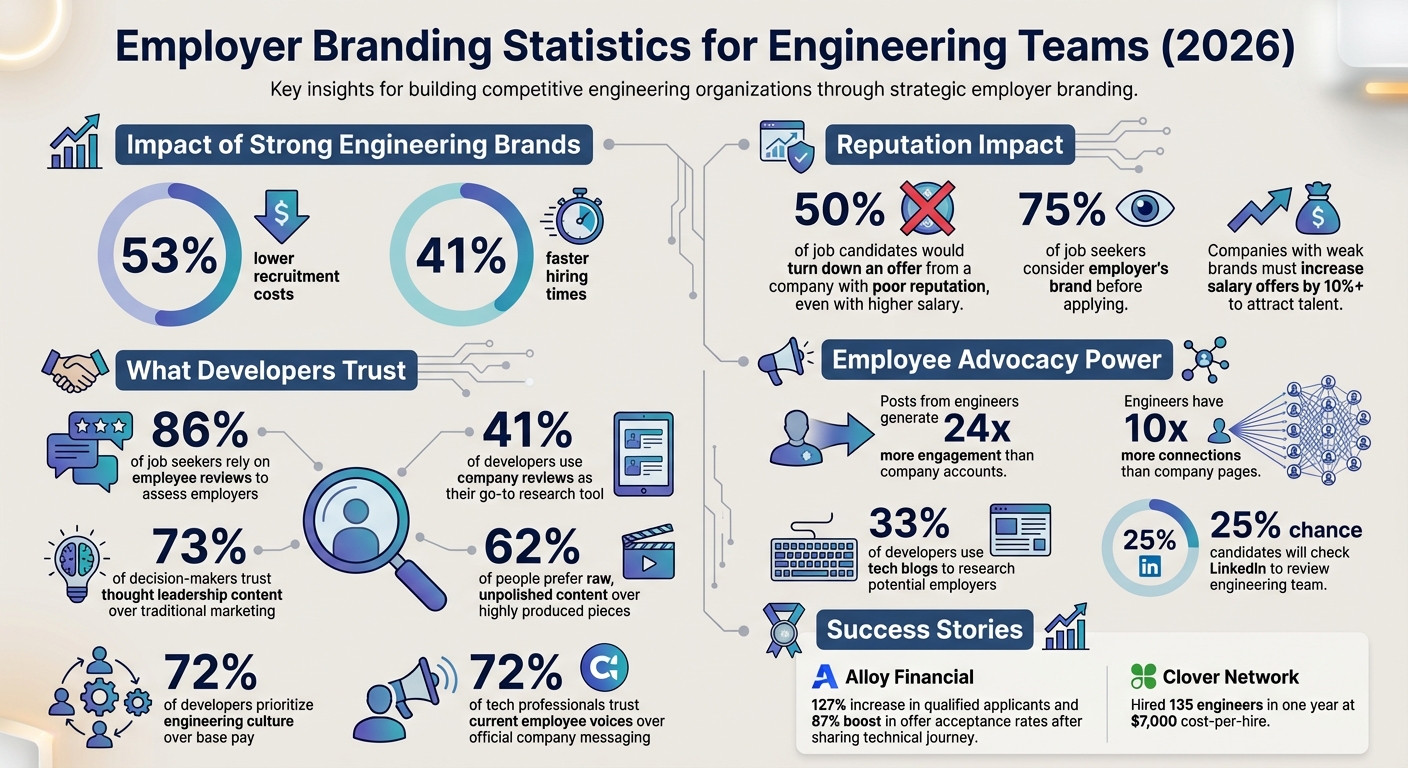 {Key Employer Branding Statistics for Engineering Teams 2026}
What Employer Brand Means to Developers (Not HR)
When HR teams craft Employee Value Propositions (EVPs), they often highlight compensation, benefits, and diversity initiatives. While these points matter, developers tend to see them as secondary. What truly grabs their attention? Technical credibility. Developers are far more interested in GitHub activity, engineering blogs, and feedback from peers than polished corporate narratives.
The numbers back this up. A whopping 86% of job seekers rely on employee reviews to assess potential employers . For developers specifically, 41% use company reviews as their go-to research tool . And when they stumble upon your job posting, there's a 25% chance they'll immediately head to LinkedIn to check out your engineering team. They want to see if these are people they’d actually want to work with . This focus on peer validation is a far cry from HR's usual playbook.
Developers are drawn to entirely different signals. For instance, 73% of decision-makers trust thought leadership content over traditional marketing materials . And 62% of people prefer engaging with raw, unpolished content rather than highly produced pieces . That’s why an in-depth technical blog post often outshines a sleek corporate video - it feels more real.
This divide between HR and developers becomes even starker when you consider their priorities. HR focuses on metrics like retention and cost-per-hire. Developers? They’re looking for proof of technical excellence. Signals like active GitHub repositories, engaging blog posts, and open-source contributions speak volumes. And here’s the kicker: 50% of job candidates would turn down an offer from a company with a poor reputation, even if the salary is higher .
One of the most effective ways to build trust is through content shared by employees. Posts from engineers generate 24x more engagement than the same message from a company account . Why? Because when a senior engineer shares a personal story about solving a tough performance issue, it carries weight. It’s authentic. On top of that, engineers often have 10x more connections than the company’s official page . This makes their personal brands a powerful asset in attracting top talent. Developers trust these genuine voices far more than any scripted recruitment campaign, reinforcing the idea that authenticity trumps corporate polish every time.
Hiring engineers?
Connect with developers where they actually hang out. No cold outreach, just real conversations.
The 5 Signals Developers Check Before Applying
Before hitting "Apply", developers dig deeper than just reading your careers page or mission statement. They check five key signals to understand what it’s really like to work on your engineering team. Let’s break them down.
| Signal | Impact on Candidate Decision | What Developers Look For |
|---|---|---|
| Glassdoor Reviews | High (Social Proof) | Authenticity, management quality, work-life balance, and "cons" |
| GitHub Activity | High (Technical Proof) | Code quality, open-source contribution, and engineering transparency |
| Tech Blog | Medium (Expertise) | Problem-solving approaches, learning culture, and technical depth |
| Interview Experience | High (Respect/Standards) | Technical rigor, respect for time, and clear communication |
| Tech Stack Transparency | High (Alignment) | modernity of tools, technical debt considerations, and autonomy in tool selection |
Glassdoor Reviews
Glassdoor reviews give developers a glimpse into your company culture through the eyes of current and former employees. They’re not just looking at star ratings - they’re diving into the "Cons" section to spot potential red flags. Issues like "lack of leadership", outdated tools, or excessive overtime are quick deal-breakers .
"The recurrent issues expressed by developers in [reviews] are related to work planning, lack of leadership, and inadequate technical tools." - Nathalie Figuière, CoderPad
This matters because half of job seekers will turn down an offer from a company with a poor reputation, even if the pay is higher . Developers also check reviews about interview experiences. If they see complaints about disorganized interviews or disrespectful treatment, they’ll likely move on without a second thought.
Next up - how your GitHub activity can bolster your engineering credibility.
GitHub Activity
Your GitHub presence speaks volumes about your engineering culture. Developers check repositories to assess code quality, documentation, and your contributions to the open-source community. This is where your team’s technical transparency shines - or doesn’t.
Companies that actively engage in open-source and showcase their engineering practices often see 53% lower recruitment costs and 41% faster hiring times . For example, in 2024, Alloy Financial shared their journey of transitioning from a monolith to microservices on GitHub. They included Architecture Decision Records (ADRs) to illustrate their thought process. The result? A 127% increase in qualified applicants and an 87% boost in offer acceptance rates .
Developers don’t just want to see frequent commits - they’re looking for meaningful contributions. Sharing internal tools, providing thorough documentation, and being honest about challenges (not just polished successes) shows that your team values collaboration and transparency.
Tech Blog Content
A tech blog offers a window into your team’s problem-solving mindset. Developers are drawn to content that dives deep into technical challenges, like architecture decisions, performance optimizations, or postmortems of production incidents. In fact, 33% of developers use tech blogs to research potential employers .
The key? Quality over polish. A raw, detailed post about solving a tricky bug or migrating to a new framework can resonate far more than a glossy marketing piece. When you explain why you chose certain technologies and how they address your unique challenges, you’re giving candidates a preview of the work they’d be doing.
Your blog can also highlight your tech stack choices, which brings us to the next signal.
Team Interview Experiences
Your interview process says a lot about your engineering standards and respect for candidates. Developers evaluate how well-organized your process is, whether technical challenges are meaningful, and how their time is valued. If your interviews feel chaotic, it suggests your engineering team might be the same.
Clover Network’s Head of Recruiting, John Vormbaum, tackled this by clearly defining the company’s technical identity and interview expectations through an Employee Value Proposition (EVP) exercise. This clarity helped them hire 135 engineers in a year while keeping their cost-per-hire at just $7,000 - a competitive edge against bigger players like Square .
A respectful, well-structured interview process not only attracts top talent but also reinforces your team’s commitment to high standards.
Tech Stack Transparency
Developers want to know what tools they’ll be working with before they even apply. For 72% of developers, engineering culture and practices matter more than base salary . Your tech stack isn’t just about functionality - it reflects your team’s priorities, whether it’s scalability, developer efficiency, or type safety.
Be upfront about the tools you use and why. For instance, if you’re running PostgreSQL with Redis for caching, explain how that setup fits your needs and what you’re considering for future improvements. This kind of transparency helps candidates self-select, saving everyone time and reducing turnover. It also signals that your team values the same technical rigor that developers care about.
Building an Engineering Blog That Attracts Candidates
An engineering blog can be a powerful way to showcase your team’s technical skills and problem-solving abilities. Developers look for implementation-level details about topics like distributed systems, API design, and infrastructure decisions. They want to understand the "why" behind your technical choices, and your blog can serve as a window into your team’s approach to solving real-world challenges . Much like GitHub activity or a transparent interview process, your blog should reflect authentic engineering experiences.
Consistency is key when it comes to publishing. A biweekly schedule is manageable and helps maintain a steady flow of content. For example, in April 2019, Software Engineer Sekhar Paladugu revitalized the AdHawk (now Broadlume) Engineering Blog by dedicating just 10% of a developer's sprint time - around 2–4 hours - to writing. This approach engaged 25 engineers and kept the blog active without overwhelming the team . Allocating specific time for planning, drafting, and reviewing ensures that posts are well-thought-out and polished. This kind of discipline and transparency in your blog sets the foundation for a broader brand narrative.
When creating content, focus on problem-solving stories that highlight your team’s expertise. Cloudflare is a great example - they keep developers engaged by sharing detailed incident reports on DDoS mitigation and DNS infrastructure. These posts dive deep into technical challenges and show how their team addresses complex issues . Content like post-mortems, architecture decisions, and scaling challenges resonates because it provides a behind-the-scenes look at how your team handles real-world technical crises.
"Engineering blogs explain the reasoning behind technical choices, making them useful for developers solving similar problems." - Draft.dev
To make your blog stand out, write with clarity and authority. Every post should go through a technical review by an engineer to ensure accuracy . A single well-written tutorial that solves a genuine technical problem can do far more for your employer branding than dozens of generic posts .
Open Source as Employer Branding
Open source isn't just about sharing code - it’s a powerful way to highlight your engineering culture and attract talent. By contributing to public repositories, your team demonstrates its coding standards, review processes, and overall technical quality. This level of transparency builds trust and credibility in ways that polished marketing materials or careers pages simply can't match . It's like providing a behind-the-scenes look at how your team works, complementing what you share through GitHub activity and technical blogs.
Ahmet Altay, Software Engineering Manager at Google, sums it up perfectly:
"Let your team's open-source work speak for itself. Since your team is working in the open already, you can point to those artifacts in your blog posts, conference presentations, and other public-facing materials" .
Every pull request, issue discussion, and code review becomes a showcase of your engineering values - whether it's your commitment to quality or your collaborative approach with external contributors.
Beyond credibility, open source also signals innovation. Adopting and contributing to niche technologies can attract a passionate developer community. As Aline Lerner, CEO of interviewing.io, explains:
"Choosing a fringe or niche stack or language can be a great way to attract the entire community around it. The more culty a language, the more fiercely passionate its acolytes will be about working for you" .
For example, contributing to Rust or Go projects sends a clear message to those communities: they'll get to work with tools they love.
However, it's not about the volume of contributions; quality matters more. A thoughtfully crafted bug fix, backed by clear validation and concise documentation, can demonstrate senior-level engineering skills better than a massive refactor . Think of your pull requests as technical writing - structure them to explain the changes, the reasoning behind them, and how they were tested. This approach gives potential hires insight into how your team communicates and solves problems.
Open source does more than build credibility - it fosters connections with the broader developer community. By collaborating openly, you break down the "us versus them" mindset, creating opportunities to engage with external contributors who already understand your codebase and culture . This makes open source a unique way to connect with passive talent - right where they are: in the code itself .
Developer Community Engagement
Engaging with the developer community goes far beyond showcasing your logo or brand name. It’s about establishing genuine connections and showcasing technical expertise in a way that builds trust. Developers - especially those who aren't actively job hunting - often rely on community trust rather than traditional job boards when evaluating potential employers. This makes authentic participation a powerful tool for reinforcing your engineering brand.
The golden rule? Give before you get. Share your knowledge, offer help, and contribute resources without expecting anything in return. For example, answer questions on Stack Overflow, join Reddit programming discussions, or provide thoughtful feedback on GitHub issue threads. These actions don’t just solve problems - they build lasting trust. Developers remember the companies and engineers who’ve helped them, creating a natural foundation for future initiatives like meetups and conference participation.
Meetups and Local Events
One way to build these connections is through in-person events. Hosting or sponsoring local meetups allows developers to interact with your team in a relaxed, informal setting while gaining insight into your company’s work and culture.
Platforms like Meetup.com or LinkedIn can help you organize events tailored to specific technologies or challenges your team is tackling. Whether it’s a Python workshop, a React Q&A session, or a discussion on solving complex engineering problems, these gatherings showcase your team’s expertise while fostering relationships within the local developer community. Remember, the goal isn’t immediate recruitment - it’s about becoming a trusted and familiar name.
Conferences and Sponsorships
Conferences offer a broader stage to amplify your presence and position your team as thought leaders. When your engineers present at conferences, they’re not just sharing knowledge - they’re giving the community a glimpse into the challenges your company solves and the innovative approaches your team takes.
Sponsorships can further enhance your visibility, but they work best when paired with active participation. Instead of simply setting up a booth, ensure your team attends sessions, engages with attendees, and contributes meaningfully to the event. Partnering with organizations like Women Who Code can also highlight your commitment to inclusion and help you connect with diverse talent pools. Developers notice and remember companies that engage sincerely - far more than those who just hand out branded swag.
Social Proof That Works: Real Engineer Stories
When it comes to reaching developers, traditional corporate messaging often falls flat. Developers tend to trust their peers far more than they trust polished marketing campaigns. In fact, 72% of tech professionals say they trust the voices of current employees over official company messaging . That’s why authentic, unfiltered stories from your engineering team can be far more impactful than any scripted recruitment video.
Why does this matter? Because candidates are looking for more than just promises - they want proof. They need to see that the day-to-day reality of working at your company matches what you claim. Transparency is key here. A poor reputation can hurt you - 50% of candidates will reject a job offer from a company with a bad reputation . Real stories from your engineers help bridge that trust gap between engineers and recruiters.
To gather these stories, avoid generic testimonials. Instead, use specific, thoughtful prompts like:
- "What’s the most valuable thing you’ve learned from a teammate?"
- "How has working here shaped your career?"
These kinds of questions make it easier for developers to share meaningful insights. You can also mine existing resources like internal newsletters, project write-ups, or onboarding surveys for authentic highlights that reflect their experiences.
"Tech talent you're hoping to attract may not remember your latest product release, but they will remember the authentic stories told by your very own developers."
– Stack Overflow
Another effective strategy is encouraging engineers to share their experiences on their personal social media accounts. Provide light guidance - like suggested hashtags, messaging ideas, or images - but don’t overstep. Their voice should remain their own. To make participation more appealing, some companies offer rewards like public recognition, gift cards, or even extra time off . The goal is to keep it simple, optional, and genuine. Over-polishing or forcing participation can backfire, as authenticity is what truly resonates with developers.
Up next, we’ll dive into how you can measure the real-world impact of these stories on your hiring efforts.
Measuring Employer Brand Impact on Hiring
You can't improve what you don't measure. 75% of job seekers consider an employer's brand before they even apply . This means your branding efforts play a direct role in shaping who enters your hiring pipeline. The tricky part? Connecting your branding work - like technical content - to actual hiring outcomes. To tackle this, a modern framework for engineering talent acquisition is essential.
Anton Anokhin, an employer branding expert with over 13 years of experience, suggests tracking metrics across four stages: Visibility, Knowness, Attraction, and Satisfaction . Here's how these stages break down:
- Visibility: Focuses on your web presence and social media reach.
- Knowness: Involves gauging awareness through Glassdoor reviews and surveys.
- Attraction: Tracks how branding translates into hiring metrics like application rates, applicant quality, and offer acceptance rates.
- Satisfaction: Measures internal metrics like eNPS (Employee Net Promoter Score) and retention rates, which ultimately influence your external brand perception.
One critical metric to watch is the applicants-to-interview ratio. If this number exceeds 12%, it’s a good sign your branding is attracting high-quality candidates . Additionally, track offer acceptance rates and survey candidates who decline offers. Companies with weaker brand reputations often have to increase salary offers by at least 10% to attract talent . Analyzing rejection patterns can help identify gaps between your brand’s promise and its reality.
Employee-generated content, such as engineers sharing posts on LinkedIn, can also be a game-changer. Monitor how spikes in traffic to your tech blog align with visits to your careers page and subsequent applications . As Anokhin emphasizes:
"The only way to understand if the employer brand is strong is to evaluate its success through metrics and, more often, a system of proxy-metrics" .
While data is essential, don’t forget to leave room for creative, less quantifiable initiatives. Word-of-mouth, for instance, remains one of the most influential - yet hardest to measure - factors in engineering hiring . Striking a balance between measurable strategies and innovative experiments ensures a well-rounded approach. These metrics lay the foundation for exploring how daily.dev Recruiter can elevate your employer brand.
How daily.dev Recruiter Amplifies Your Employer Brand
daily.dev Recruiter takes your employer branding to the next level by making your engineering content - like tech blogs, open-source projects, and community posts - highly visible to developers. It turns this content into a targeted distribution channel within a professional network that developers trust. This ensures your job opportunities are showcased right alongside the technical resources developers rely on.
The platform uses an opt-in model that respects how developers prefer to engage. Forget impersonal cold outreach - here, job opportunities are shown only to developers who have expressed interest. This shifts recruitment from generic mass messaging to a more trust-based, personalized connection, aligning perfectly with the transparency and authenticity developers value.
Your job briefs become a crucial part of this discovery process. By including clear details about your tech stack, engineering challenges, and team dynamics - along with customized screening questions to assess technical fit and mindset - you engage developers who typically ignore unsolicited messages. This approach integrates smoothly into your overall recruiting strategy. For more tactical advice, check out our tech recruiting cheatsheet.
With daily.dev Recruiter, your brand connects with developers in real time, creating meaningful, non-transactional introductions. Plus, you can try it risk-free with a 30-day free trial to see how your job briefs perform. By placing your opportunities where developers already turn for trusted content, you'll attract candidates who truly understand and align with your mission.
Conclusion
Creating an employer brand that truly connects with developers in 2026 relies on showcasing technical credibility and genuine engineering insights - not polished marketing campaigns. Developers want to know how your team approaches challenges, why you’ve chosen your tech stack, and whether your engineering culture matches what you claim publicly. The best companies achieve this by sharing architecture decision records, publishing transparent technical blogs, and letting engineers tell their own stories without HR filters.
The data supports this approach: 72% of developers prioritize engineering culture over base pay, and Alloy Financial saw a 127% surge in qualified applicants and an 87% increase in offer acceptance rates after openly documenting their technical journey, including the hurdles they faced .
These numbers highlight a shift in what developers value. They’re not drawn to surface-level perks - they want to solve meaningful technical problems alongside talented peers. As Stripe puts it:
"World-class talent wants to work alongside other world-class talent" .
To attract this talent, your employer brand should spotlight the challenges your team is tackling, the growth opportunities for engineers, and the thought process behind your technical decisions.
Being genuine is key to avoiding mismatched expectations. Misleading candidates about your tech stack or culture can lead to technical headaches and operational friction. Instead, be upfront about your current challenges and share how you’re working to improve. This honest approach - acknowledging where you are and where you’re headed - builds the trust developers look for.
Ultimately, your employer brand isn’t something you fabricate. It’s a reflection of how your engineering team genuinely operates, communicated through your code, technical content, and the voices of your engineers. This authentic narrative is what resonates most with developers and sets your organization apart.
FAQs
Where should engineering employer branding start?
To connect with developers, it's important to first understand how they view "employer brand" - a perspective that often differs from HR's. For developers, it’s less about polished corporate messaging and more about genuine communication through channels they trust.
Focus on platforms and activities that resonate with developers, such as participating in open source projects, publishing technical blogs, and engaging with developer communities. Transparency is key here. Developers appreciate authenticity, so showcase real touchpoints like your GitHub profile, the team’s culture, and the technologies your company uses. These elements can help build trust and make your organization more appealing to top talent.
How do we look credible on GitHub without oversharing?
To establish credibility on GitHub while keeping things professional, aim for quality over quantity. Highlight your strongest work by pinning your top repositories, crafting clear and detailed READMEs, and showcasing meaningful contributions. Steer clear of adding unnecessary or overly personal information to keep your profile polished and focused.
Which metrics prove employer branding improves hiring?
Metrics such as the number of applications, offer acceptance rate, and cost-per-hire provide a clear picture of how employer branding influences hiring. These numbers not only help evaluate the success of your efforts but also demonstrate the importance of building a strong employer brand.
.png)