Hiring 500+ engineers requires more than just scaling up your current recruiting efforts. It demands a structured, efficient, and data-driven approach. Here's what you need to know:
- Challenges: High competition, low unemployment (2.2% for developers), and increasing turnover (38% of Gen Z sees early roles as temporary).
- Key Focus Areas:
- Build a repeatable recruitment system instead of relying on ad-hoc methods.
- Reduce inefficiencies in interviews, decision-making, and coordination.
- Avoid shortcuts that compromise quality - bad hires are costly.
- Developer-Centric Approach:
- Use skills-based evaluations and assess learning ability over rigid experience requirements.
- Offer trial periods to reduce bad hires and improve candidate fit.
- Data-Driven Hiring:
- Track metrics like reducing time-to-hire, offer acceptance rates, and technical screening pass rates.
- Identify pipeline bottlenecks and optimize processes to reduce delays and costs.
- Sourcing Strategies:
- Leverage platforms like daily.dev Recruiter for passive talent with 5x better response rates.
- Tap into developer communities like GitHub, Stack Overflow, and Kaggle for niche skills.
- Automation and Tools:
- Use AI for resume screening, candidate ranking, and outreach to save time and improve targeting.
- Integrate ATS with sourcing tools for centralized workflows and better tracking.
- Structured Interviews:
- Standardize evaluations with role-specific rubrics and multi-stage panels.
- Train interviewers and use Bar Raisers to maintain hiring quality.
- Offer Strategies:
- Benchmark competitive compensation and move quickly - decide within 48 hours and extend offers in 24 hours.
- Highlight growth opportunities and team impact to attract top talent.
Scaling your recruiting process is about building a system that balances speed, quality, and scalability. By focusing on structured processes, developer-friendly outreach, and automation, you can hire effectively without sacrificing standards.
Assessing Your Current Hiring Capacity and Finding Bottlenecks
::: @figure 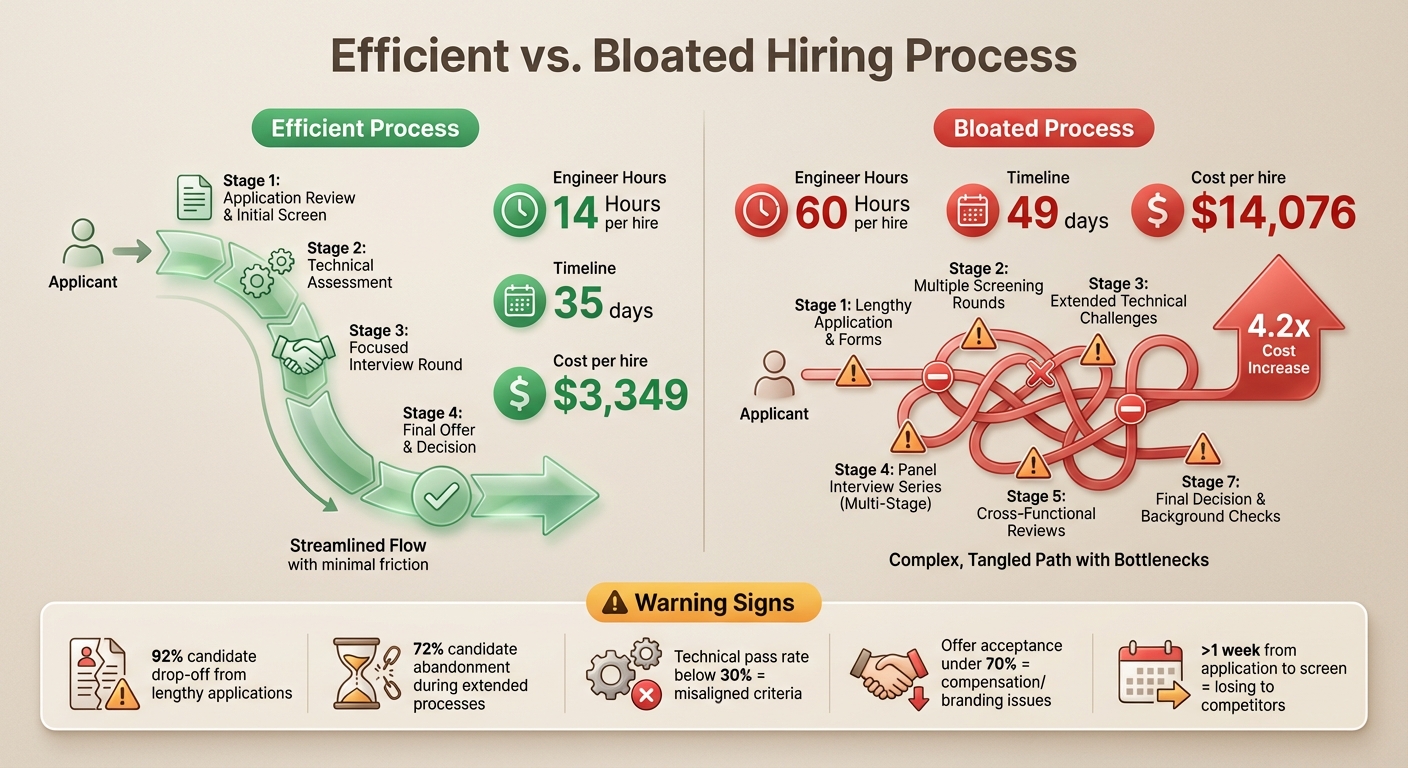 {Efficient vs Bloated Enterprise Hiring Process Comparison}
Start by taking a close look at your current recruiting process. Many companies find that their challenges aren't where they initially thought. It's rarely about needing more job postings or sourcing extra candidates. Instead, the real obstacles often lie in interview capacity, decision-making delays, and coordination issues - problems that tend to grow as teams expand. Understanding these areas is essential for improving your sourcing and screening strategies, which will be covered in later sections.
Reviewing Team Structure and Hiring Resources
To gauge your interview capacity, use this formula:
(Number of engineers × interview hours per week × 4 weeks) ÷ interview hours per hire.
For example, if you have 50 engineers dedicating 3 hours per week to interviews and each hire requires 15 hours, you can handle 40 hires per month. Trying to exceed this capacity risks overloading your team or sacrificing the quality of your hires.
As your team grows, consider evolving your structure to maintain efficiency. For every 20+ engineers, adding a Technical Recruiter can help manage candidate flow. For teams of 25-30 engineers, bringing in an Engineering Program Manager can streamline logistics and reduce bottlenecks. Additionally, ensure that engineering managers oversee no more than 5-8 direct reports. Exceeding this range can create management roadblocks, slowing down processes like scheduling interviews or approving offers.
Finding Pipeline Bottlenecks in Enterprise Recruiting
Once you've assessed your internal capacity and team structure, it's time to identify where candidates are getting stuck in your hiring pipeline.
Tracking stage-to-stage metrics is key. For instance:
- If it takes more than a week to move from application to recruiter screen, faster-moving competitors may be poaching your candidates.
- A technical pass rate below 30% might indicate misaligned screening criteria that don’t reflect your actual needs.
- An offer acceptance rate under 70% could point to issues with compensation, your employer brand, or how you’re presenting the role to candidates.
Efficient hiring processes often follow a streamlined structure: 4 stages, 14 engineer hours per hire, 35 days, and a cost of $3,349 per hire. Compare this to bloated processes that stretch to 6-7 stages, consume 60 engineer hours, take 49 days, and cost $14,076 per hire. Inefficiencies like redundant interview rounds, scheduling delays, and excessive data collection not only extend timelines but also inflate costs.
Pay attention to warning signs such as slower feature delivery, higher attrition among your top performers, which often requires a dedicated talent retention strategy or a decline in candidate quality. High drop-off rates can also signal inefficiencies - like 92% of candidates abandoning lengthy applications or 72% leaving during extended hiring processes. These inefficiencies can cost you both time and top talent.
Hiring engineers?
Connect with developers where they actually hang out. No cold outreach, just real conversations.
Building Scalable Sourcing Strategies
Once you've pinpointed the bottlenecks in your hiring process, it's time to overhaul your developer sourcing strategy. When your engineering team surpasses 500 members, relying on traditional job boards or cold LinkedIn messages just won't cut it anymore. To scale effectively, you need sourcing channels that tap into passive talent - developers who aren’t actively job hunting but might be intrigued by the right opportunity. The focus here is on moving away from mass outreach with low engagement and shifting toward precision targeting paired with personalized communication. This is essential for maintaining quality while scaling rapidly.
Using Developer-First Platforms for Sourcing
Developer-first platforms are a game-changer because they let you connect with engineers where they naturally spend their time - whether they’re reading technical content, engaging in discussions, or staying updated on their field. A great example is daily.dev Recruiter, which connects you with over 1 million active developers through warm, double opt-in introductions. This mutual opt-in process ensures that outreach is welcome and eliminates spam.
The numbers back up this approach: daily.dev Recruiter boasts 5x higher response rates than LinkedIn, with engagement rates reaching an impressive 40%, compared to the typical results from cold outreach. It also integrates directly with your ATS, reducing sourcing time by 30–50%. Companies like Microsoft and Atlassian have leveraged this platform to source over 200 senior engineers annually, achieving 35% interview conversion rates. For instance, in Q1 2026, a fintech company hired 50 backend developers specializing in Rust and Go by targeting these niche skills through the platform - completely bypassing oversaturated job boards.
This strategy works because developers actively opt in for career opportunities that match their interests and skills. AI-driven matching ensures that passive talent is identified and engaged at scale, making it easier to find the right candidates without wasting time.
Expanding Talent Pools Through Developer Communities
Another effective approach is to tap into the communities where developers showcase their work. GitHub is an excellent starting point for technical sourcing. You can search repositories that align with your role requirements - like "Kubernetes operator" for DevOps positions - and analyze contributor activity, forks, and stars to identify the top-performing maintainers. Personalized outreach based on GitHub profiles can make a big difference. Automating alerts for commits in target programming languages can yield a 25% response rate.
For specialized roles, Stack Overflow and Kaggle are invaluable. On Stack Overflow, you can target high-reputation users (500+ score) in relevant tags like "react-native" or "data-science" and engage with them via comments or careers profile links. For machine learning roles, Kaggle allows you to focus on the top 1% of kernel creators. By setting up weekly scrapes or API monitors and using skills assessments through shared notebooks, you can identify and connect with top talent. According to CompTIA data, this method has led to a 45% increase in diversity and a 35% improvement in retention.
Don’t overlook university programs and hackathons at schools like MIT and Stanford for accessing junior talent. Communities such as Hacker News and Dev.to are also excellent for connecting with mid-to-senior-level developers. Combining these external efforts with internal mobility programs and apprenticeships can yield impressive results - 70% of interns transition to full-time roles, diversifying your talent pool by 45%, cutting time-to-hire by 20%, and boosting retention by focusing on proven skills rather than credentials. With 78% of tech companies now adopting skills-based hiring through these platforms, you’re not just finding candidates - you’re finding candidates who’ve publicly demonstrated their expertise.
Automating and Streamlining the Recruiting Process
When you're scaling up to hire hundreds of engineers, manual processes quickly become unmanageable. Reviewing resumes one by one creates a bottleneck that slows everything down. That’s where AI-powered screening steps in, revolutionizing the process by automatically analyzing resumes for skills, experience, and qualifications. Instead of spending hours combing through 20 resumes, you can now process 500 in the same amount of time . AI doesn’t just skim the surface - it differentiates between deep, hands-on expertise (like five years of TensorFlow experience) and minor exposure. The result? Time-to-shortlist can shrink by 50% or more .
For example, filling 30 engineering roles might have taken weeks before. Now, with AI, qualified candidates can be shortlisted in just days, giving recruiters more time to connect with the best talent. AI also ranks candidates based on how well they fit the role, so recruiters can focus their efforts where it matters most. With 52% of talent leaders planning to integrate autonomous AI agents into their teams by 2026 , this shift from manual processes to AI-driven solutions is becoming the norm.
Using AI for Candidate Screening and Matching
AI’s real advantage lies in its ability to understand context through semantic screening. Instead of simply matching keywords, it uses natural language processing to grasp the meaning behind phrases. For instance, if a resume mentions "REST APIs", the system interprets this as API development experience and evaluates the complexity of the projects involved. Some platforms even take it a step further by scanning code repositories like GitHub to validate a candidate’s technical skills and proficiency in specific frameworks or architectures. This ensures claims on resumes are backed by real-world evidence.
Machine learning enhances this process by analyzing historical hiring patterns and career paths to predict which candidates are most likely to succeed. This predictive matching doesn’t just identify who fits the role today - it also highlights candidates with potential for future growth into senior positions. The impact is striking: 78% of tech companies using skills-based hiring report a 45% increase in candidate diversity and a 35% boost in retention rates . To make this work for your organization, ensure your applicant tracking system can handle high volumes, integrate AI tools for streamlined extraction and ranking, and train your team to use these features effectively . Once you have a refined shortlist, the next challenge is keeping candidates engaged throughout the process. This involves both technical evaluation and assessing soft skills to ensure a long-term cultural fit.
Automating Outreach and Follow-Ups at Scale
Identifying top candidates is only half the battle - consistent communication is key to keeping them engaged. Automation tools simplify this by centralizing communication and standardizing workflows, making it possible to send personalized outreach to large candidate pools without the need for manual follow-ups. Features like candidate rediscovery allow you to tap into past applicant data, quickly re-engaging qualified candidates for new roles. This keeps your talent pool organized and ready to go, categorized by industry and skillset .
The trick is to combine automation with a personal touch. Generic messages won’t cut it - outreach should reference specific details, like a candidate’s standout GitHub projects or their expertise in a particular tech stack. Properly configured automated follow-ups maintain momentum in your recruitment pipeline, freeing recruiters to focus on meaningful, one-on-one conversations with top candidates. As enterprise talent acquisition leaders look to 2026, many are planning further investments in hiring technology . These tools aren’t about replacing human judgment - they’re about giving teams the resources to handle data at scale, enabling more targeted and strategic outreach while reducing time-to-hire.
Designing Structured Interview Processes for Enterprise Engineers
Structured interviews are essential for consistent and fair candidate evaluation, especially when scaling enterprise engineering teams. Unlike unstructured interviews, which often lead to inconsistent assessments across technical, behavioral, and interpersonal dimensions, structured interviews offer a standardized approach. They ensure that every candidate is evaluated against the same criteria, reducing bias and improving the overall hiring process. Research backs this up - structured interviews have a predictive validity coefficient of 0.51, compared to 0.20–0.38 for unstructured ones, accounting for about 26% of the variance in job performance .
To make the most of this approach, think of interviews as a product you design, test, and refine. Work closely with engineering managers to create a competency blueprint for each role. Clearly define the "Must-Have" skills (e.g., Go and PostgreSQL for backend roles) versus "Nice-to-Have" skills (e.g., Python or GraphQL). Be specific about what proficiency looks like - whether it’s crafting complex SQL queries or understanding basic database relationships - so evaluators have a consistent framework to judge candidates' abilities.
Once the competency blueprint is in place, the next step is to develop detailed, role-specific evaluation rubrics.
Creating Role-Specific Evaluation Rubrics
Evaluation rubrics should focus on more than just technical correctness. They should also assess implementation quality, reasoning, and the ability to self-correct. For coding interviews, prioritize the candidate's thought process and problem-solving approach rather than just the final answer. Use clear, observable criteria - like identifying edge cases or optimizing for time complexity - instead of vague labels. This ensures that a "4 out of 5" rating means the same across your organization.
Behavioral interviews should align with your company values, using the STAR framework (Situation, Task, Action, Result) to guide questions. For example, if "ownership" is a core value, ask candidates to share a time they went beyond their defined responsibilities to drive a project forward. Score their responses based on the specificity and measurable impact of their actions. As the Karat Team wisely notes:
"If a competency is on the interview rubric it's signal. If it's not, then it's noise" .
Train interviewers to avoid being influenced by irrelevant factors like filler words, shyness, or upspeak, as these have no bearing on technical ability.
For technical questions, design problems with adjustable depth to suit candidates at different skill levels. For instance, a less experienced candidate might work on a simpler version of a problem for 20 minutes, while a more advanced candidate could tackle an extended version for up to 60 minutes. GitLab’s frontend engineering team offers a great example: in March 2021, they standardized their technical interview process with a project-based model. Candidates reviewed and fixed a partially implemented merge request in Ruby on Rails and Vue. By automating rubric scoring with Google Sheets and App Scripts, they confirmed that candidates with experience in Angular or React performed just as well as those familiar with Vue. This approach prevented a potential 70% reduction in their talent pool .
Once you’ve established clear rubrics, you can implement multi-stage panels to validate candidate fit.
Implementing Multi-Stage Interview Panels
A structured, multi-stage interview process ensures thorough evaluation without unnecessary delays. A four-stage model works well:
- Recruiter Screen (30 minutes)
- Technical Screen (60 minutes)
- Technical Deep-Dive (2–3 hours for system design or coding)
- Team Fit/Hiring Manager Review (60–90 minutes)
This format allows for parallel interviews across different regions, speeding up the process without compromising quality. To avoid anchoring bias, ensure that interviewers submit feedback independently before discussing candidates .
To scale your interview capacity, establish a training pipeline for interviewers. Start with shadowing experienced interviewers, move to reverse-shadowing, and then transition to conducting solo interviews. Regularly rotate interviewers to avoid fatigue, which can lead to default "no" decisions. Use this formula to calculate your maximum hiring capacity:
(Available engineers × sustainable hours per week × 4) / total interview hours per hire . For example, if this calculation shows you can only hire 15 engineers per month but your goal is 30, you’ll need to either expand your interviewer pool or streamline the process.
Consider adding a "Bar Raiser" program, where experienced engineers outside the immediate hiring team have veto power. This ensures quality remains a priority, even under hiring pressure . Require all feedback to be submitted within 24 hours to keep the process moving and details fresh. Additionally, hold quarterly calibration sessions where interviewers independently score anonymized candidates or mock interviews to align on what "meets the bar" means .
Optimizing Offer Strategies and Closing Candidates at Scale
Delays in the offer stage can derail weeks of hard work during the evaluation process, often causing you to lose top candidates. At the enterprise level, speed and accuracy are essential. Aim to make hiring decisions within 48 hours of the final interview and extend offers within 24 hours of that decision . This streamlined approach ensures you don’t lose momentum when securing in-demand talent.
Benchmarking Compensation for Enterprise Engineers
When it comes to niche roles, accurate compensation benchmarks are critical. In the U.S., software engineers earn an average base salary of $130,023, with total compensation (including bonuses, equity, and benefits) averaging $189,500 . That additional $59,477 in total compensation matters, especially since 41% of tech workers now prioritize immediate cash over long-term stock grants .
For specialized roles, compensation trends shift even further. Engineers with expertise in areas like MLOps, Cybersecurity Architecture, or Distributed Systems often command base salaries exceeding $235,000 . Even candidates outside of AI-focused roles, such as those with experience in LLM orchestration or vector databases, may see a 12% to 15% increase in initial offers . For Senior Software Engineers, base salaries typically hover around $155,678, with equity grants averaging 8.6% of base pay .
Tie compensation to the impact candidates can bring. For example, when hiring Site Reliability Engineers (SREs), highlight their role in preventing costly downtime - estimated at $9,000 per minute . In competitive hubs like San Jose or Seattle, expect to offer signing bonuses between $20,000 and $50,000 for top-tier architects .
Speeding Up Offer Approvals and Reducing Time-to-Close
Delays in approval processes can kill momentum. To avoid this, replace weekly hiring committee meetings with daily stand-ups during busy periods. Use pre-approved compensation bands for each role level to eliminate unnecessary back-and-forth with finance or leadership .
Introduce a "Bar Raiser" program to assess technical and soft skills and maintain hiring quality. This involves senior engineers from outside the immediate team who have veto power but aren’t pressured to fill the role . To keep the process efficient, require all interviewers to submit feedback within 24 hours, and use standardized scorecards to avoid "standard drift" that can complicate calibration .
When competing with Big Tech’s $400K+ total compensation packages, focus on what sets you apart. Highlight opportunities for career growth, meaningful equity, and the chance to make a visible impact .
"Frame the choice clearly - shipping one feature per year at a tech giant versus owning meaningful equity and shipping weekly at your organization."
Strive for an offer acceptance rate of 70-80% in a fast-scaling environment . Be transparent about your company’s growth trajectory and metrics. Overpromising can harm trust, so it’s better to share realistic expectations .
Integrating Tools for End-to-End Recruitment Management
When you're dealing with the challenge of scaling, integrating recruitment management tools isn't just helpful - it’s essential. Imagine managing over 500 engineering hires without a streamlined system. The result? Chaos. Disconnected tools lead to duplicated outreach, misplaced candidate data, and hiring managers constantly chasing recruiters for updates. The solution? Centralize your workflow by integrating sourcing, ATS (Applicant Tracking System), and onboarding tools to keep everything in sync and ensure smooth candidate tracking.
Centralizing Workflows with ATS and daily.dev Recruiter Integrations
Think of your ATS as the ultimate source of truth for all candidate activity. By integrating it with daily.dev Recruiter, you can seamlessly push warm, double opt-in introductions into your pipeline - no manual data entry required. This integration eliminates the hassle of switching between platforms, ensuring that every candidate interaction is automatically logged and tracked.
Traditional sourcing methods, like job boards and cold LinkedIn emails, often yield reply rates of just 5–8%. But when you combine daily.dev Recruiter with your ATS, personalized outreach can achieve 85–90% reply rates. Plus, every interaction is automatically recorded, eliminating delays and manual errors. A centralized system not only streamlines your workflow but also lays the groundwork for tracking key metrics that can refine and improve your hiring process.
Tracking Metrics and Optimizing Recruitment Workflow
Once your tools are integrated, tracking recruitment metrics becomes much simpler - and more actionable. Metrics are your guide to understanding and improving your process. Here are some key ones to monitor:
- Time-to-Hire: Measures how quickly you make decisions and fill roles.
- Technical Assessment Pass Rates: Helps gauge the quality of candidates in your pipeline. Using a data-driven approach helps you identify qualified technical candidates in minutes by setting clear criteria early.
- Offer Acceptance Rate: Reflects whether your compensation and candidate experience are competitive enough.
- Cost-per-Hire: Accounts for your total recruitment spend, from tools to labor.
- Source-to-Close: Tracks how effectively each channel converts candidates.
But don’t stop there. Go beyond hiring metrics to measure how quickly new engineers become productive. For senior hires, this Time to Productivity should be under 30 days . If it takes longer, the issue likely lies in your onboarding process - not your sourcing methods. Centralizing and integrating your tools helps you identify and address these bottlenecks more effectively.
Conclusion
Scaling technical recruiting to 500+ engineers isn’t about working harder - it’s about working smarter. By building a structured infrastructure, you replace ad-hoc hiring with a predictable, repeatable process. This shift requires key elements like structured rubrics, calibrated interviewers, and fast hiring cycles under two weeks . Without these foundations, even the hardest efforts can’t overcome inevitable bottlenecks.
Here’s the paradox: moving faster doesn’t mean cutting corners - it means adding more structure. A developer-first sourcing strategy, combined with standardized evaluations and trained Bar Raisers, ensures quality isn’t sacrificed as hiring volume scales . These tools help prevent bottlenecks while maintaining high standards.
But hiring at scale is only half the equation. Your onboarding system must keep pace. Typically, a team can absorb only 2–3 new engineers per senior engineer each quarter without risking quality . If new hires take more than 30–60 days to become fully productive, the problem might not be sourcing - it could be your onboarding process . Seamless integration of new hires is just as critical as finding them.
The strategies discussed - like warm, double opt-in introductions, centralized tools, tracked metrics, and automation - turn recruiting into a sustainable growth engine. These tools don’t just save time; they provide the visibility needed to refine and improve your process continuously. At enterprise scale, they’re not optional - they’re essential for meeting ambitious hiring goals. By adopting these practices, your organization can consistently hit its growth targets and build a scalable, efficient recruitment system.
FAQs
How do I calculate our maximum monthly engineering hiring capacity?
To figure out how many engineers you can hire in a month, start by looking at two key factors: your average time to hire and your pipeline capacity. Here's how you can break it down:
- First, identify your average time to hire. For instance, if it typically takes 30 days to hire someone, that's your baseline.
- Next, calculate how many hiring cycles you can complete in a month. For example, if your time to hire is 30 days, you can complete 1 cycle per month (30 days ÷ 30 days = 1 cycle).
- Finally, evaluate how many candidates you can realistically process during each hiring cycle.
If you want to boost your hiring capacity, focus on making your processes more efficient and cutting down the time it takes to hire.
Which recruiting metrics best reveal where our pipeline is breaking?
Recruiting metrics like time-to-hire, offer acceptance rate, candidate quality, and source of hire are essential for identifying problems in your hiring pipeline. These numbers shine a light on delays, mismatches, and inefficiencies, helping you address specific areas that need improvement.
How can we use AI and automation without lowering hiring quality?
AI and automation offer powerful tools to simplify high-volume hiring by taking over repetitive tasks such as sourcing candidates, screening applications, and scheduling interviews. However, it's crucial to strike the right balance - human oversight is essential to ensure fairness, compliance, and quality throughout the process. By integrating automation with a well-coordinated hiring strategy, companies can scale efficiently without sacrificing the candidate experience or overall hiring standards.
.png)