Hiring for "culture add" instead of "culture fit" can help you build diverse, high-performing engineering teams. Here's the key takeaway: Instead of asking if a candidate fits your existing team norms, focus on what new perspectives they bring while aligning with core values like integrity or curiosity.
Why does this matter? Teams that prioritize diverse viewpoints are 19% more likely to generate higher revenue and retain employees longer. But assessing "culture add" without introducing bias is the real challenge. Here's how to do it:
- Define clear, actionable values: Avoid vague phrases like "team player." Instead, set measurable criteria tied to your team's goals.
- Use structured interviews: Ask behavioral questions that reveal past actions - like handling disagreements or solving problems in unique ways.
- Reduce bias in technical hiring: Skip the "gut feeling" or "beer test", which often reinforce sameness. Use standardized scorecards and diverse interview panels.
- Support diverse working styles: Create team norms that accommodate different communication and work preferences, such as asynchronous updates or no-meeting days.
- Focus on "Additive Potential": Assess how candidates' skills and experiences fill gaps in your team while maintaining alignment with shared values.
Culture Fit Is Dead: Why Culture Add Matters for Engineering Teams
::: @figure 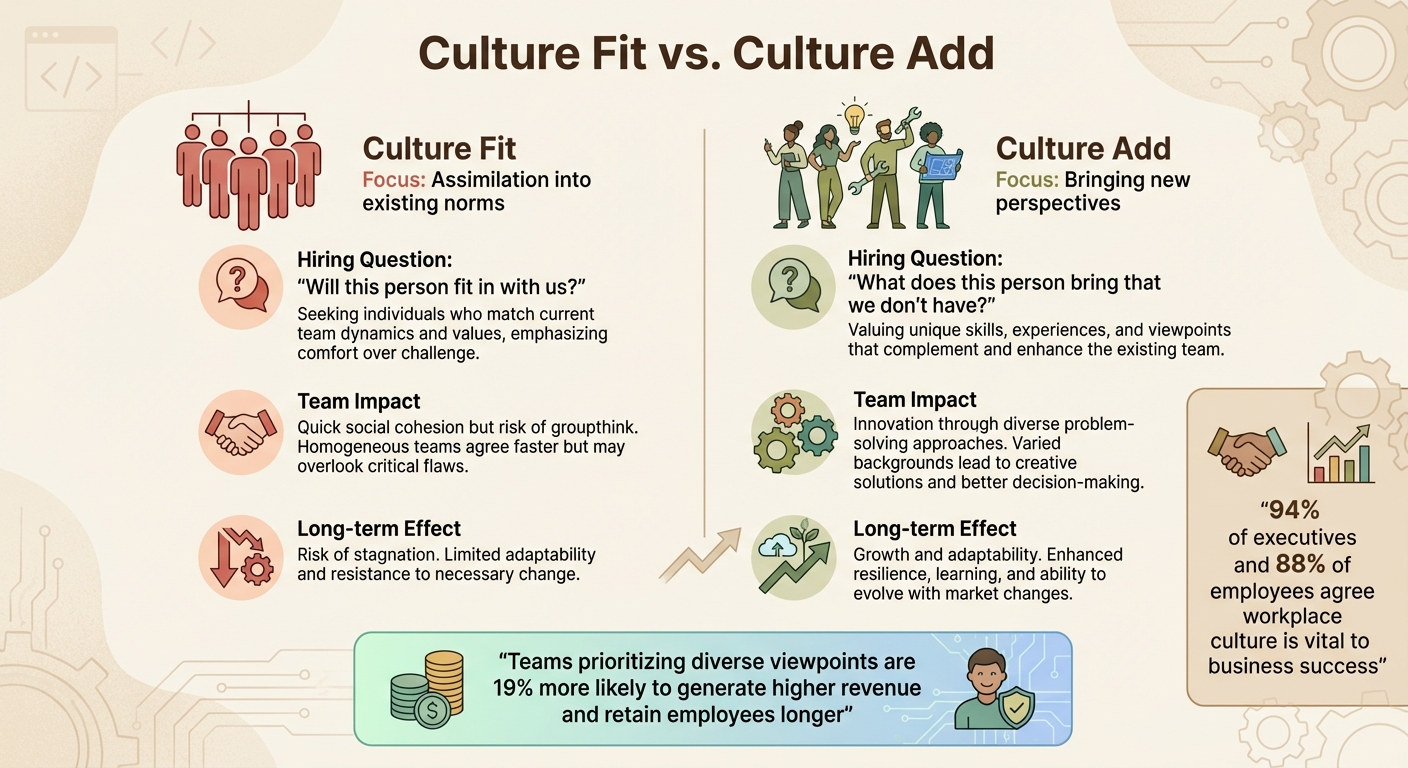 {Culture Fit vs Culture Add: Key Differences in Engineering Hiring}
As hiring practices evolve to address inherent biases, it's time to rethink what truly matters when building engineering teams. The concept of "culture fit" has long dominated recruiting strategies, but this approach often reinforces sameness, stifling potential and innovation.
The Bias Trap: How Culture Fit Becomes a Proxy for Hiring People Who Look and Think Like You
The idea of culture fit often hinges on subjective criteria like the "beer test", where managers assess whether they’d enjoy socializing with a candidate after work. While this might seem harmless, it prioritizes personal comfort over a candidate's skills and contributions. This tendency can lead to hiring individuals who share similar backgrounds, communication styles, or even hobbies, mistaking familiarity for capability.
"Hiring for fit often results in bringing in people with similar experiences or viewpoints, limiting the range of opinions and approaches within a team. This can smother creativity and block adaptability."
- arol.dev's Team
When teams become too uniform, they risk embedding bias into their work. A lack of diverse perspectives can result in blind spots - whether it’s overlooking accessibility needs, missing edge cases, or failing to identify security risks .
"Worse still, hiring for fit tends to amplify biases and prejudices. People who are 'different' might be rejected or excluded... because managers assume they will be difficult to work with."
- Ahsan Raza, Content Writer, Qureos
Employee referrals, often celebrated as a top recruiting tool, can unintentionally worsen this problem. By bringing in candidates who think and act like the referrer, referrals can encourage groupthink, where assumptions go unchallenged and adaptability suffers.
What Culture Add Brings to Engineering Teams
Shifting the focus from culture fit to culture add transforms the hiring process. Instead of asking, "Will this person fit in?" the question becomes, "What fresh perspective does this candidate bring to the team?" This approach seeks out differences in experience, technical expertise, and problem-solving styles while maintaining shared core values like accountability, curiosity, and integrity.
"Culture fit asks: will this person thrive in our existing environment? Culture add asks: will this person bring something new that enriches our culture?"
- jobsbyculture.com
In engineering, this mindset allows teams to tackle challenges from a variety of angles rather than relying on a single viewpoint. For example, a backend engineer with hardware experience might identify performance issues others overlook, while someone with an unconventional background might question outdated design assumptions. These diverse insights strengthen teams and prepare them to navigate the fast-paced changes of the tech world .
The data backs this up: 94% of executives and 88% of employees agree that workplace culture is vital to business success . The key, however, lies in building a culture that thrives on diversity. Teams that prioritize culture add over culture fit benefit from the cognitive variety needed to foster innovation, all while staying grounded in their core principles.
| Aspect | Culture Fit | Culture Add |
|---|---|---|
| Primary Focus | Assimilation into existing norms | Bringing new perspectives |
| Hiring Question | "Will this person fit in with us?" | "What does this person bring that we don’t have?" |
| Team Impact | Quick social cohesion but risk of groupthink | Innovation through diverse problem-solving approaches |
| Long-term Effect | Risk of stagnation | Growth and adaptability |
This shift doesn’t mean abandoning your team's values - it’s about distinguishing between essential principles and personal preferences. Building a team of like-minded individuals may feel comfortable, but it risks creating an echo chamber. By embracing culture add, engineering teams can unlock the diverse thinking needed to innovate and thrive. This sets the groundwork for defining the engineering values that truly matter, which we'll explore next.
Hiring engineers?
Connect with developers where they actually hang out. No cold outreach, just real conversations.
Defining Your Engineering Values: What Actually Matters vs Vague Platitudes
Before assessing how someone might add to your team’s culture, it’s important to define what your team actually values. Without this clarity, evaluations often rely on empty phrases that sound nice but don’t provide actionable guidance. Terms like “team player” or “hard worker” are too vague to be effective because they lack clear opposites or measurable criteria.
"A useful value is reversible, applicable, and honest."
- Will Larson, CTO, Carta
For a value to be truly useful, it must be reversible - its opposite should represent a legitimate alternative strategy. For example, “Ship early and often” contrasts meaningfully with “Prioritize polish and delight.” On the other hand, a phrase like “We hire the best” doesn’t offer any meaningful trade-off .
Identifying Concrete Engineering Values
To define your values, start by analyzing what drives your team’s current decisions. Look at the real forces shaping how work gets done. For example, in March 2026, Figma emphasized the value of “Communicate early and often.” This value required technical specs to include peer feedback before being considered complete, even though the process introduced slower decision-making due to the increased input .
Between 2011 and 2021, Sarah Wells, a Tech Director at the Financial Times, led a transformation by tying values to measurable outcomes. Examples included setting OKRs like “gender parity in Product & Tech by 2023” and ensuring “50% of hires this quarter will be women, trans, or non-binary.” These clear, actionable goals helped shift the department from having just a handful of women developers to achieving 35% representation of women and non-binary staff across all levels .
To uncover your own team’s values, consider conducting a values retrospective. Use sticky notes to capture key behaviors such as deployment frequency, autonomy in remote work, or code review standards. Group these into themes like “How we make progress,” “How we work together,” and “How we solve problems.” This process can help surface the unwritten rules that guide your team’s behavior .
Once your values are clearly defined, the next step is to turn them into actionable, measurable criteria.
Replacing Generic Phrases with Specific Criteria
After identifying concrete values, reframe generic phrases into standards that guide decision-making. For example, if your team values “Seek feedback,” make it clear when a technical spec is considered “done” - such as after gathering and incorporating peer input . Gearset offers a great example of this approach. In January 2026, they replaced vague goals with a prioritized list:
- Make customers succeed
- Deliver value already created (e.g., ship implemented changes)
- Facilitate colleagues’ progress (e.g., unblock others)
- Move one’s own tasks forward
This hierarchy helps engineers adjust quickly when priorities shift .
Here’s how some vague phrases can be transformed into actionable values:
| Vague Platitude | Actionable Engineering Value | Measurable Criteria |
|---|---|---|
| "Team Player" | Facilitate colleagues' progress | Reviewing and merging others' code before starting personal tasks |
| "Quality First" | Treat causes, not symptoms | Identifying root causes instead of adding special-case fixes |
| "Fast-paced" | Release good now, rather than perfect next week | Breaking work into the smallest useful chunks to deliver immediate results |
| "Hard Worker" | Deep Work / Focus | Maintaining 4+ hours of uninterrupted focus on complex tasks |
Each value should include a clear “why” and the trade-off. For instance, under Dan Pupius’s leadership at Medium Engineering in March 2026, the team adopted the value “Professional & personal growth is more important than team stability.” This was made actionable by allowing engineers to rotate between platforms and contribute directly to product direction, even if it temporarily disrupted team consistency. The trade-off? Long-term talent development .
Finally, integrate your values into your team’s definition of done. For example, if “Understand the problem before solving it” is a core value, require engineers to engage with a customer or investigate the root cause before writing code . When values are specific and actionable, they not only guide team behavior but also help evaluate potential hires based on what truly matters to your team.
Structured Culture Assessment: Behavioral Interview Questions Tied to Specific Values
Structured behavioral questions, rooted in your team’s core values, provide a clear window into a candidate’s potential cultural fit. By translating these values into targeted questions, you can better understand how a candidate might contribute to your team dynamics. The focus should always be on past experiences - not hypotheticals - since past behavior is often the best indicator of future actions . Using the STAR method (Situation, Task, Action, Result) helps capture specific examples, trade-offs, and lessons learned . To avoid subjective judgments, standardized scorecards and written justifications for evaluations ensure assessments are grounded in observable behaviors rather than personal chemistry .
Behavioral Questions That Test Values Alignment
When crafting behavioral questions, tie them directly to your team’s defined values. For example, if psychological safety is a priority, you might ask: "Describe a mistake with real consequences and how you handled it" . This question can reveal whether a candidate is comfortable with vulnerability and accountability, both essential for open communication.
For remote or async-first teams, consider: "Give me an example of a complex decision you made primarily through written communication" . This probes a candidate’s ability to document their thought process and move projects forward without relying on constant meetings. For teams that emphasize engineering-driven decision-making, a good question could be: "Tell me about a time you influenced a product decision based on a technical insight that a non-technical stakeholder hadn’t considered" . This helps gauge their ability to advocate for technical perspectives in cross-functional settings.
Here’s how you can align values with specific questions:
| Value Pillar | Sample Behavioral Question | What It Assesses |
|---|---|---|
| Transparency | "Describe a time you had to share difficult news with a stakeholder. How did you approach it?" | Candor and communication style |
| Flat Hierarchy | "Tell me about a time you drove a project forward without being assigned to it." | Autonomy and self-direction |
| Ship Fast & Iterate | "Tell me about something you shipped that you knew wasn’t perfect. Why did you ship it?" | Comfort with imperfection and speed |
| Conflict Resolution | "Describe an occasion when you had to do something you disagreed with. How did you handle it?" | Adaptability and open-mindedness |
Be mindful of red flags in candidate responses. For instance, blaming others for past mistakes, offering vague answers without concrete examples, or equating "flexible hours" with overworking can signal misalignment with values like accountability or work-life balance .
Avoiding Beer Test and Gut Feeling: Evidence-Based Cultural Evaluation
Relying on subjective methods like the "beer test" - hiring someone based on whether you'd enjoy hanging out with them socially - can introduce bias and prioritize similarity over professional alignment . This approach often excludes candidates who bring diverse perspectives.
"In terms of hiring bias, we often want to hire people who are like us, and we want to hire people who we want to hang out with after work. This is a really bad way to build a diverse and inclusive team." - Madison Butler, Founder and CEO of Blue Haired Unicorn
Instead, use objective evaluation methods. Train interviewers to focus on observable behaviors through standardized scorecards . Consider incorporating simulation days, where candidates spend 4–5 hours performing tasks with the team . This approach highlights how they solve problems, collaborate, and integrate with the team in a practical setting.
One notable example comes from Sarah Wells, Tech Director at the Financial Times, who between 2011 and 2021 increased the department’s diversity from just 4 or 5 women to 35% women and non-binary individuals in London-based roles. Her team achieved this by ensuring interview panels were diverse and implementing structured processes to reduce affinity bias .
Finally, requiring written justifications for cultural assessments ensures evaluations are based on specific examples and behaviors. This method makes it harder to rely on vague impressions or personal chemistry, providing a fairer and more transparent hiring process . By focusing on what unique perspectives each candidate can bring, you set the stage for a stronger, more inclusive team.
Culture Add Assessment Framework: What New Perspectives Does This Candidate Bring?
Shift the focus from asking, "Do they fit our norms?" to "What can they add?" . This change in perspective helps identify candidates who not only align with your core values but also introduce fresh ideas and skills that strengthen your team.
Evaluating What the Candidate Adds to the Team
Start with objective behavioral assessments, then look at what unique skills and perspectives each candidate can contribute. Pinpoint 3–5 core values - such as integrity, ownership, or transparency - that are non-negotiable . Beyond these, remain open to different communication styles or work preferences. This approach ensures you don’t overlook candidates with diverse problem-solving methods that could benefit your team.
Incorporate a structured rubric with an "Additive Potential" section to assess how candidates align with your core values and what they uniquely bring . For instance, if your team is backend-heavy, someone with strong frontend expertise and user empathy could address a critical gap. Look for candidates who bring skills your team currently lacks, offer fresh perspectives, or have a proven track record of driving positive change .
Ask targeted questions like "What insights from your background could help us solve [specific challenge]?" or "What working style do you value that might complement our team?" . These questions help uncover how their experience translates into tangible value. Additionally, use simulation days to observe how they approach tasks - your current team often has the best sense of what’s missing and can spot valuable additions .
Once you’ve identified a candidate’s unique contributions, evaluate how these align with your core values.
Aligning Values While Welcoming Different Viewpoints
After determining a candidate’s additive potential, ensure their perspectives align with your organization's values. This doesn’t mean everyone needs to think the same way. In fact, the best culture-add candidates share your mission while introducing fresh ideas that challenge and improve the status quo . The goal is to find individuals who can question norms constructively without disrupting team harmony.
"A culture-add candidate aligns with the mission and values but brings new perspectives, skills, or ways of thinking that push the organization forward." - Belen Rocha, Communications and Culture Coordinator, BEON.tech
Ask behavioral questions to assess both technical and soft skills and gauge how candidates handle disagreements constructively. Examples include: "How have you challenged a team’s usual way of thinking in a productive way?" or "Tell us about a time you had to do something you disagreed with. How did you navigate the situation?" . Look for candidates who express concerns thoughtfully, propose alternatives, and seek compromise rather than simply resisting ideas .
During onboarding, discuss the new hire’s unique contributions with the team to highlight their perspective as a strength . This helps set the expectation that diverse viewpoints are not only accepted but valued. It’s worth noting that 94% of executives and 88% of employees agree that a distinct workplace culture is critical to business success . A thriving culture balances shared values with a variety of viewpoints, creating an environment where innovation can flourish.
Cross-Functional Interview Panels to Reduce Individual Bias
Relying on just one interviewer to assess a candidate's fit can often lead to unchecked bias. Why? Because one person's "gut feeling" might favor candidates who reflect their own background or experiences. Cross-functional interview panels, which include a mix of engineers, product managers, designers, and hiring managers, help tackle this issue. By evaluating candidates based on shared principles rather than personal preferences, these panels promote a more balanced and objective hiring process .
When diverse panel members provide ratings, it becomes easier to spot outlier scores - potential red flags for individual bias. Research shows that structured panels can reduce interviewer bias by 35% in mid-sized SaaS companies . This method also ensures that subjective tests, like the infamous "beer test", don’t overshadow genuine alignment with company values .
"Calibration does not imply that every interviewer must assign the same score to an applicant. Instead, it guarantees that when discrepancies arise, they represent meaningful variations in viewpoint, rather than misalignment with the role's requirements." - Elena Bejan, People Culture and Development Director, Index.dev
To avoid groupthink, it’s crucial to gather independent feedback from each panelist before holding group discussions. This step ensures that junior interviewers don’t feel pressured to mimic their senior colleagues. Providing all panel members with a structured interview kit - including standardized questions and a clear scoring rubric (like a 1–5 scale for qualities such as "ownership" or "transparency") - ensures a consistent evaluation process.
The stakes are high: a single bad hire can cost up to $240,000 when factoring in recruitment, salary, and lost productivity. Yet, only 57% of companies use structured interviews . Pairing interviewers with outlier scores alongside experienced evaluators for co-interviews and coaching can help recalibrate their approach. This not only strengthens the panel's ability to identify candidates who truly add to the team but also supports the creation of inclusive team norms that embrace diverse working styles .
Inclusive Team Norms: Building a Culture That Accommodates Different Working Styles
Structured evaluations can help reduce bias, but the next step is creating team norms that embrace diverse working styles. Hiring for "culture add" loses its value if the workplace only supports a single way of working. Once you've built a diverse engineering team, the real challenge is fostering an environment where every work style can flourish - whether that means accommodating asynchronous communication, prioritizing deep focus time, or managing different time zones.
The data makes it clear: workplace culture plays a major role in business success. Yet, many teams still lean toward norms that favor extroverted, office-based engineers who thrive on live, synchronous collaboration. This can unintentionally exclude talented contributors with different approaches.
Adapting to Different Communication Styles
Asynchronous communication is at the heart of inclusive team norms. It not only benefits remote workers but also supports engineers who prefer written updates and documented decisions. To protect deep focus time, consider implementing no-meeting days or scheduling dedicated blocks for uninterrupted work. This is especially crucial for complex tasks like debugging or designing new features.
Shifting the focus from performative flexibility to outcome-based evaluation is another key step. Instead of tracking attendance at every meeting or the number of hours worked, evaluate the quality of the work delivered. This approach accommodates team members with varying schedules, including those balancing family responsibilities or working outside traditional hours. For hybrid teams, be aware of proximity bias - ensure remote employees have equal access to promotions and high-visibility projects as their in-office counterparts.
But communication is just one piece of the puzzle. Creating a secure and supportive environment is equally important.
Creating Psychological Safety on Engineering Teams
Google's Project Aristotle revealed that psychological safety is the top predictor of high-performing teams, even more important than structure, meaning, or dependability . But what does this look like in practice?
"Psychological safety... describes a team climate where people feel safe to take interpersonal risks: admitting mistakes, asking 'dumb' questions, proposing ideas that might fail, and disagreeing with senior people." - Amy Edmondson, Professor at Harvard
One way to foster this safety is through blameless postmortems. When failures happen, focus on identifying systemic improvements instead of assigning individual blame. This approach reinforces the idea that mistakes are learning opportunities, not career-ending missteps. Leaders can further cultivate this environment by modeling vulnerability - sharing their own mistakes and uncertainties to show that it's okay for others to do the same.
Additionally, clear processes for resolving technical disagreements can help avoid defaulting to hierarchy. Formats like RFCs (Request for Comments) give all team members a platform to share their insights, ensuring that ideas are judged on their merit rather than the seniority of the person presenting them.
How daily.dev Recruiter Enables Values-Aligned Matching Through Community Engagement Data
Creating inclusive team norms is just part of the equation - your hiring process also needs to attract developers who resonate with your core values. Instead of relying on resumes or cold outreach, daily.dev Recruiter taps into community engagement data to reveal authentic candidate value. This approach not only identifies the right talent but also ensures every interaction contributes positively to your hiring efforts.
Warm, Double Opt-In Introductions to Pre-Qualified Developers
Cold emails and generic outreach often feel impersonal and ineffective. With daily.dev Recruiter, every introduction is warm, personalized, and double opt-in. Developers only see opportunities that align with their interests and choose to engage, cutting out spam and wasted time.
Gone are the days of chasing outdated profiles or scraping contact lists. Instead, you connect with developers who are active in the daily.dev community and have already indicated interest in roles like yours. This leads to higher response rates, better candidate experiences, and more meaningful conversations right from the start.
Using Community Engagement Data to Find Values Alignment
Beyond warm introductions, daily.dev Recruiter uses community engagement data to refine candidate alignment. This data-driven approach offers an unbiased view of a candidate's professional interests and values, based on their actual behavior - what they read, share, and discuss on the platform. By analyzing this data, you can move past subjective impressions and identify developers whose demonstrated interests align with your team's goals.
For instance, if your team prioritizes continuous learning and knowledge-sharing, you can identify candidates who actively engage with technical content, contribute to discussions, or participate in the daily.dev community. The goal isn’t to find people who think exactly like your current team but to discover individuals whose values align while their experiences and perspectives bring something new. This is the essence of culture add: shared values complemented by diverse viewpoints.
Conclusion
If your team lacks diversity in both thought and appearance, you risk creating an echo chamber. Moving from a "culture fit" mindset to one that prioritizes "culture add" is essential for fostering genuine creativity and growth. While culture fit might encourage uniformity and quick rapport, the most effective engineering teams thrive when they embrace a variety of perspectives.
Start by defining 3–5 clear engineering values tied to specific, observable behaviors. Avoid vague statements - focus on actionable traits. Replace subjective evaluations with structured behavioral interviews that directly align with these values. Use consistent scoring systems to assess not only alignment with core values but also the unique contributions a candidate can bring to the team.
These steps help ensure every hire strengthens your team's vision. Incorporating cross-functional interview panels, inclusive team practices, and thoughtful onboarding processes lays the groundwork for a culture that values contributions over conformity. Consider this: 94% of executives and 88% of employees agree that a distinct workplace culture is critical to business success . The real question isn't whether culture matters - it's whether your culture encourages diverse working styles or forces assimilation.
As we've discussed, building the right culture goes beyond finding similarities. It requires actively seeking out and valuing different perspectives. This shift - from "culture fit" to "culture add" - is vital. Plademy captures this perfectly:
"The core question moves from 'Do they fit our norms?' to 'What can they teach us or add?'"
Making this change takes discipline and a willingness to challenge old habits. By hiring for shared values while embracing diversity, you're setting your team up to grow and succeed together.
FAQs
How do I define 3–5 engineering values that are actually measurable?
To create clear and actionable engineering values, tie each one to specific behaviors and outcomes. For example, instead of just listing "collaboration", define it as "engaging in cross-team projects and offering constructive feedback." This makes the value more concrete and easier to measure.
Next, design interview questions or metrics that align with these behaviors. For instance, you could ask candidates to describe a time they worked across teams to solve a problem. Structured methods, like behavioral interviews, are key here - they minimize bias and focus on observable actions, ensuring a fair and consistent evaluation process.
What should a culture-add scorecard include to reduce bias?
A culture-add scorecard is a tool designed to evaluate how candidates can enhance a team's culture in meaningful ways, free from bias. It should feature structured questions aimed at assessing their ability to contribute to areas like diversity, flexibility, and teamwork. The focus should be on measurable criteria, such as how they introduce fresh perspectives or unique skills, rather than relying on subjective judgments like instinct or "gut feelings."
To ensure fairness, the scorecard should include behavioral indicators tied to core values. For example, it might evaluate a candidate's openness to collaborating with people who have different working styles. This approach helps create an objective framework for assessing how someone can truly enrich the team dynamic.
How can we identify 'culture add' without penalizing different communication styles?
To spot 'culture add' without bias, focus on the unique perspectives candidates offer and how these align with your organization's core values, rather than their ability to fit into existing communication patterns. Using structured behavioral interview questions can help uncover how candidates have brought fresh ideas or approaches in previous roles. Additionally, including diverse interview panels ensures a variety of viewpoints are represented, helping to appreciate different communication styles as assets to team diversity.
.png)