

Finding experienced tech talent in 2025 is harder than ever. Skilled developers in areas like AI, cloud security, and scalable systems are in demand, but they’re often already employed and selective about new roles. To hire efficiently, here’s what you need to know:
- Speed is critical: Top candidates often accept offers within 2–3 weeks, so delays can cost you hires.
- Targeted platforms work best: Use developer-first networks like daily.dev Recruiter to connect with engaged professionals.
- Engage in niche developer communities: Platforms like GitHub, Stack Overflow, and Reddit are great for finding developers actively showcasing their expertise.
- Leverage tech events: Attend or sponsor conferences like AWS re:Invent or PyCon to meet developers face-to-face.
- Use AI tools: AI-driven recruitment software speeds up sourcing, screening, and matching candidates to roles.
Efficient hiring requires meeting developers where they are, personalizing outreach, and embracing tools that streamline the process. Start by focusing on one or two strategies to see immediate results.
Using Developer-First Professional Networks
Why Developer-Focused Platforms Work
Traditional recruiting channels often miss the mark when it comes to developers, largely because they fail to align with how developers prefer to engage with career opportunities. Developers tend to value context-rich, technical discussions over generic outreach, which often results in them ignoring messages that don’t resonate. This mismatch can lead to wasted time for recruiters and missed opportunities with qualified candidates.
Developer-focused platforms solve this by meeting developers in spaces where they’re already active - engaging with technical content and staying up-to-date on industry trends. By presenting career opportunities in this familiar environment, these platforms feel more natural and relevant. They also help establish trust by showcasing developers’ current skills and interests, allowing recruiters to focus on candidates who are genuinely invested in their craft rather than relying on outdated profiles.
Another major benefit is the elimination of cold outreach. On these platforms, connections happen through warm, double opt-in introductions. Developers engage with opportunities that genuinely align with their skills and interests, ensuring that recruiters only interact with candidates who have already expressed interest. This approach makes platforms like daily.dev Recruiter an effective tool for connecting with top talent directly.
How to Use daily.dev Recruiter
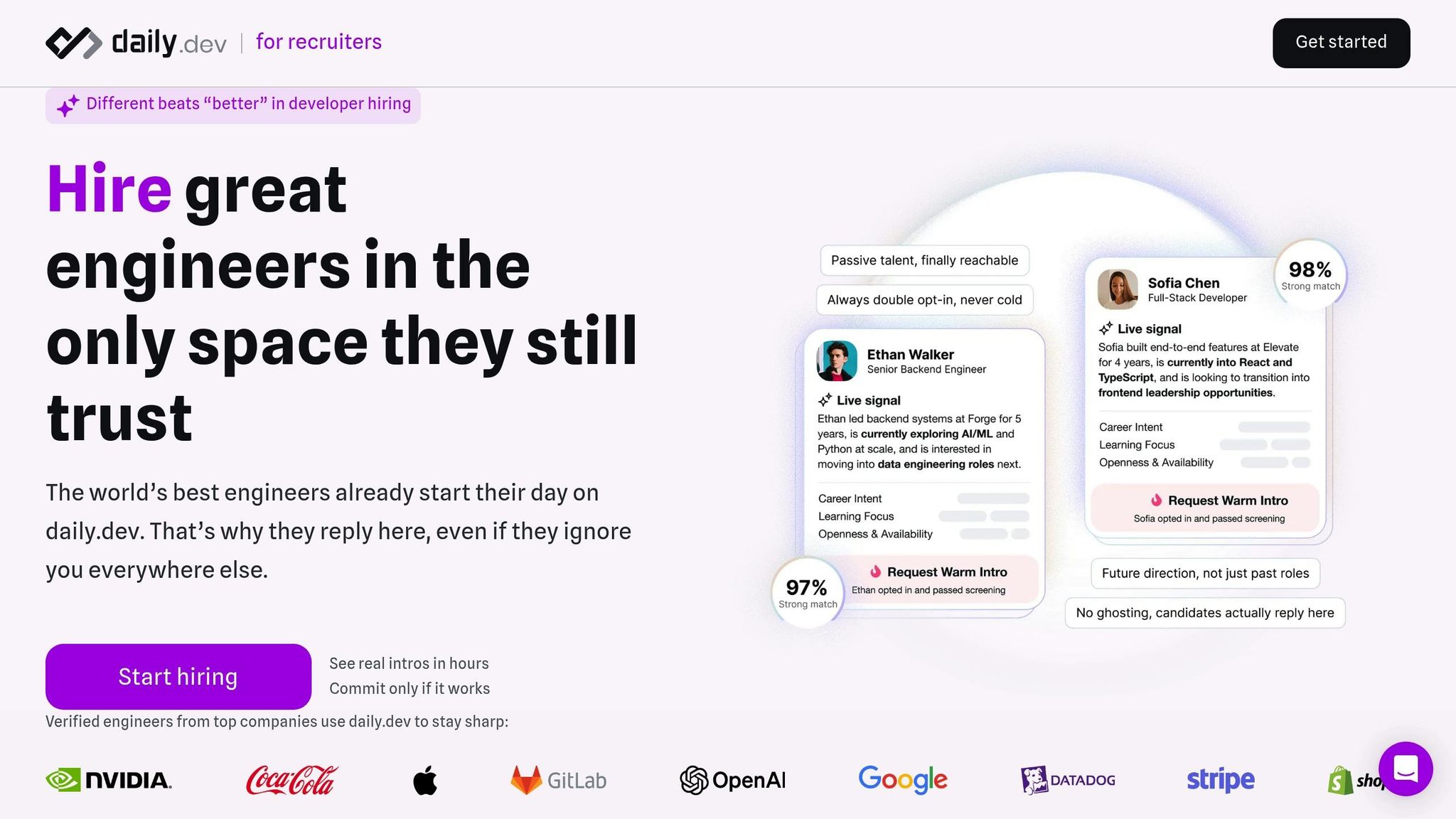
daily.dev Recruiter stands out because it’s built on an active professional network of over 1,000,000 developers . These developers aren’t just passively browsing job listings - they’re actively consuming technical content, learning new skills, and participating in the community.
One of the platform’s biggest strengths is its warm introduction model. Developers are shown opportunities tailored to their interests and expertise, so when you connect with a candidate, they’ve already expressed curiosity about the role.
To make the most of daily.dev Recruiter, craft job briefs that focus on the technical aspects of the role. Instead of using vague phrases like "seeking a passionate developer", be specific - mention the tools, challenges, and real-world impact of the projects. For example, highlight that your team is building a real-time data pipeline using Apache Kafka or tackling challenges in event-driven architectures.
The platform also offers precise targeting capabilities, allowing you to filter candidates based on actual skills, frameworks, and experience levels rather than relying on simple keyword matches. This ensures you’re connecting with candidates who truly meet your criteria, saving time and improving the quality of your outreach.
Because daily.dev Recruiter integrates seamlessly into a space where developers are already engaged, your job postings receive natural visibility. Developers discover roles while immersed in professional content, making them more open to exploring new opportunities. This focused approach significantly speeds up the hiring process, which is crucial for securing experienced talent. Once hired, focus on retaining top engineering talent to maintain your competitive edge.
How to Engage Developers Effectively
Once you’ve targeted the right candidates, the way you approach them matters. Developers can quickly spot generic, copy-pasted messages, so your outreach needs to show genuine effort and understanding of their expertise.
Reference something specific from their profile or recent activity. For example, if a developer has been engaging with Kubernetes-related content, mention that your team is transitioning to containerized infrastructure. If they’ve shown interest in machine learning, explain the challenges your team is addressing in that space. Personalizing your message in this way shows respect for their skills and time.
Avoid generic sales pitches. Instead of emphasizing perks like a "fast-paced environment" or "competitive compensation", focus on the technical aspects of the role. Talk about the architecture they’ll work on, the scale of the data they’ll handle, or the performance challenges they’ll face. Developers are more likely to respond to opportunities that match their technical interests.
Be transparent about the realities of the role, offer clear interview times, and keep your communication concise. Whether you’re a startup with tight deadlines or balancing legacy systems with new feature development, honesty helps both parties quickly determine if they assess cultural fit properly for the role. This level of transparency can also help you avoid the lengthy hiring processes that often push top candidates toward other opportunities.
Finally, make it easy for developers to learn about your technical culture on their own terms. Share links to your engineering blog, GitHub repositories, or recordings of technical talks. This openness builds trust and allows candidates to decide if your team’s technical environment aligns with their interests and goals.
Finding Developers in Niche Communities and Forums
Beyond professional networks, niche communities are treasure troves for finding engaged tech talent, especially if you're looking to speed up your hiring process in 2025.
Where Developers Gather Online
Developers flock to online platforms to collaborate, share knowledge, and solve problems. GitHub, for instance, is home to over 40 million engineers and developers . It doubles as a code repository and a place where professionals showcase their work and contribute to open-source projects. Similarly, Stack Overflow attracts a massive audience, with 100 million active users every month, making it one of the top 50 websites globally . It’s the go-to platform for tackling technical challenges.
On Reddit, you'll find a variety of developer-focused communities. Broad groups like r/Coding and r/AskProgramming coexist with specialized ones such as r/MachineLearning and r/iOSProgramming. Meanwhile, Dev.to has become a vibrant hub, hosting hundreds of thousands of developers .
For professionals in AI and machine learning, platforms like Kaggle shine. With over 15 million users worldwide , it offers competitions, datasets, and collaborative tools. Another standout is Hugging Face, a favorite for those working on natural language processing and transformer models.
If you’re targeting specific programming languages, there are communities tailored to that too. Reactiflux connects nearly 150,000 React.js developers , while the iOS Developers Slack Community boasts over 35,000 members . Python enthusiasts can be found in spaces like the Official Python Forum, the Real Python Community Slack, and PySlackers.
Real-time collaboration tools also play a big role. Discord hosts over 50 million developer servers , with groups like Python Discord, Programmers Palace, and Game Dev League offering spaces for real-time discussions. Platforms like CodeProject and LeetCode, which features more than 3,500 coding challenges , are also key for developers looking to sharpen their skills.
Understanding these platforms is the first step toward building trust and making meaningful connections.
Building Trust in Developer Communities
Gaining credibility in developer communities takes time and effort. Jumping in with recruitment pitches without understanding the group’s culture is a surefire way to get ignored - or worse, banned. Start by observing. Read through discussions, note the types of questions people ask, and get a sense of the overall tone. Some groups stick strictly to technical topics, while others are more open to career-related conversations.
Before reaching out, focus on contributing value. Answer questions, share insights, or offer help with technical problems. This positions you as a helpful, engaged member rather than someone with an agenda. When you do participate, be upfront about your role. Developers value honesty - if you're in recruiting, say so. Pretending to be a fellow developer will only backfire, which is one of the main reasons developers ignore recruiters.
Another way to build trust is to engage with individual members’ work. Review their GitHub projects or check out their contributions on Stack Overflow. This research not only shows respect for their work but also helps you craft personalized, thoughtful messages.
Many communities have designated areas for recruitment posts. Stick to these guidelines. Posting in the wrong place can damage your reputation and even result in bans. While it takes time to earn trust, once you’ve established yourself as someone who respects the community’s values, developers are far more likely to respond positively to your outreach.
How to Reach Out in Forums
Once you’ve built credibility and identified potential candidates, your outreach should reflect the effort you’ve put into understanding the community. Skip the generic messages - tailor your approach to each platform and individual.
When reaching out, reference specific contributions. For example, mention a thoughtful answer someone shared on Stack Overflow or highlight an impressive project on GitHub. This personal touch shows that you’ve done your homework.
Focus on the technical challenges your team is tackling rather than generic job titles or perks. Whether it’s improving performance, working with large-scale data, or solving tricky architectural problems, developers are drawn to opportunities that let them flex their problem-solving skills.
Keep your messages short and to the point. Attention spans are limited in online communities, so a clear call to action - like scheduling a quick call or sharing more job details - can make all the difference. Also, respect each platform’s rules about direct messaging. While some communities are open to public recruitment posts, others frown on unsolicited private messages.
If you don’t get a response right away, avoid bombarding the person with follow-ups. Repeated messages can feel more like harassment than genuine interest. A respectful, well-informed approach not only increases your chances of engagement but also helps you build lasting connections with top-tier tech talent.
Recruiting at Tech Events and Conferences
Tech events are a fantastic way to connect with skilled and enthusiastic developers. Whether virtual or in-person, these gatherings offer professionals a chance to learn, network, and explore new opportunities. For recruiters, they provide a unique chance to engage directly with potential candidates, speeding up the hiring process. Implementing strategies for reducing time to hire ensures you don't lose top talent to competitors. The secret lies in choosing events that align with your goals and making a memorable impact while you're there.
Choosing the Right Events
Selecting the right events is all about matching them to your recruitment needs. Large conferences like AWS re:Invent, Google I/O, and Microsoft Build attract thousands of developers, making them ideal for filling multiple roles or boosting your company's visibility. On the other hand, smaller, niche events often yield better results for targeted hiring. For example:
- React Conf and VueConf: Great for finding front-end developers.
- PyCon: Perfect for Python enthusiasts, from data scientists to backend engineers.
- KubeCon: Ideal for connecting with cloud-native and DevOps professionals.
- NeurIPS and CVPR: Excellent for AI and machine learning experts.
Don’t underestimate the value of local meetups or regional tech gatherings. These smaller, more intimate events - often found on platforms like Meetup.com or through hackathons - can reveal emerging talent and are typically more budget-friendly to attend or sponsor.
When evaluating any event, look at the attendee demographics, speaker lineup, and session topics. This helps ensure the event aligns with your team’s technologies and hiring needs. Also, events during slower hiring periods can give you a competitive edge, as fewer recruiters may be vying for candidates’ attention.
Making the Most of Event Participation
Attending an event is just the beginning - active participation is what turns it into a productive recruiting opportunity. Sponsorship packages can provide booth space, speaking slots, and access to attendee lists, all of which enhance your visibility and credibility.
If you have a booth, make it interactive. Instead of the usual swag, consider hosting live coding challenges with meaningful prizes, leading technical discussions about real-world problems your team is solving, or offering hands-on demos of your tech stack. Having an engineer from your team present on a technical topic can also position your company as a thought leader, subtly attracting developers who value authenticity and expertise.
For recruiters without a booth or speaking engagement, strategic networking is key. Attend relevant sessions and use breaks to strike up conversations. Ask thoughtful questions about the technologies being discussed and take the time to understand a candidate’s work and interests before bringing up job opportunities. When exchanging contact information - like LinkedIn profiles or email addresses - be clear about your follow-up intentions and jot down key details to personalize your outreach later.
Following Up After Events
The work doesn’t end when the event does. Following up is essential to turn those initial connections into real candidates. Reach out within 48 hours, referencing specific details from your conversation - like a session you both attended or a technical challenge they mentioned. This personal touch shows genuine interest and keeps the dialogue fresh.
For passive candidates, staying on their radar without being pushy is important. Share relevant educational content, such as articles, webinar invites, or updates on exciting projects your team is working on. This keeps the relationship warm and positions you as a valuable resource.
Consistent and clear communication is key throughout the process. If a candidate expresses interest, provide quick updates on next steps. For those not ready to move forward, offering constructive feedback can leave a lasting positive impression and protect your employer brand .
Hiring engineers?
Connect with developers where they actually hang out. No cold outreach, just real conversations.
Using AI-Powered Recruitment Tools
Artificial intelligence is changing the way recruiters discover and assess tech talent. Tasks that used to take hours can now be completed in minutes, freeing you up to focus on building relationships with candidates. These AI-driven solutions also boost the hiring speed and efficiency discussed earlier.
AI for Finding Candidates
AI-powered sourcing tools can quickly identify candidates who match your job requirements by analyzing patterns in their professional activity. For example, if you're searching for a developer with expertise in a specific technology, AI can pinpoint individuals actively contributing in that field - even if they aren’t actively job hunting. This approach is especially useful for uncovering passive talent: highly skilled professionals who might not be looking for new roles but could be intrigued by the right opportunity.
Some tools, like daily.dev Recruiter, connect you directly with active developers through an established network. Instead of pulling data from scattered sources, this platform provides access to a community of developers who have opted in to hear about career opportunities. The AI matches your job requirements with developer profiles and activity patterns. Plus, every introduction is double opt-in, meaning both you and the candidate agree to connect - making the process more efficient and respectful.
Once you’ve identified potential candidates, the next step is to evaluate them effectively using AI.
AI for Screening Candidates
AI-powered screening tools simplify candidate evaluation by applying custom technical criteria. These tools focus on objective factors like proven skills and project experience, filtering out candidates who don’t meet your standards. By automating this part of the process, you can reduce your team’s administrative workload and spend more time engaging with top-tier candidates who are likely to be a great match.
This blend of AI-driven objectivity and human judgment creates a more efficient and skills-focused screening process.
Connecting AI Tools to Your Workflow
AI tools don’t just stop at sourcing and screening - they can also integrate seamlessly into your recruitment workflow. By connecting these tools to your ATS (Applicant Tracking System), you can automate tasks like candidate follow-ups and profile updates. This integration ensures that double opt-in introductions flow smoothly into your system, reducing manual data entry and keeping candidate information current.
Providing regular feedback on AI recommendations can further refine how candidates are matched to your roles, making the process even more effective over time.
Conclusion
Main Points to Remember
Hiring skilled tech talent in 2025 demands a smarter, more focused approach than simply posting on job boards or sending generic messages. The best recruiters are tapping into spaces where developers naturally spend their time - think developer-centric platforms, niche online communities, and industry events.
Developer-first platforms like daily.dev Recruiter offer a unique edge by connecting you with engaged professionals. Their double opt-in model ensures you're reaching candidates who are genuinely interested, making your outreach feel more like an opportunity than an interruption.
Niche communities and forums remain a goldmine for finding talent, but they require finesse. These spaces value trust and authenticity, and spammy recruiting tactics won’t get you far. Take the time to understand the culture, contribute meaningfully, and only approach candidates when you have a relevant opportunity. In these spaces, quality beats quantity every time.
Tech events and conferences create opportunities for real connections with developers who are passionate about their work. Whether you attend in person or virtually, these gatherings are a chance to highlight your company’s values and technical challenges. Just make sure to follow up quickly while your conversations are still fresh.
AI-powered recruitment tools have completely changed the game, making it faster and easier to find and evaluate candidates. These tools can help you uncover passive talent, objectively assess technical skills, and handle repetitive tasks that used to eat up your time. When integrated with your ATS, they streamline your workflow and keep your hiring process moving smoothly.
Now that you’ve got the key takeaways, it’s time to take action.
What to Do Next
Take a hard look at your current recruiting strategy. Are you wasting time on outdated methods like generic job boards or impersonal outreach? If so, it’s time to pivot.
Start small - try one or two of the strategies discussed here. For example, if you haven’t explored developer-first platforms, check out daily.dev Recruiter to see how it connects you with pre-qualified talent through warm introductions. If AI tools seem daunting, experiment with one that could save you time and improve candidate quality.
Set some 30-day goals to get the ball rolling. Attend a tech meetup, join a couple of developer communities, or implement an AI-powered sourcing tool. Measure your success by tracking response rates and how quickly you’re able to fill roles.
The tech hiring landscape is fast-paced, and staying competitive means evolving your methods to align with how developers engage with career opportunities today. These strategies aren’t just theoretical - they work when applied consistently.
FAQs
What makes developer-first platforms like daily.dev Recruiter better than traditional job boards for finding tech talent?
Platforms like daily.dev Recruiter are designed with developers in mind, offering a more dynamic way to connect with skilled tech professionals. Instead of relying on the passive nature of traditional job boards, these platforms embed themselves directly into spaces where developers are already active and engaged. This means you're reaching candidates who are genuinely interested in exploring new opportunities.
By leveraging tools tailored for tech recruiting, you can streamline your hiring process. These platforms let you tap into niche communities, coding forums, and developer events, making it easier to find experienced candidates. Not only does this save time, but it also boosts the quality of applicants while helping your company stand out in a competitive hiring landscape.
How can I build trust and connect with developers in niche online communities without being intrusive?
To connect with developers in niche online communities, aim for authentic, value-focused interactions. Share resources, tips, or advice that resonate with the community's interests, and approach discussions as an equal rather than someone with an agenda. Speak their language and demonstrate that you understand their challenges.
Consistency matters. Be an active participant, not someone who only shows up when there's something to gain. Take the time to build relationships by actively listening, offering thoughtful responses, and respecting the norms and culture of the group. When you're genuine in your approach, you'll create meaningful connections without feeling intrusive.
How do AI-powered tools make hiring experienced tech talent faster and more efficient?
AI-driven recruitment tools have transformed the hiring process by efficiently sifting through massive amounts of candidate data to pinpoint the best matches for specific roles. This not only cuts down on the time and effort recruiters spend but also allows them to concentrate on building meaningful connections with the most qualified candidates.
These tools also improve the hiring process by minimizing unconscious bias, creating a fairer evaluation system. Using advanced algorithms, they evaluate skills, experience, and even alignment with a company's values, enabling businesses to make smarter, data-informed hiring choices.
.png)


