Recruiters face challenges finding senior backend engineers using outdated Boolean search methods. These keyword-heavy queries often rely on static, past data, leading to low response rates and mismatched candidates. The solution? Behavioral signal analysis and AI-powered tools.
Behavioral signals - like profile updates, learning activity, and online engagement - help identify engineers actively building relevant skills or open to career changes. AI tools further refine the process by ranking candidates based on real-time data, improving outreach timing and relevance.
Key takeaways:
- Boolean search is limited by static data and outdated profiles.
- Behavioral signals reveal current skills, interests, and career readiness.
- AI tools analyze activity patterns, reducing time-to-hire by up to 40%.
- Combining behavioral signals with technical screening ensures better matches.
This approach shifts recruitment from cold outreach to meaningful, timely connections, boosting response rates and attracting higher-quality candidates.
::: @figure 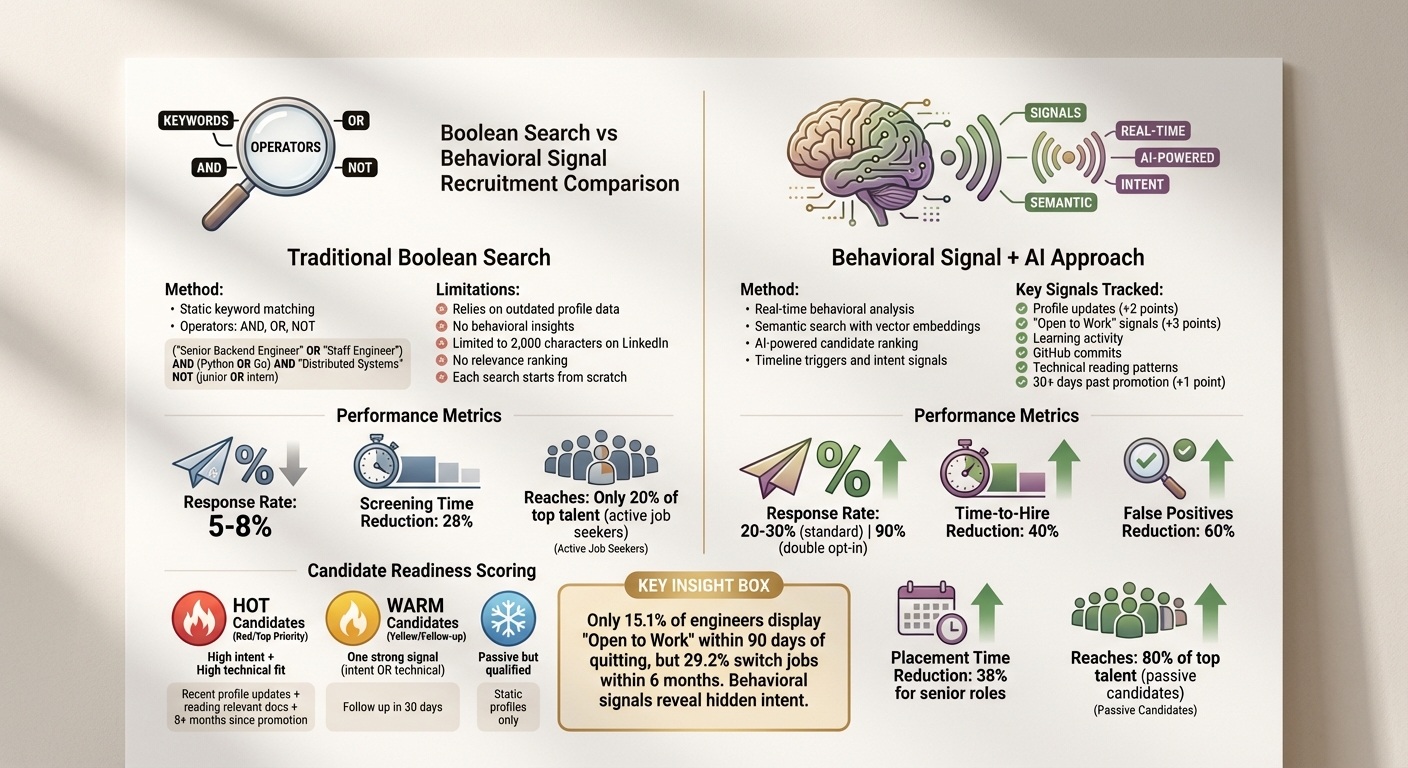 {Boolean Search vs Behavioral Signal Recruitment: Key Differences and Performance Metrics}
Boolean Search and Its Limitations
How Boolean Search Works
Boolean search relies on operators like AND, OR, and NOT to refine searches and include or exclude specific keywords. Recruiters craft detailed "strings" to sift through platforms like LinkedIn, GitHub, and applicant tracking systems, helping them narrow down large pools of potential candidates .
Here’s a quick breakdown of the key operators:
- AND: Narrows results by requiring all specified terms (e.g.,
Python AND Django). - OR: Broadens results by including alternatives (e.g.,
"Backend Engineer" OR "Software Developer"). - NOT: Excludes specific terms (e.g.,
NOT intern).
Recruiters also use quotation marks for exact phrase matching, like "Senior Backend Engineer", and parentheses to group terms, such as (Java OR Kotlin) AND "Microservices" .
For example, a typical Boolean search string for a backend engineering role might look like this:("Senior Backend Engineer" OR "Staff Engineer") AND (Python OR Go) AND "Distributed Systems" NOT (junior OR intern)
This approach helps recruiters filter thousands of profiles to find candidates with the right technical skills.
While Boolean search works well for filtering explicit terms, it struggles to account for more nuanced or dynamic candidate attributes.
Why Boolean Search Falls Short
Despite its structured framework, Boolean search has notable limitations. It relies on static keywords from profiles, which means it can surface outdated or irrelevant results. For instance, a developer who once worked on "microservices" but has since shifted focus might still appear in searches. Similarly, someone who briefly mentioned "project management" could be mistakenly flagged for engineering manager roles .
Another challenge is LinkedIn’s lack of relevance ranking, which can bury strong candidates under less suitable ones. Plus, Boolean strings are capped at around 2,000 characters on LinkedIn, restricting how detailed recruiters can get when searching for niche backend skills .
"Boolean search is no longer a technical crutch. It is a language spoken by a new kind of recruiter. AND, OR, NOT are not just operators. They are a way to hear meaning through the noise."
– weare.guru
The most significant drawback, however, is that Boolean search can’t pick up on behavioral signals or evolve with recruiter insights. Each search starts from scratch, and there’s no way to factor in patterns from past successful hires automatically . While Boolean search can cut screening time by about 28% , recruiters still face the challenges of outdated profiles and limited visibility into candidate availability.
AI-Powered Semantic Search in Recruitment
What Semantic Search Does Differently
Semantic search takes a smarter approach by using vector embeddings to transform resumes and profiles into mathematical representations. This allows it to identify conceptual connections, like linking "ReactJS" with "Vue.js" or "DevOps" with "Infrastructure automation." Unlike traditional keyword searches, it evaluates the depth of a candidate's skills instead of just scanning for specific terms. This shift addresses the limitations of outdated Boolean search methods, which often rely on static keywords.
By converting text into numerical vectors, semantic search uses cosine similarity (where 1.0 indicates a perfect match) to measure how well a candidate fits a role. This method also excels at analyzing unstructured data, such as project summaries or open-source contributions - areas where Boolean searches often fall short. The result? Fewer irrelevant matches and a more accurate assessment of candidates. Companies employing semantic hiring technologies have reported a 40% faster time-to-hire and a 60% drop in false positives. For senior engineering roles, which typically take over four months to fill, this approach can cut placement times by 38%.
How AI Improves Developer Sourcing
AI-powered tools bring efficiency to the recruitment process by automating candidate ranking through "Candidate Readiness Scores." These scores weigh behavioral signals, such as adding points for indicators like "Open to Work" (+3) or recent profile updates (+2) and subtracting points for less favorable signs, like a recent promotion (-1). This system helps recruiters zero in on candidates who are actively open to new opportunities.
Retrieval-Augmented Generation (RAG) takes things further by generating natural-language summaries that explain why a candidate is a good fit for a position. This reduces the need for recruiters to sift through countless resumes manually. On top of that, language model ranking systems can increase throughput by over 75x under fixed latency, cutting down on manual screening while improving match accuracy. Together, these tools streamline candidate evaluation, combining automated ranking with behavioral insights to provide a more complete picture of each candidate.
Using Behavioral Signals to Find Top Talent
Key Behavioral Signals in Developer Recruitment
Recruitment is evolving. Gone are the days of relying solely on static keyword searches. Today, understanding behavioral signals is key to identifying top talent, especially in tech roles like backend engineering. These signals, which build on advancements in semantic search, offer a more dynamic and precise approach to evaluating candidates.
Take digital body language, for example. Actions like updating a LinkedIn or GitHub profile, receiving new skill endorsements, or increased online activity can hint at a candidate's openness to new opportunities. If a senior backend engineer starts tweaking their profiles or engaging more online, it might indicate a shift in their career mindset.
Some signals stand out for their reliability. Direct opt-ins, such as when candidates explicitly agree to a private job pitch or answer tailored screening questions, are highly dependable. Another strong indicator? A candidate's reading habits - tracking the articles or topics they consume can reveal their professional interests. On the other hand, static resumes often fall short, as they may contain outdated or self-reported information that doesn’t tell the full story .
Timeline triggers are another critical factor. For instance, retention risk tends to peak six months into a new role or 180 days after a promotion. Interestingly, engineers who’ve recently been promoted are 18% less likely to leave their current job. Meanwhile, candidates who haven’t actively searched for 30 days are 45% more likely to consider new opportunities. External factors, like company funding rounds or leadership changes, can also make backend engineers more open to new roles within a 30–60 day window .
These behavioral insights, when combined with technical screening, provide a more comprehensive view of a candidate’s potential.
Why Behavioral Signals Matter
Behavioral signals do more than just identify candidates - they help recruiters understand a candidate’s intent on a deeper level. For instance, inferred "Open to Work" behavior is linked to a +135% hazard ratio for leaving a current role . However, only 15.1% of engineers display the "Open to Work" banner within 90 days of quitting, even though 29.2% switch jobs within six months .
Senior backend engineers often exist in a gray area between active and passive job seekers. Rather than being firmly one or the other, they may fall into categories like "Open but Not Looking" (content but curious) or "Passively Open" (satisfied but willing to entertain exceptional offers) . By analyzing these nuanced behavioral signals, recruiters can spot potential candidates before they actively start applying elsewhere - giving them a crucial first-mover advantage.
Combining Behavioral Data with Technical Screening
Building a Complete Candidate Profile
The best hiring processes go beyond just scanning resumes - they combine behavioral insights with technical skills to create a deeper, more accurate picture of each candidate. Think of it as turning a flat, two-dimensional profile into something dynamic and multi-layered.
One way to do this is by creating a Candidate Readiness Score. For example, you could assign points like this:
- +3 for inferred "Open to Work" signals
- +2 for recent updates to their profile
- +1 for being 30 days past a promotion
- -1 if the candidate was promoted within the last six months
This scoring system helps prioritize outreach based on how likely a candidate is to engage, rather than just relying on keyword matches.
Once you’ve scored candidates, group them into tiered categories:
- Hot: High intent and high technical fit
- Warm: One strong signal, either intent or technical skills
- Cold: Passive but qualified
For example, picture a senior backend engineer who’s been reading up on Kubernetes, recently updated their GitHub, and hasn’t been promoted in eight months. That’s a "Hot" candidate - someone you should reach out to right away. On the other hand, a Python expert with no recent activity might fall into the "Warm" category, meaning you could follow up in a month.
By tracking real-time activity - like GitHub commits, technical reading patterns, or Stack Overflow contributions - and combining it with static skills, you get a snapshot of both a candidate’s qualifications and their current engagement. Add timeline triggers, like the six-month mark where retention risks often rise , and you’re not just finding backend engineers - you’re finding the ones most likely to respond and move forward. This streamlined approach also simplifies the technical screening process that follows.
Faster Screening and Better Response Rates
Merging behavioral data with technical assessments speeds up the entire hiring process while improving the quality of responses. Pre-filtering candidates based on intent shortens the time it takes to fill roles. In fact, combining behavioral signals with short work-sample tests has shown validities above .60 - far better than traditional keyword-based screening . When you know a candidate is already exploring new frameworks or showing signs of career movement, your outreach feels timely rather than random.
Taking it a step further, double opt-in introductions - where candidates review key details like the tech stack, salary range, and work model before engaging - filter out those who aren’t genuinely interested. This approach ensures that the conversations you have are with candidates who are already aligned with the role, leading to higher reply rates. Platforms that tap into active developer communities also help, as they provide a "warm" context for outreach rather than a cold one.
To avoid losing senior talent juggling multiple offers, keep initial coding tests short - 15 to 30 minutes is ideal. Follow this with a quick 15–20 minute video call to dive into the reasoning behind their technical decisions. This not only reveals their problem-solving approach but also gives insight into their communication skills, all without taking up too much of their time.
Lastly, use knockout questions in your ATS to filter out candidates who don’t meet critical requirements, like time zone compatibility or experience with specific frameworks. Automating these basic checks saves you from wasting time on unqualified leads. That way, you can focus your energy on evaluating the subtler, more human factors - like communication style or career trajectory - that automation might miss. The result? You spend less time chasing dead ends and more time connecting with backend engineers who are genuinely ready to take the next step.
Building a Modern Sourcing Workflow
Step-by-Step Sourcing Process
Start by clearly defining what you’re looking for in a "senior backend engineer." Be specific about the frameworks, architectural patterns, and problem-solving scenarios that are essential for the role. Use semantic and AI-powered tools to cast a wider net by identifying synonyms and related skills, which can help uncover candidates you might otherwise miss.
Next, incorporate behavioral analysis into your process. Pay attention to engineers who frequently visit documentation pages related to your tech stack or update their profiles with new skills. These subtle intent signals can help you identify potential candidates before they officially start job hunting.
After spotting these signals, prioritize your outreach. Begin with candidates showing strong interest, such as those with multiple visits to relevant documentation or direct opt-in behaviors. Then, focus on individuals with recent profile updates or an active history of engaging with technical content. Leave static CVs for last - they often provide outdated information and are less reliable for gauging current interest. This tiered approach ensures your outreach aligns with when candidates are most likely to respond positively.
By focusing on behavioral signals, this method ensures your interactions are timely and meaningful. To make this process seamless, automation tools can integrate directly into your workflow, helping you execute each step without unnecessary delays.
Tools and Automation to Save Time
Once your sourcing process is streamlined, automation can take it to the next level by improving efficiency and precision. Start with a system that handles data collection, enrichment, and outreach. For example, use data scrapers to compile candidate lists, enrichment tools to verify contact details, and CRM platforms to manage multi-channel outreach. The goal isn’t to send more messages but to deliver the right message at the right time.
Automated follow-ups are essential. Schedule follow-ups with 2–3 day intervals, as conversion rates often increase significantly up to the fifth email. Tracking all of this manually isn’t feasible at scale, but your ATS can help by reactivating past candidates who may now be a perfect fit for your current roles.
Looking ahead, advanced automation tools powered by agentic AI can further refine your pipeline. These systems monitor real-time market data and behavioral signals - like increased profile activity or engagement with technical content - and automatically flag high-potential candidates for immediate outreach. While these tools don’t replace human judgment, they ensure you’re focusing your time on the candidates who are most likely to engage right now. This blend of automation and human insight can make your sourcing workflow both efficient and highly effective.
Conclusion
The process of hiring senior backend engineers has changed significantly. Relying solely on traditional Boolean searches often means missing out on a massive pool of passive candidates - around 80% of top talent - who aren't actively job hunting but might be open to the right opportunity. By focusing on behavioral signals like profile updates or increased learning activity, recruiters can spot potential candidates long before they officially signal availability. This proactive approach leads to better engagement and results.
For instance, traditional cold outreach typically sees response rates of just 5–8%. In contrast, outreach based on behavioral signals can achieve response rates of 20–30%. Even more impressively, double opt-in systems can push those rates to as high as 90%. Considering that developers rate recruiter credibility at only 2.5 out of 5.0, reaching out at the right time with personalized, relevant messaging helps build trust and opens the door to meaningful conversations.
FAQs
What counts as a behavioral signal for engineers?
Behavioral signals for engineers can include activities like updating their profiles, showcasing increased engagement, receiving skill endorsements, joining specialized communities, or achieving career milestones such as promotions. These actions provide insights into an engineer's readiness, level of involvement, and potential interest in exploring new opportunities.
How do you score candidate readiness without bias?
Scoring a candidate's readiness fairly means focusing on behavioral signals such as profile updates, increased activity, earned certifications, and contributions to professional communities. These actions often indicate genuine interest and involvement.
By leveraging data-driven frameworks, you can evaluate multiple signals collectively, ensuring a more balanced and objective approach. This approach avoids the pitfalls of subjective judgments. Additionally, using standardized qualification questions and automated tools helps maintain impartiality by concentrating on candidates' actions and potential, rather than surface-level traits.
What’s the best first step to replace Boolean search?
To go beyond the limitations of Boolean search, leverage behavioral signals and intent data. Pay attention to factors like profile updates, online activity, and engagement trends. These clues can guide you toward identifying candidates who are actively seeking opportunities, making it easier to connect with skilled backend engineers who align with your needs.
.png)