Developers are frustrated with LinkedIn for hiring. Why? It’s outdated and doesn’t meet their needs. 61.5% of developers say recruiters aren’t doing their job well, and 46% rate their trust in cold outreach at 0–2 out of 5. Static profiles, spammy messages, and irrelevant job offers are the main culprits. Developers want platforms that focus on what they actually need—real-time skills, proof of work, and mutual interest - not cold, impersonal outreach.
New platforms like daily.dev Recruiter aim to fix this. They embed hiring into spaces developers already use, verify skills through actual work, and use a double opt-in system so both sides agree before talking. This approach respects developers' time and builds trust, leading to 3x higher reply rates compared to traditional methods.
Key takeaways:
- LinkedIn struggles with outdated profiles, low trust, and spammy outreach.
- Developers prefer platforms that verify skills (e.g., GitHub activity) and respect their time.
- Platforms like daily.dev Recruiter use real-time data and mutual consent to improve hiring.
The shift is clear: developer-first platforms are replacing LinkedIn for technical hiring.
Why LinkedIn Doesn't Work for Developer Recruitment
::: @figure 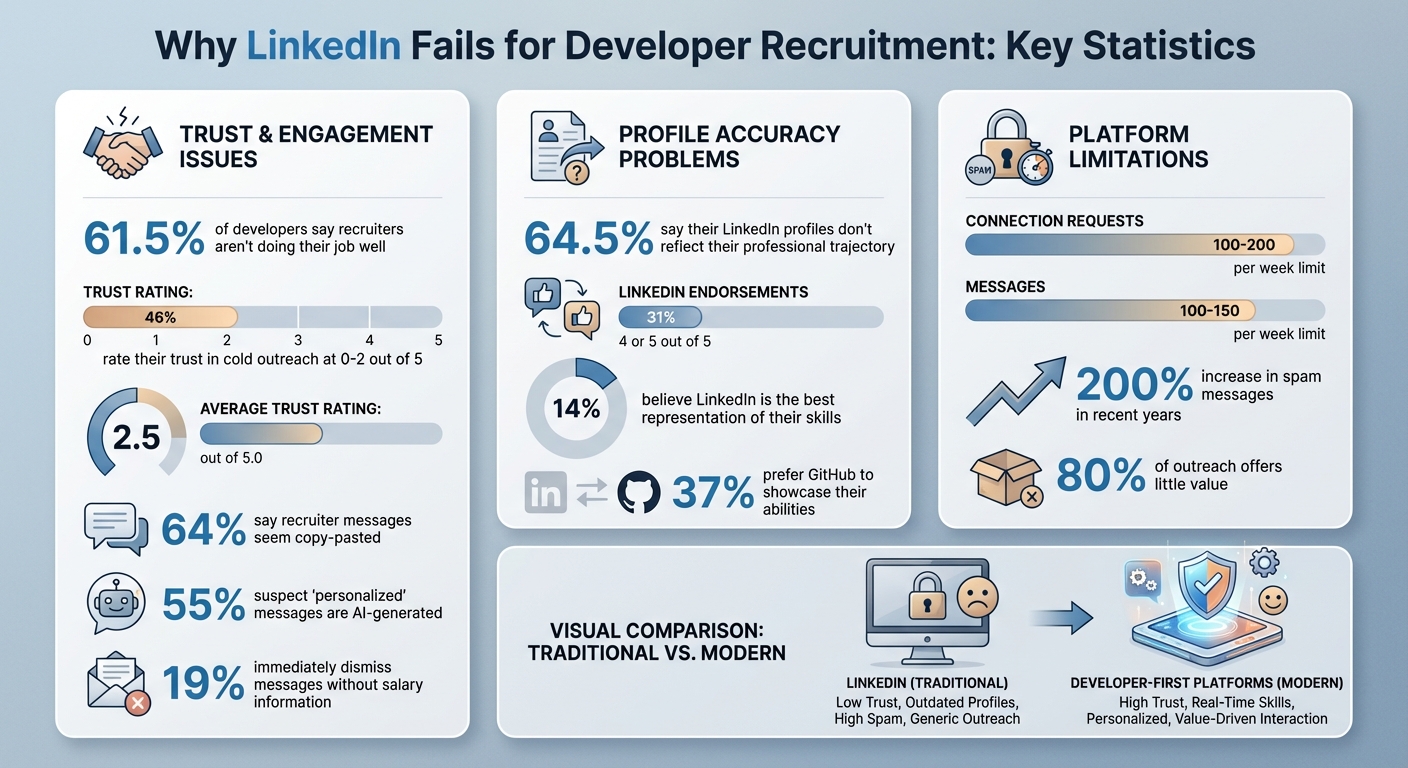 {Why LinkedIn Fails for Developer Recruitment: Key Statistics}
LinkedIn may be a go-to platform for professional networking, but when it comes to recruiting developers, it often falls short. Its structure caters to broad professional connections, not the specific needs of technical hiring. This mismatch creates trust issues and inefficiencies, making LinkedIn a frustrating tool for both recruiters and developers.
Here are the key reasons why LinkedIn struggles in this area.
Passive Developers Rarely Respond
Developers tend to be wary of LinkedIn messages. On average, they rate their trust in recruiters at only 2.5 out of 5.0. Why? Because most outreach feels impersonal. In fact, 64% of developers say recruiter messages seem copy-pasted, and 55% suspect that even so-called "personalized" messages are AI-generated. It's no surprise these messages are often ignored.
To make matters worse, recruiters frequently leave out crucial details like salary range, the tech stack, or the work model. For example, 19% of developers will immediately dismiss a message if it doesn't include salary information. Without clear, relevant details upfront, developers lose interest fast. These omissions suggest a lack of understanding of what developers care about, causing them to disengage entirely.
Profiles Are Outdated and Skills Are Hard to Verify
Even when developers do respond, LinkedIn profiles often fail to provide an accurate picture of their current skills or career goals.
Profiles on LinkedIn are static and rarely updated, making it hard to assess a candidate's expertise. A staggering 64.5% of developers say their profiles don’t reflect their professional trajectory, and only 31% rate the accuracy of LinkedIn skill endorsements as a 4 or 5 out of 5. Even more telling, just 14% believe LinkedIn is the best representation of their skills, while 37% prefer platforms like GitHub. Without real-time insights into a developer's contributions or projects, recruiters are left to guess - and often guess wrong.
No Tools Built for Developers
LinkedIn also lacks features tailored to technical professionals, adding another layer of complexity to the hiring process.
The platform does not natively showcase GitHub activity, Stack Overflow contributions, or technical blog posts - key indicators of a developer's expertise. As a result, recruiters must spend extra time digging through external platforms to evaluate candidates. This manual effort is not only inefficient but also prone to error.
On top of that, LinkedIn imposes strict limits on recruiter activity: only 100–200 connection requests and 100–150 messages per week. Exceed these limits, and recruiters risk account restrictions, often referred to as "LinkedIn Jail", which can last anywhere from 24 hours to a full week. Meanwhile, the platform prioritizes engagement-driven content over meaningful professional discussions. This, combined with a 200% increase in spam messages in recent years, has turned LinkedIn into a hub of generic sales pitches, with 80% of outreach offering little value. For developers, the platform has become more of a distraction than a resource.
Hiring engineers?
Connect with developers where they actually hang out. No cold outreach, just real conversations.
Developer-First Hiring Platforms Are Changing Recruitment
The days of outdated profiles and impersonal outreach are fading fast. New hiring platforms are stepping up, meeting developers where they are, verifying skills through real work, and ensuring both parties agree before starting a conversation. This shift replaces ignored messages with real, meaningful connections.
Let’s dive into how active communities, live skill verification, and mutual consent are reshaping how developers are recruited.
Active Communities Create Better Connections
Platforms centered around active developer communities allow recruiters to engage with talent in real time, rather than relying on cold, impersonal outreach. When developers participate in these communities - sharing insights, contributing to projects, and discussing technical topics - they’re naturally more open to opportunities that align with their passions.
"Trust is the only hack. Engineers already come to daily.dev to grow. They already trust the platform... When your role shows up inside that flow, it doesn't feel like outreach. It feels like an opportunity." – Nimrod Kramer, CEO & Co-Founder, daily.dev
Instead of bombarding developers with generic messages, these platforms integrate hiring into the natural flow of their daily activities. The result? Introductions that feel genuine and respectful, not intrusive.
Building on these authentic connections, platforms are now verifying skills in real time, offering a more accurate view of a candidate's abilities.
Skills Are Verified Through Actual Work
Static resumes and self-reported skills often leave gaps in understanding a candidate’s true abilities. Platforms like daily.dev Recruiter address this by evaluating developers based on their live contributions. This behavioral approach goes beyond outdated profiles, providing recruiters with real-time insights into the technologies developers use and the challenges they tackle.
Rather than relying on scraped data, these platforms analyze activity within their networks, verifying key details like timezone, location, tech stack expertise, and seniority level - all automatically .
Double Opt-In Ensures Mutual Interest
One of the most impactful changes is the move from one-sided outreach to a system based on mutual consent. With a double opt-in model, both recruiters and developers express interest before any conversation begins. Developers can review job details and answer screening questions before deciding to opt in. This "hand-raising" system ensures that every interaction starts on a foundation of mutual interest.
This approach values real behavior over buzzwords and replaces cold outreach with trust, making the hiring process more respectful and effective for everyone involved.
How daily.dev Recruiter Works
daily.dev Recruiter is a platform designed to simplify hiring developers by using real-time behavioral data. It connects your job opportunities with engineers whose current work aligns with your needs, making the process faster and more effective .
Here’s how it works: you create a role, and the platform transforms it into a developer-friendly brief. This brief is then privately shared with matched candidates. Developers can review the opportunity as part of their workflow and opt in if interested. Once they do, you can approve their profile and screening answers, leading to a warm introduction - no need for cold emails or unsolicited messages . Let’s break down how its features streamline the recruitment process.
Only Talk to Developers Who Want to Talk
With a double opt-in system, every conversation begins with mutual interest. Developers review your brief, answer up to three screening questions, and opt in only if they’re genuinely interested. This ensures you connect exclusively with candidates who are eager to engage .
The results? Recruiters report reply rates that are three times higher than traditional cold outreach methods. Why? Because every introduction is built on trust and relevance . This approach eliminates wasted time and fosters meaningful connections.
Job Briefs Written for Developers
daily.dev Recruiter takes care of creating job briefs that speak directly to developers. These briefs are clear, concise, and tailored to what developers care about most - details like the tech stack (React, TypeScript, Rust), team size, salary range, and the engineering challenges they’ll tackle.
This straightforward and honest communication style stands out from the clutter of generic job posts .
"LinkedIn is a database of resumes. daily.dev is a living community. You meet engineers where they learn, not where they look for jobs." – daily.dev Recruiter
By focusing on what developers value, these briefs build trust and encourage genuine engagement.
Access Developers Worldwide
daily.dev Recruiter expands your reach with access to a global network of over 1 million active developers. What sets this apart? These developers are actively learning and building, not just maintaining outdated profiles .
The platform also verifies critical details like timezone, location, tech stack expertise, and seniority using behavioral signals rather than relying on self-reported data . This ensures you’re connecting with the right candidates, no matter where they are, and at a scale that traditional methods can’t match.
How to Get Better Results with daily.dev Recruiter
To make the most of daily.dev Recruiter, focus on refining your messaging and targeting strategies. While the platform connects you to an active network of developers, success hinges on how effectively you communicate and filter candidates. Developers value their time, so a thoughtful and intentional approach is key.
Write Job Briefs That Developers Actually Read
Developers are quick to dismiss generic job postings, especially ones filled with vague buzzwords. They’re looking for clarity and relevance. To grab their attention, lead with specifics: highlight the core technical challenge, the tech stack (e.g., React, TypeScript, or Rust), team structure, and even the salary range. Transparency builds trust and shows respect for their time.
Avoid phrases like "rockstars" or "ninjas" - these don’t resonate. Instead, focus on the actual engineering work and the impact they’ll have. For instance, with 60% of U.S. tech managers projected to seek AI engineers in 2025 (up from 35% the year before), being upfront about AI/ML responsibilities is more important than ever .
Once your job brief is polished, the next step is ensuring it reaches the right candidates.
Use Targeting and Screening to Find the Right Candidates
daily.dev Recruiter stands out by focusing on real-time engagement rather than outdated resume keywords. The platform tracks what developers are actively reading and building, giving you access to "pre-intent" talent - developers exploring new tools and frameworks before they even think about updating their profiles .
Its AI-powered matching system filters out irrelevant candidates by ranking them based on their actual engagement with the required tech stack. If a developer hasn’t demonstrated active interest or experience with your tools, they won’t show up in your pipeline . You can also add up to three custom screening questions to confirm specific skills or experience before initiating contact. This ensures your outreach is targeted and efficient.
Build Trust Through Clear Communication
Generic outreach has eroded trust in recruitment, which makes clear and respectful communication essential. With daily.dev Recruiter’s double opt-in model, every developer who responds has already reviewed your job brief and chosen to engage. This sets a strong foundation for mutual trust.
Be transparent in your follow-ups. Outline the next steps, timelines, and any additional information you need from them. Misleading tactics will only hurt your chances. The platform also provides pipeline intelligence, allowing you to track reply rates and engagement. If responses drop, it’s a signal to revisit your job brief and add more detail .
For context, traditional platforms like LinkedIn achieve only a 5% trust score with InMail, while daily.dev Recruiter’s warm introductions ensure 100% mutual interest from the start . This level of trust gives you a significant advantage in developer recruitment.
Pricing and Getting Started
daily.dev Recruiter charges a flat monthly fee for each active role, offering unlimited hires and team collaboration without additional licenses, placement fees, or commissions. The billing is flexible - month-to-month and can be canceled at any time .
How to Get Started
The pricing is straightforward, and the onboarding process is just as simple. You can get started in minutes with a self-serve setup. First, create a free account and upload your job description (either via URL or as a file). The platform's AI will analyze the details - like role title, tech stack, location, and compensation - and present them in a side-by-side editor for your review . You can also add up to three screening questions to help pre-qualify candidates . Once the role is ready, choose between the Agent plan ($350/month) for standard matching or the Super Agent plan ($1,000/month) for faster matching, enhanced feedback, and ATS integrations . After payment, your role goes live instantly and starts matching with developers based on their real-time engagement and technical skills .
For companies hiring on a larger scale, there’s an Enterprise plan with custom pricing designed for teams managing 10 or more active roles . Importantly, you’re only billed for "Active" roles - drafts, paused, or closed positions won’t incur charges. You can pause a search anytime to stop billing .
Measuring Success with Developer Hiring
Once your role is live, you can track its performance using detailed analytics. The Pipeline Intelligence dashboard provides insights into reply rates, drop-off points, and the overall health of your hiring funnel in real time . Thanks to a double opt-in model, reply rates are three times higher, saving recruiters up to 37 hours per hire while reducing costs by 15–20% . For those on the Super Agent plan, ATS sync is automatic - candidates appear in your system with their status updated in real time, eliminating the need for manual data entry . These tools and metrics reflect daily.dev Recruiter’s focus on making developer hiring efficient and effective.
Conclusion
Traditional static profiles and cold outreach methods struggle to keep up with developers' evolving skills and expectations. Today’s developers value transparency, respect for their time, and clear proof that a role is worth their attention.
daily.dev Recruiter tackles these challenges by using real-time behavioral signals - like the content developers read, follow, and create - to form meaningful connections that reflect their current expertise and interests . Its double opt-in model ensures that every conversation begins with mutual interest and consent.
This thoughtful, real-time strategy not only builds trust but also delivers measurable results. Recruiters see higher response rates, smoother workflows, and lower costs. Plus, integrations with applicant tracking systems like Greenhouse, Lever, and Ashby keep candidate pipelines automatically updated . These benefits come from treating developers as active participants in the hiring process, rather than passive leads.
As the industry moves toward data-driven hiring - emphasizing verified skills through AI-powered assessments rather than relying solely on social signals - the focus on intent-driven matching will only grow stronger. With its forward-thinking approach, daily.dev Recruiter is already leading the way. Recruiters who embrace this developer-first mindset will have a competitive edge in attracting top talent in an increasingly demanding market.
FAQs
What makes a hiring platform 'developer-first'?
A hiring platform designed with a 'developer-first' mindset puts the needs and preferences of developers front and center. Instead of relying on outdated methods like static profiles or impersonal cold outreach, it emphasizes real-time activity signals, community involvement, and mutual consent in interactions.
Key elements of this approach include:
- Trust-focused engagement: Building relationships based on mutual respect and understanding.
- Double opt-in introductions: Ensuring both parties agree to connect, creating a more meaningful interaction.
- Behavioral data-driven sourcing: Prioritizing developers' actions and interests over traditional resumes.
This method not only respects developers' preferences but also leads to more authentic connections and better hiring results. By aligning with what developers value, companies can achieve greater relevance and see improved response rates.
How does double opt-in change recruiter response rates?
Double opt-in boosts recruiter response rates by making sure developers actively agree to be contacted. This method helps establish trust, reduces unwanted messages, and leads to better engagement. By focusing on consent, recruiters can build genuine connections with developers, paving the way for clearer communication and stronger professional relationships.
How are developer skills verified in real time?
Developers' skills are assessed in real time using automated platforms designed to mimic practical, on-the-job scenarios. These tools evaluate a developer's abilities by presenting realistic challenges, providing an accurate and current measure of their expertise.
.png)