High-intent developer candidates are individuals who signal their readiness for new roles through subtle online behaviors rather than overt declarations. These behaviors, often referred to as digital body language, include actions like updating profiles, earning certifications, engaging with technical content, or participating in niche communities. While only 15.1% of engineers display an "Open to Work" status, 29.2% change employers within six months, showing that traditional signals often miss these candidates.
Key insights:
- Developers explore opportunities discreetly, often through technical interactions rather than public job searches.
- Early identification of these signals allows recruiters to connect during the exploration phase, avoiding generic outreach that 43% of developers ignore.
- Examples of readiness signals include profile updates, increased learning activity, participation in technical groups, and direct engagement with recruiters.
To identify qualified technical candidates effectively, tools like daily.dev Recruiter track real-time signals such as reading habits, coding activity, and community involvement. This approach prioritizes trust and transparency, ensuring developers only engage with roles they find relevant. Recruiters who act quickly on these signals are far more likely to establish meaningful connections.
Online Activity Signals to Watch For
Spotting online signals is crucial for connecting with high-intent candidates before they even think about submitting an application.
Engagement with Job-Related Content
Developers rarely broadcast that they're job hunting. Instead, their online behavior often gives away their intentions. For example, frequent visits to pages like pricing, demos, or features, as well as downloading in-depth resources such as checklists, guides, or case studies, can indicate they’re exploring options seriously .
Another major clue comes from third-party research. When developers spend time on review platforms like G2 and Capterra, comparing vendors or searching for alternatives, they’re digging into the details that often precede a career decision . This behavior often pairs with increased searches for terms like "best [category] software" or "alternatives to [competitor]" .
Samuel Thimothy, VP at OneIMS, puts it this way: "Intent signals are the digital and behavioral clues that reveal a prospect's level of interest and likelihood to purchase" .
Another avenue for insights is tracking engagement with technical articles on platforms like daily.dev. Developers don’t engage randomly; their activity reflects focused professional interests. Considering that 80% of developers are open to new opportunities even when they’re not actively job hunting , recognizing these signals early can make all the difference.
These engagement cues often go hand-in-hand with changes in how developers approach learning, offering even more insight into their intent.
Consistent Learning Patterns
Beyond casual browsing, shifts in learning behavior can be a strong indicator of readiness. A sudden jump in reading activity - known as "surge behavior" - is a reliable signal . For instance, if a developer who typically skims general tech news starts diving into detailed topics like "cloud security" or "Kubernetes deployment strategies", they might be gearing up for roles requiring those skills or reassessing their current expertise.
Similarly, participation in technical webinars, virtual events, or niche communities like Stack Overflow, Reddit, or private Discord groups can reveal intent . These activities demand a level of commitment that separates serious candidates from casual observers. In fact, developers who complete virtual job simulations are four times more likely to convert into hires compared to those who don’t . The challenge for recruiters lies in spotting these patterns early, especially as online research continues to grow - 69% of B2B marketers noted an increase in buyer research in 2024 . This trend mirrors how developers carefully research their next career steps.
Behaviors That Signal Candidate Readiness
Online activity might hint at interest, but certain direct actions provide stronger evidence that a developer is ready to make a career move.
Direct Messages to Recruiters or Companies
When developers take the initiative to reach out, it's a clear sign they’re serious about exploring opportunities. High-intent candidates often ask focused questions about key aspects like the tech stack, salary, or work arrangements. For example, a message like, "Can you share the tech stack and salary range for the senior backend role?" demonstrates that the candidate has done their homework and is genuinely interested. This aligns with research showing that 69% of developers expect salary details upfront.
These proactive steps build on earlier online signals, providing further confirmation of a developer’s readiness to transition.
Active Participation on Developer Networks
How developers engage on professional platforms can also reveal their intent. For example, double opt-in systems - where developers agree to an introduction after reviewing role details - indicate mutual interest. Platforms like daily.dev Recruiter use this approach to ensure developers only engage after seeing relevant job details, making interactions more meaningful. This model also helps improve recruiter trust, which averages just 2.5 out of 5.0.
Another key signal? Profile updates. Developers adding new skills or certifications, such as TensorFlow or similar frameworks, often suggest they’re preparing for new opportunities. Participation in technical discussions, sharing expertise, or engaging in niche communities further highlights active growth and potential readiness to move on. These subtle changes often occur weeks - or even months - before formal applications are submitted.
Tools for Identifying High-Intent Candidates
Manually pinpointing high-intent candidates can be a tedious process. Thankfully, the right tools can automate this task by leveraging real-time signals instead of relying on outdated resumes.
Advanced Targeting and Intent-Based Matching
Platforms like daily.dev Recruiter use real-time signals to identify candidates based on their current learning activities. By tracking live indicators such as reading habits, coding activities, and community involvement, the platform provides a clearer picture of a developer's skills. For instance, if someone is frequently reading about React performance optimization or exploring LLMs, that’s a much stronger indicator of their expertise than a static resume could ever provide.
The Smart Career Match feature goes a step further, connecting recruiters with developers whose learning signals - like active engagement with GenAI content - align perfectly with open job roles. Nimrod Kramer, CEO of daily.dev, explains:
"Trust is the only hack. Engineers already come to daily.dev to grow. They already trust the platform, engage daily, and treat what they see here as signal."
To ensure meaningful connections, the platform uses a double opt-in system. This means developers only engage with roles they’re genuinely interested in. After reviewing details like the tech stack, salary range, and work model, candidates can choose whether to proceed. Recruiters can then use these signals to prioritize outreach based on reliability.
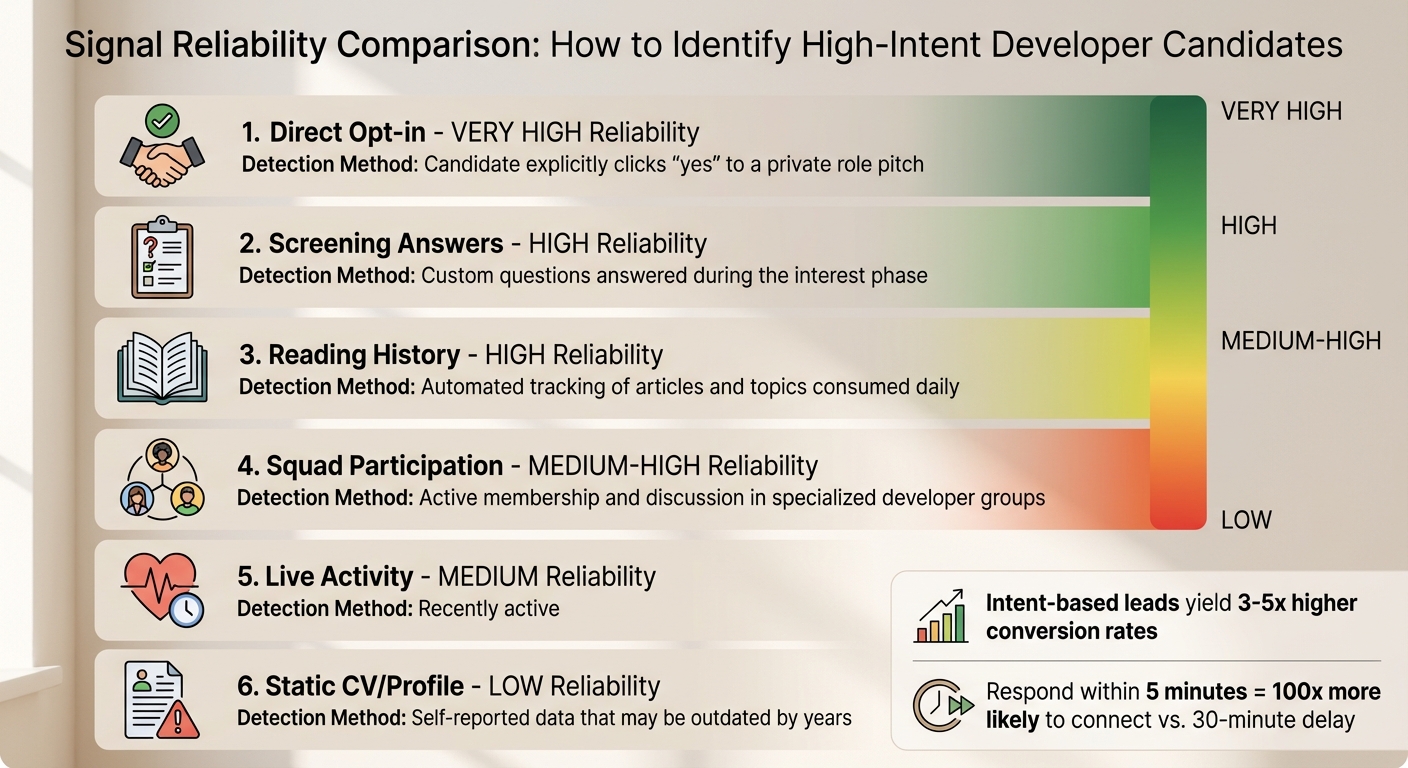
Comparing Signal Types for Reliability
Not all signals carry the same weight, and understanding their reliability can help recruiters focus their efforts more effectively.
| Signal Type | Reliability | Detection Method |
|---|---|---|
| Direct Opt-in | Very High | Candidate explicitly clicks "yes" to a private role pitch |
| Screening Answers | High | Custom questions answered during the interest phase |
| Reading History | High | Automated tracking of articles and topics consumed daily |
| Squad Participation | Medium-High | Active membership and discussion in specialized developer groups |
| Live Activity | Medium | Recently active |
| Static CV/Profile | Low | Self-reported data that may be outdated by years |
The most effective approach combines explicit intent (like a developer opting into a role) with verified behavior (such as consistent learning or community participation). This dual-layered verification is why intent-based leads often yield 3 to 5 times higher conversion rates compared to traditional methods. Additionally, companies that reach out within 5 minutes of a high-intent action are 100 times more likely to connect with candidates than those who wait 30 minutes.
How to Engage High-Intent Candidates
The way you approach high-intent developers can make or break your chances of capturing their interest. Developers are often put off by generic, impersonal messages, which has created a general skepticism toward recruiters. The following strategies can help you build trust and foster genuine engagement with these candidates.
Using Warm Introductions
Once you've identified a developer's intent through their online activity, the next step is to establish trust with a clear and mutual introduction. Warm, double opt-in introductions stand out because they give developers the power to decide whether to proceed, armed with all the essential role details upfront.
For instance, daily.dev Recruiter flips the traditional outreach model on its head by ensuring every introduction is mutual. Developers receive critical information - such as the tech stack, salary range, and work model - before they even engage. This level of transparency fosters trust and sets the stage for more meaningful conversations.
Tracking Emerging Intent Signals
A developer's intent doesn’t remain static - it evolves. High-intent candidates often exhibit subtle changes in behavior as they inch closer to making a career move. Paying attention to these shifts allows you to reach out at just the right moment.
For example, if a developer starts consuming content about interview preparation, salary negotiation, or technologies relevant to your company, they might be gearing up for a job change. Similarly, increased activity in developer forums or engagement with targeted job ads could signal growing interest in new opportunities.
When a developer opts in or answers screening questions, respond quickly with the details they care about most: tech stack, salary range, and work model. Transparency is critical - 69% of developers expect salary information in the very first message, and 19% will dismiss outreach outright if that detail is missing.
Conclusion: Making the Most of High-Intent Candidates
Finding high-intent developers isn’t about casting a wide net; it’s about making meaningful connections with the right people - those who often bypass traditional job boards and instead engage within trusted professional communities.
The move from cold outreach to intent-based hiring addresses a core issue: trust. Developers, on average, rate recruiters a low 2.5 out of 5 for credibility. This signals a major disconnect, often explaining why developers ignore recruiters. As Nimrod Kramer, CEO of daily.dev, aptly states:
"This isn't a sourcing problem. It's a trust problem."
daily.dev Recruiter tackles this challenge head-on by connecting with developers where they naturally spend time - on a platform they actively use to stay informed about technology. Instead of relying on outdated resumes or spamming inboxes with cold emails, this approach gives you access to 80% of developers who are open to opportunities. These connections are based on real-time learning activity, not static profiles. Plus, every introduction is warm and double opt-in, with all key role details shared upfront - aligning with the transparency that 69% of developers expect.
This trust-first approach shifts hiring from a numbers game to a relationship-building process. Instead of competing with waves of recruiters clogging inboxes, you’re presenting opportunities to developers who have already shown genuine interest through their actions. It’s a method that values their time and intelligence.
FAQs
What are some signs that a developer might be open to new job opportunities?
Developers often drop subtle hints through their online behavior when they're exploring new career opportunities. For instance, they might start updating their profiles with fresh skills, certifications, or recent projects - essentially polishing their professional image.
You might also notice a spike in their activity, like posting more frequently, commenting, or engaging in professional communities. This could indicate they're working to increase their visibility and make connections.
Other signs to watch for include an uptick in endorsements or new connections, suggesting they're actively growing their network, or timeline updates that highlight recent promotions or changes in their job status. By paying attention to these patterns, recruiters can spot motivated candidates early and approach them with opportunities that align with their career goals.
How can recruiters connect with high-intent developers without relying on traditional job boards?
Recruiters looking to connect with high-intent developers should focus their efforts on platforms where these professionals are most active, like specialized communities and professional networks. A great starting point is personalized outreach. Highlighting a developer's recent achievements - such as contributions to open-source projects or active participation in their community - can make your message stand out. Tailored communication like this often gets a much better response than generic, cookie-cutter messages.
Another effective strategy is to engage genuinely within developer forums. Whether it’s commenting on projects, answering technical questions, or sponsoring events, your authentic involvement can help establish trust and credibility. Tools that track online activity, like searches for particular technologies or participation in relevant discussions, can also be a game-changer. They allow you to identify developers who are actively exploring new opportunities.
Lastly, think beyond one-off interactions and aim to build lasting relationships. Share useful industry news, invite developers to events, or simply follow up on their work. By positioning yourself as a reliable and knowledgeable resource, you’ll stay on their radar, keeping them engaged and more likely to join your talent pool when the timing aligns.
Why is trust crucial in recruiting, and how does daily.dev Recruiter help build it?
Trust plays a crucial role in recruiting, especially when it comes to developers. Many developers approach traditional outreach with skepticism, and for good reason. Studies show recruiters often face low trust levels right from the start. Most messages are either ignored or met with doubt, thanks to common frustrations like irrelevant job offers, ghosting, or even fake listings. These experiences erode trust and leave developers hesitant to engage, no matter how promising an opportunity might seem.
daily.dev Recruiter addresses this trust gap by focusing on transparency and relevance. The platform ensures clear communication by sharing detailed salary information and crafting concise, personalized messages. More importantly, it only connects with developers who have actively expressed interest in conversations. Leveraging real-time data, daily.dev Recruiter identifies genuine opportunities and reaches out at the right moment. This thoughtful approach not only boosts response rates but also builds lasting credibility with developers.
.png)