Hiring cloud engineers in 2026 is challenging due to rising demand and a growing skills gap. With 94% of enterprises using cloud services and 72% of workloads hosted in the cloud, companies are prioritizing multi-cloud strategies to leverage AWS, Azure, and GCP. This shift has created fierce competition for engineers skilled in multiple platforms, with salaries rising 15–20% higher for multi-cloud expertise. Here's what you need to know:
- Multi-Cloud Demand: 85% of enterprises now use multiple cloud providers, driving demand for engineers who can manage AWS, Azure, and GCP environments.
- Certifications: AWS, Azure, and GCP certifications validate knowledge but don’t replace hands-on experience. Focus on advanced certifications like AWS Solutions Architect Professional, Azure Solutions Architect Expert, or GCP's Professional Cloud Architect.
- Key Skills: Proficiency in Terraform, Kubernetes, FinOps, and security best practices is critical. Practical assessments, like debugging Kubernetes manifests or designing cost-efficient systems, are more effective than coding tests.
- Where to Find Talent: Look beyond job boards. Attend cloud conferences (e.g., AWS re:Invent), explore open source contributors, and leverage tools like daily.dev Recruiter for targeted hiring.
- Salary Insights: U.S. cloud engineers earn $135,000–$152,000 on average, with senior roles and multi-cloud expertise commanding up to $240,000+.
Hiring the right cloud engineer requires prioritizing practical expertise, multi-cloud fluency, and efficient hiring processes. Engineers who can design secure, scalable, and cost-effective systems are in high demand, so act quickly to secure top talent.
Cloud Engineering Demand in 2026
Why Multi-Cloud Is Standard Practice
The days of relying on a single cloud provider are long gone. Today, around 85% of enterprises use multiple cloud platforms. This isn’t just a trend - it’s become a strategic must. By distributing workloads across AWS, Azure, and GCP, businesses can sidestep vendor lock-in and avoid disruptions caused by service limitations or outages.
The rapid rise of AI, especially since 2024, has pushed this shift into overdrive. Many organizations with AI projects have found their existing infrastructure unable to handle the heavy compute demands of GPU clusters and large-scale distributed training. To keep up, they’ve started picking platforms based on specific strengths: GCP for AI workloads, AWS for general computing, and Azure for enterprise integration. The result? Cloud infrastructure spending reached a staggering $99 billion in a single quarter of 2025, marking a 25% year-over-year increase.
This growing complexity has created a demand for engineers who can juggle multiple cloud environments effortlessly. In fact, 42% of job postings now explicitly require experience with two or more cloud platforms. With multi-cloud expertise becoming essential, engineers who master this space are finding themselves in a highly competitive - and rewarding - market.
Why Specialists Command Premium Salaries
The job market for cloud engineers is heating up, and demand is far outstripping supply. In 2025 alone, cloud-related roles grew by 20–30% year-over-year, yet 94% of companies reported difficulty finding skilled DevOps and cloud professionals. This talent gap has made engineers with deep multi-cloud expertise some of the most sought-after professionals in tech.
Specialists who know their way around multiple cloud platforms are seeing their salaries soar. On average, they earn 15%–20% more than those focused on a single platform. For example, while a senior AWS engineer might make $139,000–$200,000 annually, the addition of hands-on Azure and GCP experience can push that range to $165,000–$240,000. The pay bump is even higher for those with niche skills - such as managing Kubernetes clusters across multiple platforms or implementing FinOps cost-saving measures. In such cases, offers can climb up to 25% above standard rates.
The hiring process for these specialists is also moving at lightning speed. From the initial screening to the final offer, the timeline has shrunk to just 2–3 weeks. Companies that delay decisions risk losing top talent, as the best engineers are well aware of their value and won’t wait around for slow-moving employers. The competition is fierce, and those who act quickly often come out on top.
Understanding AWS, Azure, and GCP Certifications
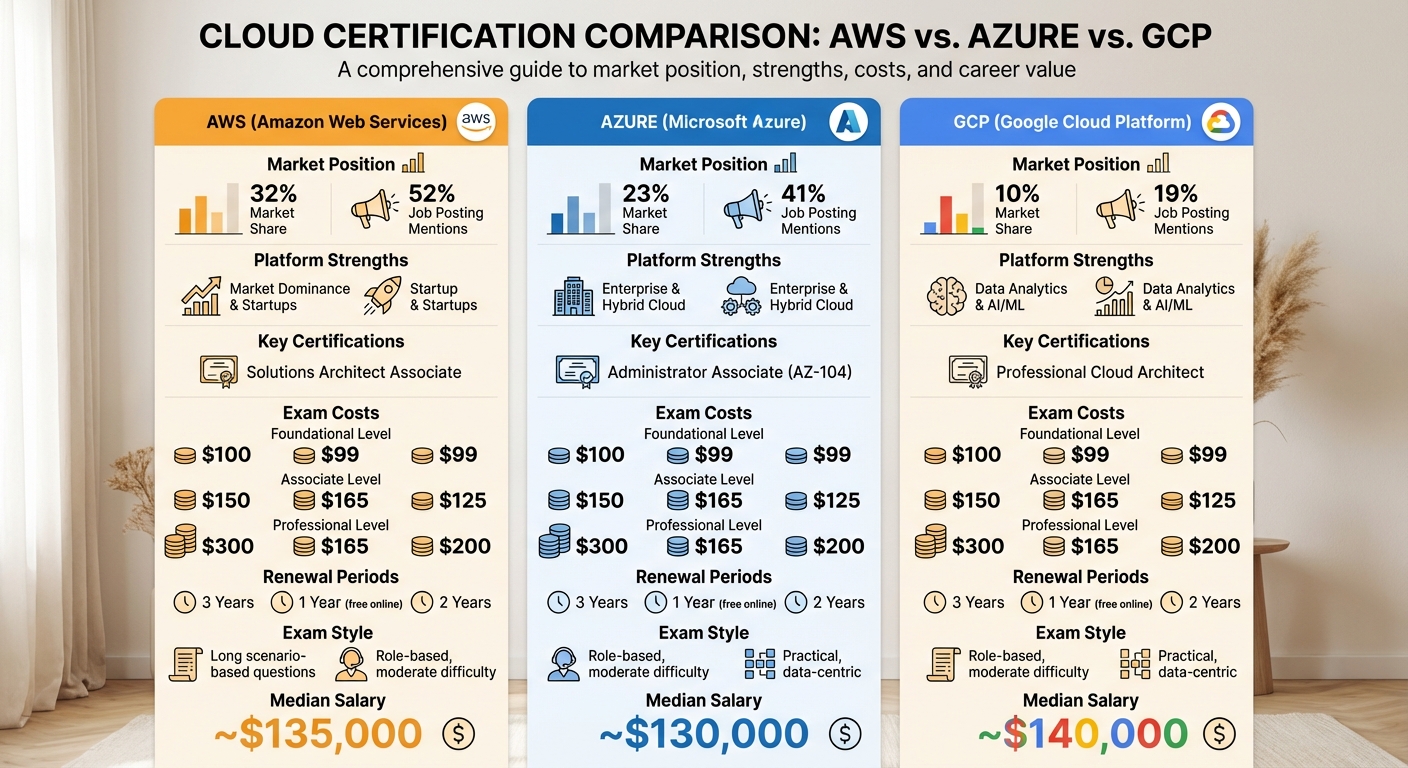
Certifications act as a universal yardstick to confirm cloud knowledge, covering areas like architecture, automation, security, networking, and DevOps . While they can't replace hands-on experience, they showcase the specific areas a candidate has studied and passed exams for.
Each cloud provider organizes certifications into four levels: Foundational (basic understanding), Associate (practical skills), Professional/Expert (advanced architecture), and Specialty (expertise in niche areas) . Understanding what each certification represents can help you decide which ones align with your hiring needs.
Although certifications validate theoretical knowledge, practical experience remains irreplaceable.
AWS Certification Paths
AWS certifications are widely recognized, given AWS's 32% market share and presence in 52% of cloud job postings . They’re often seen as the standard for cloud engineers.
The AWS Certified Solutions Architect – Associate (SAA) demonstrates the ability to design scalable, cost-effective, and highly available systems . In the U.S., this certification correlates with annual salaries exceeding $159,000 . For senior roles, the AWS Certified Solutions Architect – Professional showcases expertise in designing complex multi-tier architectures.
For DevOps roles, the AWS Certified DevOps Engineer – Professional signals advanced skills in automation, CI/CD pipelines, and infrastructure-as-code . AWS also offers specialty certifications in areas like Security, Machine Learning, and Advanced Networking for those with specific technical skills.
Azure Certification Paths
Azure certifications take a role-based approach, making them particularly relevant for enterprise environments . With a 23% market share and appearing in 41% of cloud job postings, Azure certifications are essential for businesses heavily invested in Microsoft technologies .
The Azure Administrator Associate (AZ-104) is a foundational certification for managing identity, governance, storage, and virtual networks . For advanced roles, the Azure Solutions Architect Expert (AZ-305) highlights expertise in designing enterprise-scale infrastructure .
"Azure dominates the boardroom." - Karmankkhan
For niche roles, certifications like the Azure Security Engineer Associate (AZ-500) and Azure DevOps Engineer Expert focus on security and DevOps, respectively .
GCP Certification Paths
GCP certifications cater to specialized areas like data analytics, AI/ML, and Kubernetes-native infrastructure . Despite its smaller 10% market share and appearance in only 19% of job postings, GCP-certified professionals often earn higher median salaries due to the limited talent pool .
The Professional Cloud Architect (PCA) is GCP’s flagship certification, emphasizing expertise in designing secure, compliant, and reliable cloud-native solutions . GCP exams are known for their hands-on, practical challenges, with a difficulty rating of 8.5/10 .
"GCP doesn't compete by volume; it competes by specialization... built by the company that invented Kubernetes and TensorFlow." - Karmankkhan
For data-focused roles, the Professional Data Engineer and Professional ML Engineer certifications are highly regarded .
Certification Comparison Table
| Feature | AWS | Azure | GCP |
|---|---|---|---|
| Market Share | 32% | 23% | 10% |
| Job Posting Mentions | 52% | 41% | 19% |
| Strength | Market dominance & startups | Enterprise & hybrid cloud | Data analytics & AI/ML |
| Key Certification | Solutions Architect Associate | Administrator Associate (AZ-104) | Professional Cloud Architect |
| Foundational Exam Cost | $100 | $99 | $99 |
| Associate Exam Cost | $150 | $165 | $125 |
| Professional Exam Cost | $300 | $165 | $200 |
| Renewal Period | 3 years | 1 year (free online) | 2 years |
| Exam Style | Long scenario-based questions | Role-based, moderate difficulty | Practical, data-centric |
| Median Salary | ~$135,000 | ~$130,000 | ~$140,000 |
When hiring, skip foundational certifications like AWS Cloud Practitioner or Azure Fundamentals (AZ-900) for technical roles . These entry-level credentials don’t demonstrate hands-on expertise. Focus on advanced certifications for cloud engineering candidates, but remember that real-world projects and experience carry the most weight .
Technical Skills Beyond Certifications
Certifications can show that someone has studied and passed an exam, but they don’t necessarily prove a person’s ability to build, secure, and fine-tune production infrastructure.
Infrastructure as Code and Automation
Terraform has become the go-to tool for multi-cloud provisioning. While AWS CloudFormation and Azure Bicep work well for single-cloud setups, Terraform stands out because it works seamlessly across multiple cloud platforms. Relying on manual infrastructure management is a sign of outdated practices that can’t scale effectively.
"Any DevOps engineer you hire in 2026 should be proficient in at least one IaC tool - manual infrastructure management is a red flag indicating legacy practices." - StepTo
In addition to provisioning, automating tasks is a critical skill. Engineers who can work with tools like Python, Bash, PowerShell, or Go often stand out. When assessing candidates, a live 90-minute Terraform task can reveal their ability to follow security best practices, such as avoiding public S3 buckets and adhering to least-privilege IAM policies .
Once the infrastructure is in place, the next step is containerization.
Containers and Orchestration
Proficiency in Docker and Kubernetes is essential, especially as AI workloads drive the need for engineers who can manage GPU/TPU clusters and build real-time inference pipelines . While many companies use managed services like EKS, AKS, or GKE, engineers must still understand the core principles of orchestration.
A great way to test these skills is with a broken Kubernetes manifest exercise. Provide candidates with a YAML file containing RBAC misconfigurations and observe how they debug using tools like kubectl logs and events .
Networking, Cost Optimization, and Security
To ensure production-grade deployments, engineers need a strong grasp of networking and security. Key areas include VPCs, subnets, security groups, load balancers, and DNS configuration. Without these fundamentals, teams risk bottlenecks and potential vulnerabilities .
As companies adopt multi-cloud strategies, managing costs and security becomes even more challenging. FinOps skills are now a priority, especially as AI-driven projects launched in 2024–2025 have caused cloud expenses to surge. Engineers who understand reserved instance strategies, spot pricing, and resource right-sizing can help companies save significantly. During interviews, ask candidates to explain the ROI of their previous infrastructure decisions to see if they prioritize cost efficiency alongside functionality.
Security knowledge is equally critical. Engineers should be adept at IAM policies, secrets management (using tools like HashiCorp Vault or AWS Secrets Manager), and implementing security controls as code. Practical tasks, such as provisioning an S3 bucket with encryption at rest and lifecycle policies, can help evaluate their ability to balance security with cost considerations .
Where to Find Cloud Engineers
Finding top cloud engineers often means looking beyond job boards, as many of the best candidates are passive job seekers who engage in specialized communities.
Cloud Conferences and Events
AWS re:Invent is a standout event for connecting with cloud talent. Scheduled for November 30–December 4, 2026, in Las Vegas, NV, it offers over 1,000 technical sessions and brings together the global cloud community . The Expo Hall provides a chance to have direct conversations with AWS experts. AWS Summits, held throughout the year in various locations, offer additional opportunities to meet professionals in person at no cost .
For those focused on Azure or Google Cloud Platform (GCP), events like Microsoft Ignite and Google Cloud Next provide similar networking opportunities. These gatherings attract highly motivated engineers who dedicate personal time to staying updated on the latest advancements. Attending these events not only helps identify skilled professionals but also complements technical assessments by offering face-to-face interactions with experienced engineers.
Open Source Project Contributors
Another excellent way to identify skilled cloud engineers is through their contributions to open source projects. Open source work offers a clear view of their hands-on expertise, which certifications alone may not reveal. Engineers who contribute to Infrastructure as Code repositories, such as Terraform projects, demonstrate their ability to build and manage entire environments using code . Similarly, activity in Kubernetes and container orchestration projects showcases their experience in handling complex infrastructure challenges .
In 2023, AWS introduced its Skills-Based Hiring Program, spearheaded by Stacy Penright and Mat Wisner. This initiative eliminated the bachelor’s degree requirement for over 500 roles and connected with nearly 900 students at U.S. community colleges in its first year. By 2024, the program expanded to 13 job categories, reaching 1,600 students .
"The Skills Based Hiring Program is built on a core belief that there is qualified talent for cloud jobs that exists outside the four-year university system." – Mat Wisner, Recruiting Director at AWS
While open source contributions highlight practical expertise, modern tools like daily.dev Recruiter make it easier to connect with these skilled professionals.
Using daily.dev Recruiter
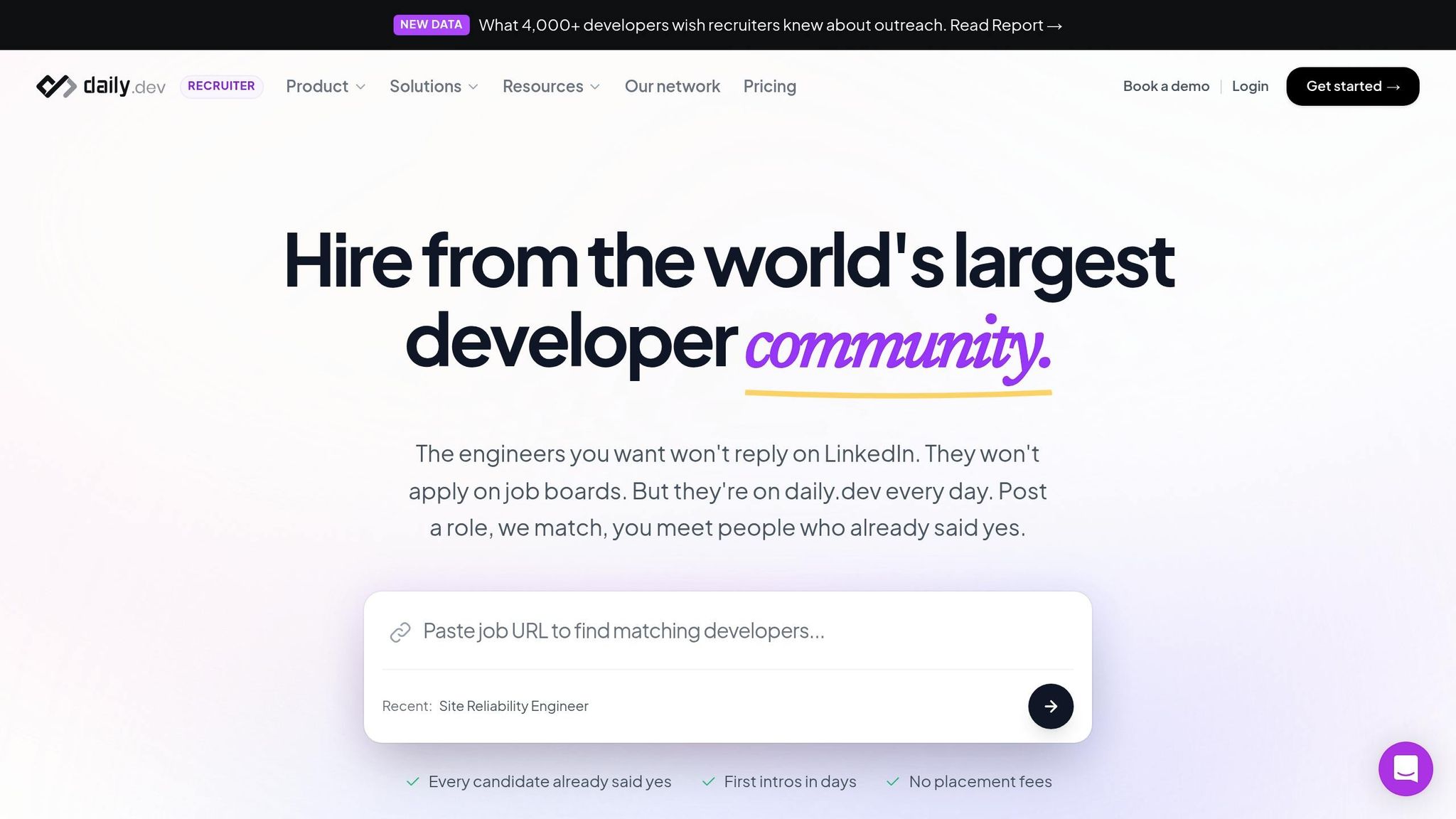
daily.dev Recruiter is designed to identify cloud developers based on their engagement with specific technologies. This platform helps you find passive candidates who are actively learning and engaging with technical content related to AWS, Azure, and GCP. It allows filtering by interactions with tools like Kubernetes, Terraform, and CI/CD pipelines . Unlike traditional recruiting methods that rely on outdated profiles or cold outreach, daily.dev Recruiter uses warm, double opt-in introductions. This ensures that candidates are genuinely interested in exploring new opportunities, which is crucial given that 77% of employers reported challenges in hiring skilled tech professionals over the past year .
How to Assess Cloud Engineers
Traditional coding interviews often fall short when it comes to evaluating the core skills needed for cloud engineering. Designing resilient, multi-cloud infrastructures requires a different approach - one that mirrors the real-world challenges cloud engineers face every day. Instead of theoretical puzzles, assessments should simulate the complexities of actual cloud environments.
Architecture Design Reviews Over Coding Tests
One of the most effective ways to evaluate cloud engineers is through scenario-based architecture discussions rather than abstract coding exercises. For instance, present candidates with a "messy stack" audit. This could include overlapping tools like Jenkins and GitHub Actions running simultaneously, inconsistent naming conventions, and incomplete documentation. Ask them to propose a 12-month consolidation roadmap that includes realistic phases, rollback criteria, and success metrics .
The deliverables should demonstrate practical problem-solving skills. A strong candidate might produce:
- A target architecture diagram
- A phased migration plan, breaking down a 3-month pilot and a 12-month rollout
- A risk register
- Clear KPIs to measure success
For senior-level candidates, you can add more complexity by asking for a stakeholder RACI map and an ROI analysis. This helps assess their ability to influence leadership and manage high-level priorities. These methods ensure you're evaluating skills aligned with the dynamic, multi-cloud environments discussed earlier . Keep on-site assessments to 90–180 minutes or limit take-home projects to 72 hours to respect candidates' time .
To ensure fairness and consistency, use a weighted rubric for evaluation:
- 25%: Trade-off reasoning
- 25%: Practical migration planning
- 20%: System design
- 15%: Security and compliance considerations
- 15%: Communication clarity
Multi-Cloud Problem-Solving
Building on architecture reviews, it’s crucial to test candidates' ability to handle cross-cloud challenges. Multi-cloud scenarios are particularly revealing, as they separate those with hands-on production experience from those with only theoretical knowledge. For example, you could design a case study where a company operates across AWS and GCP. Ask candidates how they would address issues like cross-cloud observability, data residency requirements, and identity management. These are complex areas that require a deep understanding of cloud operations .
Evaluate how candidates handle trade-offs, such as balancing vendor lock-in with operational overhead or short-term speed with long-term maintainability. It’s not about selecting the "right" answer but about providing clear, well-reasoned justifications for their choices . For database selection, challenge them with scenarios involving RDS, DynamoDB, and Redshift, asking them to base their decisions on schema requirements, scalability needs, and query complexity . Dive deeper by asking about their "worst outage" experience - this can reveal real troubleshooting skills that go beyond certifications .
"The right hire isn't just a Terraform or Kubernetes expert - it's an integration-minded cloud engineer who can audit a messy stack, recommend pragmatic consolidation, and produce an incremental migration plan." – recruits.cloud
Speed is critical when hiring cloud engineers. Top talent often receives multiple offers within 2–3 weeks, while the average time-to-hire for cloud roles is about 17 days . Streamline your process to focus on what truly matters: the ability to integrate systems, weigh trade-offs effectively, and manage tool sprawl - not just memorized service names.
Cloud Engineer Salary Benchmarks
In 2026, cloud engineers in the U.S. can expect base salaries ranging from $135,000 to $152,000, with total compensation - including bonuses and equity - often surpassing $175,000 . These numbers highlight a tight talent market. As Kore1 explains:
"The floor keeps rising because even junior engineers have options" .
Experience plays a major role in determining salary. The biggest salary leap happens when engineers move from mid-level to senior positions, as their responsibilities shift from hands-on tasks to making architectural decisions and planning strategic infrastructure . Entry-level engineers with 0–2 years of experience now earn $90,000 to $130,000 annually - roughly $10,000 more than two years ago . Mid-level engineers with 3–5 years of experience see salaries between $118,000 and $160,000, while senior engineers with 6+ years earn $139,000 to $200,000+ . For those with 8+ years of experience, cloud architects can command salaries as high as $332,000 .
Specialization in a specific platform also impacts earnings. AWS specialists generally earn 3–8% more than their Azure or GCP counterparts, thanks to AWS's dominant market position . However, Azure-focused engineers are seeing some of the fastest pay increases in 2026, with median compensation between $130,800 and $162,000, compared to AWS's $130,800 to $140,000 range . GCP specialists, known for their expertise in analytics, machine learning, and Kubernetes, earn an average of $143,000 . These differences emphasize the importance of tailoring compensation packages to market demands.
2026 Cloud Engineer Salary Ranges by Experience (U.S.)
| Experience Level | Base Salary Range |
|---|---|
| Junior (0–2 years) | $90,000 – $130,000 |
| Mid-Level (3–5 years) | $118,000 – $160,000 |
| Senior (6+ years) | $139,000 – $200,000+ |
| Cloud Architect (8+ years) | $148,000 – $332,000 |
Median Salary Range by Platform
| Platform | Median Salary Range |
|---|---|
| AWS | $130,800 – $140,000 |
| Azure | $130,800 – $162,000 |
| GCP | ~$143,000 |
Additional factors also influence total compensation. Engineers with multi-cloud fluency - practical experience across multiple platforms - can earn 15–20% more. Certifications boost pay by 10–15%, while specialized skills like cloud security engineering add another 10–20%. Expertise in Kubernetes and container orchestration can increase earnings by 8–15% . Certain industries, like financial services and healthcare, offer a 10–20% premium due to stricter compliance needs . Location also matters, with salaries in tech hubs like San Francisco and New York City running 20–30% higher than the national average .
When planning budgets for hiring, remember that total compensation packages usually add 15–30% to the base salary through bonuses and equity . Offering competitive pay combined with an efficient hiring process - often compressed to just 2–3 weeks from screening to offer - is crucial for securing top talent .
Generalists vs Specialists: When to Hire Each
Once you've evaluated a candidate's technical skills, the next step is figuring out the focus of the role. Should you bring in a cloud specialist or a generalist? The answer depends on your infrastructure's specific needs. A well-rounded team often includes both: senior specialists who excel in tackling platform-specific challenges and generalists who bring flexibility to manage multi-cloud environments.
When to Hire Specialists
Specialists are your go-to for platform-specific migrations or any project with tight deadlines that requires deep expertise in both the source and target environments. They're also crucial for AI and ML infrastructure projects, where their advanced knowledge often justifies higher salary demands. If you're focusing on cost optimization, specialists with FinOps expertise can deliver tangible results. For niche needs - like Kubernetes security, advanced GCP data engineering, or intricate serverless architectures - platform specialists are indispensable.
When to Hire Generalists
Generalists shine in roles that don’t tie them to a single platform. They excel in areas like Infrastructure as Code, networking, and security principles that are applicable across various cloud providers. This adaptability is especially valuable in multi-cloud setups, where the ability to move seamlessly between AWS, Azure, GCP, and even on-premise systems is more critical than deep knowledge of one platform. Look for candidates with strong foundational cloud skills that can easily transfer from one platform to another. For example, an engineer experienced in AWS can often transition to Azure with minimal friction because the core principles remain the same.
"The person who's an expert in AWS, Azure, GCP, Kubernetes, Terraform, security, FinOps, and AI infrastructure at your budget? That person is either retired in Bali or doesn't exist."
Balancing your team with both specialists and generalists avoids creating knowledge silos and ensures your infrastructure doesn't hinge on a single person. This approach supports a robust multi-cloud strategy, which has become a cornerstone for many enterprises. It’s a safeguard for continuity and a smart way to strengthen your cloud recruitment strategy.
Conclusion
Hiring cloud engineers requires more than just verifying certifications - it demands a deep understanding of hands-on experience. While certifications show theoretical knowledge, they don’t guarantee practical expertise. The engineers you want are those who’ve designed resilient multi-cloud systems, implemented secure architectures, and optimized costs by tackling real-world challenges and learning from failures.
Your hiring process should reflect these realities. Instead of relying on traditional whiteboard exercises, focus on scenario-based evaluations. For example, ask candidates to design a system capable of handling 10,000 requests per second while maintaining high availability. Or, have them securely integrate an Azure Function with Key Vault or build a full-stack AWS environment with proper network isolation. These practical tests help identify engineers who understand the high stakes of cloud infrastructure - where security breaches, cost overruns, and downtime can lead to significant financial losses.
Finding top talent often takes 4–6 weeks, but you can accelerate the process by looking in the right places. Beyond job boards, explore cloud community events, open source contributions, and platforms where developers actively engage with new technologies. Tools like daily.dev Recruiter make this easier by connecting you with engineers who are already immersed in AWS, Azure, and GCP ecosystems. Every introduction is warm and double opt-in, ensuring you’re only speaking with developers genuinely interested in the opportunity. This approach eliminates inefficient cold outreach and fosters meaningful conversations with pre-qualified candidates.
As multi-cloud demand grows, it’s crucial to balance your team with both specialists and generalists. Specialists can tackle platform-specific challenges, while generalists bring the flexibility to manage multi-cloud environments. Test candidates' expertise with tasks like Infrastructure as Code (IaC) refactoring, IAM security assessments, and FinOps discussions. Engineers who can clearly articulate their real-world accomplishments are the ones who will deliver immediate value to your team.
FAQs
How can I verify real multi-cloud experience fast?
To assess multi-cloud expertise effectively, look at candidates' practical project experience and relevant certifications. Dive into the specific environments they've worked on, the services they’ve utilized, the scale of deployments they’ve handled, and how they tackled challenges like failures or security issues. Pay attention to their certification paths across platforms like AWS, Azure, and GCP. Additionally, incorporate scenario-based assessments, such as architecture design reviews, to gauge their real-world problem-solving abilities and depth of knowledge in multi-cloud setups.
Which certs matter most for senior cloud hires?
Certifications that stand out for senior cloud professionals often include AWS certifications, which align with AWS's leading position in the cloud market. Additionally, advanced or specialty certifications in areas like AI, machine learning (ML), and data platforms are highly regarded. These credentials showcase a candidate's ability to design resilient architectures and utilize cutting-edge cloud technologies.
However, certifications alone aren't the full picture. Skills such as infrastructure design and cost optimization play a crucial role in assessing a candidate's overall capability and readiness for senior cloud roles. These practical abilities often set top-tier professionals apart.
What interview tasks best predict on-call performance?
Scenario-based architecture design reviews are a powerful way to evaluate how well a candidate might handle on-call responsibilities. These tasks dive into practical skills like troubleshooting, optimizing, and managing cloud infrastructure in real-world scenarios. By emphasizing hands-on problem-solving over theoretical understanding, this method ensures candidates are ready to tackle the challenges that come with on-call duties.
.png)