Hiring developers in 2026 is more complex than ever - but it doesn’t have to be overwhelming. Here’s what you need to know:
Remote Work Dominates: 58% of developers are fully remote, making global hiring more common.
Costs Are Higher Than Salaries: Expect to pay 1.4x–2.5x a U.S. developer’s salary due to benefits, taxes, and more, with first-year costs exceeding $248,000 for senior roles.
AI Has Shifted Priorities: Debugging AI outputs, critical thinking, and communication are now more important than traditional coding tests.
Smaller Teams, Bigger Impact: Companies prefer small teams of highly skilled developers, focusing on shipped features over hours worked.
Public Work Matters: GitHub contributions and shipped products outweigh résumés in hiring decisions.
Compliance Is Key: Remote hiring requires handling legal and payroll complexities, often via Employer of Record (EOR) services.
Where to Hire:
Pre-Vetted Networks: Toptal, Arc.dev - best for senior roles, fast access, but higher costs.
Freelance Marketplaces: Upwork, Fiverr - great for short-term tasks, requires more vetting.
Job Boards: Stack Overflow Jobs, Wellfound - ideal for niche roles, slower hiring cycles.
Nearshore/Offshore Partners: LATAM and Eastern Europe offer cost savings with timezone overlap.
Costs:
U.S. Salaries: $150,000–$200,000 for senior developers; $180,000–$280,000 for AI experts.
Contractor Rates: $150–$250/hour in the U.S.; $50–$120/hour offshore.
Hidden Expenses: Mis-hires, turnover, onboarding delays, and rework can add up.
Pro Tip: Use paid trials, structured onboarding, and clear developer job descriptions to avoid costly mistakes. Whether you need one contractor or a full team, this guide will help you hire smarter in 2026.
Quick Decision Framework: Pick Your Hiring Path
Before diving into hiring, take a moment to assess your project's needs - its duration, complexity, and how much management bandwidth you can dedicate. This framework ties into the broader hiring strategies outlined in this guide and helps you zero in on the right approach. For a deeper dive into the end-to-end process, see our guide to hiring remote developers. Whether you need a contractor for a quick task, a senior engineer for core development, or a full team to tackle multiple roles, this guide will help you decide based on your project's scale and timeline.
Path 1: Need 1 Contractor Fast
Best for: Specific, well-defined tasks like UI tweaks, bug fixes, or standalone integrations .
Freelance platforms like Upwork or pre-vetted networks such as Toptal are your go-to options here. These services can provide a shortlist of candidates within 6 to 48 hours. The catch? You’ll need to provide clear instructions upfront and stay actively involved in daily oversight . Contractors excel when the scope is narrow and you’re ready to stay hands-on.
To keep things on track, set a clear, measurable short-term goal - like “Ship a payments MVP in 30 days.” This ensures that the engagement stays focused and results-oriented.
Path 2: Need 1–3 Senior Engineers
Best for: Long-term projects, core product development, or building scalable systems .
This is where daily.dev Recruiter can make a difference. Instead of relying on cold outreach or outdated LinkedIn profiles, you’ll connect with passive candidates who are already engaged and open to the right opportunity. Each introduction is warm and double opt-in, meaning you’ll only talk to developers who are genuinely interested.
When hiring senior engineers, it’s crucial to assess their technical skills in real-world scenarios. Use the "Real Ticket" test - a 45-minute paired session where candidates work on a simplified version of an actual ticket from your codebase . This approach reveals how they approach real challenges, not just theoretical ones.
If your hiring needs extend beyond one or two engineers, you may want to explore the next option for a more coordinated solution.
Path 3: Need a Full Development Team
Best for: Companies or startups requiring multiple roles - frontend, backend, and QA - working together on a shared roadmap .
Hiring a dedicated team or using staff augmentation can simplify management and offer predictable monthly costs. These setups often handle local compliance, taxes, and benefits on your behalf, reducing administrative headaches . To start, assign the team lower-risk tasks like maintenance or internal tools. Once they’ve proven their capabilities, you can move them to core product development .
Nearshore teams - those in nearby time zones - are particularly effective for fast-moving projects. A timezone overlap of 0–4 hours allows for same-day iteration cycles, making frequent syncs much easier. While cost savings are important, prioritizing faster iteration cycles often delivers better results when speed is critical .
Path 4: Need Engineering Leadership
Best for: Scaling teams, establishing systems, or setting long-term technical direction.
Hiring a VP of Engineering typically takes 3–5 weeks. To ensure a smooth start, prepare hardware, access credentials, and a well-defined 30-day plan before their first day . Use daily.dev Recruiter to find candidates with a proven history in system design and team growth. Look for leaders who can back up their experience with concrete architectural achievements, not just years on a résumé.
Hiring engineers?
Connect with developers where they actually hang out. No cold outreach, just real conversations.
What's Different About Hiring Developers in 2026
Hiring developers in 2026 means adapting to shifting priorities and updated processes. AI-assisted development has reshaped the skills in demand, placing more emphasis on critical thinking than traditional coding tests. Smaller, highly skilled teams are replacing large engineering groups, and showcasing public work - like GitHub contributions or live projects - has become more valuable than a conventional résumé. Additionally, stricter compliance standards are now essential for remote hiring. Let’s explore these changes and how they influence hiring strategies.
How AI Tools Changed What to Look For
AI tools like GitHub Copilot and ChatGPT have transformed how developers work, making tasks like generating boilerplate code almost effortless. This shift means hiring managers need to prioritize skills beyond basic coding. For example, developers must now excel at identifying errors in AI-generated code, evaluating architectural trade-offs, and explaining technical decisions to non-technical stakeholders. Instead of relying on LeetCode-style challenges, the hiring process should test candidates' ability to debug AI outputs and assess their problem-solving and communication skills.
Smaller Teams, Higher Impact Engineers
The rise of AI tools has also influenced team structures. Companies are moving toward smaller, more agile teams composed of developers who can handle a wide range of tasks independently. These teams focus on hiring engineers with specialized skills - such as expertise in AI, DevOps, or Cloud - who can take full ownership of features from start to finish. Metrics for success have shifted too. Rather than tracking hours worked or online activity, companies now measure success based on shipped features and tangible results. This makes traits like self-motivation, clear communication in asynchronous environments, and independent problem-solving more critical than ever.
Public Work Matters More: GitHub, Open Source, Shipped Products

In an era where 58% of developers work remotely, public proof of work has become a cornerstone of remote hiring. An active GitHub profile, open-source contributions, or a history of launching successful products often carries more weight than a traditional résumé. When engaging with potential hires, referencing their public work not only demonstrates that you’ve done your research but also helps identify candidates who are passionate and actively involved in their craft.
Remote Work Compliance and Security Requirements
Global hiring in 2026 comes with its own set of challenges, particularly around compliance and security. Misclassifying international employees can lead to hefty fines, which is why many companies rely on Employer of Record (EOR) services to handle local payroll, benefits, and legal obligations. These compliance considerations are now a vital part of any hiring strategy, ensuring that companies can navigate the complexities of global remote work without unnecessary risks.
Where to Hire Developers in 2026: Platform Breakdown
::: @figure 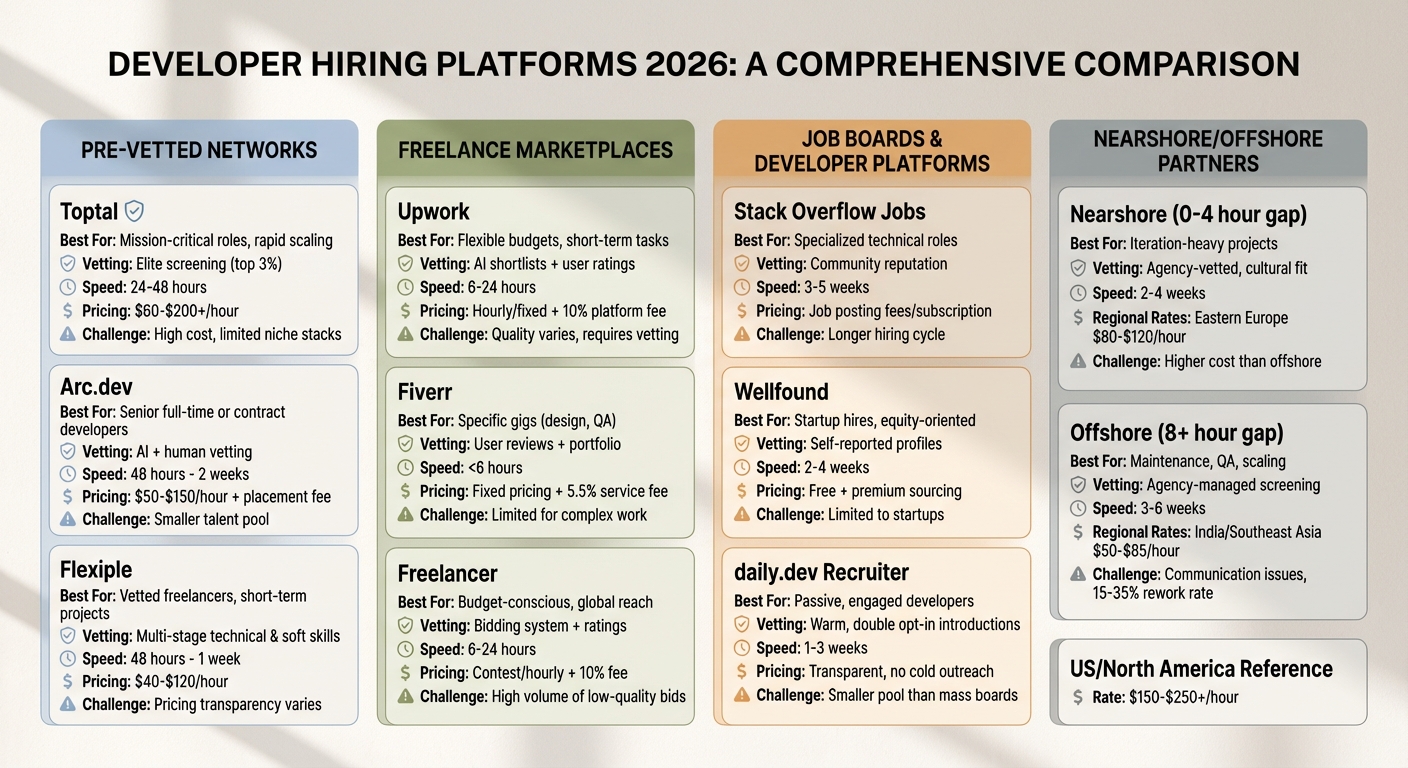 {Developer Hiring Platforms Comparison 2026: Costs, Speed, and Best Use Cases}
Choosing the right platform depends on factors like your timeline, budget, and how much vetting you're prepared to handle. Pre-vetted networks are great for critical roles but come with higher fees. Freelance marketplaces offer flexibility and global reach but require you to do the vetting. Job boards and developer platforms connect you with active developer communities, while nearshore and offshore partners handle the administrative side of scaling teams.
For example, if you need a senior engineer quickly, pre-vetted networks are your best bet. For short-term or budget-friendly projects, freelance marketplaces are a good choice. Platforms like daily.dev Recruiter are ideal for building an employer brand or finding specialized talent through warm introductions. Meanwhile, nearshore or offshore partners can help you scale teams while managing compliance and payroll.
Here’s a closer look at each platform category:
Pre-Vetted Networks
Platforms like Toptal, Arc.dev, and Flexiple rigorously screen developers, often accepting only the top 1–3% of applicants. Their vetting includes technical interviews, code reviews, and soft skills assessments.
| Platform | Best For | Vetting Model | Speed to Shortlist | Pricing Model | Challenges |
|---|---|---|---|---|---|
| Toptal | Mission-critical roles, rapid scaling | Elite screening (top 3%) | 24–48 hours | Hourly: $60–$200+; platform fee varies | High cost; limited niche stacks |
| Arc.dev | Senior full-time or contract developers | AI + human vetting | 48 hours–2 weeks | Hourly: $50–$150; placement fee for FT | Smaller talent pool |
| Flexiple | Vetted freelancers for short-term projects | Multi-stage technical & soft skills | 48 hours–1 week | Hourly: $40–$120 | Pricing transparency varies |
Pros: Quick access to highly qualified candidates with minimal effort on your end.
When NOT to use: For junior roles, tight budgets, or exploratory projects that need maximum flexibility.
Next, let’s check out freelance marketplaces for broader, more flexible hiring.
Freelance Marketplaces
Freelance marketplaces like Upwork, Fiverr, and Freelancer connect you with a global pool of developers. While these platforms offer fast access, you’ll need to vet candidates yourself. AI tools, user ratings, and portfolios can help, but the final decision is in your hands.
| Platform | Best For | Vetting Model | Speed to Shortlist | Pricing Model | Challenges |
|---|---|---|---|---|---|
| Upwork | Flexible budgets, short-term tasks | AI shortlists + user ratings | 6–24 hours | Hourly or fixed; 10% platform fee (sliding scale) | Quality varies; requires thorough vetting |
| Fiverr | Specific gigs (e.g., design, QA) | User reviews + portfolio | <6 hours | Fixed project pricing; 5.5% service fee | Limited for complex or ongoing work |
| Freelancer | Budget-conscious projects, global reach | Bidding system + ratings | 6–24 hours | Contest or hourly; 10% fee | High volume of low-quality bids |
Pros: Large talent pool, fast hiring, competitive pricing, and flexible engagement options.
When NOT to use: For roles requiring deep vetting, long-term hires, or projects needing tight cross-timezone collaboration.
Job Boards and Developer Platforms
These platforms connect you with developers who are already active in their communities. Stack Overflow Jobs and Wellfound (formerly AngelList Talent) attract job seekers, while daily.dev Recruiter specializes in connecting employers with passive, pre-qualified talent via warm introductions.
| Platform | Best For | Vetting Model | Speed to Shortlist | Pricing Model | Challenges |
|---|---|---|---|---|---|
| Stack Overflow Jobs | Specialized technical roles, employer branding | Community reputation & activity | 3–5 weeks | Job posting fees or subscription | Longer hiring cycle; needs a strong job brief |
| Wellfound | Startup hires, equity-oriented roles | Self-reported profiles & startup fit | 2–4 weeks | Free tier + premium sourcing | Limited to startups |
| daily.dev Recruiter | Passive, engaged developers | Warm, double opt-in introductions | 1–3 weeks | Transparent pricing; no cold outreach | Smaller pool than mass job boards |
Pros: Access to engaged communities, high-quality talent, and a chance to enhance your employer brand.
When NOT to use: For urgent hires, immediate start dates, or if your company lacks a compelling value proposition.
For scaling teams with managed compliance, nearshore and offshore partners are worth considering.
Nearshore and Offshore Development Partners
Agencies and talent partners take care of compliance, payroll, and HR. For instance, Index.dev helped NetRefer expand its global engineering team while managing cross-border compliance and maintaining high standards.
| Model | Best For | Vetting Model | Speed to Hire | Challenges |
|---|---|---|---|---|
| Nearshore (0–4 hour gap) | Iteration-heavy projects, frequent collaboration | Agency-vetted with focus on cultural fit | 2–4 weeks | Higher cost than offshore |
| Offshore (8+ hour gap) | Maintenance, QA, scaling capacity | Agency-managed screening | 3–6 weeks | Communication issues; rework rates of 15–35% |
Regional Hourly Rates (Senior Developers):
US/North America: $150–$250+
Eastern Europe: $80–$120
India/Southeast Asia: $50–$85
Pros: Streamlined compliance and team scaling with less management overhead.
When NOT to use: For real-time collaboration or roles requiring deep domain-specific insights, especially if timezone overlap is limited.
Nearshore vs. Offshore in 2026: Companies are leaning toward nearshore partners (e.g., Poland, LATAM) over offshore options (e.g., India, Southeast Asia). Better timezone overlap and smoother communication often outweigh the slightly higher costs.
What It Costs to Hire Developers in 2026
When planning to hire developers, it's essential to look beyond just base salaries. The actual cost includes platform fees, benefits, taxes, and less obvious expenses like mis-hires or slow onboarding. For instance, in 2026, hiring a senior developer in the U.S. with a salary of $140,000–$200,000 could result in a first-year cost exceeding $248,000. This figure factors in recruitment fees, benefits (typically 25–35% of the salary), equipment, and software licenses - which are increasing by over 13% annually .
Costs can vary significantly based on location, hiring model (full-time vs. contractor), and hidden factors like turnover or rework. Companies hiring in regions like Latin America or Eastern Europe can potentially cut costs by 40–70% while maintaining strong technical standards . However, these savings often come with added challenges in management and communication.
Let’s break down the key cost categories.
Full-Time Salaries by Role and Level
Salaries in 2026 depend heavily on the developer’s role, experience, and location. AI and machine learning engineers are among the most expensive, with U.S. salaries ranging from $180,000 to $280,000 annually . Other roles, such as full-stack developers, DevOps engineers, and iOS developers, typically earn between $150,000 and $210,000, depending on demand .
Experience also plays a significant role in costs. Senior developers generally earn 30–50% more than mid-level engineers but are reported to deliver 2–3 times the output with less management oversight . This makes them a better choice for critical projects, despite their higher upfront cost.
| Level | Years Experience | US Annual Salary |
|---|---|---|
| Junior | 0–2 years | $70,000 – $100,000 |
| Mid-Level | 2–5 years | $100,000 – $150,000 |
| Senior | 5–8 years | $150,000 – $200,000 |
| Staff/Principal | 8+ years | $200,000 – $300,000 |
| Engineering Manager | 5+ years mgmt | $180,000 – $280,000 |
Geographic location is another key factor. For example, hiring developers in Eastern Europe can lower costs to $40,000–$70,000 annually, while hiring in India can reduce it further to $25,000–$45,000 . Latin American developers, often preferred for their ability to collaborate in real-time with U.S. teams, offer 50–70% savings compared to U.S. salaries . These insights are critical for companies deciding between building full teams or hiring individual contractors.
Contractor Rates and Platform Fees
Contractor rates vary widely depending on experience and location. In the U.S., senior contractors typically charge $150–$250+ per hour, while developers in Eastern Europe charge $80–$120 per hour and those in Asia charge $50–$85 per hour. These rates often exclude platform fees, which can add an extra layer of cost. For instance, freelance platforms like Upwork charge around 10% in platform fees on a sliding scale.
Pre-vetted talent networks tend to have higher hourly rates because they handle vetting and matching, saving companies time. Staff augmentation models, which often include replacement guarantees, offer predictable all-inclusive rates that help reduce the risk of a bad hire .
The engagement model you choose has a big impact on both cost and risk. In-house hires come with the highest total cost of ownership (TCO) but give you the most control. Freelancers may offer lower hourly rates but can pose risks in terms of quality and commitment. Staff augmentation strikes a balance, offering vetted talent, guaranteed replacements, and consistent pricing.
Hidden Costs: Mis-Hires, Turnover, and Slow Onboarding
Some of the most costly hiring mistakes aren’t immediately obvious. A mis-hire can cost between $50,000–$150,000 in lost productivity and rehiring expenses . Replacing a developer due to turnover can add up to 21% of their annual salary .
Onboarding delays also contribute to hidden costs. In-house hires typically take 2–4 weeks to reach full productivity, while offshore developers may need 4–8 weeks . During this time, you’re paying full salaries for reduced output. Additionally, the quality of onboarding during the first week determines 67% of long-term retention .
Distributed teams also demand more management oversight. While in-house teams require 5–10% of management time, offshore teams may need 20–40% . Miscommunication in offshore setups can further increase rework rates to 15–35%, compared to just 5–15% for in-house teams .
"The Total Cost of Ownership (TCO) for an in-house US developer often includes hidden costs (benefits, recruitment, overhead) that add 40% to 150% to the base salary."
– Coders.dev
To address these hidden costs, consider implementing paid trial periods (1–2 weeks) or using staff augmentation models with replacement guarantees to evaluate performance before committing long-term . Standardizing documentation and maintaining decision logs can also reduce knowledge loss during turnover . Lastly, investing in a structured onboarding process can help reduce the lag in productivity.
Ready-to-Use Hiring Templates and Tools
Streamlining your hiring process can be a game-changer, especially with the challenges of 2026 in mind. Developers today expect transparency on remote logistics, teams need structured ways to evaluate both technical and interpersonal skills, and paid trials have become a practical way to minimize the risk of hiring mistakes before extending a full-time offer. Below are some ready-to-use templates and tools that can help simplify and improve your hiring workflow.
1-Page Role Brief Template
A concise, one-page role brief helps clarify exactly what your team needs before you begin sourcing candidates. Developers tend to focus on specific technical stacks, remote work logistics, and daily responsibilities rather than broad job titles or years of experience.
Here’s what to include in your role brief:
Technical stack: Be specific. For example, list tools like "React.js, Next.js, TypeScript, and PostgreSQL" instead of just saying "JavaScript."
Time zone overlap: Mention required overlap hours, like "4 hours between 10 AM - 2 PM EST."
Collaboration tools: Specify tools like Jira, GitHub, Docker, or AWS that your team relies on daily.
Seniority level: Define this based on responsibilities, not years of experience. For instance, highlight tasks like "mentoring junior developers" or "leading architectural decisions" instead of requiring "5+ years in the field."
Soft skills: Emphasize qualities like self-direction, proactive communication, and strong documentation habits - essential traits for remote work .
"The success of hiring remote developers hinges less on where you look and more on how well you define what you're looking for."
- Boundev Team
Template structure: Role title and team context (2-3 sentences) | Technical stack (specific tools and frameworks) | Day-to-day responsibilities (3-5 bullet points) | Remote logistics (time zone overlap, async expectations) | Seniority definition (outcomes, not years) | Collaboration tools (Jira, Slack, GitHub, etc.)
Interview Scorecard Example
Using a scorecard ensures consistent evaluations across all candidates by focusing on both technical and remote collaboration skills. A well-structured scorecard breaks down the hiring process into stages, such as initial screening (chemistry and logistics), take-home assignments (problem-solving), and live technical or behavioral interviews .
Here’s what to evaluate:
Autonomy: Ask candidates how they handle being "stuck" when teammates are offline. This tests their ability to work independently .
Feedback receptivity: Observe how they handle constructive criticism during pairing sessions. Developers who struggle with feedback can slow down team progress.
| Evaluation Category | Specific Skill/Metric | Why It Matters in 2026 |
|---|---|---|
| Technical | Documentation Habits | Prevents knowledge silos in async and remote teams |
| Collaborative | Proactive Communication | Reduces "rework rate", which can hit 15-35% in distributed teams |
| Collaborative | Feedback Receptivity | Maintains code quality and enables faster iteration |
| Remote-Specific | Autonomy/Self-Direction | Ensures progress during time zone gaps |
Red flags: Watch out for candidates who blame others for past issues, lack documentation habits, or resist flexible working hours in distributed settings .
1-Week Paid Trial Structure
A 1-week paid trial is a practical way to evaluate a candidate's real-world skills, communication, and fit within your team before making a long-term commitment. Many companies use this approach - up to 160 hours for contractors - to assess both technical abilities and soft skills .
How to structure the trial:
Define scope and deliverables upfront: Clearly outline the problem the candidate will solve, the timeline, and the platforms they’ll use .
Include a pairing session: Observe how they collaborate with your team and respond to feedback in real-time .
Post-trial evaluation: Ask the candidate to explain their architectural decisions and how they’d address potential bugs if the feature launched tomorrow. This helps gauge their critical thinking and sense of ownership .
Trial breakdown:
Day 1: Onboarding and environment setup
Days 2-4: Core feature development
Day 5: Code review, pairing session, and trade-off discussion
Post-trial: Decision within 48 hours
Reference Check Questions
Generic reference checks often fail to provide useful insights. Instead, ask behavioral questions that reveal how the candidate worked in previous roles. Focus on their communication habits, feedback handling, and ability to work independently.
Examples of effective questions:
How did [Candidate] communicate blockers or delays? Did they raise issues early or wait until deadlines?
Can you share an example of how they responded to critical feedback on their code?
How much oversight did they need to stay productive? Could they work autonomously for 2-3 days without check-ins?
Did they document their work well enough for others to pick it up seamlessly?
Would you hire them again? If not, why?
By asking these targeted questions, you can verify the soft skills that are critical for remote teams, such as proactive communication and strong documentation habits .
Hiring Funnel Checklist
Finally, tie everything together with a structured hiring funnel checklist. This ensures you don’t miss important steps or lose momentum during the process - especially if your team doesn’t have a dedicated recruiter.
Checklist highlights:
Pre-sourcing: Define role requirements using the 1-page brief | Choose sourcing channels (job boards, pre-vetted networks, or developer platforms) | Set up an interview scorecard and assign interviewers
Sourcing and Screening: Post the role or send outreach messages | Screen resumes for technical stack alignment and public work (e.g., GitHub) | Conduct 15-minute chemistry calls to confirm logistics and communication style
Evaluation: Send a take-home assignment (2-4 hours max) or schedule a live coding session | Conduct technical and behavioral interviews using the scorecard | Complete a 1-week paid trial with clear deliverables
Final Steps: Check references with behavioral questions | Prepare an onboarding plan (tools, access, first-week tasks) | Extend the offer and confirm the start date within 48 hours
This checklist helps you maintain a smooth process and ensures no promising candidate slips through the cracks.
7 Mistakes to Avoid When Hiring Developers
When it comes to hiring developers, many companies still rely on outdated practices that can alienate top talent or result in costly mis-hires. The hiring landscape has shifted significantly, and staying stuck in the past can derail your efforts. Here are some common mistakes to watch out for and how to sidestep them.
Testing Algorithms Instead of Real Skills
Algorithm-heavy tests, like those on LeetCode, often scare off experienced developers. These tests rarely reflect the actual skills needed for real-world projects. For example, a senior engineer might ace a coding puzzle but struggle when debugging a live system or explaining technical trade-offs to non-technical team members. What you should prioritize is their ability to architect solutions, work through live codebases, and communicate decisions clearly.
Instead of long take-home tests (which can lead to high drop-off rates if they take more than 3–4 hours ), try evaluating candidates with tasks that mirror real work. For instance, pair program on a simplified ticket from your backlog or ask candidates to draft a status update or technical plan. Before you even start recruiting, define what success looks like within the first 30 days of the role. For example, hiring someone to "Ship a payments MVP with Stripe integration" is far more actionable than seeking a generic "Python Developer" . Vague job descriptions only lead to mismatched expectations and wasted time.
Beyond technical skills, logistical factors can also make or break your hiring process.
Ignoring Time Zones and Communication Gaps
Time zone mismatches can quickly erode productivity for remote teams. Imagine a developer in India wrapping up their day at 6 PM IST while your U.S.-based team is just starting theirs. That delay could turn a quick fix into a 24-hour roadblock .
While offshore hiring might seem cost-effective (with rates often 40–70% lower), the hidden costs of delays and miscommunication can offset those savings. That’s why many U.S. companies are turning to nearshore talent in Latin America, where overlapping time zones enable real-time collaboration while still cutting costs by 30–50% .
Take the example of Revinate, a hotel guest platform that modernized its tech stack with the help of Mismo. By working with LATAM engineers, they transitioned from PHP/jQuery to React, Java, and Kafka in under six weeks. The nearshore model allowed for seamless real-time collaboration, avoiding the delays common with offshore teams .
"Co-located LATAM teams in U.S. time zones enable real-time collaboration, which reduces handoff delays and miscommunication." - Mismo
To minimize communication gaps, establish 2–3 hours of mandatory overlap for synchronous work while keeping the rest asynchronous . During interviews, include live pairing sessions to evaluate real-time collaboration and English proficiency. A paid trial period (typically one week) can also help you assess not just coding skills but also responsiveness and clarity in communication .
But even with the right talent, skipping proper onboarding can amplify these challenges.
Skipping the Onboarding Plan
A poorly executed onboarding process can drive up hiring costs and hurt retention. In fact, the quality of onboarding in the first week impacts 67% of long-term retention rates . Without access to the right tools, workflows, or clear guidance, new hires may feel lost, leading to delays in productivity - or worse, early resignations.
Good onboarding helps developers integrate into your team smoothly. For in-house hires, expect them to reach meaningful productivity within 2–4 weeks; for offshore hires, it may take 4–8 weeks . Without a clear plan, these timelines can stretch even further.
Start with pre-Day 1 logistics: ensure all necessary hardware (like laptops and monitors) arrives before their start date. On Day 1, have all accounts - Slack, GitHub, Jira, AWS - ready to go. Assign a peer mentor, someone other than their manager, to guide them through workflows and help with social integration. During the first week, assign a couple of small tasks with quick feedback to build their confidence and help them settle in.
"A smooth, welcoming onboarding directly correlates with higher engagement, faster productivity, and 67% better retention rates." - Boundev Team
For remote teams, documentation is non-negotiable. Use tools like Notion, Confluence, or Loom to document processes and decisions. Verbal agreements won’t cut it when teams are spread across time zones. If you're working with offshore teams, consider sending a key engineer or manager for an in-person visit within the first few months. This investment can go a long way toward building trust and strengthening relationships.
Avoiding these mistakes will help you streamline your hiring process and ensure your new developers hit the ground running.
Final Checklist: Your Developer Hiring Workflow
Hiring developers in 2026 doesn’t have to feel overwhelming. By following the steps in this guide, you’ll streamline the process and stay ahead of the competition. Here’s a recap of the key actions to take for a smooth hiring experience.
Define Scope and Role Requirements
Before posting a job, get crystal clear on what you need. Start by analyzing your project’s timelines, deliverables, and any uncertainties involved. Break down the role into essential skills (must-haves) and desirable skills (nice-to-haves). This way, you avoid eliminating candidates who could still excel. Most importantly, set a measurable 30-day goal that aligns with your priorities. For instance, instead of a vague title like "Python Developer", aim for something actionable like, "Deliver a payments MVP with Stripe integration within 30 days." This level of clarity will help you avoid wasting time on mismatched applicants.
Choose Your Platform and Sourcing Channel
Your sourcing strategy should reflect your hiring needs, timeline, and budget. If you’re after senior-level talent quickly, consider pre-vetted platforms like daily.dev Recruiter, which connects you to passive, pre-qualified developers through warm introductions. For short-term or flexible projects, freelance platforms like Upwork can provide solid candidate lists in under six hours. If you’re building a full team and need ongoing collaboration, nearshore partners in Latin America can be a great fit.
Combining multiple sourcing channels - like pre-vetted networks, niche communities (e.g., GitHub, Stack Overflow), and freelance platforms - can significantly improve the quality of your candidates. In fact, using a multi-channel approach can boost candidate quality by up to three times .
Use Structured Vetting and Paid Trials
Forget generic algorithm tests - focus on practical tasks that reflect real-world work. Keep take-home challenges short (3–4 hours max) to respect candidates’ time . A 90-minute structured evaluation works well:
Spend 15 minutes reviewing their past projects.
Conduct 45 minutes of paired coding on an actual ticket.
Wrap up with 30 minutes simulating asynchronous communication .
For finalists, consider a one-week paid trial. Define clear objectives and acceptance criteria to gauge not just technical skills but also responsiveness, communication, and problem-solving under real pressure.
Check References and Prepare Onboarding
Before making an offer, reach out to 2–3 former managers for references. Ask precise questions about reliability, communication habits, and how the candidate deals with challenges .
Once you’ve made your decision, start onboarding prep immediately. Make sure all hardware arrives before their first day and that software accounts (Slack, GitHub, Jira) are set up in advance . Assign a peer mentor to help with guidance and integration. During their first week, establish clear 30/60/90-day milestones to give them a roadmap for success. This is crucial - 67% of long-term retention is determined by the onboarding process during the first week . Skipping this step could cost you down the line.
FAQs
Which hiring path should I choose for my project?
The best approach to hiring in 2026 will largely depend on the specific needs, timeline, and scope of your project. If you're dealing with quick, short-term tasks, bringing on a contractor or freelancer can provide the agility and speed you need. However, for roles that are more specialized or require long-term commitment, platforms like daily.dev Recruiter can connect you with thoroughly vetted professionals to ensure high-quality hires.
Planning to build remote teams? It's crucial to define roles clearly, implement a thorough vetting process, and weigh the benefits of nearshore versus offshore options. Factors like cost, time zone compatibility, and alignment in work culture should guide your decision.
What’s the real first-year cost to hire a developer?
When hiring a developer, the first-year cost is much more than just their salary - it typically ranges between 1.4x and 2.5x the base salary. This includes expenses like benefits, recruitment, onboarding, and overhead. For instance, hiring a senior developer with a $150,000 salary could end up costing between $210,000 and $375,000. The cost also depends on the hiring model: nearshore options might help save money, while contractors often charge higher hourly rates but come with less long-term stability. It's essential to account for all these factors to create an accurate budget.
How do I vet developers in 2026 with AI tools?
By 2026, using AI tools to vet developers has become a sophisticated process. These platforms go beyond just assessing technical skills - they evaluate collaboration abilities and system thinking as well. AI can analyze a candidate's public contributions, like work on GitHub or open-source projects, to gauge their expertise. It also examines interactions during code reviews and team projects to get a sense of their soft skills.
Another key feature is screening for remote readiness. AI tools ensure candidates meet compliance standards and can work effectively across different time zones. When you combine these AI-driven insights with structured interviews, companies can achieve a more accurate and well-rounded evaluation. This approach helps align candidates' technical abilities with both the job's requirements and the company's culture.
.png)